Built for GitHub, and built on it
Technology
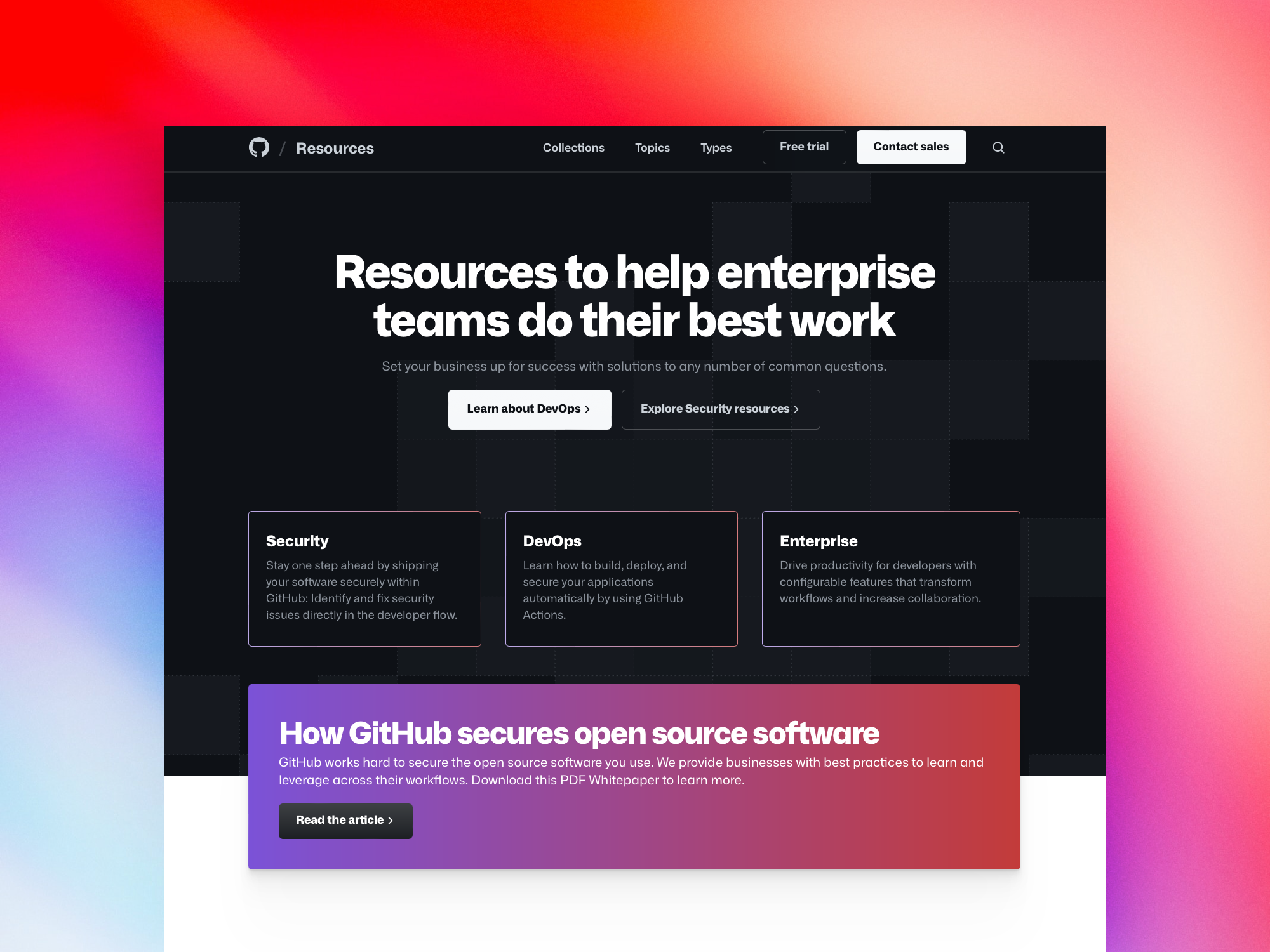
GitHub is two things to us at once: it is the client whose Resources Hub we rebuilt in 2022, and it is the platform every one of our repos, pull requests, and CI runs sit on. We are careful to keep those separate. One is a case study, the other is how we work every day.
For the client relationship, we built GitHub's Resources Hub in Next.js and Contentful, with a GitHub Actions pipeline running Playwright and Jest. For the everyday relationship, git history, pull request review, and Actions show up on nearly every project we ship, regardless of who the client is.

Both sides
We have built for GitHub and on it, and they are not the same story
- GitHub is a client, not just a tool
In 2022, GitHub hired us to rebuild its Resources Hub in Next.js and Contentful, with a GitHub Actions pipeline running Playwright and Jest on every deploy. That case study is the client relationship. Everything else on this page is the tool we use on every other project, including this one.
- Pull requests are the record of what happened
Code review on GitHub is where a decision gets written down: why a query changed, why a dependency got pinned, why a feature shipped behind a flag. We treat that history as documentation, not ceremony, because six months later it is the only account of the tradeoff anyone kept.
- Actions minutes are a cost, not a given
GitHub Actions minutes meter, and the cheapest hosted runners are slow enough that a large test suite turns pipeline design into a cost decision rather than only an engineering one. Caching and job parallelism stop being nice to have at that point.