# Monogram
> Monogram is an Applied AI Studio based in Atlanta that designs and deploys production AI systems — connecting models, data, workflows, and enterprise software to automate real work.
The full content of every page indexed in https://monogram.io/llms.txt.
---
title: "Applied AI Studio | Monogram"
url: https://monogram.io
description: "Monogram helps companies design, build, and deploy AI systems that connect with real products, data, and operations."
---
# Monogram
## WE HELP BUILD THE
NEXT GENERATION OF
AI EXPERIENCES
We help companies design, build, and deploy AI systems that connect with real products, data, and operations.
---
Monogram is an AI services firm that helps companies, enterprises, and organizations identify, build, and deploy practical AI systems.
## The Problem
Many organizations are overwhelmed by manual processes and operate across numerous disconnected tools and platforms. Although they now have access to powerful AI models, they often lack a clear strategy for applying AI to their operations.
## How Monogram Helps
Monogram works with organizations to:
- Understand their existing operations, workflows, and technology
- Identify high-impact opportunities for AI and automation
- Develop a practical roadmap for implementing AI
- Design and build custom AI systems
- Integrate AI into existing tools, data, and business processes
- Support the deployment, adoption, and ongoing improvement of these systems
## Forward-Deployed Engineering
Monogram’s forward-deployed engineers work directly alongside client teams. We embed within an organization, study how the business operates, identify inefficiencies, and build custom AI solutions around the company’s specific needs.
The goal is not simply to provide access to AI. The goal is to create reliable AI systems that employees can use to reduce manual work, connect fragmented processes, improve decision-making, and operate more efficiently.
---
## Our Mission
AI is changing how people search, interact, decide, and work.
## We're an applied AI studio that helps enterprises build AI systems for the next decade.
## Our pillars
These are the core principles that guide all of our work, from ideation to launch. This is our foundation.
### Design
Design AI experiences people can trust. Interfaces, workflows, dashboards, and human-in-the-loop systems for products powered by AI.
### Engineering
Our deep knowledge of systems that work. Agents, RAG, integrations, data pipelines, evals, and infrastructure designed for real business environments.
### Service
Keep momentum from idea to launch. Clear strategy, thoughtful execution, and the same deadline discipline our clients already rely on.
## Trusted by the world's best organizations
Our work sits behind platforms, products, and operations for organizations shipping at enterprise scale.
- [Google](/work/real-time-collaboration-in-a-cloud-ide.md) — Client
- [IBM](/work/ai-alliance.md) — Client
- [GitHub](/technology/github.md) — Client
- [Vercel](/technology/vercel.md) — Client + Partner
- [Stanford](https://ftl.stanford.edu) — Client
- United Healthcare — Client
- [Zenity](/work/zenity.md) — Client
- Contextual AI
- Abnormal
## A few shapes of agentic systems we ship
### Multi-agent orchestration
Specialized agents with single responsibilities, dynamic instruction injection, programmatic validators where determinism matters. Production proof: a 9-agent pipeline serving 800-1,000 daily users.
### Voice & conversational interfaces
Built on Amazon Connect, Lex, or GCP equivalents. Sub-2 second latency. Real customer transactions, not demos. Live API integration with payments, inventory, and identity.
### MCP & RAG knowledge agents
Agents grounded in your real data through MCP-connected knowledge bases, vector stores, and live API access. No hallucination from training data. Full audit trail of what context shaped each answer.
### Internal copilots & workflow automation
Multi-step reasoning, human-in-the-loop, memory across sessions. For due diligence, document processing, customer service, reconciliation, sales enablement, and the long tail of internal work that consumes expert capacity.
### Agent ops & evaluation systems
Review queues, eval suites, telemetry, and regression tests that make agent behavior measurable. Route low-confidence outputs to people, catch drift, and improve prompts, tools, and policies against real usage.
### Custom AI agents
Have a workflow that does not fit a neat category? We'll build the agent around how your team actually works.
[Contact us](/contact)
## Approach
We help teams identify the right opportunities, shape the experience, connect the data, build the system, and bring it into use.
### From strategy to shipped systems
1. **Define the use case** — We clarify the business workflow, success criteria, constraints, and human handoffs before choosing a model, tool, or interface pattern. The goal is to identify where AI can improve a real operation rather than add another disconnected demo.
2. **Design the workflow** — We map the end-to-end experience for users, operators, reviewers, and systems. That includes escalation paths, confidence states, failure modes, feedback loops, and the moments where people need clear control.
3. **Connect the data and tools** — We ground the system in the content, APIs, business data, and operational tools it needs to act usefully. Retrieval, permissions, integrations, and context shaping are treated as product infrastructure, not implementation details.
4. **Build the interface** — We turn the workflow into an interface people can actually use: dashboards, agent panels, chat and voice surfaces, review queues, or AI-native product flows with clear states and measurable outcomes.
5. **Deploy, measure, and improve** — We ship into production with evaluation, telemetry, and iteration paths in place. After launch, the system can be measured, tuned, expanded, and kept aligned with real usage instead of drifting after the first release.
## Featured Work
### Recent case studies
- [Agentic AI for Customer Journey Intelligence](/work/agentic-ai-for-customer-journey-intelligence.md) — AI Agents, Claude, AWS, TypeScript, Angular
- [Multi-agent AI solution generator for a developer platform at scale](/work/multi-agent-ai-solution-generator-for-a-developer-platform.md) — AI Agents, Gemini, Model Context Protocol, BigQuery, Google Cloud, TypeScript
- [Conversational AI booking agent for inbound voice via Amazon Connect](/work/conversational-ai-booking-agent.md) — AI Agents, AWS, Amazon Connect, Claude, LangChain, TypeScript
[View all work](/work.md)
## Thinking
### Sharing our knowledge
- [Spec-Driven Development: Turning AI Coding from Guesswork into Ground Truth](/blog/spec-driven-development-turning-ai-coding-from-guesswork-into-ground-truth.md) — May 26, 2026
- [Meritech Capital](/blog/meritech-capital.md) — May 22, 2026
- [What isitagentready.com Actually Measures](/blog/what-isitagentready-com-actually-measures.md) — Apr 21, 2026
[View all posts](/blog.md)
## Contact Us
[Build what comes next](https://monogram.io/#contact) | Email: [hello+llm@monogram.io](mailto:hello+llm@monogram.io)
Provide your contact details and claim a time to meet. We'll help you do the rest.
Monogram is an Applied AI Studio based in Atlanta that designs and deploys production AI systems — connecting models, data, workflows, and enterprise software to automate real work.
The contact form collects: name, email, company, estimated budget (USD), a project description, and how you heard about Monogram.
Not sure where to start? Tell us what you're trying to automate or build — we'll help you figure out where AI fits.
---
**More content:** [About](/about.md) | [Blog](/blog.md) | [Work](/work.md) | [Engineering](/engineering.md)
Monogram helps companies, organizations, and firms adopt AI by designing and building proof of concepts (POCs), MVPs, intelligent workflows, and production-ready AI applications.
Website designed and developed by [Monogram](https://monogram.io)
---
---
title: "Our Portfolio"
url: https://monogram.io/work
description: "Your favorite teams and product companies trust us with their design and engineering. Join them."
---
# Work
## Our work speaks for itself
---
**Filter:** [AI](/work/category/ai.md) | [Design](/work/category/design.md) | [AI Agents](/work/category/ai-agents.md) | [Vercel](/work/category/vercel.md) | [Contentful](/work/category/contentful.md) | [Sanity](/work/category/sanity.md) | [Next.js](/work/category/next-js.md) | [DatoCMS](/work/category/datocms.md) | [Algolia](/work/category/algolia.md) | [Prismic](/work/category/prismic.md) | [Stripe](/work/category/stripe.md) | [Shopify Plus](/work/category/shopify.md)
- [Agentic AI for Customer Journey Intelligence](/work/agentic-ai-for-customer-journey-intelligence.md) — AI Agents, Claude, AWS, TypeScript, Angular
- [Multi-agent AI solution generator for a developer platform at scale](/work/multi-agent-ai-solution-generator-for-a-developer-platform.md) — AI Agents, Gemini, Model Context Protocol, BigQuery, Google Cloud, TypeScript
- [Conversational AI booking agent for inbound voice via Amazon Connect](/work/conversational-ai-booking-agent.md) — AI Agents, AWS, Amazon Connect, Claude, LangChain, TypeScript
- [Walden Robotics](/work/walden-robotics.md) — AI, Robotics, Next.js, Prismic, TypeScript, Tailwind CSS, Vercel, Basin, Rippling, Node.js, React
- [Kasada](/work/kasada.md) — Cybersecurity, Bot & Fraud Defense, AI, AI Agents, Figma, Next.js, Sanity, TypeScript, Tailwind CSS, Vercel, Hubspot, WebMCP, Node.js, React
- [Meritech](/work/meritech.md) — Financial, Claude, ChatGPT, Gemini, Figma, Framer, Final Cut Pro
- [Fireworks AI](/work/fireworks-ai.md) — AI, Figma, Raster
- [Vercel AI Accelerator](/work/vercel-ai-accelerator.md) — AI, GitHub
- [Abnormal AI](/work/abnormal-ai.md) — AI, Security, Vercel, Next.js, Plasmic, Node.js, React
- [Zenity](/work/zenity.md) — AI, Security, Next.js, Tailwind CSS, Sanity, Vercel, Raster, Hubspot, Node.js, React
- [Contextual AI](/work/contextual-ai.md) — AI, Next.js, Vercel, Sanity, Tailwind CSS, Node.js, React
- [Quicknode Builder’s Guide](/work/quicknode-builders-guide.md) — Web3, AI, AI Agents, Developer Tooling, Cloudflare Workers, LangGraph, LangChain, OpenAI, Contentful, Tavily Search API, TypeScript, D1 Database, Figma
- [Orb](/work/orb.md) — SaaS, Fintech, Next.js, Tailwind CSS, Figma, Sanity, Vercel, Relume, Unicorn Studio, Node.js, React
- [Subcore AI](/work/subcore-ai.md) — AI, Figma, Payload, Vercel, Raster, Next.js, Tailwind CSS, Basin, Node.js, React
- [CrewAI](/work/crew-ai.md) — AI, Developer Tooling, Next.js, Contentful, Vercel, GraphQL, TypeScript, Figma, Ghost CMS, HubSpot Marketing Forms API, Zod, OAuth 2.0, OpenAPI 3.1, Model Context Protocol, Node.js, React
- [Addiction Education Society](/work/addiction-education-society.md) — Nonprofit, Astro, Tailwind CSS, Contentful, Square Web Payments, Vercel, TypeScript, Node.js
- [Tecton](/work/tecton.md) — AI, Figma
- [UPLIFT Desk](/work/uplift-desk.md) — Retail, Figma, Contentful
- [Brightfold AI](/work/brightfold-ai.md) — Education, AI, Vercel, Payload, Figma, Raster, Next.js, Tailwind CSS, Basin, Node.js, React
- [ACR](/work/acr.md) — Figma
- [Living Canvas](/work/living-canvas.md) — Developer Tooling, Angular, Phaser, Gemini, Imagen, Veo, Firebase Hosting
- [Google Checks](/work/google-checks.md) — AI, Astro, Sanity, Tailwind CSS, Node.js
- [Vercel](/work/vercel.md) — Engineering, Next.js, Tailwind CSS, Vercel, Contentful, GitHub, Node.js, React
- [Angular](/work/angular.md) — Developer Tooling, Angular, GitHub, Algolia, Firebase, WebGL
- [Harvard NeuroLaw Library](/work/harvard-neurolaw-library.md) — Education, Research, AI, Next.js, Contentful, Gemini, Vercel, Typesense, GitHub, Node.js, React
- [BigCommerce](/work/bigcommerce.md) — SaaS, Next.js, Makeswift, Contentful, Vercel, Algolia, Tailwind CSS, Smartling, GitHub, Node.js, React
- [Jetify](/work/jetify.md) — Developer Tooling, AI
- [Alchemy](/work/alchemy.md) — Web3, Blockchain, Vercel, DatoCMS, Next.js, Tailwind CSS, GitHub, GraphQL, React, Node.js
- [Hy-Vee](/work/hy-vee.md) — Food, Retail, Next.js, Sanity, Tailwind CSS, Vercel, GitHub, Basin, Node.js, React
- [Milvet Angels](/work/milvet-angels.md) — Public Sector Leadership, Next.js, Vercel, DatoCMS, Tailwind CSS, Raster, GraphQL, React, Node.js
- [IBM AI Alliance](/work/ai-alliance.md) — AI, Prismic, Next.js, Vercel, Three.js, WebGL, GitHub, Node.js, React
- [Checkly](/work/checkly.md) — Developer Tooling, Next.js, Prismic, Vercel, Tailwind CSS, GitHub, Basin, Node.js, React
- [M8](/work/m8.md) — Engineering, AI, Next.js, Turborepo, Sanity, Vercel, Tailwind CSS, Pinecone, OpenAI, WebGL, Basin, Raster, GitHub, Shopify Hydrogen, Shopify Plus, Remix, Claude, Node.js, React
- [Newfront](/work/newfront.md) — Insurance, Vercel, Next.js, Contentful, Node.js, React
- [CLS Health](/work/cls-health.md) — Healthcare, Vercel, Next.js, Prismic, Tailwind CSS, Kyruus Health, Node.js, React
- [Goodnature](/work/goodnature.md) — Hardware, Vercel, Shopify Plus, Svelte, Prismic, Stripe, Tailwind CSS, Algolia, GitHub, Node.js
- [Brave Capital ](/work/brave-capital.md) — Venture Capital, Next.js, DatoCMS, Tailwind CSS, Vercel, Raster, GraphQL, React, Node.js
- [Raster](/work/raster.md) — AI, GitHub, Basin
- [MacStadium](/work/macstadium.md) — Engineering, Next.js, Prismic, Tailwind CSS, Vercel, Algolia, GitHub, Node.js, React
- [Goss RV](/work/goss-rv.md) — Luxury Travel, DatoCMS, Next.js, Tailwind CSS, Next.js, Hubspot, GitHub, GraphQL, React, Node.js
- [GoHealth Urgent Care](/work/gohealth.md) — Healthcare, Next.js, Prismic, Vercel, Turborepo, NextAuth.js, Tailwind CSS, GitHub, Node.js, React
- [Hypermode](/work/hypermode.md) — AI, Vercel, Next.js, Tailwind CSS, Three.js, WebGL, GitHub, Node.js, React
- [DomeTag](/work/dometag.md) — Manufacturing, Svelte, Vercel, DatoCMS, Tailwind CSS, GitHub, GraphQL, Node.js
- [Voyage AI ](/work/voyage-ai.md) — AI, Figma
- [Canvas Medical](/work/canvas-medical.md) — Healthcare, Next.js, Tailwind CSS, Algolia, Prismic, Vercel, GitHub, Node.js, React
- [LeVar Burton](/work/levar-burton.md) — Education, GitHub, Basin
- [Cottrell Trailers](/work/cottrell-trailers.md) — Manufacturing, Transportation, DatoCMS, Vercel, Next.js, Tailwind CSS, Raster, BigQuery, GraphQL, React, Node.js
- [Angular Demo for Google I/O](/work/angular-demo.md) — AI, Angular, Firebase, Gemini, Tensorflow
- [Barranco](/work/barranco.md) — Commercial Contracting, Next.js, Tailwind CSS, DatoCMS, Vercel, Raster, Basin, GitHub, GraphQL, React, Node.js
- [Three Notch Group](/work/three-notch-group.md) — Infrastructure Consulting, Environmental, Astro, DatoCMS, Tailwind CSS, Vercel, Raster, GraphQL, Node.js
- [The Decision Lab](/work/the-decision-lab.md) — Market Research, Next.js, Prismic, Vercel, GitHub, Basin, Node.js, React
- [Birchbox](/work/birchbox.md) — Retail, Vercel, Shopify Plus, Next.js, Stripe, Prismic, Tailwind CSS, GitHub, Node.js, React
- [Calyptia](/work/calyptia.md) — Developer Tooling, Next.js, DatoCMS, Tailwind CSS, Vercel, Basin, GitHub, GraphQL, React, Node.js
- [PQ ESSA](/work/pq-essa.md) — Education, Vercel, Next.js, Clever, Tailwind CSS, Payload, Raster, Firebase, Node.js, React
- [Lightcast](/work/lightcast.md) — Marketing Data, Next.js, DatoCMS, Tailwind CSS, Vercel, GitHub, GraphQL, React, Node.js
- [Remi](/work/remi.md) — Energy, AI
- [Bravura](/work/bravura.md) — Hardware, Algolia, Vercel, Prismic, GitHub
- [Backtrace](/work/backtrace.md) — Gaming Technology, Next.js, Prismic, Vercel, GitHub, Basin, Node.js, React
- [Gateway First Bank](/work/gateway-first-bank.md) — Financial, Contentful, Next.js, Vercel, Tailwind CSS, GitHub, Node.js, React
- [Quinlan Partners](/work/quinlan-partners.md) — Professional Services, Prismic, Next.js, Vercel, Tailwind CSS, GitHub, Node.js, React
- [Magic](/work/magic.md) — Engineering, Webflow, GitHub
- [GitHub](/work/github.md) — Engineering, Next.js, Contentful, React, GitHub, Node.js
- [Pathpoint](/work/pathpoint.md) — Insurance, Next.js, Prismic, Tailwind CSS, Vercel, GitHub, Node.js, React
## More Clients
We work with the best
## Additional Clients
- [GitHub](/technology/github.md) *(Client)*
- [Fireworks AI](/work/fireworks-ai.md) *(Client)*
- [IBM](/work/ai-alliance.md) *(Client)*
- [Google](/work/real-time-collaboration-in-a-cloud-ide.md) *(Client)*
- [Vercel](/technology/vercel.md) *(Client + Partner)*
- [Makeswift](/technology/makeswift.md) *(Partner)*
- Gwinnett County Public Schools
- Birchbox *(Client)*
- Starbucks *(Client)*
- [Calyptia](/work/calyptia.md) *(Client)*
## Contact Us
[Build what comes next](https://monogram.io/#contact) | Email: [hello+llm@monogram.io](mailto:hello+llm@monogram.io)
Provide your contact details and claim a time to meet. We'll help you do the rest.
Monogram is an Applied AI Studio based in Atlanta that designs and deploys production AI systems — connecting models, data, workflows, and enterprise software to automate real work.
The contact form collects: name, email, company, estimated budget (USD), a project description, and how you heard about Monogram.
Not sure where to start? Tell us what you're trying to automate or build — we'll help you figure out where AI fits.
---
**More content:** [Home](/.md) | [About](/about.md) | [Blog](/blog.md) | [Engineering](/engineering.md)
Monogram helps companies, organizations, and firms adopt AI by designing and building proof of concepts (POCs), MVPs, intelligent workflows, and production-ready AI applications.
Website designed and developed by [Monogram](https://monogram.io)
---
---
title: "Blog"
url: https://monogram.io/blog
description: "Explore the forefront of web development with Monogram's blog, an Atlanta-based digital agency excelling in composable architecture, Next.js, React, and headless CMS. Our blog offers insightful articles and videos on cutting-edge design and technology, crafted by industry experts. Whether you're a seasoned developer or a design enthusiast, our content provides valuable insights into the latest trends and innovations in the digital world. Join us at Monogram, where great design meets innovative technology, for exceptional insights into the future of web development."
---
# Knowledge
## Our Thoughts
**Filter:** [Design](/blog/category/design.md) | [Engineering](/blog/category/engineering.md) | [AI](/blog/category/ai.md) | [Videos](/blog/category/videos.md)
---
### [How to get your website agent-ready](/blog/how-to-get-your-website-agent-ready.md)
**Published:** Apr 20, 2026
- [Spec-Driven Development: Turning AI Coding from Guesswork into Ground Truth](/blog/spec-driven-development-turning-ai-coding-from-guesswork-into-ground-truth.md) — May 26, 2026
An agent can build the feature and still have no idea why it exists.
- [Meritech Capital](/blog/meritech-capital.md) — May 22, 2026
Portfolio Reel
## Top Articles
### [llms.txt: Helping AI Understand Your Website](/blog/llms-txt-helping-ai-understand-your-website.md)
**Published:** Jul 24, 2025
### [2025 Rewind](/blog/2025-rewind.md)
**Published:** Jan 01, 2026
### [The Power of MCP](/blog/the-power-of-mcp.md)
**Published:** Aug 14, 2025
### [Content Migration Done Right: Moving from Legacy to Headless CMS](/blog/content-migration-done-right.md)
**Published:** Nov 11, 2025
- [What isitagentready.com Actually Measures](/blog/what-isitagentready-com-actually-measures.md) — Apr 21, 2026
- [Kiro: The (Power)ful Agentic IDE](/blog/kiro-the-powerful-agentic-ide.md) — Feb 13, 2026
- [From Vector Search to Knowledge Runtime: The New RAG Standard](/blog/from-vector-search-to-knowledge-runtime-the-new-rag-standard.md) — Feb 10, 2026
- [Declarative macOS with Nix: A Practical Guide](/blog/declarative-macos-with-nix-a-practical-guide.md) — Jan 21, 2026
- [Monogram is Now a Shopify Plus Partner](/blog/monogram-is-now-a-shopify-plus-partner.md) — Aug 05, 2025
Monogram is now a Shopify Plus Partner, delivering enterprise-level solutions and expertise to help high-growth brands scale.
- [How to Optimize for AI Search: A Technical Guide](/blog/how-to-optimize-for-ai-search.md) — Aug 04, 2025
Generative AI is transforming online discovery, placing a new emphasis on crawlability, structured data, and site performance. Discover how to optimize your technical foundation to ensure your content is understood, trusted, and cited as an authoritative source.
- [Zenity Announcement](/blog/zenity-announcement.md) — May 27, 2025
- [Build with Jules, your asynchronous coding agent, now in public beta](/blog/build-with-jules-your-asynchronous-coding-agent.md) — May 20, 2025
- [Transform ideas into UI designs with Stitch](/blog/transform-ideas-into-ui-designs-with-stitch.md) — May 20, 2025
- [Migrating Algolia to Typesense: A Practical Guide](/blog/migrating-algolia-to-typesense.md) — Mar 10, 2025
Learn how to migrate from Algolia to Typesense with this step-by-step guide, covering schema handling, filtering, sorting, and key optimizations for a smooth transition.
- [The Dawn of Agentic AI](/blog/agentic-ai.md) — Jan 17, 2025
Agentic AI is transforming industries with autonomous decision-making, adaptive learning, and scalable automation. Discover how your business can leverage AI agents to streamline operations, enhance efficiency, and drive innovation.
- [2024 Rewind](/blog/2024-rewind.md) — Jan 01, 2025
A look back at our favorite moments from 2024 as we gear up for an exciting 2025.
- [Five Strategies for Creating Composable Applications](/blog/five-strategies-for-creating-composable-applications.md) — Dec 12, 2024
Discover five essential strategies to build composable applications that scale. Learn about modular architecture, API-first design, headless CMS, and more.
- [Headless vs. Composable Commerce](/blog/headless-vs-composable-commerce.md) — Dec 06, 2024
Headless vs. composable commerce explained: Understand their benefits, challenges, and how to choose the right ecommerce solution for your business
- [The Top Headless ecommerce Platforms for 2025](/blog/the-top-headless-ecommerce-platforms-for-2025.md) — Nov 19, 2024
Wondering which headless ecommerce platform suits your needs? Discover the top headless eCommerce platforms for 2025.
- [Why Composable Architecture Will Dominate 2024 and Beyond](/blog/why-composable-architecture-will-dominate-2024-and-beyond.md) — Aug 30, 2024
Discover how Monogram can help you transition to composable architecture.
- [Top 5 Benefits of Headless Commerce ](/blog/top-5-benefits-of-headless-commerce.md) — Aug 29, 2024
Discover the top 5 benefits of headless commerce for personalized experiences and improved performance.
- [A Practical Guide to Implementing AI in Business](/blog/a-practical-guide-to-implementing-ai-in-business.md) — Aug 23, 2024
Learn about the types of AI, marketing, and project management use cases, costs, and other crucial considerations for integrating AI in business.
- [A Developer's Guide to Conquering Composable Architecture](/blog/developers-guide-to-conquering-composable-architecture.md) — Aug 16, 2024
Transform your development approach with composable architecture. Get insights into MACH, implementation strategies, and tech stack recommendations.
- [Designing Composable Software Architecture](/blog/designing-composable-software-architecture.md) — Aug 12, 2024
Build better software with composable architecture. Learn best practices for designing modular and reusable components for your applications.
- [Monogram Makes Inc. 5000 for Third Consecutive Year, Leading the AI-First Web](/blog/monogram-makes-inc-5000-for-third-consecutive-year.md) — Aug 09, 2024
Monogram is proud to announce that we've climbed to #446 on the Inc. 5000 list of America’s fastest-growing private companies.
- [A Beginner's Guide to Composable Architecture](/blog/a-beginners-guide-to-composable-architecture.md) — Aug 08, 2024
Learn how composable architecture helps developers build flexible, scalable systems with reusable components, reducing costs and enhancing innovation.
- [A Guide to Astro Navigation](/blog/a-guide-to-astro-navigation.md) — Aug 06, 2024
Our best practices when dealing with navigation in Astro
- [Speeding Up Time to Market with Composable Commerce](/blog/speeding-up-time-to-market-with-composable-commerce.md) — Aug 01, 2024
Find out how composable commerce enhances your time to market with modular solutions that adapt to your business needs.
- [Integrating Algolia with SSR in Next.js App Router](/blog/integrating-algolia-with-ssr-in-next-js-app-router.md) — Jul 26, 2024
Implement Algolia search with SSR in your Next.js app. Install, sync content, and integrate instant search for fast, responsive results.
- [ACR Sneak Peek](/blog/acr-teaser-video.md) — Jun 20, 2024
Exciting New Designs Unveiled
- [How Monogram Is Using AI to Help Harvard](/blog/how-monogram-is-using-ai-to-help-empower-incarcerated-youth.md) — Jun 14, 2024
Digital agency Monogram teamed up with neuroscience researchers on a tool to reduce the number of incarcerated adolescents.
- [Why Marketers Love Composable Websites: Freedom, Flexibility, and Faster Results](/blog/why-marketers-love-composable-websites.md) — Jun 12, 2024
Tired of clunky websites that hold your marketing back? Composable architecture offer freedom, flexibility, and faster results. Build your site with independent building blocks, so you can swap elements, add features, and experiment with ease.
- [Harnessing AI to Streamline Project Management at Monogram](/blog/harnessing-ai-to-streamline-project-management.md) — Jun 08, 2024
At Monogram, we manage a diverse array of projects, each demanding unique skills and constant learning. To enhance efficiency and transparency, we use Gemini Pro, an AI tool that transforms our extensive task notes into concise, coherent weekly summaries.
- [Checks](/blog/checks.md) — May 14, 2024
Looking to use AI to create safer & trusted digital products?
- [Add Notifications to your iOS PWA](/blog/notifications-from-ios-and-ipados-pwas.md) — May 01, 2024
How to add notifications to your iOS & iPadOS progressive web apps (PWA).
- [Boosting Monogram’s Smarts: Leveraging RAG for Enhanced AI Interactions](/blog/leveraging-rag-for-enhanced-ai-interactions.md) — Apr 09, 2024
Enhancing Monogram's with the integration of RAG technology revolutionizes AI interactions, empowering precise data retrieval and generation.
- [How Monogram Thrives as a Global Team](/blog/how-monogram-thrives-as-a-global-team.md) — Feb 27, 2024
Where diverse viewpoints and a relentless pursuit of excellence come together, driving our global impact.
- [Exploration: How AI can Craft a Compelling Marketing Story with Gemini 1.5 Pro + Raster](/blog/gemini-raster-ai-assistant-marketing.md) — Feb 16, 2024
We explore how integrating Google's Gemini 1.5 Pro, with its advanced image recognition and expansive context window within Raster can empower marketing teams to effortlessly curate the best photos for campaigns.
- [Helping Others: Monogram's Commitment to Community Welfare](/blog/helping-others.md) — Feb 07, 2024
How Monogram makes it's impact through helping others.
- [Exploring New Horizons: Gemini Pro Vision's Test Integration with Raster Promises a Smarter Way to Handle Visual Content.](/blog/raster-gemini.md) — Jan 15, 2024
- [Our best moments from 2023](/blog/2023-recap.md) — Jan 01, 2024
As we say goodbye to 2023 and welcome 2024, we wanted to share our highlights.
- [Crafting Interactivity: How Monogram Built the Engaging Animations for Angular.dev's Homepage (Part 2)](/blog/how-monogram-built-animations-for-angular-part-2.md) — Dec 07, 2023
Discover the advanced WebGL and GLSL techniques in Angular animations in this in-depth exploration. Delve into the workings of the View base class and its application of TRSA values for managing the WebGL scene graph. This technical dive covers transforming and rotating 3D geometries, scaling, and alpha transparency, alongside a mastery of GLSL shader code for effects like mask, line gradients, and the "Build for everyone" transition. Learn efficient animation strategies using InstancedMesh and LineObject instances, optimizing performance while maintaining visual appeal. Access complete code examples and further insights on Angular's GitHub and CodeSandbox.
- [Crafting Interactivity: How Monogram Built the Engaging Animations for Angular.dev's Homepage (Part 1)](/blog/how-monogram-built-animations-for-angular-part-1.md) — Dec 04, 2023
- [Angular Announcement](/blog/angular-announcement.md) — Nov 13, 2023
Say hello to Angular.
- [Angular Teaser](/blog/angular-teaser.md) — Nov 06, 2023
Stay tuned 11.6.23
- [Benefits of Composable Architecture](/blog/benefits-of-composable-architecture.md) — Sep 27, 2023
Composable architecture is based on the idea of building websites and apps from small, independent parts that you can combine via APIs to form a complete system.
- [Contentful's "Everything is a Type" Approach](/blog/contentful-everything-is-a-type.md) — Sep 21, 2023
Contentful's approach celebrates simplicity. With every element being a type, the convoluted process of deciding whether something is a block, model, or document becomes redundant.
- [Monogram joins Inc. 5000 in 2023 — second year in a row](/blog/monogram-joins-inc-5000-in-2023-second-year-in-a-row.md) — Aug 15, 2023
We're honored to be a part of this twice. And we're just getting started.
- [Building on Today's Web: An Interplay of Technologies](/blog/building-on-the-web.md) — Jul 25, 2023
Developing a modern website is a multidimensional task, where various technologies come together to create a cohesive whole.
- [Meet the new Checkly.](/blog/meet-the-new-checkly.md) — May 09, 2023
We reimagined the Checkly brand to be more serious (but cheeky & fun, too).
- [The Future of Education: Professors as Prompt Engineers](/blog/the-future-of-education-professors-as-prompt-engineers.md) — Mar 26, 2023
The future of education is right around the corner: Professors as prompt engineers crafting AI-driven tutoring sessions for students.
- [Authentication with SvelteKit and Auth.js](/blog/authentication-with-sveltekit-and-authjs.md) — Mar 08, 2023
Setup GitHub login in your app using the new library from the folks behind NextAuth.js.
- [Node.js in the Browser with WebContainers](/blog/node.js-in-the-browser-with-webcontainers.md) — Feb 27, 2023
An overview of WebContainer, outlining tradeoffs and use cases.
- [Getting started with Turborepo](/blog/getting-started-with-turborepo.md) — Jan 24, 2023
Learn how Turborepo can help you manage your monorepo.
- [Notify users about new deployments with Next.js + SWR](/blog/notify-users-about-new-deployments-with-next-js-swr.md) — Jan 16, 2023
Keep your users informed about new features and bug fixes by ensuring that they always use the latest version of your app.
- [What Did We Do In 2022?](/blog/what-did-we-do-in-2022.md) — Dec 31, 2022
We wanted to take a moment to reflect, so here’s a recap of our 2022
- [Loading data in SvelteKit](/blog/loading-data-in-sveltekit.md) — Dec 20, 2022
How to use load function to get data needed to render a page component.
- [Syncing Swell Ecommerce data into Prismic](/blog/syncing-swell-ecommerce-data-into-prismic.md) — Dec 09, 2022
How to sync product data from Swell into Prismic using webhooks and integration fields.
- [Next.js eCommerce for large-scale Enterprise](/blog/nextjs-conf-2022.md) — Oct 25, 2022
See Monogram's talk for Next.js conf 2022
- [Monogram & Svelte](/blog/monogram-and-svelte.md) — Oct 10, 2022
For the development of Monogram's new website, our team delved into Svelte & SvelteKit for the first time. Here's what we discovered.
- [How to Add Multiple GitHub Accounts to your Mac](/blog/how-to-add-multiple-github-accounts-to-your-mac.md) — Oct 01, 2022
Sometimes work requires you to use multiple GitHub accounts. For example, you might have a personal account and a client account. Whatever the reason, you might need to use multiple GitHub accounts on your Mac.
- [Sharing authentication between Next.js projects with NextAuth](/blog/sharing-authentication-between-nextjs-projects-with-nextauth.md) — Sep 16, 2022
- [Stores + Svelte](/blog/stores-svelte.md) — Sep 09, 2022
Watch Monogram at Svelte Summit Fall 2022 in Stockholm
- [Handling Counters with Firestore triggers](/blog/handling-counters-with-firestore-triggers.md) — Sep 06, 2022
How to handle counters using Firestore Triggers with the Firebase Node.js SDK
- [Formatting a Phone Number Input](/blog/formatting-a-phone-number-input.md) — Jul 19, 2022
How to easily auto-format a phone number input
- [Instant server side redirects with Vercel](/blog/vercel-server-side-redirects.md) — May 23, 2022
Redirect users to their dashboard when they're logged in.
- [Welcome to Raster](/blog/welcome-to-raster.md) — May 03, 2022
Where do you keep your professional photos?
- [Adding Partytown to a SvelteKit Project](/blog/add-partytown-to-svelte.md) — May 02, 2022
Utilize the full power of your analytics suite while keeping Google Lighthouse scores in the green
- [Building an enterprise-grade web app with Svelte: Raster](/blog/enterprise-grade-web-app-svelte.md) — Apr 30, 2022
Watch Monogram at Svelte Summit Spring 2022
- [Our Journey to Prettier and ESLint](/blog/our-journey-to-prettier-and-eslint.md) — Mar 31, 2022
Why we built our own config to improve internal code quality
- [Building the new MacStadium website with Next.js + Prismic](/blog/building-macstadium-nextjs-conf-2021.md) — Oct 28, 2021
Join Heather Robertson and TJ Kohli at Next.js Conf 2021
- [Prismic Meetup - Delivering next level quality with the JAMStack](/blog/prismic-meetup-next-level-quality.md) — Oct 27, 2021
Watch our Prismic Meetup about how to get the most out of composable websites
- [Why Next.js is the best Composable framework right now](/blog/nextjs-best-framework.md) — Jun 01, 2021
Next.js is ten steps ahead of other frameworks – and getting even better
- [Build high-performing websites with Prismic](/blog/prismic-x-monogram-macstadium-high-performing-websites.md) — Feb 22, 2021
Watch the Prismic x Monogram Webinar about MacStadium
- [How Vercel + Monogram help improve Google Core Web Vitals together](/blog/vercel-core-web-vitals.md) — Feb 16, 2021
This is the future of SEO, and we‘re ready for it.
- [Jamstack vs. WordPress — the facts](/blog/jamstack-vs-wordpress.md) — Jul 10, 2020
Here's what you need to know about the future of web technologies.
- [What makes Monogram unique?](/blog/what-makes-monogram-unique.md) — May 15, 2020
Learn why we're one of the top 10 software development companies in Atlanta.
## Stay Connected
Want to stay connected with Monogram? Sign up for our newsletter to get updates on what we're building and thinking about.
[Subscribe to our newsletter](https://monogram.io/blog#newsletter)
## Contact Us
[Build what comes next](https://monogram.io/#contact) | Email: [hello+llm@monogram.io](mailto:hello+llm@monogram.io)
Provide your contact details and claim a time to meet. We'll help you do the rest.
Monogram is an Applied AI Studio based in Atlanta that designs and deploys production AI systems — connecting models, data, workflows, and enterprise software to automate real work.
The contact form collects: name, email, company, estimated budget (USD), a project description, and how you heard about Monogram.
Not sure where to start? Tell us what you're trying to automate or build — we'll help you figure out where AI fits.
---
**More content:** [Home](/.md) | [About](/about.md) | [Work](/work.md) | [Engineering](/engineering.md)
Monogram helps companies, organizations, and firms adopt AI by designing and building proof of concepts (POCs), MVPs, intelligent workflows, and production-ready AI applications.
Website designed and developed by [Monogram](https://monogram.io)
---
---
title: "Engineering: Ecommerce"
url: https://monogram.io/engineering/ecommerce
description: "Acquire and convert customers with a custom e-commerce experience. Built with your revenue in mind. Learn how."
---
# Ecommerce
## Headless Commerce
Ecommerce has seen an incredible rise in recent years. Now, businesses of all sizes and industries can build their own ecommerce stores to reach new customers. At Monogram, we pride ourselves on creating ecommerce stores that provide the best online shopping experience through a combination of cutting-edge technology and customization.
---
### 01. Headless Commerce Architecture
Headless Commerce architecture is the decoupling of a website’s front-end presentation layer from the backend e-commerce functionality.
### 02. Built Decoupled
Developers can utilize their front-end technology of choice to deliver high-quality content experiences and plug in an ecommerce solution on the backend that manages all the commerce functionality.
## Platform Expertise
- [Shopify Plus](/technology/shopify.md) *(Partner)*
- [BigCommerce](/technology/bigcommerce.md) *(Client + Partner)*
- [Builder.io](/technology/builder-io.md) *(Partner)*
- [Next.js](/technology/next-js.md)
- [Vercel](/technology/vercel.md) *(Client + Partner)*
- [Svelte](/technology/svelte.md)
- [Algolia](/technology/algolia.md) *(Partner)*
- [Raster](/technology/raster.md) *(Client)*
- [Stripe](/technology/stripe.md) *(Partner)*
- [Contentful](/technology/contentful.md) *(Partner)*
- [Prismic](/technology/prismic.md) *(Partner)*
- [Astro](/technology/astro.md)
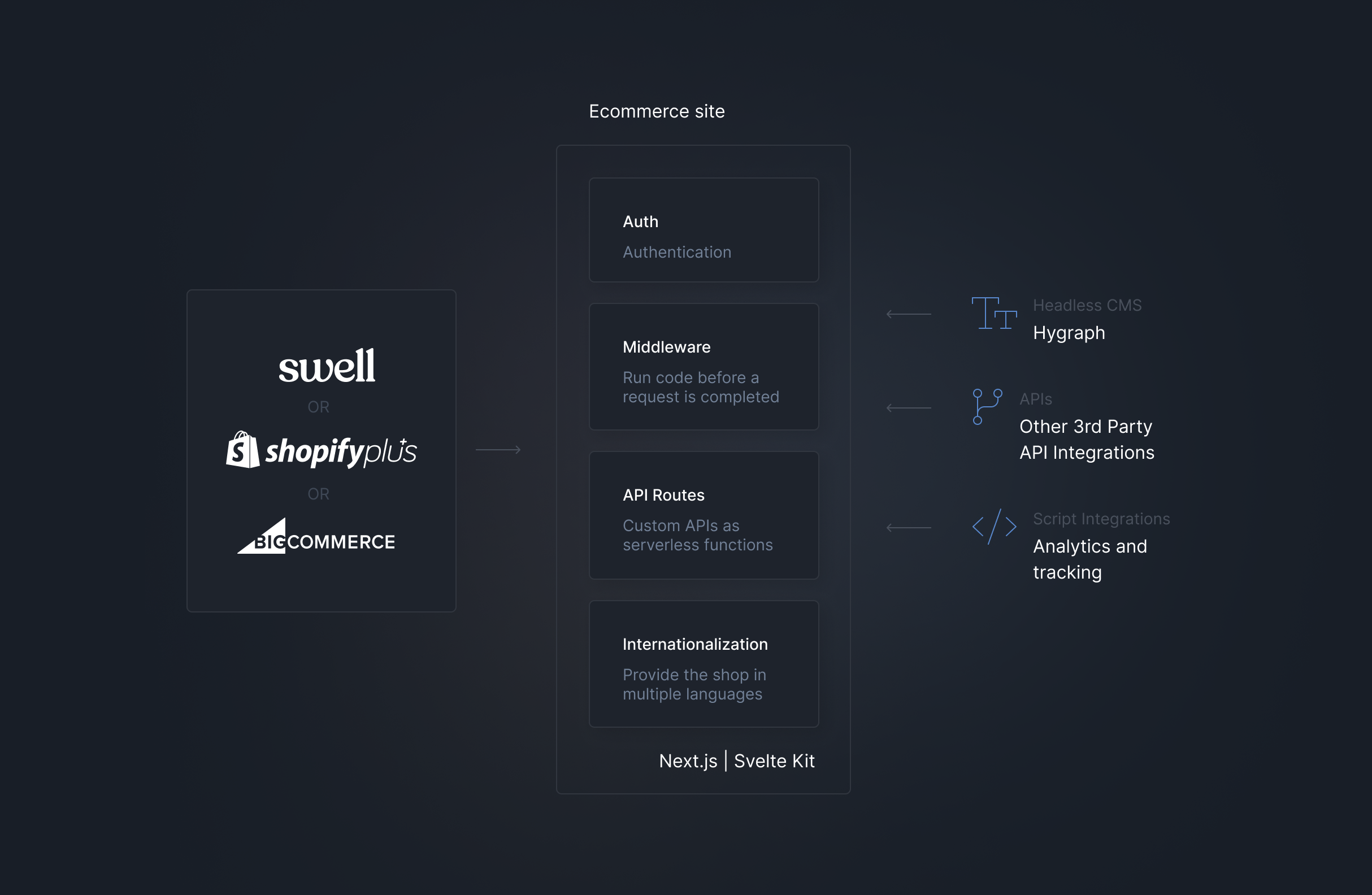
## Composable Ecommerce
Composable ecommerce architecture offers numerous advantages, such as plug-and-play, API-first, and independent development.
## Headless ecommerce
### 01. Fast websites
Leverage modern and advanced technologies to create visionary, fast websites via page pre-render which results in better performance and better SEO. Pre-rendered pages makes the page fully interactive via hydration.
### 02. Flexibility
Headless ecommerce offers flexibility and familiarity for front-end developers where common frameworks like React can be used to achieve excellent results.
### 03. Complete ownership over site architecture
Headless ecommerce on an composable architecture offers complete ownership over site architecture with decoupled front and back ends.
### 04. Marketing effectiveness
Marketing effectiveness for innovation without hurting backend processes.
### 05. Speed to market
A headless architecture solution is not only scalable, but also flexible and easily replicable especially for international and omnichannel market.
### 06. Increased conversion rates
The first five seconds of a page-load time have the highest impact on your conversion rate, and this is where headless shines: performance.
### Our Work Speaks for Itself
- [Birchbox](/work/birchbox.md) — Retail, Vercel, Shopify Plus, Next.js, Stripe, Prismic, Tailwind CSS, GitHub, Node.js, React
- [Goodnature](/work/goodnature.md) — Hardware, Vercel, Shopify Plus, Svelte, Prismic, Stripe, Tailwind CSS, Algolia, GitHub, Node.js
- [Bravura](/work/bravura.md) — Hardware, Algolia, Vercel, Prismic, GitHub
[View all projects](/work.md)
## Contact Us
[Build what comes next](https://monogram.io/#contact) | Email: [hello+llm@monogram.io](mailto:hello+llm@monogram.io)
Provide your contact details and claim a time to meet. We'll help you do the rest.
Monogram is an Applied AI Studio based in Atlanta that designs and deploys production AI systems — connecting models, data, workflows, and enterprise software to automate real work.
The contact form collects: name, email, company, estimated budget (USD), a project description, and how you heard about Monogram.
Not sure where to start? Tell us what you're trying to automate or build — we'll help you figure out where AI fits.
---
**More content:** [Home](/.md) | [About](/about.md) | [Blog](/blog.md) | [Work](/work.md) | [Engineering](/engineering.md)
Monogram helps companies, organizations, and firms adopt AI by designing and building proof of concepts (POCs), MVPs, intelligent workflows, and production-ready AI applications.
Website designed and developed by [Monogram](https://monogram.io)
---
---
title: "Privacy"
url: https://monogram.io/legal/privacy
description: "Monogram composable agency's privacy information on data collection, usage and storage."
---
# Privacy Policy
## Introduction
This Privacy Notice informs you about the types of personal information collected through the Monogram, LLC (“we, our or us”) website (“Site”), and how we use, share and protect that information.
## Applicability of this Privacy Notice
This Privacy Notice applies to the personal information we collect on this Site (at [monogram.io](https://monogram.io/)) and not to any information that we collect through other methods or services, including websites owned or operated by our affiliates, vendors or partners.
## Information You Provide to Us
We may collect and store personal information that you choose to voluntarily provide to us when you contact us, such as when you contact us for business purposes or in relation to a job application. Personal information may include your name, email address, telephone number, and your resume. We use the information you provide to respond to your request or question or to process your application for employment. We may also use the information to communicate with you about other topics that we think may be of interest to you.
## Information We Collect by Automated Means
We are committed to making your online experience with our Site informative and relevant. To achieve this, we collect certain information by automated means when you visit this Site, such as your IP address, the type of internet browser you are using, operating system, referring URLs, information on actions taken on the Site, how many users visited our Site and dates and times of Site visits. By collecting this information, we learn how to best tailor this Site to our visitors. We collect this information by various means, as explained below.
Cookies are bits of text that are placed on your computer’s hard drive or Internet-connected device when you visit certain websites. Cookie technology hold information a site may need to personalize a visitor’s experience. Cookies may also be used for security purposes and to gather website statistical data, such as which pages are visited, what is downloaded, and the paths taken by visitors to our website as they move from page to page.
You do have control over cookies, and can refuse the use of cookies by selecting the appropriate settings on your browser. Note, however, that by not accepting or deleting the use of cookies, you may affect your website experience and you may not be able to take full advantage of all features on this Site. Most browsers will tell you how to stop accepting new cookies, how to be notified when you receive a new cookie, and how to disable existing cookies. Please consult the “Help” section of your browser for more information.
### Google Analytics
We may also use third-party web analytics services on this Site, such as Google Analytics. Google Analytics uses technologies such as cookies to help analyze how users use this website. The information generated by the cookie about your use of this Site (such as your IP address, the URL visited, the date and time the page was viewed) will be transmitted and stored by Google on servers in the United States. Google will use this information to monitor your use of this Site, compiling reports on website activity for website operators and providing other services related to website activity and internet usage. Google may transfer this information to third parties where required by law, or where such third parties process information on Google’s behalf. For more information about Google’s privacy policy in respect of Google Analytics, please refer to [http://www.google.com/analytics/learn/privacy.html](https://support.google.com/analytics/answer/6004245). You may opt out of Google Analytics by visiting [https://tools.google.com/dlpage/gaoptout?hl+en=GB](https://tools.google.com/dlpage/gaoptout?hl+en=GB).
## How We Use the Information We Collect
We may use the information we obtain about you both to further our relationship with you and for other purposes, including to:
- process, evaluate and respond to your requests and inquiries;
- verify your identity to ensure security for the other purposes listed here;
- operate, evaluate and improve our business (including developing new services; managing our communications; learning about our visitors, analyzing our services and website; and facilitating the functionality of our website);
- process applications for employment;
- perform data analyses (including anonymization of personal information);
- enforce our Terms of Use
- comply with applicable legal requirements and industry standards and our policies
We may use personal information for other additional purposes. We will identify these additional purposes at the time of collection.
## Sharing Information
We do not sell or otherwise disclose personal information we collect about you, except as described herein or otherwise disclose to you at the time the data is collected.
We also may share information provided by our visitors to this Site with service providers we have retained to perform services on our behalf, including without limitation, hosting or operating this Site, carrying out your requests, responding to your inquiries, and analyzing data. We require these service providers by contract to appropriately safeguard the privacy and security of personal information they process on our behalf.
We may disclose information about you as compelled or required by law, to law enforcement authorities or other government officials, to protect or defend our legal rights, or in order to investigate, prevent or take action regarding illegal activities, suspected fraud, or violations for our Terms and conditions for using this Site or other applicable policies.
We also reserve the right to transfer personal information we have about you in the event that we sell or transfer all or a portion of our business assets.
## Data Transfer
We may transfer the personal information we collect on this website to other countries other than in which the information was originally collected. Those countries may not have the same data protection laws as your country of residence. Currently, job applicant data may, in certain circumstances, be hosted by our service provider located in the United States and who has certified compliance to the Department of Commerce’s US/EU and US/Swiss Safe Harbor Frameworks. Your job application and any additional information you provide to us when applying for a position will be used for the purpose of processing your application for employment and possibly to determine whether you would be suitable for other positions within Monogram. Monogram may share job applicant data with its affiliated agencies in around the world. Your job application and any additional information you provide to us when applying for a position will be used for the purpose of processing your application for employment and possibly to determine whether you would be suitable for other positions within Monogram. Monogram may share job applicant data with its affiliated agencies in around the world. By submitting your personal data, you consent to this transfer. When we transfer your personal information to other countries, we will protect it as described in this Privacy Notice.
## Security
The security of information is important to us, and we are committed to using reasonable measures to protect the personal information we may collect. However, due to the inherent open nature of the Internet, we cannot guarantee that communications between you and us or the information stored on this Site is absolutely secure.
## Links to Other Websites
This Site may provide links to other websites for your convenience and information. These websites may operate independently from us. Linked sites may have their own privacy notices or policies, which we strongly encourage you to review to better understand their procedures for collecting, using and disclosing personal information. We are not responsible for the content of the linked websites, any use of these sites, or the privacy practices of these sites.
## Children
This Site is not intended for children and we do not knowingly solicit personal data from or communicate with children under the age of 13. Further, this Site is not intended for incapacitated persons, and we do not knowingly solicit personal data from individuals who are incapacitated. If you become aware that your child, any child under your care, or a person otherwise not able to provide valid consent has provided us with information without a parent or guardian’s consent, please contact us as described below.
## Access, Updates and Your Choices
You can tell us at any time not to send you marketing communications by email by clicking on the unsubscribe link within the marketing emails you receive from us or by contacting us as indicated below.
If you have provided us with personal information, you may request that it be updated, modified or deleted. You may do this by sending your request to the following addresses:
- For inquiries relating to our U.S. offices: legal@monogram.io
## Consent
By using this Site, you consent to the processing of your personal information as described in this Privacy Notice.
## Contacting Us
If you have any questions about this Privacy Notice or our privacy practices, please feel free to email us at legal@monogram.io or write to us at:
Monogram, LLC 8000 Avalon Boulevard Suite 100 Alpharetta, GA 30009 Attn: DJ Patel
## Changes to this Privacy Notice
We reserve the right to change or add to this Privacy Notice from time to time and will post any revisions on this Site. We will indicate at the bottom of the Privacy Notice when it was most recently updated. We encourage you to check back often to review the latest version.
Privacy Notice Effective Date: 20 May 2018
## Contact Us
[Build what comes next](https://monogram.io/#contact) | Email: [hello+llm@monogram.io](mailto:hello+llm@monogram.io)
Provide your contact details and claim a time to meet. We'll help you do the rest.
Monogram is an Applied AI Studio based in Atlanta that designs and deploys production AI systems — connecting models, data, workflows, and enterprise software to automate real work.
The contact form collects: name, email, company, estimated budget (USD), a project description, and how you heard about Monogram.
Not sure where to start? Tell us what you're trying to automate or build — we'll help you figure out where AI fits.
---
**More content:** [Home](/.md) | [About](/about.md) | [Blog](/blog.md) | [Work](/work.md) | [Engineering](/engineering.md)
Monogram helps companies, organizations, and firms adopt AI by designing and building proof of concepts (POCs), MVPs, intelligent workflows, and production-ready AI applications.
Website designed and developed by [Monogram](https://monogram.io)
---
---
title: "Terms of Use"
url: https://monogram.io/legal/terms
description: "Information on Monogram agency's asset usage and distribution."
---
# Terms of Use
## Introduction
Monogram, LLC (“Monogram”) provides to you this website (“Website”) for your personal informational, educational and entertainment use. The following Terms of Use govern your access and use of this Website. Please read these Terms of Use carefully before using this Website. Also, specific terms and conditions may apply to specific Content (as defined below) on or available through this Website (the “Content”) and to specific content, data, materials, or information you may upload, submit and/or publish to the Website (“User Content”) or transactions conducted through this Website. Such specific terms may be in addition to these Terms of Use or, where and then only to the extent expressly specified, may supersede these Terms of Use. When used in these Terms of Use, “we” and “our” means Monogram, and “you” and “your” refers to any individual, company or legal entity that accesses or otherwise uses this Website.
### I. Acceptance of Terms of Use
By accessing, browsing or using this Website, you agree to be bound by these Terms of Use and all terms and conditions contained or referenced herein or any additional terms and conditions set forth on this Website. If you do NOT agree to all of these terms, you should NOT access or use this Website.
### II. Modification of Terms
These Terms of Use may be amended by Monogram, in its sole discretion, at any time without notice to you. Such amended Terms of Use shall be effective upon posting. By continuing to access or use this Website, you will be deemed to have accepted such amendments. You are advised to regularly review any applicable terms and conditions. Monogram reserves the right to discontinue or make changes or updates with respect to the Website or the Content of the Website at any time without notice.
### III. Privacy Notice
Personal information provided through this Website shall be used in accordance with [privacy](https://monogram.io/legal/privacy) and these Terms of Use are subject to the Privacy Notice as posted on this page.
### IV. Copyright & Trademarks
You acknowledge that all content on this Website, including the Website’s design, graphics, text, formatting, sounds, pictures, images, software, other materials, information, and the selection and arrangement thereof (collectively, “Content”), are the property of Monogram or its licensors, and are subject to and protected by United States and international copyright and other intellectual property laws and rights. All rights to Content not expressly granted in these Terms of Use are reserved to their respective intellectual property right owners. Except as expressly authorized in these Terms of Use or on the Website, you may not copy, reproduce, distribute, republish, download, perform, display, post, transmit, exploit, create derivative works or otherwise use any of the Content in any form or by any means, without the prior written authorization of Monogram or the respective intellectual property rights owner. Monogram authorizes you to view and download the Content only for personal, non-commercial use, provided that you keep intact all copyright and other proprietary notices contained in the original Content. You may not modify or adapt the Content in any way or otherwise use them for any public or commercial purposes. The trademarks, service marks, trade names, trade dress and logos (collectively, “Marks”) contained or described on this Website (including, without limitation, Monogram) are the sole property of Monogram and/or its licensors and may not be copied, imitated or otherwise used, in whole or in part, without the prior written authorization of Monogram and/or its licensors. In addition, all page headers, custom graphics, button icons and scripts are Marks of Monogram and may not be copied, imitated or otherwise used, in whole or in part, without the prior written authorization of Monogram. Monogram will enforce its intellectual property rights to the fullest extent of the law.
### V. Links to Third Party Websites
Links on the Website to third party websites are provided only as a convenience to you. If you use these links, you will leave the Website. Monogram does not control or endorse any such third party websites. You agree that Monogram and its affiliates will not be responsible or liable for any content, goods or services provided on or through these outside websites or for your use or inability to use such websites. You will use these links at your own risk. You are advised that other websites on the Internet, including third party websites linked from this Website, might contain material or information that some people may find offensive or inappropriate; or that is inaccurate, untrue, misleading or deceptive; or that is defamatory, libelous, infringing of others’ rights or otherwise unlawful. Monogram expressly disclaims any responsibility for the content, legality, decency or accuracy of any information, and for any products and services, that appear on any third party website. Monogram recommends that you make yourself aware of and read the legal and privacy notices of all other websites that you visit.
### VI. Disclaimer of Warranties
Monogram strives to provide accurate and up-to-date material on this Website. However, we make no warranties or representations as to the accuracy or timeliness of the Content on this Website.
YOUR USE OF THE WEBSITE IS AT YOUR SOLE RISK. THE WEBSITE AND THE CONTENT CONTAINED ON THIS WEBSITE ARE PROVIDED ON AN “AS IS” AND “AS AVAILABLE” BASIS. Monogram EXPRESSLY DISCLAIMS ALL WARRANTIES OF ANY KIND, WHETHER EXPRESS OR IMPLIED, INCLUDING, BUT NOT LIMITED TO THE IMPLIED WARRANTIES OF MERCHANTABILITY, FITNESS FOR A PARTICULAR PURPOSE AND NON-INFRINGEMENT. Monogram MAKES NO WARRANTY THAT (I) THE WEBSITE WILL MEET YOUR REQUIREMENTS, (II) THE WEBSITE WILL BE UNINTERRUPTED, TIMELY, SECURE, OR ERROR-FREE, (III) THE RESULTS THAT MAY BE OBTAINED FROM THE USE OF THE WEBSITE WILL BE ACCURATE OR RELIABLE, (IV) THE WEBSITE IS FREE FROM VIRUSES OR OTHER HARMFUL COMPONENTS, OR (V) ANY ERRORS IN THE WEBSITE WILL BE CORRECTED. ANY MATERIAL DOWNLOADED OR OTHERWISE OBTAINED THROUGH THIS WEBSITE IS PROVIDED AT YOUR OWN RISK, AND YOU ARE SOLELY RESPONSIBLE FOR ANY DAMAGE TO YOUR COMPUTER SYSTEM OR LOSS OF DATA THAT RESULTS FROM YOUR USE OF THE WEBSITE, INCLUDING WITHOUT LIMITATION, DAMAGES RESULTING FROM COMPUTER VIRUSES.
SOME JURISDICTIONS MAY NOT PERMIT CERTAIN DISCLAIMERS OF WARRANTIES, SO SOME OF THE EXCLUSIONS ABOVE MAY NOT APPLY TO YOU. IN SUCH JURISDICTIONS, WE DISCLAIM WARRANTIES TO THE FULLEST EXTENT PERMITTED BY APPLICABLE LAW.
### VII. Disclaimer of Damages & Limitation of Liability
NEITHER Monogram OR ITS AFFILIATES SHALL UNDER ANY CIRCUMSTANCES BE LIABLE FOR ANY DAMAGES OF ANY KIND ARISING OUT OF, IN CONNECTION WITH OR RELATING TO YOUR ACCESS TO, OR USE OF OR INABILITY TO USE THIS WEBSITE OR ANY MATERIAL, OR ANY OTHER WEBSITE YOU ACCESS THROUGH A LINK FROM THIS WEBSITE, OR ANY INCORRECT OR INACCURATE INFORMATION ON THIS WEBSITE. THIS IS A COMPREHENSIVE LIMITATION OF LIABILITY THAT APPLIES TO ALL DAMAGES OF ANY KIND, INCLUDING ANY DIRECT, INDIRECT, SPECIAL, INCIDENTAL OR CONSEQUENTIAL DAMAGES (INCLUDING BUT NOT LIMITED TO PROPERTY DAMAGE, LOSS OF USE, LOSS OF DATA, LOSS OF BUSINESS, ECONOMIC LOSS OR LOSS OF PROFITS), WHETHER BASED ON BREACH OF CONTRACT, BREACH OF WARRANTY, TORT (INCLUDING NEGLIGENCE) OR OTHERWISE, EVEN IF Monogram HAS BEEN ADVISED OF THE POSSIBILITY OF SUCH DAMAGE OR LOSS. TO THE MAXIMUM EXTENT PERMITTED BY APPLICABLE LAW, YOU EXPRESSLY WAIVE ALL CLAIMS AGAINST Monogram AND ITS AFFILIATES AND THEIR OFFICERS, DIRECTORS, EMPLOYEES, SUPPLIERS AND PROGRAMMERS THAT MAY ARISE FROM YOUR ACCESS OR USE OF THIS SITE.
### VIII. Indemnification & Release
You agree to indemnify, defend and hold harmless Monogram and its affiliates against all claims, demands, causes of action, losses, expenses, damages and costs, including any reasonable attorneys’ fees, resulting or arising from or relating to your use of or conduct on the Website, any activity related to use of the Website by you, any message or material that you submit to, post on or transmit through the Website, your violation of these Terms of Use, your infringement or violation of any rights of another, or termination of your access to the Website. If you have a dispute with one or more users, you release Monogram and its affiliates from claims, demands and damages (actual and consequential) of every kind and nature, known and unknown, arising out of or in any way connected with such disputes.
### IX. No Unlawful or Prohibited Activity
As a condition of your use of this Website, you agree not to use the Website for any purpose that is unlawful or prohibited by these terms and conditions. You further agree that you are responsible for your use of and communications on the Website. You agree not to post on or transmit through this Website any unlawful, infringing, threatening, harassing, defamatory, vulgar, obscene, profane, indecent, offensive, hateful or otherwise objectionable material of any kind, including any material that encourages criminal conduct or conduct that would give rise to civil liability, violates the privacy rights of others, infringes others’ intellectual property rights or otherwise violates any applicable local, state, national or international law. You agree not to use this Website in any manner that interferes with its normal operation or with any other user’s use and enjoyment of the Site. You agree to use reasonable efforts to scan and remove any viruses or other contaminating or destructive features before submitting any material. Monogram reserves the right, in its sole discretion, to suspend or terminate your access to this Website and prohibit any and all current and future use of this Website (or any portion thereof) by you, if you fail to comply with any term or provision of these Terms of Use or your use is harmful to the interests of another user of this Website.
### X. Shut-down of Website
Monogram reserves the right at any time and from time to time to modify or discontinue, temporarily or permanently, the Website (or any part thereof) with or without notice or consent. Monogram and its affiliates shall have no responsibility or liability for failure to store or delete any Content or User Content submitted to the Website.
### XI. Governing Law and Dispute Resolution
These Terms of Use shall be governed by, and construed in accordance with, the laws of the United States and the State of New York, without giving effect to conflicts of law principles thereof. Monogram makes no representations that the material and information on this Website are appropriate or available in all national locations or languages. You agree that any action at law or in equity arising from or relating to the use of this Website or to these Terms of Use shall be brought exclusively in the Federal or State Courts residing in New York. You hereby consent and submit to personal jurisdiction in of such courts for the purposes of any action relating to this Website, your access or use thereof, or these Terms of Use, and to extra-territorial service of process.
### XII. Severability
If any provision of these Terms of Use is held to be unlawful, void, or for any reason unenforceable by a court of competent jurisdiction, then the invalid or unenforceable provision shall be replaced by a valid, enforceable provision that most closely matches the intent of the original provision, and the validity and enforceability of any remaining provisions shall not be affected.
### XIII. No Waiver
The failure of Monogram and its affiliates to enforce any part of these Terms of Use shall not constitute a waiver of such term or provision, and shall not be considered a waiver or limit Monogram’s right thereafter to insist upon strict adherence to that term or any other provision of these Terms of Use.
Last Update: 20 May 2018
## Accessibility Policy & Commitment Statement
Monogram is committed to interacting, communicating and providing goods and services to all customers and members of the public that are based on the full inclusion of all persons with disabilities.
We recognize people with disabilities may have different needs and we will in accordance with government guidelines, support the identification, removal and prevention of barriers for persons with disabilities. As an employer, Monogram, believes in integration and equal opportunity for all individuals, and is committed to treat all people in a way that allows them to maintain their dignity and independence and contribute to their maximum potential. In accordance with government guidelines and in a timely manner, Monogram will provide the facilities, processes, tools and training to create an accommodating and barrier free work environment.
Monogram has established additional policies to support our Accessibility Policy.
### Human Resources Policies & Procedures
1. Discrimination Policy
1. Harassment Policy
1. Employment Equity and Human Rights
1. Respectful Work Environment Policy
1. Health and Safety Policies
**Monogram is committed to achieve a barrier-free and accommodating work environment through the following means:**
1. This policy and commitment statement
1. A Multi‐Year Accessibility Plan that outlines actions to prevent and remove barriers to accessibility and meet the requirements under the AODA.
1. Modifications to this or other policies: Any policy of Monogram that does not respect and promote the dignity and independence of people with disabilities will be modified or removed.
1. All documentation is available in accessible formats upon request.
### Customer Service Policy Providing Goods & Services to Persons with Disabilities
*About Monogram:* Monogram is an interactive agency specializing in digital business to create products and services that transform organizations for the digital economy, and integrated marketing to build brands and drive sales with a cross-channel, digital-led approach to communication. Monogram creates experience that transform brands, grow businesses and make people’s lives better.
*Our Commitment:* Monogram is committed to providing its goods and services in a way that respects the dignity and independence of persons with disabilities. We are also committed to giving persons with disabilities the same opportunity to access our goods and services allowing them to benefit from the same services, in the same place and in a similar way as other users.
### Providing Goods and Services to Persons with Disabilities:
Monogram is committed to excellence in serving all customers including persons with disabilities and we will carry out our functions and responsibilities in the following areas:
1. Communication - we will communicate with persons with disabilities in ways that take into account their disabilities. Employees who deal with customers will be trained on how to interact and communicate with persons with disabilities.
1. Telephone Services - we are committed to providing fully accessible telephone services to our customers. Employees communicating with customers by telephone are trained to use plain language and speak clearly. They are also familiar with telephone technologies intended for persons with disabilities. We will offer to communicate with customers by e-mail or other acceptable forms of communication if telephone is not suitable to their communication needs or is not available.
1. Assistive Devices- we are committed to serving persons with disabilities who use assistive devices to obtain, use or benefit from our goods and services. We will ensure that our staff are trained and familiar with various assistive devices that may be used by customers with disabilities while accessing our goods and services.
1. Billing - we are committed to providing accessible invoices to all our customers. For this reason, invoices will be provided in the following formats upon request: hard copy, large print, e-mail. We will answer any questions customers may have about the content of their invoices in person, by telephone or e-mail.
### Service Animals
Monogram is committed to welcoming persons with disabilities who are accompanied by a service animal on the parts of premises that are open to the public or other third parties. We will also ensure that staff are properly trained on how to interact with persons with disabilities who are accompanied by a service animal. While visiting the Monogram offices, it is the responsibility of the person with a service animal to control the animal at all times.
### Support Person
We are committed to welcoming persons with disabilities who are accompanied by a support person. At no time will a person with a disability who is accompanied by a support person be prevented from having access to his or her support person while on the premises. No issues related to privacy will be discussed while the support person is present without expressed authorization from the person with disability.
### Notice of Temporary Disruption
Monogram will make all reasonable effort to provide customers and employees with notice in the event of planned or unexpected disruption in the facilities or services usually used by persons with disabilities. The notice will include information about the reason or the disruption, anticipated duration, and a description of alternative facilities/services if available.
Monogram will ensure that the signs and notices will be clearly laid out, of sufficient size and easily readable.
### Training for Staff
Monogram will provide training to all employees, volunteers and others who deal with the public or third parties on their behalf.
Training will include the following:
1. Purpose of the Accessibility for Ontarians with Disabilities Act, 2005 and the requirements of the customer service standard.
1. How to interact and communicate with people with various types of disabilities.
1. How to interact with persons with disabilities who use an assistive device or requite the assistance of a service animal or a support person.
1. What do to if a person with a disability is having difficulty in accessing Monogram’s services.
1. Monogram’s policies, practices and procedures relating to the customer service standard.
Staff will be trained on an ongoing basis when changes are made to the policies, practices and procedures.
### Feedback Process
The end goal of Monogram is to meet and surpass customer expectations when serving customers with disabilities. Comment on our services regarding how well those expectations are being met are welcomed and appreciated.
Feedback regarding the way Monogram provides services to persons with disabilities can be made to:
*DJ Patel Managing Director:* Reachable by email at dj@monogram.io and by phone at 415-997-7754.
### Modifications to Policies
We are committed to developing customer service policies that respect and promote the dignity and independence of persons with disabilities. No changes will be made to our policies without first considering the impact on persons with disabilities.
Any Monogram policy that does not respect and promote the dignity and independence of persons with disabilities will be modified or removed.
### Questions about this Policy?
This policy exists to achieve service excellence to customers with disabilities. If anyone has a question about the policy, an explanation can be provided by Jen Langer, HR Generalist.
## Information and Communications Standards.
*Commitment:* Monogram is committed to making company information and communications accessible to all persons with disabilities. Monogram will incorporate new accessibility requirements under the Information and Communication Standard to ensure all communication systems and platforms are accessible and are provided in accessible formats the meet the needs of persons with disabilities.
1. Emergency Procedure, Plans or Public Safety Information.
Commitment: Monogram is committed to providing and maintaining premises that respect the dignity of persons with disabilities.
Action Taken: Monogram’s Health and Safety policies include procedures for Emergency Evacuation. These can be made available in accessible format or with appropriate communication supports upon request.
1. Feedback, Accessible Formats and Communication Supports Existing processes for receiving and responding to feedback are accessible to persons with disabilities by various accessible formats including telephone, written letter, in person and e-mail. Other formats are available upon request.
1. Accessible Websites and Web Content Monogram will ensure all internet websites and web content under our direct control and conform with the Web Content Accessibility Guidelines (WCAG) 2.0 Level A and increasing to Level AA as per the IASR Requirements.
## Employment Standards.
**Recruitment.**
Commitment: Monogram is committed to fair and accessible employment practices that attract and retain employees with disabilities. This includes providing accessibility across all stages of the employment cycle.
Planned Action: In accordance with the IASR, Monogram will do the following:
Recruitment General: Monogram will notify employees and the public of the availability of accommodation for applicants with disabilities in the recruitment process: This will include:
1. A review and, as necessary, a modification of existing recruitment policies, procedures and processes.
1. Specify accommodation is available for applicants with disabilities on website and job postings.
1. Work with suppliers to ensure external web pages are compliant with the Information and Communication Standards under the IASR’s requirements.
**Recruitment and Selection:**
Monogram will notify job applicants, when they are individually selected to participate in an assessment or selection process that accommodations are available upon request in relation to the materials or processes to be used in the assessment/selection process.
This will include:
1. A review and, as necessary, medication of existing recruitment policies, procedures and processes.
1. Inclusion of availability of accommodation as part of the notice when scheduling and interview and or assessment.
1. Where a selected applicant requests accommodation, Monogram will consult with the applicant and arrange for the provision of suitable accommodations in the manner that takes into account the applicant’s accessibility needs due to disability
Notice to Successful Applicants When making offers of employment, Monogram will notify the successful applicant of its policies for accommodating employees with disabilities. This will include:
1. A review and, as necessary, medication of existing recruitment policies, procedures and processes.
1. Inclusion of notification of Monogram’s policies on accommodating employees with disabilities in offer of employment letters.
**Informing Employees of Supports.**
In accordance of the IASR, Monogram will inform all employees of policies that support employees with disabilities, including, but not limited to, policies on the provision of job accommodations that take into account an employee’s accessibility needs due to a disability. This will include:
1. Informing current employees and new hires of Monogram’s policies supporting employees with disabilities, including, but not limited to, policies on the provision of job accommodations that take into account an employee’s needs due to disability.
1. Incorporate the supporting policies as part of the Orientation for new employees that will be provided to employees as soon as practicable after they begin employment.
1. Keep employees up to date on changes to the existing policies on job accommodations with respect to disability.
1. Where an employee with disability so request it, Monogram will provide or arrange for provision of suitable accessible formats and communications supports for information that is needed in order to perform the employee’s job as well as information that is generally available to employees in the workplace
1. In meeting the obligations to provide the information that is set out in the paragraph above, Monogram will consult the requesting employee in determining the suitability of an accessible format and communication support
**Workplace Emergency Response Information.**
Commitment: Where Monogram is aware that an employee has a disability and that there is need for accommodation, individualized workplace emergency response information will be provided to the employee as soon as possible.
Action Taken: As of July 2016, the following measures have been implemented:
1. Individualized workplace emergency response information can be developed for employees with disabilities, where necessary.
1. Where required, Monogram provides assistance to specific disabled employees, with the disabled employees’ prior consent, to help them evacuate the workplace in case of an emergency or disaster.
1. Individual emergency plans will be communicated to the employees’ respective managers and Monogram’s JHSC , on an “as needed basis.”
On an ongoing and regular basis, and as per the applicable terms of the IASR, Monogram will review and assess general workplace emergency response procedures and individualized emergency plans to ensure accessibility issues are addressed.
**Documented Individual Accommodation Plans/Return to Work Process.**
Commitment: Monogram will ensure that corporate policies surrounding accommodation and return to work are followed, documented and in compliance with the requirements of the IASR.
Planned Action:
1. Monogram’s existing policies include steps that Monogram will take to accommodate an employee with a disability and to facilitate an employee’s return to work after absenteeism due to disability.
1. Monogram will review, assess and standardize all policies to ensure that they include a process for the development of documented individual accommodation plans for employees with a disability, if required.
1. Monogram will ensure that the process for the development of documented individual accommodation plans includes the following elements, in accordance with the provisions of the IASR.
1. Monogram will include in the process the manner in which the employee requesting accommodation can participate in the development of the plan.
1. Monogram will include in the process the means by which the employee is assessed.
1. Monogram will include in the process the manner in which Monogram can request an evaluation by an outside medical or other expert, at Monogram’s expense, to assist in determining how accommodation can be achieved.
1. Steps are in place to protect the privacy of the employee’s personal information.
1. Monogram will outline the frequency in which individual accommodation plans will be reviewed and updated and the manner that this will be done.
1. Monogram will provide the employee with the reasons for the denial if individual accommodation is denied.
1. Monogram will include in the process the means of providing the individual accommodation plan in a format that takes into account the employee’s accessibility needs.
1. If individual accommodation plans are established, Monogram will ensure they include the individualized workplace emergency response information that is required and any information regarding accessible formats and communication supports that have been provided or arranged, in order to provide the employee with necessary information.
1. Monogram will ensure that the return to work process as set out in it’s existing policies outlines the steps we will take to facilitate the employee’s return to work after a disability related absence, outlines the development of a written individualized return to work plan, and requires the use of individual accommodation plans, as discussed above, in the return to work process.
**Performance Management, Career Development and Redeployment.**
Commitment: Monogram will take into account the accessibility needs of employees with disabilities, as well as accommodation plans:
1. When using its performance management process in respect to employees with disabilities.
1. When providing career development and advancement to its employees with disabilities.
1. When redeploying employees with disabilities.
Planned Action: In accordance with the IASR, Monogram will:
1. Review, assess and, as necessary, modify existing policies, procedures and practices to ensure compliance with IASR.
1. Take into account the accessibility needs of employees with disabilities, as well as individual accommodation plans, when using performance management tools.
1. Take into account the accessibility needs of employees with disabilities when providing career development and advancement to its employees with disabilities, including notification of the ability to provide accommodations on internal job postings.
1. Take into account the accessibility needs of employees with disabilities when redeploying employees, including review and, as necessary, modification of employee transfer checklist.
**This document is available in accessible formats upon request.**
## Contact Us
[Build what comes next](https://monogram.io/#contact) | Email: [hello+llm@monogram.io](mailto:hello+llm@monogram.io)
Provide your contact details and claim a time to meet. We'll help you do the rest.
Monogram is an Applied AI Studio based in Atlanta that designs and deploys production AI systems — connecting models, data, workflows, and enterprise software to automate real work.
The contact form collects: name, email, company, estimated budget (USD), a project description, and how you heard about Monogram.
Not sure where to start? Tell us what you're trying to automate or build — we'll help you figure out where AI fits.
---
**More content:** [Home](/.md) | [About](/about.md) | [Blog](/blog.md) | [Work](/work.md) | [Engineering](/engineering.md)
Monogram helps companies, organizations, and firms adopt AI by designing and building proof of concepts (POCs), MVPs, intelligent workflows, and production-ready AI applications.
Website designed and developed by [Monogram](https://monogram.io)
---
---
title: "Company"
url: https://monogram.io/about
description: "Monogram is a digital agency from Atlanta specializing in composable experiences, AI, headless, web and mobile technologies."
---
# Company
## Applied AI Studio
Monogram is an Applied AI Studio based in Atlanta. We design and deploy production AI systems that integrate into how businesses actually operate — connecting models, data, workflows, and enterprise software to automate real work.
---
Monogram is an AI services firm that helps companies, enterprises, and organizations identify, build, and deploy practical AI systems.
## The Problem
Many organizations are overwhelmed by manual processes and operate across numerous disconnected tools and platforms. Although they now have access to powerful AI models, they often lack a clear strategy for applying AI to their operations.
## How Monogram Helps
Monogram works with organizations to:
- Understand their existing operations, workflows, and technology
- Identify high-impact opportunities for AI and automation
- Develop a practical roadmap for implementing AI
- Design and build custom AI systems
- Integrate AI into existing tools, data, and business processes
- Support the deployment, adoption, and ongoing improvement of these systems
## Forward-Deployed Engineering
Monogram’s forward-deployed engineers work directly alongside client teams. We embed within an organization, study how the business operates, identify inefficiencies, and build custom AI solutions around the company’s specific needs.
The goal is not simply to provide access to AI. The goal is to create reliable AI systems that employees can use to reduce manual work, connect fragmented processes, improve decision-making, and operate more efficiently.
---
## How We Started
> We started as a web engineering studio in Atlanta, building composable websites and applications for companies like GitHub, Google, Vercel, IBM, and Stanford.
>
> That work taught us how to ship production systems at scale, integrate with complex enterprise environments, and deliver under real constraints.
- [Google](/work/real-time-collaboration-in-a-cloud-ide.md) *(Client)*
- [GitHub](/technology/github.md) *(Client)*
- [IBM](/work/ai-alliance.md) *(Client)*
- United Healthcare *(Client)*
- [Stanford](https://ftl.stanford.edu) *(Client)*
- [Vercel](/technology/vercel.md) *(Client + Partner)*
*When AI shifted from research curiosity to operational tool, we moved early — the same instinct that took us from WordPress to headless before the rest of the industry caught up. Atlanta's enterprise ecosystem — logistics, finance, healthcare — gave us the client base to prove that AI systems work in production, not just in demos.*
## Today, the work is different. Companies don't just need websites — they need systems that think.
## We build those systems and make them run in production. We've shipped:
- Internal knowledge assistants for regional banks
- **40%** — Customer service automation that cut resolution times by 40%
- **15+** — Agentic reporting pipelines for PE firms that replaced 15+ hours/week of analyst work
- Multi-channel conversational systems integrated with enterprise TMS and ERP platforms
## Meet The Founders
- **DJ** — Managing Director *(Cool Kat)*
- **TJ** — Creative Director • AI Experience Design *(Chief Emoji Officer)*
- **Claudio** — Director of Engineering • AI Systems *(Il Pizzaiolo)*
*What We Believe*
AI is changing what companies need built. The value of production labor — design, development, content — is compressing fast. The new value is in systems that connect intelligence to operations: AI that doesn't just generate, but acts, integrates, and runs.
We work LLMs-first: designing for how intelligent systems reason and act, then layering in the human experience around them.
We build with security and data governance as first-class requirements — SOC 2-aligned patterns, HIPAA-ready deployment, role-based access, and audit trails built in from the start, not added at the end.
And we ship systems that run — not prototypes, not demos, production.
*Partners*
## Technology Partners
We partner with the platforms where AI systems actually get deployed — not to resell infrastructure, but to build on it.
- [Vercel](/technology/vercel.md) *(Client + Partner)*
- Anthropic *(Partner)*
- [Google Cloud](/technology/google-cloud.md)
- [AWS](/technology/aws.md)
- [Cursor](/technology/cursor.md)
- [OpenAI](/technology/openai.md)
- [Pinecone](/technology/pinecone.md)
- [Hugging Face](/technology/hugging-face.md)
- [LangChain](/technology/langchain.md)
- [ElevenLabs](/technology/elevenlabs.md)
- [Contentful](/technology/contentful.md) *(Partner)*
- [Stripe](/technology/stripe.md) *(Partner)*
- [Algolia](/technology/algolia.md) *(Partner)*
- [Raster](/technology/raster.md) *(Client)*
- [Shopify Plus](/technology/shopify.md) *(Partner)*
- [Sanity](/technology/sanity.md) *(Partner)*
## Contact Us
[Build what comes next](https://monogram.io/#contact) | Email: [hello+llm@monogram.io](mailto:hello+llm@monogram.io)
Provide your contact details and claim a time to meet. We'll help you do the rest.
Monogram is an Applied AI Studio based in Atlanta that designs and deploys production AI systems — connecting models, data, workflows, and enterprise software to automate real work.
The contact form collects: name, email, company, estimated budget (USD), a project description, and how you heard about Monogram.
Not sure where to start? Tell us what you're trying to automate or build — we'll help you figure out where AI fits.
---
**More content:** [Home](/.md) | [Blog](/blog.md) | [Work](/work.md) | [Engineering](/engineering.md)
Monogram helps companies, organizations, and firms adopt AI by designing and building proof of concepts (POCs), MVPs, intelligent workflows, and production-ready AI applications.
Website designed and developed by [Monogram](https://monogram.io)
---
---
title: "AI Solution Agency"
url: https://monogram.io/ai
description: "Deliver rich experiences through custom AI agents, enterprise-grade LLM applications, conversational bots and more. Employ the best AI models"
---
# AI
## We help you build AI Agents
---
## We build automation that thinks, acts, and scales. Our intelligent agents empower your experts to drive innovation and create truly adaptive experiences for every customer.
**Services:**
- Optimize my checkout flow
- Automate routine operations
- Improve data-driven decisions
- Automate content updates
- Boost operational efficiency
- Prevent fraud
- Simplify my content
- Automate document processing
- Deploy an AI bot
[Schedule a Strategy Session](#contact)
### Agentic AI
Built on proven foundations
### Composable Architecture
A future-ready stack that flexes and scales.
- [Vercel](https://vercel.com/experts/monogram)
- Langbase
- [Contentful](https://www.contentful.com/partners/solutions/monogram/)
- [Algolia](https://partners.algolia.com/partners/monogram)
### World-class AI models
The best intelligence—plugged in.
- Openai
- Gemini
- Elevenlabs
### Model context protocol (MCP)
A new standard for providing safe, structured, and verifiable context to AI models. This ensures your agents aren't just guessing—they're operating on ground truth from your own systems.
## Your Stack Is Ready.
Let’s Wake It Up.
You’ve already invested in a modern, composable architecture. Now it’s time to make it intelligent. Traditional systems weren’t built for agents. Yours was.
[Work with us](#contact)
## Intelligent Workflow Agents
What we build
### The Problem
Critical workflows like due diligence, client onboarding, or data reconciliation are slow, error-prone, and drain expert resources.
### Our Solution
From due diligence to onboarding—autonomous agents that run full workflows, end-to-end. No fatigue. No errors. Just precision.
### How
We use agentic frameworks like LangGraph, integrated with GPT-4o, Claude, and Gemini—whichever model gets the job done best.
*Available for projects*
## Autonomous
Systems For
Ambitious Teams
Your team is brilliant, but bottlenecks and manual work are holding them back. You need to do more than just speed up a process—you need to reimagine how the work gets done, delivering experiences as unique as your customers. That’s where we begin.
[Video](https://rstr.in/monogram/website/l48x4SgSw_1)
## How
How We Work
### Strategize & Design
We dive into your business and tech stack to pinpoint where agents will deliver the most impact.
### Engineer & Build
Every system is custom-built—tailored to your workflows and powered by the right AI models.
### Deploy & Optimize
We integrate seamlessly, support continuously, and measure relentlessly.
### Hosted AI Agents
Access our pre-built AI Agents.
[Work With Us](#contact)
*Tags: Dedicated AI team, Customization, Month to month*
### Custom Development
For businesses that need more complex systems.
[Contact Us](#contact)
*Tags: Dedicated AI team, Custom systems, Month to month, 8+ build hours/week, Priority support*
## Clients
- [Vercel](/technology/vercel.md) *(Client + Partner)*
- [GitHub](/technology/github.md) *(Client)*
- [Google](/work/real-time-collaboration-in-a-cloud-ide.md) *(Client)*
- Delta *(Client)*
- [Harvard CLBB NeuroLaw Library](/work/harvard-neurolaw-library.md) *(Client)*
- [Zenity](/work/zenity.md) *(Client)*
- [Hypermode](/work/hypermode.md) *(Client)*
- [Alchemy](/work/alchemy.md) *(Client)*
## AI Projects
### AI Powered Projects
- [Subcore Dashboard App](/work/subcore-dashboard-app.md) — AI, Engineering, Next.js, Supabase, TypeScript, Tailwind CSS, Gemini, Node.js, React
- [Abnormal AI](/work/abnormal-ai.md) — AI, Security, Vercel, Next.js, Plasmic, Node.js, React
- [Contextual AI](/work/contextual-ai.md) — AI, Next.js, Vercel, Sanity, Tailwind CSS, Node.js, React
## Contact Us
[Build what comes next](https://monogram.io/#contact) | Email: [hello+llm@monogram.io](mailto:hello+llm@monogram.io)
Provide your contact details and claim a time to meet. We'll help you do the rest.
Monogram is an Applied AI Studio based in Atlanta that designs and deploys production AI systems — connecting models, data, workflows, and enterprise software to automate real work.
The contact form collects: name, email, company, estimated budget (USD), a project description, and how you heard about Monogram.
Not sure where to start? Tell us what you're trying to automate or build — we'll help you figure out where AI fits.
---
**More content:** [Home](/.md) | [About](/about.md) | [Blog](/blog.md) | [Work](/work.md) | [Engineering](/engineering.md)
Monogram helps companies, organizations, and firms adopt AI by designing and building proof of concepts (POCs), MVPs, intelligent workflows, and production-ready AI applications.
Website designed and developed by [Monogram](https://monogram.io)
---
---
title: "Building Scalable Backend Solutions"
url: https://monogram.io/backend
description: "Ship reliable, secure and scalable backend solutions with a future-proof cloud infrastructure. Learn how."
---
# Backend
## Secure and Scalable Backend Development
---
### 01. Custom Backend Development
We specialize in mobile app backend development, cloud solutions, and web applications. Our services also include API development and integration, backend refactoring, custom server development, as well as testing and consulting to keep your applications running smoothly, from data processing to complex integrations.
### 02. API DEVELOPMENT AND INTEGRATION
Our backend services include designing, developing, and integrating RESTful and GraphQL APIs that connect your application with external services, databases, and microservices. We use automated testing to verify that your APIs are well-documented, secure, and reliable.
## Our Platform Expertise
- [Vercel](/technology/vercel.md) *(Client + Partner)*
- [GraphQL](/technology/graphql.md)
- [Azure](/technology/azure.md)
- [Google](/work/real-time-collaboration-in-a-cloud-ide.md) *(Client)*
- [AWS](/technology/aws.md)
## CLOUD-NATIVE BACKENDS
Our cloud-native backend solutions are built for scalability, resilience, and seamless integration with cloud services. Leveraging AWS Lambda, Google Cloud Functions, and Azure App Services, we create dynamic backends that adapt to your growing business demands.
### 01. SCALABILITY AND PERFORMANCE
Our backend solutions are designed to handle millions of requests per second, making your applications ready for peak loads without compromising performance. We optimize speed and resource usage using advanced caching, load balancing, and auto-scaling techniques.
### 02. SECURITY FIRST
Security is at the core of our development process. From encryption and secure authentication methods to regular vulnerability assessments, we employ best practices to safeguard your data and protect against cyber threats.
### 03. RAPID DEPLOYMENT AND CI/CD
Our backend services integrate CI/CD pipelines to automate code testing, integration, and deployment, minimizing downtime and enhancing code quality. This results in faster delivery and continuous updates, keeping your applications up-to-date with the latest features.
### 04. COST-EFFECTIVE SOLUTIONS
We reduce infrastructure costs while maintaining high availability by using serverless technologies and microservices. Our backend architectures are built to optimize resources, so you only pay for what you use.
### 05. HIGHLY AVAILABLE AND RELIABLE
We build backends with fault tolerance and high availability in mind. Our solutions incorporate redundancy, failover mechanisms, and real-time monitoring to keep your applications up and running 24/7.
### 06. FUTURE-PROOF TECHNOLOGY STACK
We leverage modern backend technologies that are constantly evolving to keep your systems adaptable and competitive. Whether adopting new frameworks or integrating AI-driven solutions, your backend stays future-proof.
### Our Work Speaks for Itself
- [BigCommerce](/work/bigcommerce.md) — SaaS, Next.js, Makeswift, Contentful, Vercel, Algolia, Tailwind CSS, Smartling, GitHub, Node.js, React
- [Angular](/work/angular.md) — Developer Tooling, Angular, GitHub, Algolia, Firebase, WebGL
- [Calyptia](/work/calyptia.md) — Developer Tooling, Next.js, DatoCMS, Tailwind CSS, Vercel, Basin, GitHub, GraphQL, React, Node.js
## Contact Us
[Build what comes next](https://monogram.io/#contact) | Email: [hello+llm@monogram.io](mailto:hello+llm@monogram.io)
Provide your contact details and claim a time to meet. We'll help you do the rest.
Monogram is an Applied AI Studio based in Atlanta that designs and deploys production AI systems — connecting models, data, workflows, and enterprise software to automate real work.
The contact form collects: name, email, company, estimated budget (USD), a project description, and how you heard about Monogram.
Not sure where to start? Tell us what you're trying to automate or build — we'll help you figure out where AI fits.
---
**More content:** [Home](/.md) | [About](/about.md) | [Blog](/blog.md) | [Work](/work.md) | [Engineering](/engineering.md)
Monogram helps companies, organizations, and firms adopt AI by designing and building proof of concepts (POCs), MVPs, intelligent workflows, and production-ready AI applications.
Website designed and developed by [Monogram](https://monogram.io)
---
---
title: "Careers"
url: https://monogram.io/careers
description: "Join our talented team of engineers, designers and strategists delivering bespoke digital experiences. "
---
# Careers
## Join our team
---
## Open Roles
Make your impact, your way
### 01. Associate Creative Director
An Associate Creative Director at Monogram will help drive the creative vision across major projects while working under the Creative Director. Here, you will mentor designers, refine ideas, and grow into stronger creative leadership.
[Associate Creative Director](mailto:careers@monogram.io)
### 02. Sr Design Engineer
A senior design engineer at Monogram is someone that is motivated to combine the art of design with the art of programming. An ideal fit is a designer first, and a HTML and CSS wizard 🧙🏻 at the same time. AI skills are a huge bonus.
[Sr Design Engineer](mailto:careers@monogram.io)
### 03. Sales Executive
A Sales Executive at Monogram will be the bridge between new clients and our team. Expected to pursue and nurture opportunities, you will guide prospects through our process, with support from Creative, Engineering, and Service teams — and technical skills are a strong bonus.
[Sales Executive](mailto:careers@monogram.io)
### 04. AI Engineer
A Web AI Engineer at Monogram will build fast, reliable AI features for modern web apps through effective prompting and training LLMs. Here, you will collaborate with designers and engineers and receive clear feedback to refine your craft.
[AI Engineer](mailto:careers@monogram.io)
### 05. Next.js Engineer
As part our strong, fast moving team, you will be helping convert beautifully designed web applications into reality, including building performant APIs and modern front-ends using Next.js.
[Next.js Engineer](https://www.notion.so/monogramdesign/Next-js-Engineer-29f823e8a0d548b0a245e7a6814b2fa6)
### 06. Don't see your superpower?
Reach out anyway → careers@monogram.io
## Contact Us
[Build what comes next](https://monogram.io/#contact) | Email: [hello+llm@monogram.io](mailto:hello+llm@monogram.io)
Provide your contact details and claim a time to meet. We'll help you do the rest.
Monogram is an Applied AI Studio based in Atlanta that designs and deploys production AI systems — connecting models, data, workflows, and enterprise software to automate real work.
The contact form collects: name, email, company, estimated budget (USD), a project description, and how you heard about Monogram.
Not sure where to start? Tell us what you're trying to automate or build — we'll help you figure out where AI fits.
---
**More content:** [Home](/.md) | [About](/about.md) | [Blog](/blog.md) | [Work](/work.md) | [Engineering](/engineering.md)
Monogram helps companies, organizations, and firms adopt AI by designing and building proof of concepts (POCs), MVPs, intelligent workflows, and production-ready AI applications.
Website designed and developed by [Monogram](https://monogram.io)
---
---
title: "Composable Architecture"
url: https://monogram.io/composable-architecture
description: "Monogram digital agency serves composable solutions with best-of-breed tools and API services. Learn how. "
---
# Composable Architecture
## What is Composable architecture?
Composable architecture is a modular and flexible approach to building digital systems, where independent, interoperable components, connected via APIs, are assembled to create scalable and customizable solutions. This approach allows for seamless integration of different technologies, facilitating agile adaptation to evolving business needs and enabling a more efficient and tailored technology stack.
---
## The Composable Architecture Advantage.
- [Next.js](/technology/next-js.md)
- [Svelte](/technology/svelte.md)
- [Vue.js](/technology/vuejs.md)
- [React](/technology/react.md)
- [Node.js](/technology/nodejs.md)
- Firebase *(Client)*
- [Vercel](/technology/vercel.md) *(Client + Partner)*
- [Prismic](/technology/prismic.md) *(Partner)*
### 01. API First
Composable architecture is based on the principle of API-first, ensuring that applications in the stack work with other APIs regardless of the programming language or platform they are written in. Not only the APIs are language agnostic, but if used correctly, they can be used to build a complete stack of products that work together seamlessly.
### 02. Composable vs. monoliths
Composable architecture offers a number of clear advantages such as plug-and-play, API-first, and independent development. The main advantage is that it allows you to build a complete stack of products that work together seamlessly. This is in contrast to monolithic architecture, which is based on the idea of building a complete stack of products from a single codebase. This approach is not only more difficult to implement, but it also makes it difficult to integrate with other products.
### 03. Jamstack as the foundation
Jamstack is here to stay. While composable architecture encompasses something larger than Jamstack we still believe in statically generating certain pages and assets that are deployed on a CDN, and build upon that foundation with headless, APIs and other microservices.
### 04. Only the best technology
We can help you select the products that best suit your needs and easily integrate them with other products to build your stack. That way the focus is placed on the best technology for the job, not on the technology that is available from one vendor alone.
## Contact Us
[Build what comes next](https://monogram.io/#contact) | Email: [hello+llm@monogram.io](mailto:hello+llm@monogram.io)
Provide your contact details and claim a time to meet. We'll help you do the rest.
Monogram is an Applied AI Studio based in Atlanta that designs and deploys production AI systems — connecting models, data, workflows, and enterprise software to automate real work.
The contact form collects: name, email, company, estimated budget (USD), a project description, and how you heard about Monogram.
Not sure where to start? Tell us what you're trying to automate or build — we'll help you figure out where AI fits.
---
**More content:** [Home](/.md) | [About](/about.md) | [Blog](/blog.md) | [Work](/work.md) | [Engineering](/engineering.md)
Monogram helps companies, organizations, and firms adopt AI by designing and building proof of concepts (POCs), MVPs, intelligent workflows, and production-ready AI applications.
Website designed and developed by [Monogram](https://monogram.io)
---
---
title: "Contact Us"
url: https://monogram.io/contact
---
# Contact Us
## Contact Us
[Build what comes next](https://monogram.io/#contact) | Email: [hello+llm@monogram.io](mailto:hello+llm@monogram.io)
Provide your contact details and claim a time to meet. We'll help you do the rest.
Monogram is an Applied AI Studio based in Atlanta that designs and deploys production AI systems — connecting models, data, workflows, and enterprise software to automate real work.
The contact form collects: name, email, company, estimated budget (USD), a project description, and how you heard about Monogram.
Not sure where to start? Tell us what you're trying to automate or build — we'll help you figure out where AI fits.
---
**More content:** [Home](/.md) | [About](/about.md) | [Blog](/blog.md) | [Work](/work.md) | [Engineering](/engineering.md)
Monogram helps companies, organizations, and firms adopt AI by designing and building proof of concepts (POCs), MVPs, intelligent workflows, and production-ready AI applications.
Website designed and developed by [Monogram](https://monogram.io)
---
---
title: "Data & APIs"
url: https://monogram.io/data-and-apis
description: "Create well-designed APIs for consumers and enterprise using the latest technologies"
---
# Data & APIs
## Data & APIs
At Monogram, we specialize in building applications designed to solve simple and complex business problems. Our team has created dozens of solutions for our clients using all major platforms or creating custom development-intensive solutions.
---
### 01. APIs, the Key Component of the Composable Stack
Composable architecture leverages the API economy and encourages businesses to put their offerings together modularly, such as breaking down components into smaller microservices services.
### 02. Used Everywhere
Most mobile apps and web apps are required to connect to the internet to work correctly. APIs allow websites the option for backend communication, improving the functionality and the user experience.
## Our Modern Toolset
- [Next.js](/technology/next-js.md)
- [Svelte](/technology/svelte.md)
- [Vercel](/technology/vercel.md) *(Client + Partner)*
- [GitHub](/technology/github.md) *(Client)*
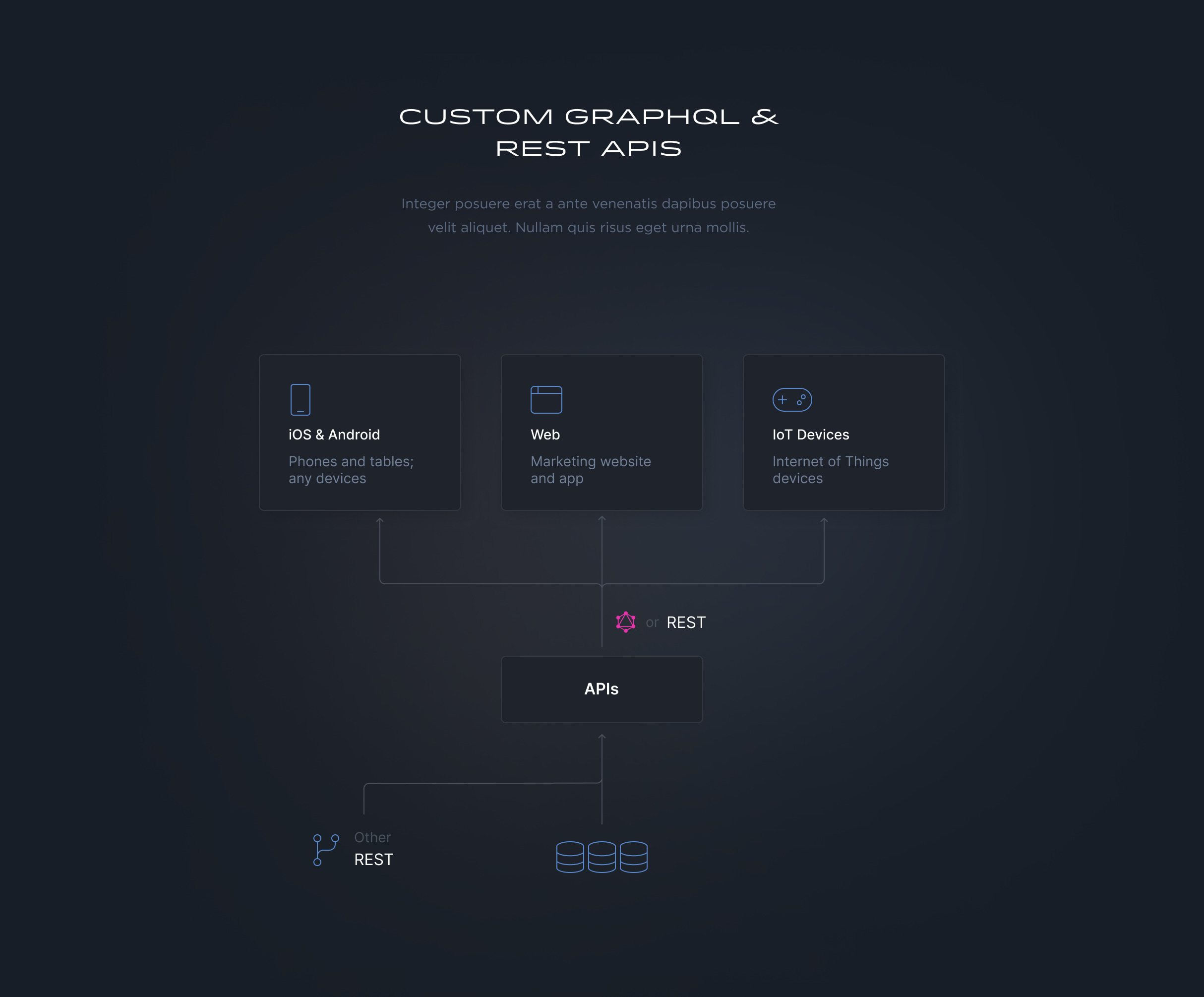
## Custom GraphQL & REST APIs
### 01. GraphQL, Key component of the Modern Stack
Apollo Server as a standalone GraphQL server has a straightforward setup and is universally compatible with any data source. We can start fetching data quickly.
### 02. Production Ready, Autoscaled
Deployed on our partner's infrastructure, your custom APIs will scale to meet user demand, automagically, and based on load.
### 03. One Client, Multiple Sources
A backend that serves data to clients from multiple sources be it a database, REST APIs, or a combination of both. It can be deployed anywhere that can run Node.js.
### 04. Cache Management
Caching can be set up not only client side when using Apollo Client (or SWR), but also server side. This means that your API server can cache the results of your queries, and return them to the client without having to hit the database. End result: faster response times and less load on your database.
### 05. APIs, One Source for Web and Phone Apps
APIs, not only plays a key role into the Composable Architecture, but is a great way to share data between different clients (Web, Mobile, Desktop, IoT devices, etc) and to build a single source of truth for your data.
## Our Work Speaks for Itself
- [GoHealth Urgent Care](/work/gohealth.md) — Healthcare, Next.js, Prismic, Vercel, Turborepo, NextAuth.js, Tailwind CSS, GitHub, Node.js, React
- [Lightcast](/work/lightcast.md) — Marketing Data, Next.js, DatoCMS, Tailwind CSS, Vercel, GitHub, GraphQL, React, Node.js
[View all projects](/work.md)
## Contact Us
[Build what comes next](https://monogram.io/#contact) | Email: [hello+llm@monogram.io](mailto:hello+llm@monogram.io)
Provide your contact details and claim a time to meet. We'll help you do the rest.
Monogram is an Applied AI Studio based in Atlanta that designs and deploys production AI systems — connecting models, data, workflows, and enterprise software to automate real work.
The contact form collects: name, email, company, estimated budget (USD), a project description, and how you heard about Monogram.
Not sure where to start? Tell us what you're trying to automate or build — we'll help you figure out where AI fits.
---
**More content:** [Home](/.md) | [About](/about.md) | [Blog](/blog.md) | [Work](/work.md) | [Engineering](/engineering.md)
Monogram helps companies, organizations, and firms adopt AI by designing and building proof of concepts (POCs), MVPs, intelligent workflows, and production-ready AI applications.
Website designed and developed by [Monogram](https://monogram.io)
---
---
title: "DATA ENGINEERING AND API INTEGRATION"
url: https://monogram.io/data-engineering-and-api-integration-services
---
# Data Engineering and API Integration Services
## DATA ENGINEERING AND API INTEGRATION
---
### 01. EXPERTS IN DATA AND API INTEGRATION SERVICES
Monogram builds high-performance websites and apps with expert data engineering and API integration. We design custom APIs and connect eCommerce platforms, mobile apps, and headless commerce. We improve your platform’s functionality and user experience across all components by securely syncing data with CRM, ERP, AI/ML, and third-party services.
## Our Platform Expertise
- [Vercel](/technology/vercel.md) *(Client + Partner)*
- [Google](/work/real-time-collaboration-in-a-cloud-ide.md) *(Client)*
- [Hugging Face](/technology/hugging-face.md)
- [Pinecone](/technology/pinecone.md)
- [AWS](/technology/aws.md)
## API-FIRST ARCHITECTURE
API-first architecture is at the heart of our integration approach, enabling your business to build flexible, scalable, and interconnected platforms. Your digital environment is adaptable, easily extendable, and capable of integrating with emerging technologies when we design with APIs from the outset.
### 01. FAST INTEGRATION AND DEPLOYMENT
Our data engineering services enable quick and efficient API integration, allowing your website or app to communicate flawlessly with various external services, from payment gateways to third-party platforms. This results in faster deployment cycles and less downtime.
### 02. SCALABLE AND FLEXIBLE ARCHITECTURE
Using microservices and an API-first design, our composable architecture approach provides a scalable and adaptable foundation for your website and app, making it easy to add new features or respond to market changes without disrupting existing operations.
### 03. OPTIMIZED DATA FLOW AND MANAGEMENT
With real-time data synchronization between your web or app platform and backend systems, our services ensure data flows smoothly, accurately, and securely, enabling better decision-making, enhanced user experiences, and streamlined business processes.
### 04. ENHANCED SECURITY AND COMPLIANCE
We build secure, high-capacity connections that meet the most stringent security standards, protecting your data and maintaining compliance with industry regulations.
### 05. IMPROVED USER EXPERIENCE
By integrating APIs that connect to various data sources, we deliver a rich, interactive user experience that keeps customers engaged and satisfied. Our advanced data engineering techniques enable features such as real-time updates, dynamic content delivery, and personalized interactions.
### 06. AI INTEGRATION FOR SMARTER SOLUTIONS
Our AI-driven API integrations, including tools like OpenAI, Gemini, and HuggingFace, elevate digital platforms with intelligent features such as conversational bots, autonomous agents, and machine learning models. These integrations enable your website or app to offer personalized user experiences, automate business processes, and enhance decision-making through advanced data insights.
## Contact Us
[Build what comes next](https://monogram.io/#contact) | Email: [hello+llm@monogram.io](mailto:hello+llm@monogram.io)
Provide your contact details and claim a time to meet. We'll help you do the rest.
Monogram is an Applied AI Studio based in Atlanta that designs and deploys production AI systems — connecting models, data, workflows, and enterprise software to automate real work.
The contact form collects: name, email, company, estimated budget (USD), a project description, and how you heard about Monogram.
Not sure where to start? Tell us what you're trying to automate or build — we'll help you figure out where AI fits.
---
**More content:** [Home](/.md) | [About](/about.md) | [Blog](/blog.md) | [Work](/work.md) | [Engineering](/engineering.md)
Monogram helps companies, organizations, and firms adopt AI by designing and building proof of concepts (POCs), MVPs, intelligent workflows, and production-ready AI applications.
Website designed and developed by [Monogram](https://monogram.io)
---
---
title: "Design"
url: https://monogram.io/design
description: "Craft beautiful human-centered digital experience with modern design paired with the best service. Here's how Monogram does it."
---
# Design
## Design Pioneers
---
## Design Services
- Creative Direction
- UI Design
- UX Design
- User Journeys
- Brand Identity
- Brand Strategy
- Brand Guidelines
- App Design
- Motion Design
> We’re focused on delivering the best user experience across all platforms and devices. From conception all the way to functional prototypes, we craft beautiful human-centered digital experiences.
### Recent Design Work
- [Fireworks AI](/work/fireworks-ai.md) — AI, Figma, Raster
- [Google Checks](/work/google-checks.md) — AI, Astro, Sanity, Tailwind CSS, Node.js
- [Quinlan Partners](/work/quinlan-partners.md) — Professional Services, Prismic, Next.js, Vercel, Tailwind CSS, GitHub, Node.js, React
- [IBM AI Alliance](/work/ai-alliance.md) — AI, Prismic, Next.js, Vercel, Three.js, WebGL, GitHub, Node.js, React
- [ACR](/work/acr.md) — Figma
- [Jetify](/work/jetify.md) — Developer Tooling, AI
- [Voyage AI ](/work/voyage-ai.md) — AI, Figma
- [Harvard NeuroLaw Library](/work/harvard-neurolaw-library.md) — Education, Research, AI, Next.js, Contentful, Gemini, Vercel, Typesense, GitHub, Node.js, React
- [Raster](/work/raster.md) — AI, GitHub, Basin
- [Vercel](/work/vercel.md) — Engineering, Next.js, Tailwind CSS, Vercel, Contentful, GitHub, Node.js, React
- [Checkly](/work/checkly.md) — Developer Tooling, Next.js, Prismic, Vercel, Tailwind CSS, GitHub, Basin, Node.js, React
- [Angular](/work/angular.md) — Developer Tooling, Angular, GitHub, Algolia, Firebase, WebGL
- [GoHealth Urgent Care](/work/gohealth.md) — Healthcare, Next.js, Prismic, Vercel, Turborepo, NextAuth.js, Tailwind CSS, GitHub, Node.js, React
- [Hy-Vee](/work/hy-vee.md) — Food, Retail, Next.js, Sanity, Tailwind CSS, Vercel, GitHub, Basin, Node.js, React
- [Hypermode](/work/hypermode.md) — AI, Vercel, Next.js, Tailwind CSS, Three.js, WebGL, GitHub, Node.js, React
- [Goss RV](/work/goss-rv.md) — Luxury Travel, DatoCMS, Next.js, Tailwind CSS, Next.js, Hubspot, GitHub, GraphQL, React, Node.js
- [Calyptia](/work/calyptia.md) — Developer Tooling, Next.js, DatoCMS, Tailwind CSS, Vercel, Basin, GitHub, GraphQL, React, Node.js
- [DomeTag](/work/dometag.md) — Manufacturing, Svelte, Vercel, DatoCMS, Tailwind CSS, GitHub, GraphQL, Node.js
- [Backtrace](/work/backtrace.md) — Gaming Technology, Next.js, Prismic, Vercel, GitHub, Basin, Node.js, React
- [Gateway First Bank](/work/gateway-first-bank.md) — Financial, Contentful, Next.js, Vercel, Tailwind CSS, GitHub, Node.js, React
- [Birchbox](/work/birchbox.md) — Retail, Vercel, Shopify Plus, Next.js, Stripe, Prismic, Tailwind CSS, GitHub, Node.js, React
- [MacStadium](/work/macstadium.md) — Engineering, Next.js, Prismic, Tailwind CSS, Vercel, Algolia, GitHub, Node.js, React
[View All](https://monogram.io/portfolio)
## Services
Our Design Process
### 01. Paper first
Every design project we work on starts its journey as ink that flows onto a piece of paper. Our thoughts manifest through rapid ideation and we listen carefully.
### 02. Testing Prototypes
In the spirit of rapid ideation, as soon as we have a light bulb moment on paper, we take the process to build quick prototypes to demonstrate our thoughts.
### 03. Visual Design
This is when the design comes to life. We carefully craft each and every pixel of the design, down to the minor details, to create a real vision of the product.
### 04. Style Guide
Working with companies large and small, we understand the importance of making design repeatable and consistent. That's why we build detailed style guides.
### 05. Working UI Prototypes
We take the UI design and create a moving, functional prototype that helps define just how your product would look and work. Usability is tested here.
### 06. We can build it
One of the biggest benefits of working with Monogram is we can build everything we design, and retain our top-notch quality of work to the development phase.
## Our Mediums
### 01. Web Applications
Web apps and design systems including typography, grid systems, buttons, menus, sidebars, and more. We design the pieces to build your software more usable and beautiful than ever.
### 02. Mobile Apps
iOS, iPadOS and Android apps are our home turf because we use them every day. We unleash our creativity to design the most usable and attractive mobile experiences on the planet.
### 03. Redesigns & Flows
Probably one of the most satisfying things for us is to take a step back and see how we have improved software that was confusing, ugly, and unusable into something far better.
### 04. Kickass Websites
Monogram has designed and developed hundreds of world-class web experiences with a quality that's on par or exceeding that of marketing and branding agencies. Our design just works.
## Contact Us
[Build what comes next](https://monogram.io/#contact) | Email: [hello+llm@monogram.io](mailto:hello+llm@monogram.io)
Provide your contact details and claim a time to meet. We'll help you do the rest.
Monogram is an Applied AI Studio based in Atlanta that designs and deploys production AI systems — connecting models, data, workflows, and enterprise software to automate real work.
The contact form collects: name, email, company, estimated budget (USD), a project description, and how you heard about Monogram.
Not sure where to start? Tell us what you're trying to automate or build — we'll help you figure out where AI fits.
---
**More content:** [Home](/.md) | [About](/about.md) | [Blog](/blog.md) | [Work](/work.md) | [Engineering](/engineering.md)
Monogram helps companies, organizations, and firms adopt AI by designing and building proof of concepts (POCs), MVPs, intelligent workflows, and production-ready AI applications.
Website designed and developed by [Monogram](https://monogram.io)
---
---
title: " DevOps Services"
url: https://monogram.io/dev-ops
---
# DevOps Services
## DevOps Services
---
### 01. A DevOps-DRIVEN APPROACH
DevOps powers our web and app development at Monogram, allowing you to benefit from faster development cycles, reliable deployments, and adaptable solutions that meet changing market demands with precision and quality.
### 02. DevOps SOLUTIONS FOR EVERY BUILD
We use tools like GitHub and Kubernetes to automate code integration and testing, making your website and app fast and secure while adapting to your changing needs.
## Our Platform Expertise
- [Docker](/technology/docker.md)
- [GitHub](/technology/github.md) *(Client)*
- [Kubernetes](/technology/kubernetes.md)
- [Google](/work/real-time-collaboration-in-a-cloud-ide.md) *(Client)*
- [AWS](/technology/aws.md)
## THE ENGINE BEHIND MODERN APPs
With Docker and Kubernetes, we package your applications into portable containers, making them easier to test and deploy and enhancing your ability to manage high traffic with stability.
### 01. AGILITY IN DEVELOPMENT
Our efficient DevOps implementations let you adapt to feedback, implement changes quickly, and deliver a responsive, evolving product that serves your users.
### 02. AUTOMATED PROCESSES FOR RELIABILITY
By automating testing and deployments, we minimize errors, delivering consistent and reliable releases that save you time and enhance your application’s stability.
### 03. ENHANCED SECURITY INTEGRATION
We embed security into every stage of development, catching vulnerabilities early to keep your applications safe and compliant.
### 04. CLOUD-NATIVE CAPABILITIES
Our use of AWS, Azure, and Google Cloud empowers your applications with scalability and resilience, providing optimal performance as your user base grows.
### 05. BOOSTED BUSINESS METRICS
Experience improved deployment speed, reduced downtime, and enhanced feature rollouts directly impacting your bottom line and customer satisfaction.
## Contact Us
[Build what comes next](https://monogram.io/#contact) | Email: [hello+llm@monogram.io](mailto:hello+llm@monogram.io)
Provide your contact details and claim a time to meet. We'll help you do the rest.
Monogram is an Applied AI Studio based in Atlanta that designs and deploys production AI systems — connecting models, data, workflows, and enterprise software to automate real work.
The contact form collects: name, email, company, estimated budget (USD), a project description, and how you heard about Monogram.
Not sure where to start? Tell us what you're trying to automate or build — we'll help you figure out where AI fits.
---
**More content:** [Home](/.md) | [About](/about.md) | [Blog](/blog.md) | [Work](/work.md) | [Engineering](/engineering.md)
Monogram helps companies, organizations, and firms adopt AI by designing and building proof of concepts (POCs), MVPs, intelligent workflows, and production-ready AI applications.
Website designed and developed by [Monogram](https://monogram.io)
---
---
title: "Docs: machine-readable monogram.io"
url: https://monogram.io/docs
description: "Every page on this site has a markdown twin. This is the index of them, plus the discovery documents an agent can read to work with monogram.io."
---
# Docs
## This site is readable by machines
Every page here has a plain markdown twin, and the whole site is published as a single file. If you are an agent, a crawler, or a person writing one, start with llms.txt.
---
We build agent systems, so it would be strange to run a site an agent cannot read. Every page on monogram.io is served twice: once as HTML for people, and once as markdown at the same path with .md on the end. Nothing is rendered by JavaScript that is missing from the markdown.
The fastest way in is https://monogram.io/llms.txt, an index of every page on the site with a one line description of each. If you would rather have the entire site as one document, https://monogram.io/llms-full.txt is exactly that, around 1.4 MB.
## What is here
Three ways to read this site
### 01. Markdown twins of every page
Add .md to any path, or append /markdown, and you get that page as plain markdown. The two forms are separate routes serving one document, so during a revalidation one can trail the other briefly. Case studies keep their metrics and technology pages keep their project links.
### 02. Two index files
llms.txt lists every page with a short description, grouped by section. llms-full.txt inlines the full text of all of them in one file, with a source comment above each entry so you can tell where a passage came from. Navigate with the first, ingest the second.
### 03. Discovery documents
The well-known directory carries an OpenAPI 3.1 description of the public read-only endpoints, an RFC 9727 catalog linking them together, and OAuth and OpenID metadata. Every one of them is listed below with its direct URL, so nothing here needs to be guessed at.
### The index
Every machine-readable surface, by URL
- [llms.txt, an index of every page](https://monogram.io/llms.txt)
- [llms-full.txt, the whole site in one file](https://monogram.io/llms-full.txt)
- [sitemap.xml](https://monogram.io/sitemap.xml)
- [sitemap.md, the same sitemap as markdown](https://monogram.io/sitemap.md)
- [robots.txt, including our Content-Signal](https://monogram.io/robots.txt)
- [OpenAPI 3.1 description](https://monogram.io/.well-known/openapi.json)
- [API catalog, RFC 9727](https://monogram.io/.well-known/api-catalog)
- [OAuth authorization server metadata, RFC 8414](https://monogram.io/.well-known/oauth-authorization-server)
- [OAuth protected resource metadata, RFC 9728](https://monogram.io/.well-known/oauth-protected-resource)
- [OpenID configuration](https://monogram.io/.well-known/openid-configuration)
- [MCP server card](https://monogram.io/.well-known/mcp/server-card.json)
- [auth.md, how agent authentication is meant to work here](https://monogram.io/auth.md)
- [Health check](https://monogram.io/api/health)
## Before you build against it
What is published, and what is not live
### 01. The MCP server card describes an endpoint that is not enabled
The server card at the well-known path advertises tools, resources and prompts at /mcp. That transport is not switched on, and a request to it returns 501 with a message saying so. Read the card as a statement of intended shape rather than a live server.
### 02. There is no interactive OAuth for external clients
The authorization server and protected resource documents are published so discovery resolves, and auth.md describes the model. The authorize endpoint itself returns 501, and the JWKS document is an empty key set. Nothing here issues you a token today.
### 03. Freshness varies by route, so check the header
llms.txt and llms-full.txt revalidate on every request, so the index is never stale. Blog markdown and the markdown sitemap cache for an hour with a day of stale while revalidate. Most other markdown routes send no explicit lifetime, so treat the HTML as the fresher copy.
## Want your own site to read like this?
We build the agent-readable layer into the sites we ship: markdown mirrors, index files, and discovery documents that resolve. If you are working out what your own site should expose to agents, that is a conversation worth having.
[Talk to us](https://monogram.io/#contact)
## Contact Us
[Build what comes next](https://monogram.io/#contact) | Email: [hello+llm@monogram.io](mailto:hello+llm@monogram.io)
Provide your contact details and claim a time to meet. We'll help you do the rest.
Monogram is an Applied AI Studio based in Atlanta that designs and deploys production AI systems — connecting models, data, workflows, and enterprise software to automate real work.
The contact form collects: name, email, company, estimated budget (USD), a project description, and how you heard about Monogram.
Not sure where to start? Tell us what you're trying to automate or build — we'll help you figure out where AI fits.
---
**More content:** [Home](/.md) | [About](/about.md) | [Blog](/blog.md) | [Work](/work.md) | [Engineering](/engineering.md)
Monogram helps companies, organizations, and firms adopt AI by designing and building proof of concepts (POCs), MVPs, intelligent workflows, and production-ready AI applications.
Website designed and developed by [Monogram](https://monogram.io)
---
---
title: "Education"
url: https://monogram.io/education
---
# Education
## Monogram Education
We offer fast, secure, and easy-to-use software that gives teachers, principals, and districts the insights they need to do their jobs effectively.
---
## Excellent Education Deserves Superior Software.
We’ve worked with some of the nation’s top school districts and built technology solutions that helped improve teaching and learning for millions of students.

## PQ ESSA
The leading teacher certification analysis software for K-12 school systems.

## Contact Us
[Build what comes next](https://monogram.io/#contact) | Email: [hello+llm@monogram.io](mailto:hello+llm@monogram.io)
Provide your contact details and claim a time to meet. We'll help you do the rest.
Monogram is an Applied AI Studio based in Atlanta that designs and deploys production AI systems — connecting models, data, workflows, and enterprise software to automate real work.
The contact form collects: name, email, company, estimated budget (USD), a project description, and how you heard about Monogram.
Not sure where to start? Tell us what you're trying to automate or build — we'll help you figure out where AI fits.
---
**More content:** [Home](/.md) | [About](/about.md) | [Blog](/blog.md) | [Work](/work.md) | [Engineering](/engineering.md)
Monogram helps companies, organizations, and firms adopt AI by designing and building proof of concepts (POCs), MVPs, intelligent workflows, and production-ready AI applications.
Website designed and developed by [Monogram](https://monogram.io)
---
---
title: "Agentic AI Engineering"
url: https://monogram.io/engineering
description: "We design and deploy custom agentic AI systems that connect to your products, data, and operations to automate entire workflows end to end. No generic software. No massive migrations."
---
# Engineering
## Agentic AI engineered for production
We design and deploy custom agentic AI systems that connect to your products, data, and operations to automate entire workflows end to end. No generic software. No massive migrations.
---
## Production proof
- **< 2 sec** — Voice response on live customer calls
- **92%** — automation on a live customer facing workflow
- **800–1,000** — daily users served by a 9 agent pipeline in production
- **73%** — token reduction through architectural optimization, no quality loss
## Clients
- [Vercel](/technology/vercel.md) *(Client + Partner)*
- [Google](/work/real-time-collaboration-in-a-cloud-ide.md) *(Client)*
- [GitHub](/technology/github.md) *(Client)*
- [IBM](/work/ai-alliance.md) *(Client)*
- United Healthcare *(Client)*
- [Stanford](https://ftl.stanford.edu) *(Client)*
- Zenity
- Contextual AI
- Abnormal
## A few shapes of agentic systems we ship
### 01. Multi-agent orchestration
Specialized agents with single responsibilities, dynamic instruction injection, programmatic validators where determinism matters. Production proof: a 9-agent pipeline serving 800-1,000 daily users.
### 02. Voice & conversational interfaces
Built on Amazon Connect, Lex, or GCP equivalents. Sub-2 second latency. Real customer transactions, not demos. Live API integration with payments, inventory, and identity.
### 03. MCP & RAG knowledge agents
Agents grounded in your real data through MCP-connected knowledge bases, vector stores, and live API access. No hallucination from training data. Full audit trail of what context shaped each answer.
### 04. Internal copilots & workflow automation
Multi-step reasoning, human-in-the-loop, memory across sessions. For due diligence, document processing, customer service, reconciliation, sales enablement, and the long tail of internal work that consumes expert capacity.
## Agent ops and evaluation systems
Most agents pass the demo and drift in production. This is the layer that keeps them honest.
Review queues, eval suites, telemetry, and regression tests that make agent behavior measurable instead of anecdotal. Low confidence outputs route to people, drift gets caught before users feel it, and prompts, tools, and policies improve against real usage rather than a static test set.
### 01. Observability & telemetry
Every run is logged: what the agent was asked, which tools it called, what it decided, what it returned. When something breaks, the cause traces to the exact step that produced it rather than a hunt through the whole chain.
### 02. Evaluation
The agent runs against a suite of test cases that score quality, backed by regression tests so a change today doesn't quietly break behavior that worked yesterday.
### 03. Drift detection
Behavior that degrades over time gets caught early, whether the cause is a model update, shifting real world inputs, or a prompt edit from last week.
### 04. Human in the loop
Low confidence or high risk outputs go to a person instead of the agent acting on its own. The agent escalates what it shouldn't decide alone.
### 05. Feedback loops
Real production data drives the next round of prompt, tool, and policy improvements, not guesswork.
**REGRESSION SUITE ON EVERY RELEASE · ~8% ROUTED TO REVIEW**
## Applied AI Showcase
### AI deployments across multiple clouds
- [Multi-agent AI solution generator for a developer platform at scale](/work/multi-agent-ai-solution-generator-for-a-developer-platform.md) — AI Agents, Gemini, Model Context Protocol, BigQuery, Google Cloud, TypeScript
- [Conversational AI booking agent for inbound voice via Amazon Connect](/work/conversational-ai-booking-agent.md) — AI Agents, AWS, Amazon Connect, Claude, LangChain, TypeScript
## Why Monogram
Applied AI sits on top of years of production engineering, not the other way around.
### 01. Engineering depth, not slideware
Our public case studies show architecture, model selection rationale, and production tradeoffs. That is the work, not the wrapper.
### 02. Composable foundations since 2017
We've shipped enterprise software for Google, Delta, IBM, Vercel, GitHub, and dozens of teams. Applied AI builds on years of production engineering, not the reverse.
### 03. Cloud and model neutrality
We're not selling you our preferred stack. We're picking the right cloud, model, and framework for your workload, your existing infrastructure, and your data sovereignty requirements.
### 04. MCP-native and protocol forward
We've been building on the composable thesis since before MCP existed. Now that it does, our agents work from real data through standardized protocols, not custom integrations that break on the next release.
## Other Engineering Services
- [Composable Architecture](/composable-architecture.md)
- [eCommerce](/engineering/ecommerce.md)
- [Frontend](/frontend.md)
- [Backend](/backend.md)
- [Data & APIs](/data-and-apis.md)
## Contact Us
[Build what comes next](https://monogram.io/#contact) | Email: [hello+llm@monogram.io](mailto:hello+llm@monogram.io)
Provide your contact details and claim a time to meet. We'll help you do the rest.
Monogram is an Applied AI Studio based in Atlanta that designs and deploys production AI systems — connecting models, data, workflows, and enterprise software to automate real work.
The contact form collects: name, email, company, estimated budget (USD), a project description, and how you heard about Monogram.
Not sure where to start? Tell us what you're trying to automate or build — we'll help you figure out where AI fits.
---
**More content:** [Home](/.md) | [About](/about.md) | [Blog](/blog.md) | [Work](/work.md)
Monogram helps companies, organizations, and firms adopt AI by designing and building proof of concepts (POCs), MVPs, intelligent workflows, and production-ready AI applications.
Website designed and developed by [Monogram](https://monogram.io)
---
---
title: "Designing Exceptional Frontend Experiences"
url: https://monogram.io/frontend
description: "Delight your users with state-of-the-art mobile and web experiences powered by Monogram. Learn how."
---
# Frontend
## HIGH-PERFORMANCE WEBSITES AND APPS
---
### 01. INNOVATIVE LEADERS IN FRONTEND DEVELOPMENT SERVICES
Monogram provides innovative frontend development services, focusing on building visually appealing, fast, and scalable digital platforms. We specialize in Server-Side Rendering (SSR), Static Site Generation (SSG), mobile app frontends, and legacy frontend modernization. Our solutions help your website or app stand out while delivering top performance across devices and browsers.
### 02. CUSTOM FRONTEND WEB DEVELOPMENT SERVICES
From conceptualization to design to UI development and cross-browser testing, we push the boundaries of what's possible in frontend development. Our team integrates design thinking methodologies—including discovery, empathizing, research, ideation, prototyping, and testing—to elevate your customer experiences through tailored state-of-the-art frontend technologies.
## Our Platform Expertise
- [Vercel](/technology/vercel.md) *(Client + Partner)*
- [Next.js](/technology/next-js.md)
- [Svelte](/technology/svelte.md)
- [Tailwind CSS](/technology/tailwind-css.md)
- [Prismic](/technology/prismic.md) *(Partner)*
- [DatoCMS](/technology/datocms.md) *(Partner)*
- [Contentful](/technology/contentful.md) *(Partner)*
- [Algolia](/technology/algolia.md) *(Partner)*
## COMPOSABLE AND HEADLESS ARCHITECTURE
Using composable and headless architectures empowers your business to build flexible and scalable digital platforms. By decoupling frontend and backend systems, you get unparalleled customization, rapid development cycles, and an outstanding user experience, all while maintaining backend stability.
### 01. FLEXIBLE AND SCALABLE ARCHITECTURE
With an API-first approach, our composable architecture gives you control over your website and app’s structure, allowing for easy adaptability. This flexibility means you can quickly respond to market changes or add new features without rebuilding your entire platform.
### 02. Fast and Optimized Websites
By adopting advanced frameworks like Next.js and Svelte, we create fast-loading websites that enhance user experience and improve SEO. Our use of techniques like pre-rendering and server-side rendering means your site loads quickly and performs optimally, keeping visitors engaged and boosting conversion rates.
### 03. Improved User Experience
We prioritize creating intuitive and responsive interfaces that provide a remarkable user experience across all devices. Using tools like Figma, Tailwind CSS, and React, your site’s design is visually appealing and highly functional, boosting user satisfaction and engagement.
### 04. Optimized Content Management
As a trusted Prismic/Contentful partner, we rely on these headless CMS solutions to separate your content management from the frontend development. This decoupled approach allows for faster content updates, empowers marketing teams, and offers greater flexibility, so your site always provides fresh, relevant information.
### 05. Embedded SEO Optimization
Our frontend development services focus on SEO best practices, from optimizing site structure to fast load times. A well-optimized website ranks higher on search engines and attracts more organic traffic, driving growth and increasing your online visibility.
### 06. SUPERIOR DEVELOPMENT AND DEPLOYMENT
We set up robust CI/CD pipelines, and with Vercel as our preferred platform for deployment, your website is hosted on reliable, high-performance infrastructure. Performance optimization, cross-browser and cross-device testing, and continuous monitoring and maintenance keep your site running flawlessly from launch to long-term operation.
### Our Work Speaks for Itself
- [Checkly](/work/checkly.md) — Developer Tooling, Next.js, Prismic, Vercel, Tailwind CSS, GitHub, Basin, Node.js, React
- [Angular](/work/angular.md) — Developer Tooling, Angular, GitHub, Algolia, Firebase, WebGL
- [BigCommerce](/work/bigcommerce.md) — SaaS, Next.js, Makeswift, Contentful, Vercel, Algolia, Tailwind CSS, Smartling, GitHub, Node.js, React
## Contact Us
[Build what comes next](https://monogram.io/#contact) | Email: [hello+llm@monogram.io](mailto:hello+llm@monogram.io)
Provide your contact details and claim a time to meet. We'll help you do the rest.
Monogram is an Applied AI Studio based in Atlanta that designs and deploys production AI systems — connecting models, data, workflows, and enterprise software to automate real work.
The contact form collects: name, email, company, estimated budget (USD), a project description, and how you heard about Monogram.
Not sure where to start? Tell us what you're trying to automate or build — we'll help you figure out where AI fits.
---
**More content:** [Home](/.md) | [About](/about.md) | [Blog](/blog.md) | [Work](/work.md) | [Engineering](/engineering.md)
Monogram helps companies, organizations, and firms adopt AI by designing and building proof of concepts (POCs), MVPs, intelligent workflows, and production-ready AI applications.
Website designed and developed by [Monogram](https://monogram.io)
---
---
title: "Jamstack"
url: https://monogram.io/jamstack
---
# Jamstack
## We're the Jamstack experts.
Jamstack is not a technology or a product. It's a way of thinking that moves the web forward, making it secure, faster, and easier to scale.
---
## The Jamstack Advantage.
- [Next.js](/technology/next-js.md)
- [Svelte](/technology/svelte.md)
- [Vue.js](/technology/vuejs.md)
- [React](/technology/react.md)
- [Node.js](/technology/nodejs.md)
- Firebase *(Client)*
- [Vercel](/technology/vercel.md) *(Client + Partner)*
- [Prismic](/technology/prismic.md) *(Partner)*
## Contact Us
[Build what comes next](https://monogram.io/#contact) | Email: [hello+llm@monogram.io](mailto:hello+llm@monogram.io)
Provide your contact details and claim a time to meet. We'll help you do the rest.
Monogram is an Applied AI Studio based in Atlanta that designs and deploys production AI systems — connecting models, data, workflows, and enterprise software to automate real work.
The contact form collects: name, email, company, estimated budget (USD), a project description, and how you heard about Monogram.
Not sure where to start? Tell us what you're trying to automate or build — we'll help you figure out where AI fits.
---
**More content:** [Home](/.md) | [About](/about.md) | [Blog](/blog.md) | [Work](/work.md) | [Engineering](/engineering.md)
Monogram helps companies, organizations, and firms adopt AI by designing and building proof of concepts (POCs), MVPs, intelligent workflows, and production-ready AI applications.
Website designed and developed by [Monogram](https://monogram.io)
---
---
title: "Knowledge"
url: https://monogram.io/knowledge
---
# Knowledge
## Our Thoughts
---
## Contact Us
[Build what comes next](https://monogram.io/#contact) | Email: [hello+llm@monogram.io](mailto:hello+llm@monogram.io)
Provide your contact details and claim a time to meet. We'll help you do the rest.
Monogram is an Applied AI Studio based in Atlanta that designs and deploys production AI systems — connecting models, data, workflows, and enterprise software to automate real work.
The contact form collects: name, email, company, estimated budget (USD), a project description, and how you heard about Monogram.
Not sure where to start? Tell us what you're trying to automate or build — we'll help you figure out where AI fits.
---
**More content:** [Home](/.md) | [About](/about.md) | [Blog](/blog.md) | [Work](/work.md) | [Engineering](/engineering.md)
Monogram helps companies, organizations, and firms adopt AI by designing and building proof of concepts (POCs), MVPs, intelligent workflows, and production-ready AI applications.
Website designed and developed by [Monogram](https://monogram.io)
---
---
title: "Legal"
url: https://monogram.io/legal
description: "Monogram composable agency is transparent and privacy-aware by default."
---
# Legal
## Legal Stuff
- [Terms of Use](/legal/terms.md)
- [Privacy Policy](/legal/privacy.md)
> Monogram was founded on the principle of ethics and doing what's *right*. You're welcome to delve deeper into our legal doublespeak, but it's fairly standard material. There isn't anything hidden up our sleeve, and we're definitely not selling your data to anyone. In fact, we do everything we can to protect you and your information to the best of our knowledge. We try our best to choose vendors that pledge similar fundamental beliefs as us.
## Contact Us
[Build what comes next](https://monogram.io/#contact) | Email: [hello+llm@monogram.io](mailto:hello+llm@monogram.io)
Provide your contact details and claim a time to meet. We'll help you do the rest.
Monogram is an Applied AI Studio based in Atlanta that designs and deploys production AI systems — connecting models, data, workflows, and enterprise software to automate real work.
The contact form collects: name, email, company, estimated budget (USD), a project description, and how you heard about Monogram.
Not sure where to start? Tell us what you're trying to automate or build — we'll help you figure out where AI fits.
---
**More content:** [Home](/.md) | [About](/about.md) | [Blog](/blog.md) | [Work](/work.md) | [Engineering](/engineering.md)
Monogram helps companies, organizations, and firms adopt AI by designing and building proof of concepts (POCs), MVPs, intelligent workflows, and production-ready AI applications.
Website designed and developed by [Monogram](https://monogram.io)
---
---
title: "Modern and Fast Websites & Apps Development"
url: https://monogram.io/modern-websites-and-apps
description: "Receive high-performance mobile and web experiences, delivered with the latest technologies and best service. Learn how."
---
# Websites & Web Apps
## Modern and Fast Websites & Apps
We build modern and fast websites to meet the specific needs of your business that off-the-shelf software can't.
Our technology choices making this possible is rooted in the belief that moves the web forward, making it secure, faster, and easier to scale. Our front-end development frameworks are comprised of Next.js, Svelte Kit and Astro to name a few.
---
### 01. A leader in the Field
In the digital era, nearly every business around the world must have its website and mobile app. But as you’ve likely noticed, not every website and app is equal. At Monogram, we pride ourselves on creating fast-working, modern websites and web applications for our clients.
### 02. Custom Websites and Apps
Our team of experienced professionals specializes in creating customized websites and apps that go above and beyond.By using the most modern technology, we are constantly creating websites and apps that move the web forward and help our clients grow their brands.
## Our Platform Expertise
- [Vercel](/technology/vercel.md) *(Client + Partner)*
- [Next.js](/technology/next-js.md)
- [Svelte](/technology/svelte.md)
- [Tailwind CSS](/technology/tailwind-css.md)
- [Prismic](/technology/prismic.md) *(Partner)*
- [DatoCMS](/technology/datocms.md) *(Partner)*
- [Contentful](/technology/contentful.md) *(Partner)*
- [Algolia](/technology/algolia.md) *(Partner)*
- [Raster](/technology/raster.md) *(Client)*
- [GitHub](/technology/github.md) *(Client)*
- [Auth0](/technology/auth0.md)
- [Stripe](/technology/stripe.md) *(Partner)*
## Composable Architecture
Composable architecture offers numerous advantages, such as plug-and-play, API-first, and independent development.
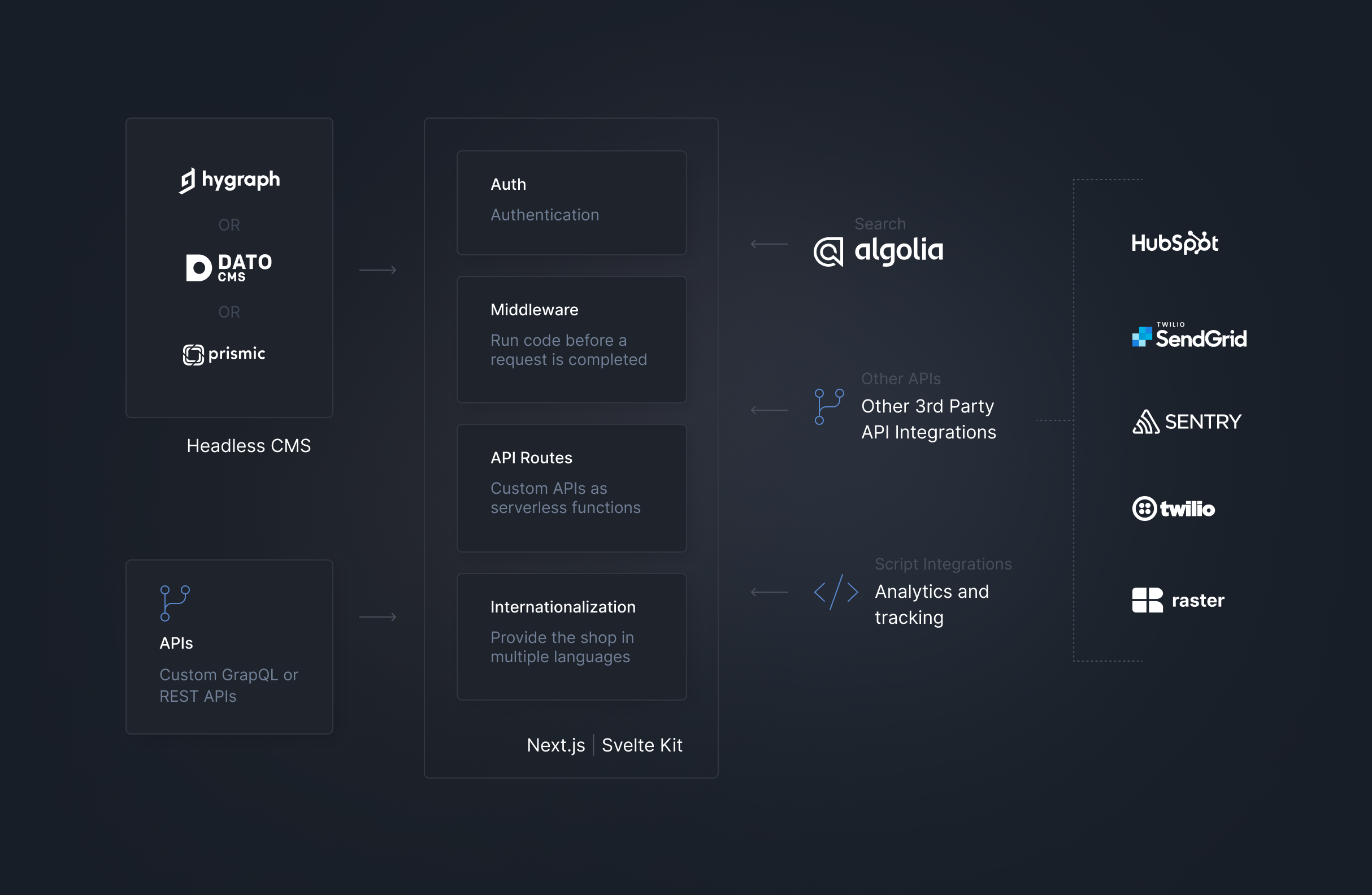
## Building Blocks of a Modern Website
### 01. Fast websites
Leverage modern and advanced technologies to create visionary, fast websites via page pre-render which results in better performance and better SEO. Pre-rendered pages makes the page fully interactive via hydration.
### 02. Composable Architecture
Composable architecture offers numerous advantages, such as plug-and-play, API-first, and independent development.
### 03. Headless CMS Backend
A site's content "backend" is based on a Headless CMS, such as Prismic, Data, Hygraph, etc. This allows us to create a superior content editing experience for our clients, including key features like previewing content while editing and reaching peak front-end performance.
### 04. Core Web Vitals
Our tools enable us to provide excellent Core Web Vitals scores* (a subset of Web Vitals and currently consists of three metrics that measure loading, interactivity, and visual stability).
### 05. Our Tools Make all the Difference
Frameworks like Next.js are on the cutting edge of optimizing user experiences. These tools provide us with a wide range of site generation schemes and customization options. Further, these tools offer hybrid static and server rendering, TypeScript support, smart bundling, and route pre-fetching.
### 06. Improved SEO Metrics
SEO is the key to increased conversion and confidence in your brand. Higher search ranking placement equates to more organic visitors. Monogram helps you improve your SEO by optimizing your website for crawling and web performance.
### Our Work Speaks for Itself
- [Checkly](/work/checkly.md) — Developer Tooling, Next.js, Prismic, Vercel, Tailwind CSS, GitHub, Basin, Node.js, React
- [Angular](/work/angular.md) — Developer Tooling, Angular, GitHub, Algolia, Firebase, WebGL
- [Vercel](/work/vercel.md) — Engineering, Next.js, Tailwind CSS, Vercel, Contentful, GitHub, Node.js, React
- [GitHub](/work/github.md) — Engineering, Next.js, Contentful, React, GitHub, Node.js
[View all projects](/work.md)
## Contact Us
[Build what comes next](https://monogram.io/#contact) | Email: [hello+llm@monogram.io](mailto:hello+llm@monogram.io)
Provide your contact details and claim a time to meet. We'll help you do the rest.
Monogram is an Applied AI Studio based in Atlanta that designs and deploys production AI systems — connecting models, data, workflows, and enterprise software to automate real work.
The contact form collects: name, email, company, estimated budget (USD), a project description, and how you heard about Monogram.
Not sure where to start? Tell us what you're trying to automate or build — we'll help you figure out where AI fits.
---
**More content:** [Home](/.md) | [About](/about.md) | [Blog](/blog.md) | [Work](/work.md) | [Engineering](/engineering.md)
Monogram helps companies, organizations, and firms adopt AI by designing and building proof of concepts (POCs), MVPs, intelligent workflows, and production-ready AI applications.
Website designed and developed by [Monogram](https://monogram.io)
---
---
title: "Modernize Your Website with Headless CMS Architecture"
url: https://monogram.io/modernize-your-website-with-headless-cms-architecture
---
# Modernize Your Website with Headless CMS Architecture
## Modernize Your Website with Headless CMS Architecture
Monogram helps companies migrate from legacy CMS platforms to modern composable architecture using Next.js, Vercel, Contentful, Sanity, Prismic, and other headless CMS platforms.
---
## Problems We Solve
- Slow website performance
- Difficult publishing workflows
- Rigid legacy CMS systems
- Poor Core Web Vitals
- SEO limitations
- Expensive maintenance
- Engineering bottlenecks
- Hard-to-scale infrastructure
## Platforms We Migrate From
- Wordpress
- Drupal
- Sitecore
- Webflow
## Our Approach
### 01. Discovery & Architecture
Audit current CMS, SEO, content models, and workflows to define the optimal frontend, hosting, and migration strategy.
### 02. Migration & Development
Migrate content, rebuild front-end templates, integrate core APIs, and optimize overall system performance.
### 03. QA & Launch
Validate SEO, redirects, and analytics to ensure total production readiness for a successful deployment.
## Technologies
- [Next.js](/technology/next-js.md)
- [Vercel](/technology/vercel.md) *(Client + Partner)*
- [Contentful](/technology/contentful.md) *(Partner)*
- [Sanity](/technology/sanity.md) *(Partner)*
- [Prismic](/technology/prismic.md) *(Partner)*
- [Payload](/technology/payload.md)
## Benefits
- Faster page speeds
- Better editor experience
- Improved SEO
- Flexible integrations
- AI-ready structured content
- Scalable composable architecture
## What Clients Gain
- Faster load times & better user experience
- Simplified publishing workflows
- More scalable infrastructure
- Improved Lighthouse scores
## Ready to modernize your CMS architecture?
Monogram helps companies migrate to faster, more flexible, AI-ready digital
experiences.
[Schedule a Discovery Call](#contact)
- [Orb](/work/orb.md) — SaaS, Fintech, Next.js, Tailwind CSS, Figma, Sanity, Vercel, Relume, Unicorn Studio, Node.js, React
- [BigCommerce](/work/bigcommerce.md) — SaaS, Next.js, Makeswift, Contentful, Vercel, Algolia, Tailwind CSS, Smartling, GitHub, Node.js, React
## Contact Us
[Build what comes next](https://monogram.io/#contact) | Email: [hello+llm@monogram.io](mailto:hello+llm@monogram.io)
Provide your contact details and claim a time to meet. We'll help you do the rest.
Monogram is an Applied AI Studio based in Atlanta that designs and deploys production AI systems — connecting models, data, workflows, and enterprise software to automate real work.
The contact form collects: name, email, company, estimated budget (USD), a project description, and how you heard about Monogram.
Not sure where to start? Tell us what you're trying to automate or build — we'll help you figure out where AI fits.
---
**More content:** [Home](/.md) | [About](/about.md) | [Blog](/blog.md) | [Work](/work.md) | [Engineering](/engineering.md)
Monogram helps companies, organizations, and firms adopt AI by designing and building proof of concepts (POCs), MVPs, intelligent workflows, and production-ready AI applications.
Website designed and developed by [Monogram](https://monogram.io)
---
---
title: "Enterprise Next.js + Vercel Development"
url: https://monogram.io/next-js-vercel-development
description: "Monogram helps teams design, build, migrate, and scale high-performance websites and web applications using Next.js, Vercel, and composable architecture."
---
# Next.js + Vercel Development
## Enterprise Next.js + Vercel Development
Monogram helps teams design, build, migrate, and scale high-performance websites and web applications using Next.js, Vercel, and composable architecture.
---
> Built for teams that need more than a marketing site
>
> We partner with growing companies and enterprise teams that need fast, flexible, scalable digital experiences. Whether you’re modernizing an existing platform, moving away from legacy CMS infrastructure, or building a new product experience, Monogram brings the strategy, design, and engineering expertise to get it done right.
## Key Services
### 01. Next.js Website Development
Custom websites and web apps built with modern frontend architecture.
### 02. Vercel Deployment + Optimization
Production-ready deployment, preview environments, performance tuning, and scalable hosting workflows.
### 03. CMS Integration
Contentful, Sanity, Prismic, Dato, Payload, Contentstack, and other headless CMS platforms.
### 04. Migration to Composable Architecture
Move from WordPress, Drupal, AEM, Sitecore, or legacy systems into a faster, more flexible stack.
### 05. Performance + Core Web Vitals
Improve speed, Lighthouse scores, SEO health, and user experience.
### 06. AI-Ready Web Experiences
Structure content and interfaces so your website is easier for search engines, LLMs, and AI agents to understand.
## Why Monogram
### We understand both design and engineering.
Your site should look great, perform well, be easy to manage, and scale with your business.
### We have deep composable experience.
We’ve worked across Next.js, Vercel, Sanity, Contentful, Firebase, Google Cloud, and modern API-driven systems.
### We build for real teams.
Editor experience, deployment workflow, QA, analytics, documentation, and maintainability are part of the work, not afterthoughts.
## Problems we solve
### 01. Slow website performance
We optimize your site's architecture and media to ensure rapid page load times and keep visitors engaged.
### 02. Poor Core Web Vitals
We resolve technical issues affecting Core Web Vitals to enhance user experience and boost search rankings.
### 03. Legacy CMS limitations
We migrate you from outdated CMS platforms to modern, headless architectures for greater flexibility and scale.
### 04. Hard-to-manage content
We implement intuitive platforms that empower your team to update content independently, speeding up publishing.
### 05. Fragile deployment process
We build robust CI/CD pipelines to ensure updates are released safely, frequently, and without breaking functionality.
### 06. Expensive engineering bottlenecks
We modernize your tech stack so developers and creators can work in parallel, drastically reducing ongoing costs.
### 07. Poor SEO structure
We rebuild your website’s foundation with semantic code to maximize organic visibility and search indexing.
### 08. Inconsistent design system
We create a unified component library to guarantee a cohesive user experience and accelerate future development.
### 10. Lack of AI/LLM readiness
We structure your data and APIs to be easily digestible by AI models, future-proofing your digital infrastructure.
### Projects built with Next.js + Vercel
- [Orb](/work/orb.md) — SaaS, Fintech, Next.js, Tailwind CSS, Figma, Sanity, Vercel, Relume, Unicorn Studio, Node.js, React
- [Contextual AI](/work/contextual-ai.md) — AI, Next.js, Vercel, Sanity, Tailwind CSS, Node.js, React
- [BigCommerce](/work/bigcommerce.md) — SaaS, Next.js, Makeswift, Contentful, Vercel, Algolia, Tailwind CSS, Smartling, GitHub, Node.js, React
- [Zenity](/work/zenity.md) — AI, Security, Next.js, Tailwind CSS, Sanity, Vercel, Raster, Hubspot, Node.js, React
- [IBM AI Alliance](/work/ai-alliance.md) — AI, Prismic, Next.js, Vercel, Three.js, WebGL, GitHub, Node.js, React
[Book a Discovery Call](#contact)
## Contact Us
[Build what comes next](https://monogram.io/#contact) | Email: [hello+llm@monogram.io](mailto:hello+llm@monogram.io)
Provide your contact details and claim a time to meet. We'll help you do the rest.
Monogram is an Applied AI Studio based in Atlanta that designs and deploys production AI systems — connecting models, data, workflows, and enterprise software to automate real work.
The contact form collects: name, email, company, estimated budget (USD), a project description, and how you heard about Monogram.
Not sure where to start? Tell us what you're trying to automate or build — we'll help you figure out where AI fits.
---
**More content:** [Home](/.md) | [About](/about.md) | [Blog](/blog.md) | [Work](/work.md) | [Engineering](/engineering.md)
Monogram helps companies, organizations, and firms adopt AI by designing and building proof of concepts (POCs), MVPs, intelligent workflows, and production-ready AI applications.
Website designed and developed by [Monogram](https://monogram.io)
---
---
title: "PERFORMANCE TESTING FOR MODULAR COMPONENTS"
url: https://monogram.io/performance-testing
description: "Ship high-performance and reliable software with 100% test coverage."
---
# Performance Testing
## PERFORMANCE TESTING FOR MODULAR COMPONENTS
---
### 01. TAILORED TESTING FOR MODULAR SYSTEMS
We focus on testing individual components as they are developed. By isolating each module, we accurately assess its performance in a controlled environment, using advanced tools to simulate various conditions and workloads. This targeted testing helps us verify that each component performs optimally both on its own and when integrated into the larger system.
### 02. OPTIMIZING MODULE INTEGRATION
Our testing covers key scenarios to identify and resolve bottlenecks, including typical usage and peak load conditions. We use real-time monitoring and detailed logging to capture and analyze data, providing actionable insights for optimization so your components perform efficiently in isolation and when integrated.
## Our Platform Expertise
- [GitHub](/technology/github.md) *(Client)*
- [GitLab](/technology/gitlab.md)
- [Circle CI](/technology/circleci.md)
- [Azure](/technology/azure.md)
- [Gatling](/technology/gatling.md)
- [K6](/technology/k6.md)
## ENGINEERING EXCELLENCE THROUGH AUTOMATION
Monogram uses containerization technologies like Docker to create isolated environments for testing consistency and repeatability. We also leverage Infrastructure as Code (IaC) tools like Terraform or Ansible to provision test environments on demand. This allows for precise performance measurements and consistent assessments without interference from other components.
### 01. SHIFT-LEFT PERFORMANCE TESTING
Monogram emphasizes early performance testing, integrating it into the development and build phases rather than waiting until deployment. This approach, known as "shift-left," helps identify and resolve performance issues early when fixes are more cost-effective and less disruptive.
### 02. INTEGRATION WITH CI/CD PIPELINES
Our DevOps approach integrates performance testing directly into your CI/CD pipelines. We use tools like GitHub Actions, Jenkins, GitLab CI, CircleCI, and Azure DevOps to automate performance tests whenever new code is committed or a build is triggered. This continuous testing provides immediate feedback on performance changes, helping to quickly identify and address any issues.
### 03. AUTOMATED TESTING AND ANALYSIS
We automate the testing process by integrating performance testing tools such as Apache JMeter, K6 and Gatling into the CI/CD pipeline, reducing manual effort and speeding up feedback loops. Automated scripts analyze test results and detect anomalies or regressions, quickly identifying and addressing performance issues.
### 04. SCALABLE TESTING AND LOAD SIMULATION
We design performance tests to simulate realistic load and stress conditions, ensuring your modular components can handle production demands. This includes varying user loads, peak usage simulations, and testing under potential failure conditions. When appropriate, we also conduct testing in production to capture real-world performance metrics, carefully balancing thorough testing with minimal impact on end-users.
## Contact Us
[Build what comes next](https://monogram.io/#contact) | Email: [hello+llm@monogram.io](mailto:hello+llm@monogram.io)
Provide your contact details and claim a time to meet. We'll help you do the rest.
Monogram is an Applied AI Studio based in Atlanta that designs and deploys production AI systems — connecting models, data, workflows, and enterprise software to automate real work.
The contact form collects: name, email, company, estimated budget (USD), a project description, and how you heard about Monogram.
Not sure where to start? Tell us what you're trying to automate or build — we'll help you figure out where AI fits.
---
**More content:** [Home](/.md) | [About](/about.md) | [Blog](/blog.md) | [Work](/work.md) | [Engineering](/engineering.md)
Monogram helps companies, organizations, and firms adopt AI by designing and building proof of concepts (POCs), MVPs, intelligent workflows, and production-ready AI applications.
Website designed and developed by [Monogram](https://monogram.io)
---
---
title: "How Monogram Prices Agentic AI Work"
url: https://monogram.io/pricing
description: "We do not publish rates. How agentic AI engagements get scoped and priced, what moves the number, and who we are the wrong studio for."
---
# Pricing
## The price comes out of the build plan
We do not publish rates. Scoping produces a build plan, and the number comes out of that. This page is the part that usually goes unsaid: what makes one agent cost several times what another one did.
---
Agentic AI does not have a shelf price. The same voice agent can be a small build at one company and a large one at another, and almost none of that gap is the model. It is the state of the systems the agent has to work through, and who has to approve it working. So we scope first and quote second.
The three phases behind the number, Strategize, Engineer, and Operate, are described on the [agentic AI service page](https://monogram.io/services/agentic-ai). A fixed scope, fixed price POC is available, and we quote it after scoping rather than before, because a fixed price against an unmapped stack is a guess wearing a number.
## What moves it
Six things move the number. Most of them are decided by your stack and your org chart, not by us.
### 01. How many systems the agent has to touch
Every integration is a cost line. Our booking agent searches live inventory, verifies identity through the client's own lookup, calls a payment API, and fires a confirmation email, all inside one phone call. Systems with clean APIs are quick. Systems that need a service layer written first are not, and that work lands before any agent work starts.
### 02. Whether your data is ready to be retrieved
Agents answer from your data, so that data has to be indexed and reachable at runtime. Retrieval through MCP covers the open ended case. The patterns an agent must never get wrong go straight into its instructions instead, because a confident model skips an optional tool call and invents the rest. Scattered or stale content gets cleaned up first.
### 03. Where it runs and who has to review it
Deployment happens inside infrastructure you already own, which is a solved question and is covered on the [agentic AI service page](https://monogram.io/services/agentic-ai). The schedule risk is elsewhere. Security review, compliance sign off, and procurement set the calendar, and those gates usually move slower than the engineering they are gating. Find out who signs before you budget.
### 04. How much evaluation and human review it needs
The cost here is set by what happens when the agent is unsure. Our booking agent transfers to a person after two unresolved turns, carrying the full conversation and the identified account, so nobody repeats themselves. Deciding that threshold, and building the [ops layer](https://monogram.io/engineering) that enforces it, is real budget rather than a switch.
### 05. Whether we are augmenting a team or building alone
Working alongside your engineers prices differently than owning the whole build, because a share of the work is transfer rather than construction. Whether your team is carrying part of the build changes both the number and the shape of the engagement, so it is worth settling before scoping.
### 06. What the system still needs after it launches
Launch is a phase, not the finish line. Our nine agent pipeline shipped, then went through four more rounds of performance engineering against real traffic: token cost per request fell 73%, evaluation cycles got about 70% faster, and API quota errors turned into the dominant failure mode at scale. Budget for the rounds after the first one.
> You are not buying access to a model. You are buying the engineering that makes one behave the same way on the thousandth call as it did on the first.
## Be honest early
Three situations where we are the wrong studio, and saying so costs us nothing.
### 01. You want a chat widget on a marketing site
We engineer agents that complete transactions and run workflows inside enterprise systems. A support widget on a brochure site is a real product, and it is not this one. Buying a custom engineering phase to get one will cost more than it returns, and we will tell you that.
### 02. Nothing the agent needs has an API yet
Agents act by calling systems. If the workflow lives in a desktop application, a shared inbox, and a spreadsheet with no service layer underneath, your first project is integration work rather than AI work. That is a legitimate project. It is just not the one you think you are buying.
### 03. Nobody will define what a good answer is
Evaluation needs a definition of correct. If no one in the organization will commit to what the agent should do in the ambiguous cases, there is nothing to score, nothing to catch drift against, and no honest way for us to tell you whether the build worked.
## The next step is a conversation,
not a checkout.
Bring the workflow you want automated, the systems it runs through, and the name of whoever has to approve it. Those three things are what turn this page into an actual number.
[Book a scoping call](#contact)
## Contact Us
[Build what comes next](https://monogram.io/#contact) | Email: [hello+llm@monogram.io](mailto:hello+llm@monogram.io)
Provide your contact details and claim a time to meet. We'll help you do the rest.
Monogram is an Applied AI Studio based in Atlanta that designs and deploys production AI systems — connecting models, data, workflows, and enterprise software to automate real work.
The contact form collects: name, email, company, estimated budget (USD), a project description, and how you heard about Monogram.
Not sure where to start? Tell us what you're trying to automate or build — we'll help you figure out where AI fits.
---
**More content:** [Home](/.md) | [About](/about.md) | [Blog](/blog.md) | [Work](/work.md) | [Engineering](/engineering.md)
Monogram helps companies, organizations, and firms adopt AI by designing and building proof of concepts (POCs), MVPs, intelligent workflows, and production-ready AI applications.
Website designed and developed by [Monogram](https://monogram.io)
---
---
title: "Product Design and Engineering"
url: https://monogram.io/product
description: "We build products with client teams: shaping, a first version in production, then iteration driven by what real users actually do with it."
---
# Product
## Ship the first version, then keep shipping
We build products for teams that think in roadmaps, not deliverables. Shape the smallest useful version, get it running in production, then let real usage decide what gets built next.
---
Most software gets sold as a project: a scope, a deliverable, a handoff. Products do not behave that way. They get shaped, shipped small, and then corrected by what users do with them. We run that loop alongside your team instead of handing you a finished thing and leaving.
## The loop
How a product engagement actually runs
### 01. Shape before you build
Discovery is where we decide what not to build. We map the workflow, name the one job the first version has to do, and cut everything else into the backlog. Most of the value in this phase is the scope we talk you out of.
### 02. Ship a version that runs
The first release runs in production with real data and the people who will use it. Scope stays small on purpose: one workflow, end to end. A ship date is a design constraint, so picking a stack that respects it is part of the work rather than a compromise made later.
### 03. Keep shipping after the launch
Version one is where the roadmap starts. PQ ESSA was already a working application when we came in, and the round we delivered was a Nuxt to Next.js migration, a redesigned authentication flow with SSO for some users, and dashboard views relaid out for usability.
## Product work
### Products we shaped, shipped, and kept shipping
- [Subcore Dashboard App](/work/subcore-dashboard-app.md) — AI, Engineering, Next.js, Supabase, TypeScript, Tailwind CSS, Gemini, Node.js, React
- [Real-Time Collaboration in a Cloud IDE](/work/real-time-collaboration-in-a-cloud-ide.md) — Developer Tooling, Engineering, SaaS, TypeScript, Node.js, Google, Firebase Hosting, Figma
- [CrewAI](/work/crew-ai.md) — AI, Developer Tooling, Next.js, Contentful, Vercel, GraphQL, TypeScript, Figma, Ghost CMS, HubSpot Marketing Forms API, Zod, OAuth 2.0, OpenAPI 3.1, Model Context Protocol, Node.js, React
- [PQ ESSA](/work/pq-essa.md) — Education, Vercel, Next.js, Clever, Tailwind CSS, Payload, Raster, Firebase, Node.js, React
## Inside a build
The decisions that separate a product from a deliverable.
### 01. Design and engineering in one group
Design and engineering sit in the same working group from day one. The entire Brightfold platform was designed in Figma, with component libraries establishing a scalable system, and Dev Mode carried specifications and measurements across the handoff. Components get built the way they were drawn.
### 02. A content model your team can operate
Someone other than an engineer has to be able to change the words. We model content as reusable blocks with types behind them. CrewAI's marketing team assembles pages from those blocks in Contentful and moves independently, while engineering keeps the rules for layout, analytics, and search.
### 03. Real time where it earns its cost
Live state earns its cost or it does not go in. Subcore's dashboard pushes new agent events and generated summaries to every connected client through Supabase Realtime, so operators see what is happening now rather than after a refresh. A layered provider architecture keeps those concerns separate.
### 04. People in the path when software should not decide
Escalation is a feature, not a fallback, and it costs real engineering. Getting a person into a live agent conversation on Subcore meant configuring each agent's backend, testing that connection, building endpoints to claim a session and hand it back, and rendering both speakers in one thread.
### 05. We change the architecture when it is wrong
On Google's cloud IDE we tried a VS Code extension with Yjs and it would not hold, because Yjs needs synchronous access to the document model and the extension API is asynchronous. That failed work is what let us recommend forking VS Code instead.
### 06. Cost and scale get profiled, not assumed
Every connection to a workspace spun up a full set of backend processes. Standard 8 GB VMs ran out of memory with a handful of users, and only 64 GB machines held about ten, which was far too expensive. We sat with Google's infrastructure team, profiled it, and brought the per-connection footprint down.
## Honest scoping
Not every engagement should be a product engagement
### 01. Buy a project when the end state is known
If you can write down what done looks like and it will not change while you build, a scoped project is cheaper and faster. Migrations, a redesign of a settled product, and integrations against a fixed contract all fit that shape. Do not pay for a roadmap you already have.
### 02. Product engagements need a decider
The loop only works when one person on your side can change their mind about scope in a week and make it stick. Without that person, iteration turns into a committee and you end up paying product prices for project economics. That is the worst of both.
### 03. Most product work continues on a retainer
A live roadmap usually means a monthly retainer, and that is the shape most product work takes once the first version ships. It is worth deciding deliberately rather than by default, because the answer changes how the engagement is scoped and what your own team needs to be ready for.
## Related Services
- [Engineering](/engineering.md)
- [Frontend](/frontend.md)
- [Backend](/backend.md)
- [Data & APIs](/data-and-apis.md)
## Show us the workflow, not the feature list.
Version one comes out of that.
Walk us through the job the product is supposed to do and who does it today. We will come back with what version one covers, what it deliberately leaves out, and what the two releases after it look like once people are using it.
[Work with us](#contact)
## Contact Us
[Build what comes next](https://monogram.io/#contact) | Email: [hello+llm@monogram.io](mailto:hello+llm@monogram.io)
Provide your contact details and claim a time to meet. We'll help you do the rest.
Monogram is an Applied AI Studio based in Atlanta that designs and deploys production AI systems — connecting models, data, workflows, and enterprise software to automate real work.
The contact form collects: name, email, company, estimated budget (USD), a project description, and how you heard about Monogram.
Not sure where to start? Tell us what you're trying to automate or build — we'll help you figure out where AI fits.
---
**More content:** [Home](/.md) | [About](/about.md) | [Blog](/blog.md) | [Work](/work.md) | [Engineering](/engineering.md)
Monogram helps companies, organizations, and firms adopt AI by designing and building proof of concepts (POCs), MVPs, intelligent workflows, and production-ready AI applications.
Website designed and developed by [Monogram](https://monogram.io)
---
---
title: "Service"
url: https://monogram.io/service
description: "Unmatched service delivery with you at the center of it. Monogram's processes make you better. See how we work."
---
# Service
## Next-Level Service
---
## Principles
- We make you look good
- Relationships are everything
- Do the impossible
- Projects of all sizes
- Dive in headfirst
- White-glove service
> You are our priority from Day 1. Anytime, anywhere, anyhow - we have your back. Our clients expect and get world-class market research, development, design, and consulting services.
## Partners
- [Vercel](/technology/vercel.md) *(Client + Partner)*
- [Contentful](/technology/contentful.md) *(Partner)*
- [Stripe](/technology/stripe.md) *(Partner)*
- [Algolia](/technology/algolia.md) *(Partner)*
- [Next.js](/technology/next-js.md)
- [Sanity](/technology/sanity.md) *(Partner)*
- [Shopify Plus](/technology/shopify.md) *(Partner)*
- [Prismic](/technology/prismic.md) *(Partner)*
- [DatoCMS](/technology/datocms.md) *(Partner)*
- [Raster](/technology/raster.md) *(Client)*
- [HyGraph](/technology/hygraph.md) *(Partner)*
- [imgix](/technology/imgix.md) *(Partner)*
- [Builder.io](/technology/builder-io.md) *(Partner)*
- [Plasmic](/technology/plasmic.md) *(Partner)*
## What our clients say about us
### 01
Delightful design, exceptional engineering. Monogram’s way of collaborating took our project beyond our hopes. They have a deep understanding of the Web platform and it shows. I will hire them again and again and again!
**Hank Taylor · VP of Marketing & RevOps at Vercel**
### 02
Working with the Monogram team has felt like a true partnership and more collaborative than I've felt with other agencies. Thank you to Monogram for living up to and beyond our expectations.
**Charlie Wettlaufer · President & CMO at GoodNature**
### 03
Monogram is a true partner for Lightcast. They hit our aggressive deadlines and the site is outperforming our expectations. We're extremely grateful to have found them.
**Dave Reinke · VP of Marketing at Lightcast**
### 04
Monogram's deep understanding of Checkly led to an elevated, scalable design, capturing our mission. Not only is it aesthetically pleasing, but robust - boosting website speed, performance, and user experience. The positive feedback received affirms Monogram's ability to deliver transformative, enduring brand experiences.
**Cinthia Portugal · CMO at Checkly**
### 05
Thanks for helping us accomplish the impossible – not once, not twice, but three times. Team Monogram rocks!
**Brandon Garcia · VP of Product at Birchbox**
### 06
Monogram built a Gold and Silver Stevie®/2022 American Business Award winning website that has immensely enhanced our customers’ and health system partners’ experience. They are a valued partner.
**Paula Blomquist · CMO at GoHealth Urgent Care**
## Contact Us
[Build what comes next](https://monogram.io/#contact) | Email: [hello+llm@monogram.io](mailto:hello+llm@monogram.io)
Provide your contact details and claim a time to meet. We'll help you do the rest.
Monogram is an Applied AI Studio based in Atlanta that designs and deploys production AI systems — connecting models, data, workflows, and enterprise software to automate real work.
The contact form collects: name, email, company, estimated budget (USD), a project description, and how you heard about Monogram.
Not sure where to start? Tell us what you're trying to automate or build — we'll help you figure out where AI fits.
---
**More content:** [Home](/.md) | [About](/about.md) | [Blog](/blog.md) | [Work](/work.md) | [Engineering](/engineering.md)
Monogram helps companies, organizations, and firms adopt AI by designing and building proof of concepts (POCs), MVPs, intelligent workflows, and production-ready AI applications.
Website designed and developed by [Monogram](https://monogram.io)
---
---
title: "AI Engineering, Design and Web Services"
url: https://monogram.io/services
description: "Monogram is an Applied AI Studio in Atlanta. We engineer agentic AI systems, design the interfaces around them, and build the composable stack underneath."
---
# Services
## An engineering studio for production AI
Monogram is an Applied AI Studio in Atlanta. We engineer agentic AI systems that ship into your own cloud accounts, we design the interfaces people use to work with them, and we build the composable stack underneath. Engineers first.
---
We do three things. We engineer agentic AI systems that survive contact with production. We design the products and interfaces around them. We build and maintain the composable web platforms underneath. Anything outside that, we will tell you who to call.
This page is the map. If you want proof before the map, [a nine agent pipeline we built serves 800 to 1,000 daily users in production](https://monogram.io/work/multi-agent-ai-solution-generator-for-a-developer-platform).
AI work runs in three phases: strategize, engineer, operate. A monthly retainer is available once a system is live, and handing the codebase back to your own team is a fine ending too. [The agentic AI page walks through each phase](https://monogram.io/services/agentic-ai).
## What we do
Three practices, one team, in that order of weight.
### 01. Agentic AI that runs in your cloud
Voice agents, multi-agent pipelines, knowledge agents over your own data, internal copilots. Built on AWS Bedrock or GCP Vertex AI and deployed into the account you already run. This is where most of our engineering hours go.
[Agentic AI](/services/agentic-ai)
### 02. Design for systems people actually use
Creative direction, UI and UX, user journeys, brand identity, motion. An interface for an autonomous system has one hard job: make it legible what the thing did, what it is about to do, and where a person takes the wheel.
[Design](/design.md)
### 03. The composable stack underneath
Frontend, backend, data and APIs, commerce, headless CMS. We have shipped this stack since 2017 for Google, GitHub, IBM, Vercel, and Stanford. An agent is only as good as the systems it reads from and writes to.
[Engineering](/engineering.md)
## Which shape is yours
### 01. Voice agents and IVR replacement
A caller talks instead of pressing 1, and the transaction finishes on the call: [see one running inside Amazon Connect](https://monogram.io/work/conversational-ai-booking-agent).
### 02. Multi-agent orchestration
Narrow agents with one job each, with plain code checking the steps where the answer has to be exact rather than plausible: [read the nine agent pipeline](https://monogram.io/work/multi-agent-ai-solution-generator-for-a-developer-platform).
### 03. MCP and RAG knowledge agents
Answers drawn from your knowledge bases and live APIs over MCP, with a record of which context produced each one: [the architecture is on the agentic AI page](https://monogram.io/services/agentic-ai).
### 04. Internal copilots and workflow automation
The expert work that quietly eats a week, handed to an agent that passes the risky calls back to a person: [the ops layer that keeps it honest is on the engineering page](https://monogram.io/engineering).
## Honest
What we do not do.
### 01. We are not a full-service marketing agency
No media buying, no paid search, no PR, no ongoing content production. We are an engineering studio that also designs. If the problem is demand generation rather than a system that needs building, we are the wrong call.
### 02. Not every workflow needs an agent
When a process is deterministic and fully specified, code is cheaper, faster, and easier to audit than a model. Plenty of what gets pitched as an agent is a scheduled script with better marketing, and we would rather say so before you spend the budget.
### 03. We do not resell infrastructure
You hold your own cloud and model provider accounts, and the systems run inside them. We pick the cloud, model, and framework that fit your workload and your data requirements rather than the ones we happen to prefer.
### Go deeper
Where to read next
- [Agentic AI](/services/agentic-ai)
- [Engineering](/engineering.md)
- [Design](/design.md)
- [AI](/ai.md)
- [Technology](/technology)
- [Work](/work.md)
## Start with the problem, not the service.
If you already know what needs building, the pages above go deep on it. If you do not, describe the problem in a sentence or two and we will tell you which of the three practices it belongs to, or that it belongs somewhere else entirely.
[Describe the problem](#contact)
## Contact Us
[Build what comes next](https://monogram.io/#contact) | Email: [hello+llm@monogram.io](mailto:hello+llm@monogram.io)
Provide your contact details and claim a time to meet. We'll help you do the rest.
Monogram is an Applied AI Studio based in Atlanta that designs and deploys production AI systems — connecting models, data, workflows, and enterprise software to automate real work.
The contact form collects: name, email, company, estimated budget (USD), a project description, and how you heard about Monogram.
Not sure where to start? Tell us what you're trying to automate or build — we'll help you figure out where AI fits.
---
**More content:** [Home](/.md) | [About](/about.md) | [Blog](/blog.md) | [Work](/work.md) | [Engineering](/engineering.md)
Monogram helps companies, organizations, and firms adopt AI by designing and building proof of concepts (POCs), MVPs, intelligent workflows, and production-ready AI applications.
Website designed and developed by [Monogram](https://monogram.io)
# Subcore Dashboard App
**Scope:** uiUxDesign, frontEndDevelopment, backEndDevelopment, apiIntegration, webAppDevelopment
---
As AI agents move from demos into production, many teams that build and operate them can face a new problem: visibility. When an agent fails in the middle of a conversation, escalates to a human, or produces the wrong answer, we can’t identify why or even if that happened at all. Subcore was built to solve this. We designed and built the full-stack observability platform, giving AI teams a real-time window into every conversation, tool call, and decision the agents make.
## Technologies
Next.js, Supabase, TypeScript, Tailwind CSS, Gemini, Node.js, React
## Sectors
AI, Engineering
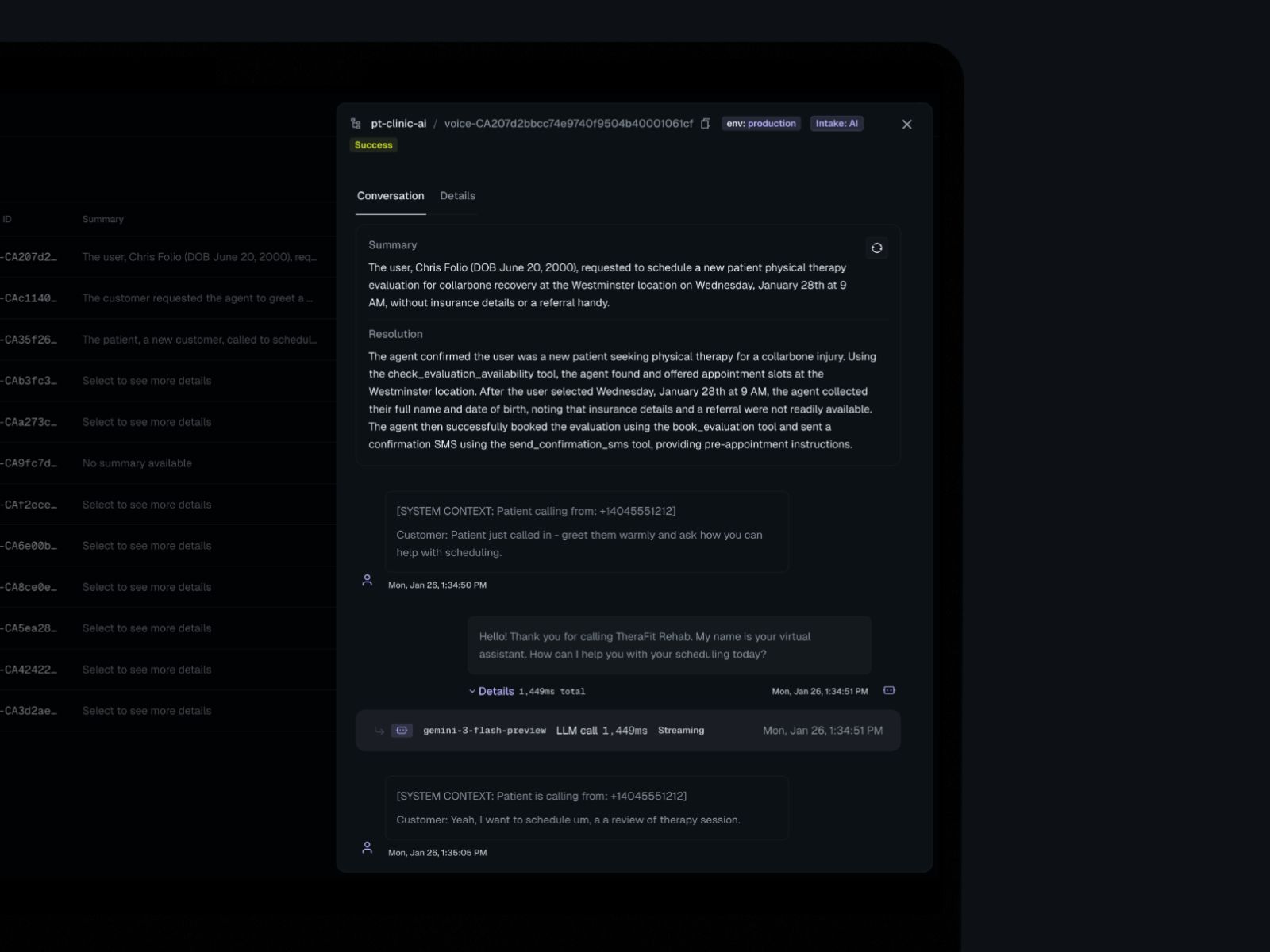
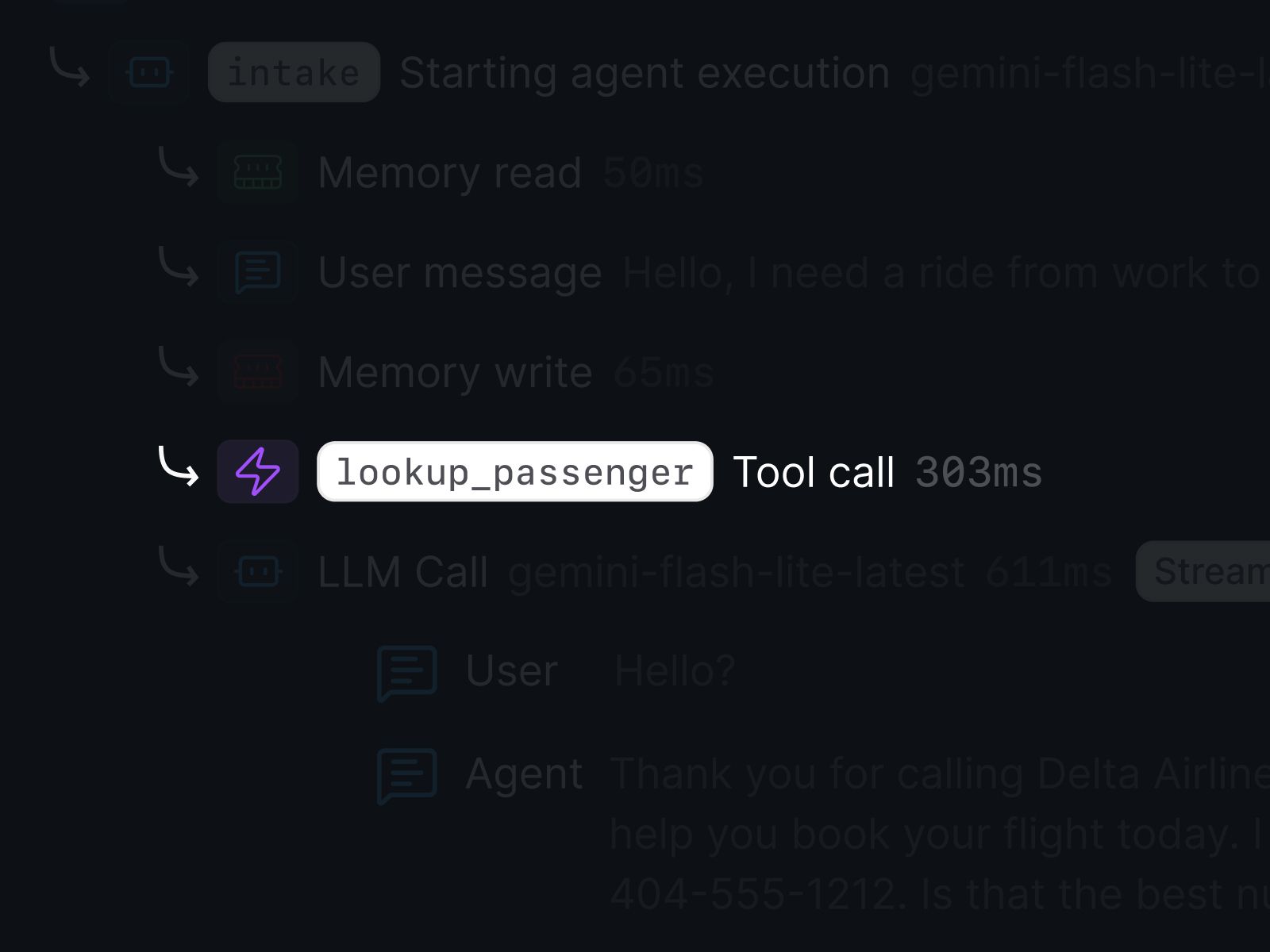
## A New Class of Infrastructure
AI agents don’t behave like traditional software, a conversation can involve dozens of events, like agent starting, an LLM call returning, a tool executing, a memory write, a human escalation, etc, all arriving in different ways. Subcore was designed around this reality from day one, building a purpose-designed event model covering the full agent lifecycle, storing and grouping every agent into sessions, and giving operators a coherent view of each conversation from start to finish.
## Turning Raw Events into Actionable Intelligence
Logs tell you what happened and Subcore tells what it meant, with Google Gemini via the Vercel AI SDK to automatically generate summaries of every session with a concise request description, a resolution narrative and a readable status. The summaries are generated server-side with strict schemas, ensuring consistent, type-safe output that flows seamlessly into the dashboard and analytics. Teams can now review thousands of conversations at a glance, identify failure patterns and improve the events that caused them, without reading raw logs.
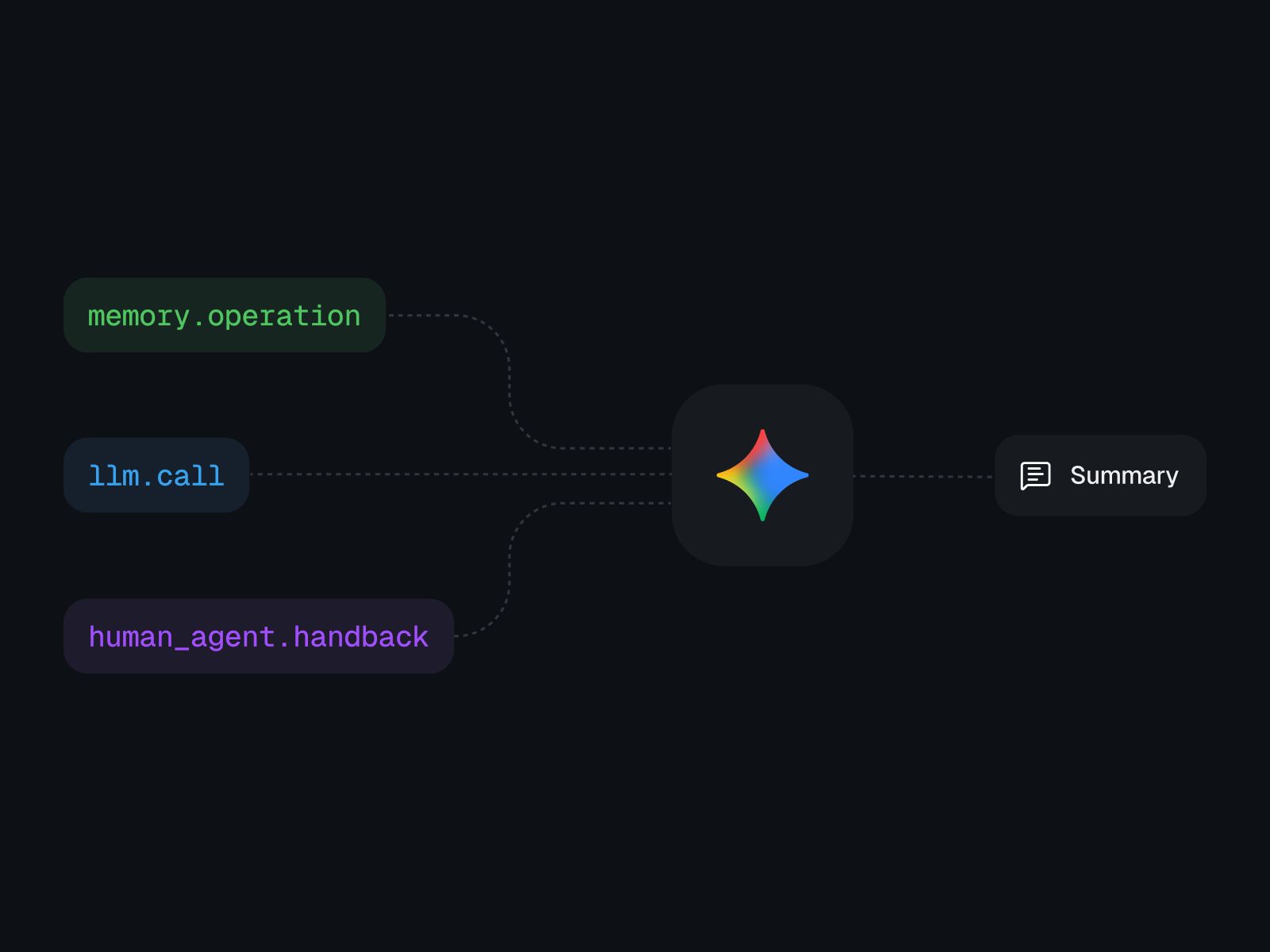
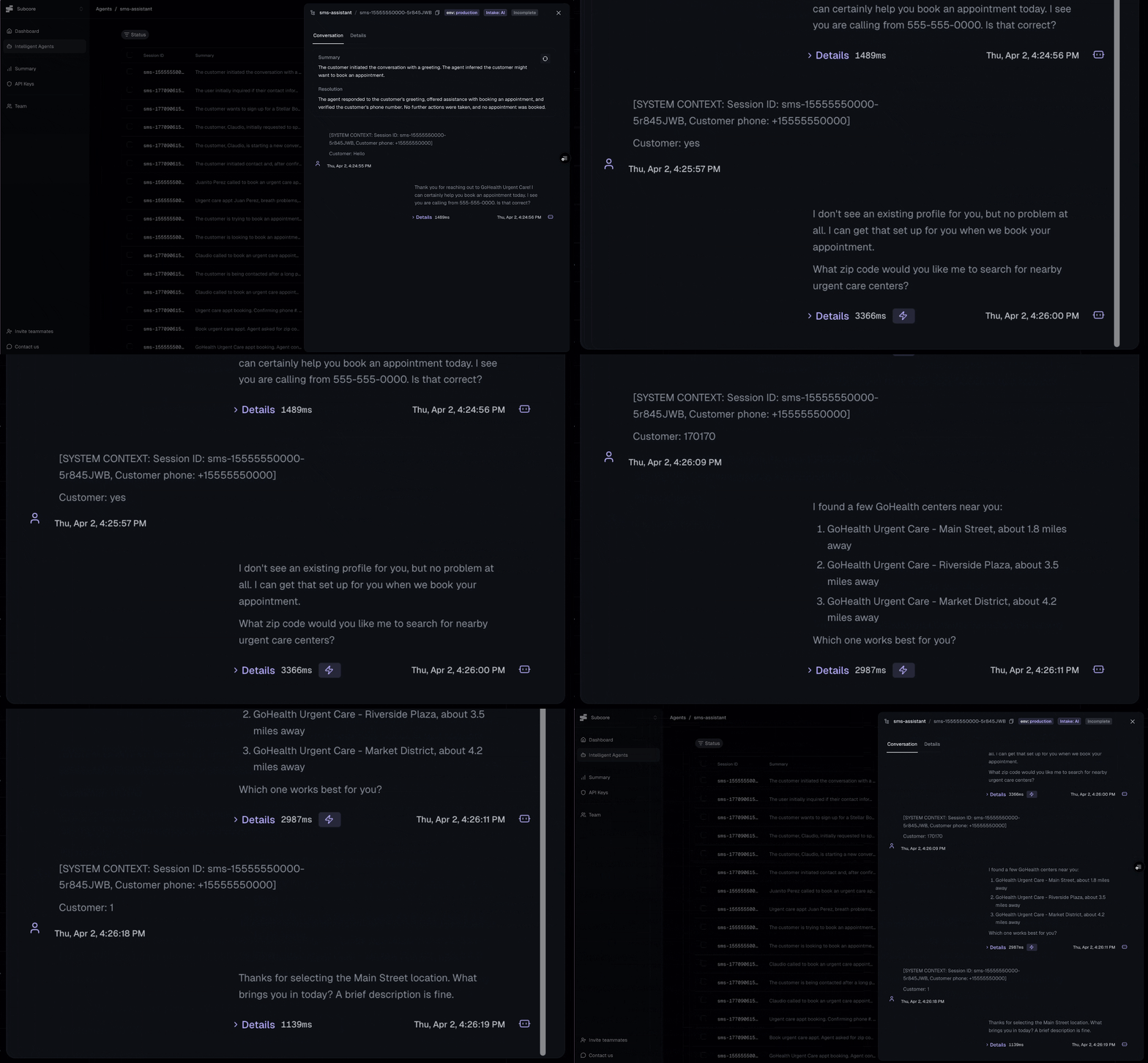
## Real-Time At Once
The people monitoring the events need to know what’s happening now, not after a page refresh. Subcore uses Supabase Realtime to push live updates to the dashboard the exact moment new events arrive or summaries are generated. We built a layered provider architecture, that separates concerns while delivering a seamless live experience. The result is that all the data updates in place without a full reload to every connected client.
## Human-in-the-Loop
One of the most distinctive capabilities is support for human-agent handoffs. When an AI agent finds a conversation needing human attention, it fires an escalation requested event, where a human operator can claim the session, exchange messages and have control back to the agent. With the full HITL workflow: custom per-agent backend configuration, a connection-test API, claim and handback endpoints, and a conversation view that shows human and AI turns in a single thread.

## Analytics
Subcore shows a picture of: total conversation volume, average session length, escalation rates, peak hours, and category-level breakdowns. The analytics, built and powered by Supabase RPCs, gives teams the data they need to understand their agents performance over time, spot regressions after deployments, and make clear and confident decisions about where to improve.
## Final Results
Subcore transformed the reality of running AI agents in production into a clear, actionable dashboard. Teams using it can trace any conversation to its root cause in seconds, understand aggregate behavior at a glance, and use human help if necessary, all in real time. We delivered a platform that helps to monitor AI systems in the way they actually work, giving teams the visibility they need to make decisions in time and trust their systems more.
---
**View Project:** [Subcore Dashboard App](https://app.subcore.ai/)
## Contact Us
[Build what comes next](https://monogram.io/#contact) | Email: [hello+llm@monogram.io](mailto:hello+llm@monogram.io)
Provide your contact details and claim a time to meet. We'll help you do the rest.
Monogram is an Applied AI Studio based in Atlanta that designs and deploys production AI systems — connecting models, data, workflows, and enterprise software to automate real work.
The contact form collects: name, email, company, estimated budget (USD), a project description, and how you heard about Monogram.
Not sure where to start? Tell us what you're trying to automate or build — we'll help you figure out where AI fits.
---
**More content:** [Home](/.md) | [About](/about.md) | [Blog](/blog.md) | [Engineering](/engineering.md)
Monogram helps companies, organizations, and firms adopt AI by designing and building proof of concepts (POCs), MVPs, intelligent workflows, and production-ready AI applications.
Website designed and developed by [Monogram](https://monogram.io)
---
# Fireworks AI
**Client:** Fireworks AI
**Scope:** uiUxDesign
---
Fireworks AI partnered with Monogram to research, iterate on, and design a fresh new brand identity. Monogram designed a fresh, serious yet lively brand identity that propelled Fireworks upmarket well into their target audience.
## Technologies
Figma, Raster
## Sectors
AI


## Day and night
Like many startups, Fireworks started with an agile methodology, growing and evolving insanely fast. Before they knew it, the company brand no longer reflected the values of innovation and thought leadership. Monogram evolved the brand from rooted in the early past into a brand that will propel Fireworks years into the future.
## Raster system
Monogram established a coherent and flexible grid system that marks a foundation for all aspects of graphical elements to be placed in and around the new logo mark. This enables easy modification for future logo needs and collaboration opportunities with partner logos and edge cases.


## Web foundation
As a part of the branding kit deliverable, Monogram also designed website examples and elements such as buttons, typography lockups, and background textures. This enabled the Fireworks AI engineering team to easily build and scale their marketing operations with very little additional design.

## "Akihabara Arcade"
The new Fireworks AI brand was designed to be inherently dark, to align with the developer and technical nature of the product. However, Fireworks AI is a beacon of knowledge in the industry, so a vibrant Purple was sourced from the Akihabara Electric Town (秋葉原) of Tokyo, Japan and chosen as the official "Fireworks Purple" for its vibrant and electric standout energy, much like the glow of the arcade-lit rainy Tokyo night.


## Standout Marketing
Fireworks needed to establish a strong social media presence for social outreach and advertising purposes, so Monogram designed a robust and powerful system of Figma templates and grids using the new cohesive brand guidelines to make it easy for the Fireworks AI marketing team to produce high quality digital and print ads.

## 'AI'SCII Artwork
Every brand needs creative uses of patterns and backgrounds for visual flarir and to reinforce the brand. For Fireworks, Monogram designed ASCII-like art made up of tiny pieces of the new Fireworks logo. Rotating the vectors of the arrows helps establish directionality and can also be animated in color and direction to create a 3D effect.

---
**View Project:** [Fireworks AI](https://fireworks.ai)
## Contact Us
[Build what comes next](https://monogram.io/#contact) | Email: [hello+llm@monogram.io](mailto:hello+llm@monogram.io)
Provide your contact details and claim a time to meet. We'll help you do the rest.
Monogram is an Applied AI Studio based in Atlanta that designs and deploys production AI systems — connecting models, data, workflows, and enterprise software to automate real work.
The contact form collects: name, email, company, estimated budget (USD), a project description, and how you heard about Monogram.
Not sure where to start? Tell us what you're trying to automate or build — we'll help you figure out where AI fits.
---
**More content:** [Home](/.md) | [About](/about.md) | [Blog](/blog.md) | [Engineering](/engineering.md)
Monogram helps companies, organizations, and firms adopt AI by designing and building proof of concepts (POCs), MVPs, intelligent workflows, and production-ready AI applications.
Website designed and developed by [Monogram](https://monogram.io)
---
# Vercel AI Accelerator
**Scope:** uiUxDesign, development
---
## Technologies
GitHub
## Sectors
AI
---
**View Project:** [Vercel AI Accelerator](https://vercel.com/ai-accelerator)
## Contact Us
[Build what comes next](https://monogram.io/#contact) | Email: [hello+llm@monogram.io](mailto:hello+llm@monogram.io)
Provide your contact details and claim a time to meet. We'll help you do the rest.
Monogram is an Applied AI Studio based in Atlanta that designs and deploys production AI systems — connecting models, data, workflows, and enterprise software to automate real work.
The contact form collects: name, email, company, estimated budget (USD), a project description, and how you heard about Monogram.
Not sure where to start? Tell us what you're trying to automate or build — we'll help you figure out where AI fits.
---
**More content:** [Home](/.md) | [About](/about.md) | [Blog](/blog.md) | [Engineering](/engineering.md)
Monogram helps companies, organizations, and firms adopt AI by designing and building proof of concepts (POCs), MVPs, intelligent workflows, and production-ready AI applications.
Website designed and developed by [Monogram](https://monogram.io)
---
# Quicknode Builder’s Guide
**Client:** Quicknode
**Scope:** uiUxDesign, backEndDevelopment, apiIntegration
---
Quicknode partnered with Monogram to transform their Builder’s Guide into an AI-powered discovery platform. Using LangGraph and GPT-4o, the system automatically generates rich, structured profiles for thousands of Web3 tools and publishes them directly to Contentful CMS.
## Technologies
Cloudflare Workers, LangGraph, LangChain, OpenAI, Contentful, Tavily Search API, TypeScript, D1 Database, Figma
## Sectors
Web3, AI, AI Agents, Developer Tooling
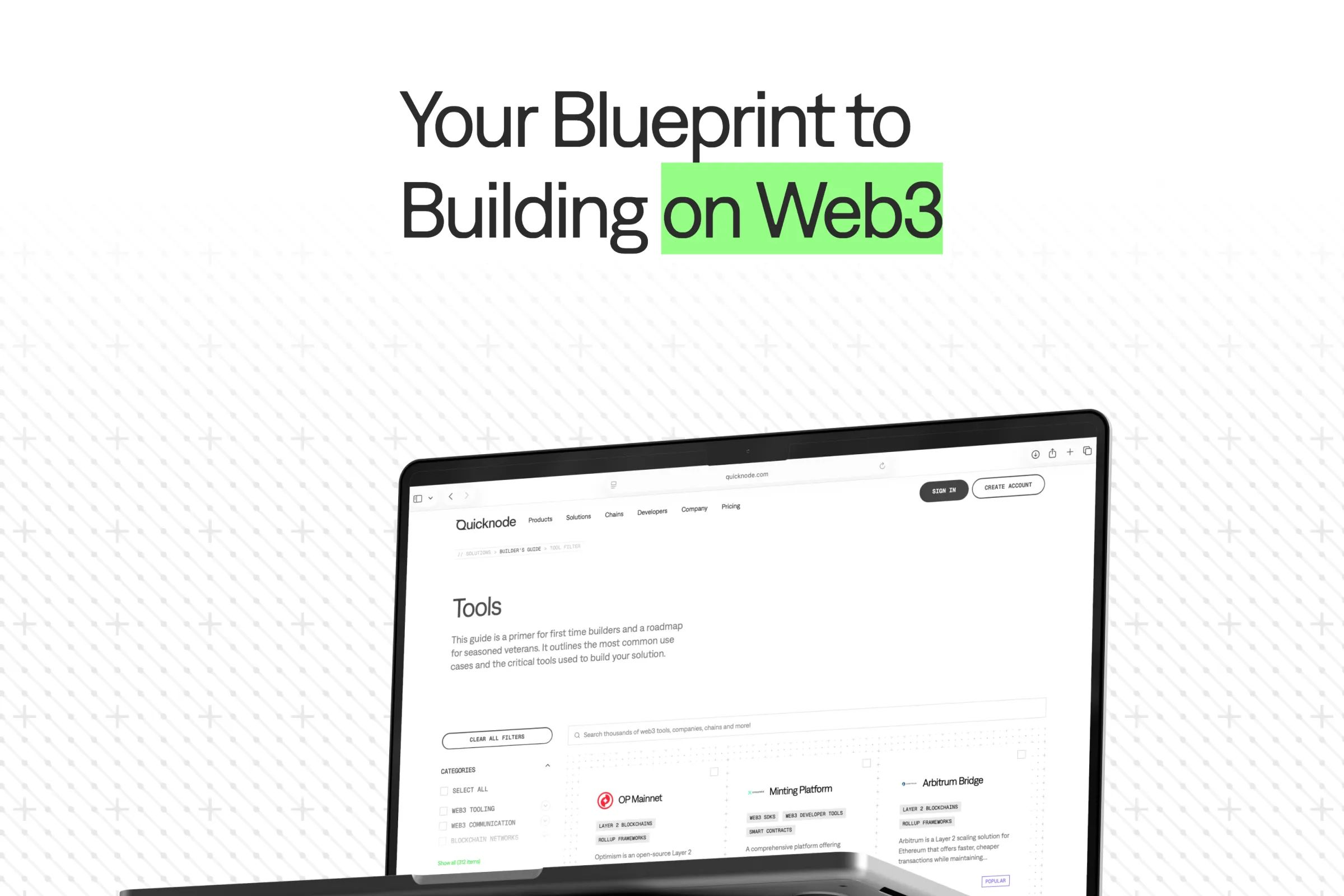
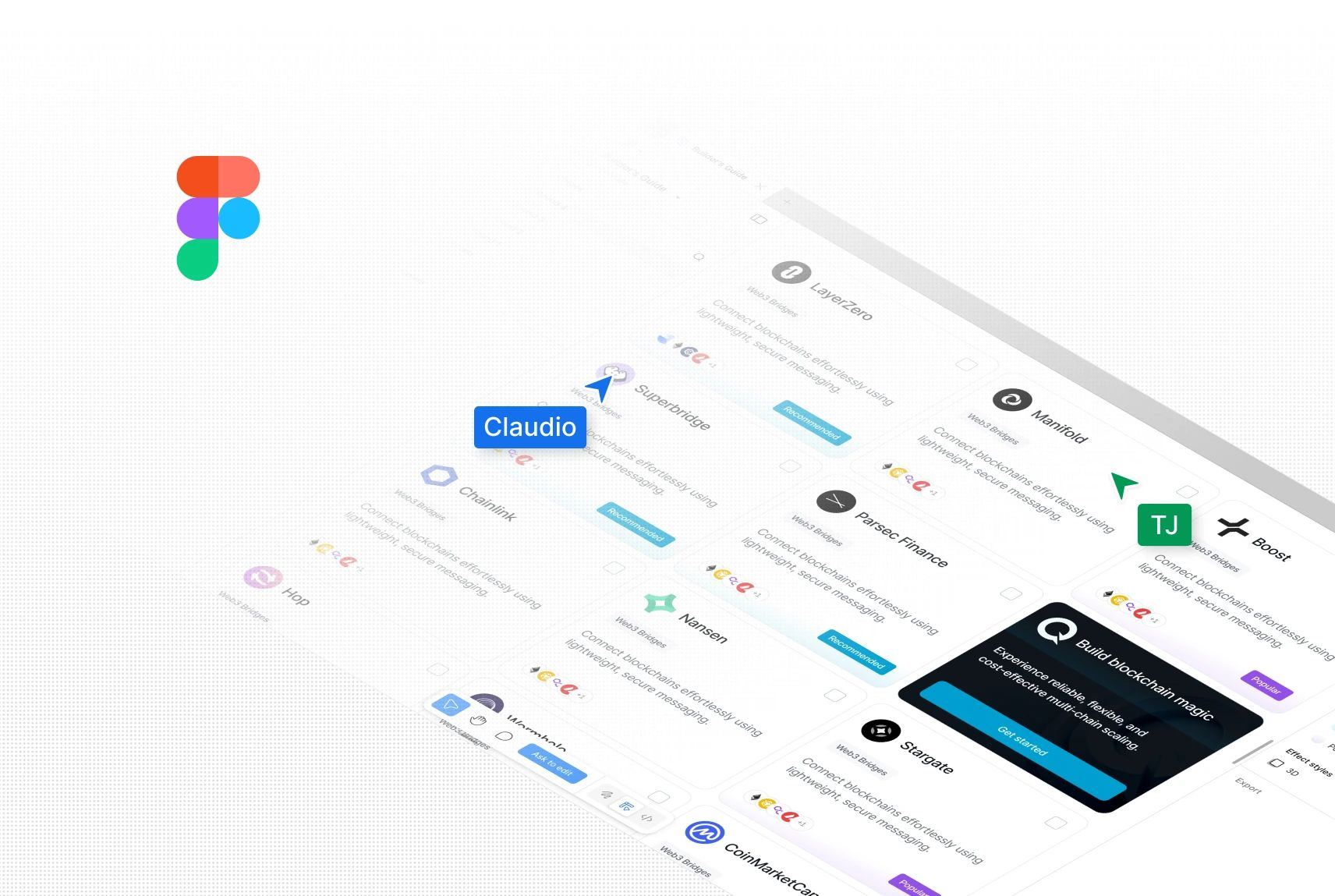
## Designed in Figma
The Builder’s Guide interface was designed in Figma, establishing a comprehensive design system for the tool discovery platform. The process focused on neatly displaying complex web3 tool information, including pricing tables, feature comparisons, and category hierarchies. Interactive prototypes validated user flows for discovering and comparing tools, while Figma Dev Mode ensured precise handoff for the frontend implementation in a separate Next.js project.
## AI-Powered Discovery Pipeline
A 5-node LangGraph workflow orchestrates the content generation process, first utilizing the Tavily API for intelligent search, extracting websites, documentation, and social links for each tool. GPT-4o powers summary generation, creating comprehensive profiles with SEO-optimized descriptions, pricing tiers, and use cases. A category validation node uses AI reasoning against Contentful definitions for accurate categorization, while the final layer scores content quality before publishing.
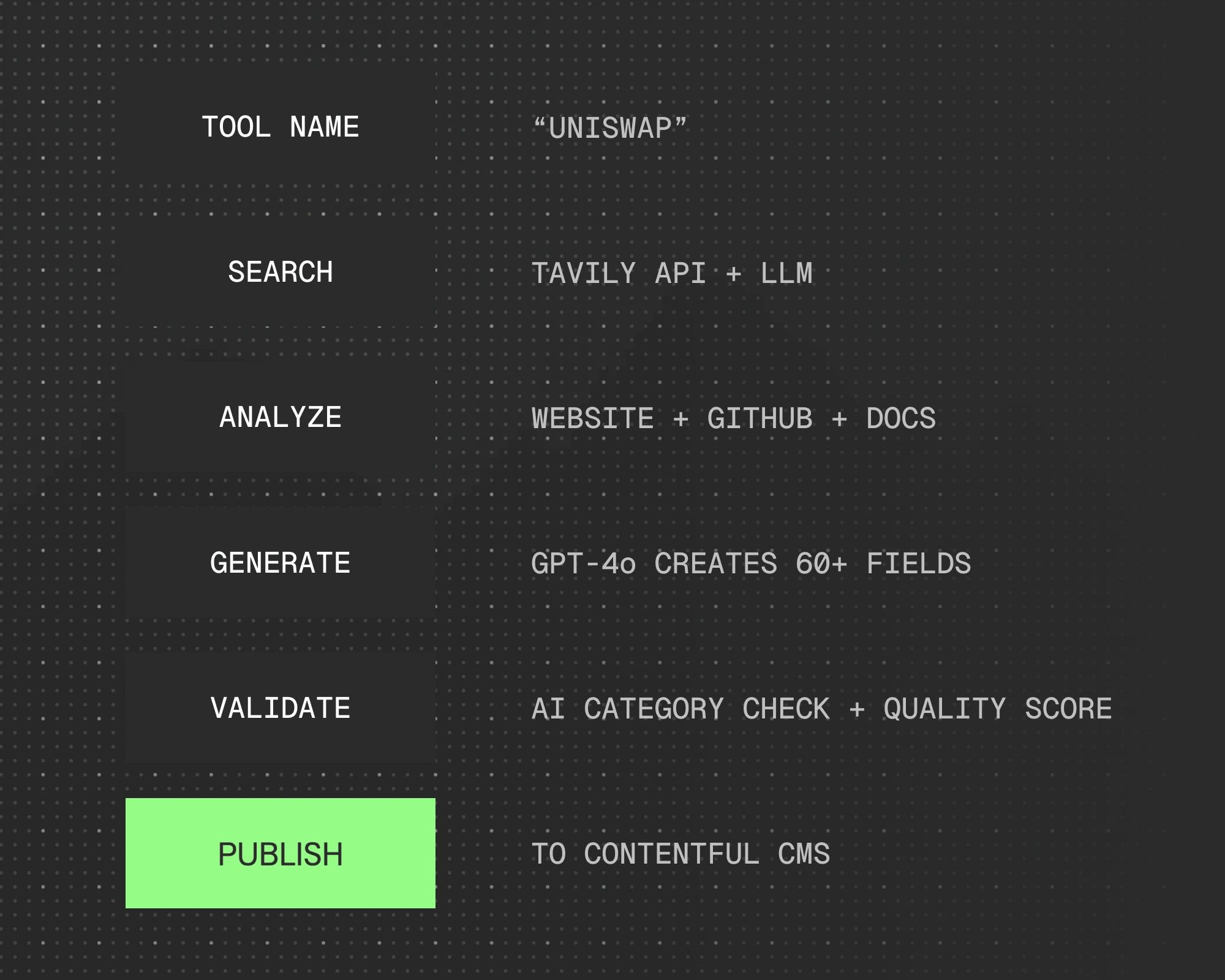

## The Reasoning Layer
The pipeline ingests fragmented data from sources like DappRadar, leveraging AI reasoning to populate over 60 structured fields per entry. This transformation turns raw technical metadata into a cohesive, searchable directory that bridges the gap between complex tools and developer needs.
## Serverless at Scale
The platform employs a coordinator-worker architecture on Cloudflare Workers using D1 for persistent storage. The Contentful Management API handles all entry creation and asset linking, converting AI-generated insights into production-ready content at scale.
## The Impact
Quicknode's Builder’s Guide started with 700 manually curated tools and can now potentially scale to over 5,000 profiles, a 7x increase in directory depth through automation. What previously required hours of manual research is now generated in minutes, significantly boosting SEO performance and establishing Quicknode as the definitive resource for web3 developers.
---
**View Project:** [Quicknode Builder’s Guide](https://www.quicknode.com/builders-guide)
## Contact Us
[Build what comes next](https://monogram.io/#contact) | Email: [hello+llm@monogram.io](mailto:hello+llm@monogram.io)
Provide your contact details and claim a time to meet. We'll help you do the rest.
Monogram is an Applied AI Studio based in Atlanta that designs and deploys production AI systems — connecting models, data, workflows, and enterprise software to automate real work.
The contact form collects: name, email, company, estimated budget (USD), a project description, and how you heard about Monogram.
Not sure where to start? Tell us what you're trying to automate or build — we'll help you figure out where AI fits.
---
**More content:** [Home](/.md) | [About](/about.md) | [Blog](/blog.md) | [Engineering](/engineering.md)
Monogram helps companies, organizations, and firms adopt AI by designing and building proof of concepts (POCs), MVPs, intelligent workflows, and production-ready AI applications.
Website designed and developed by [Monogram](https://monogram.io)
---
# Goss RV
**Client:** GossRV
**Scope:** marketResearch, uiUxDesign, development, apiIntegration
---
GossRV delivers unforgettable experiences in luxury resorts on wheels. The company saw a 346% increase in luxury motorcoach rental requests during 2020-21 as vacation-goers sought alternative means of travel during the COVID-19 Pandemic.
As client traffic increased, it became clear to the GossRV team that their website and brand presence were no longer representative of the company’s goals.
As part of their second phase, GossRV wanted to provide its travelers a more connected and personalized experience during their trips.
## Technologies
DatoCMS, Next.js, Tailwind CSS, Next.js, Hubspot, GitHub, GraphQL, React, Node.js
## Sectors
Luxury Travel


## Roads Not Travelled
As their needs increased, it became clear to the GossRV team that their website needed an upgrade. Website speeds were slow, and and the site’s art direction was not in line with GossRV’s desired high-end aesthetic. Monogram built a custom web experience, updating brand visuals and utilizing the latest technologies.

## Moving forward
Monogram constructed GossRV’s website with a custom design system within a CMS to allow for easy site management without the need for a web design intermediary. This will save the GossRV team time, money, and headaches as the company continues to grow.
The reception of the site was extremely strong amongst GossRV’s clientele, and the company has experienced a notable increase in inquiries and bookings since the launch.


## Personalized and luxury digital experience
GossRV customers are able to access the details of their trip, mainly from mobile devices, including information about all the travelers, driver, and the motorcoach. Probably the most relevant section is the trip itinerary where the GossRV team is able to add stops, dates, photos, files and even parks or events tickets to each stop, keeping a constant and good communication with their customers.
## Advanced custom solutions
GossRV already had an important user base in Hubspot and the team is already familiarized with the flow offered in Hubspot to manage customers, drivers, trips and everything related to the business logic. The ideal solution was that the new app is well integrated into their current processes.
Starting with a mobile-first approach, the app’s architecture contains three main components: Next.js, Hubspot and Firebase. All the main business related data comes from Hubspot, Firebase provides the authentication, database and storage modules and Next.js provides a fast UI. There are also use cases where we retrieve data from Dato CMS which is the main data source for the website.


## Keeping things simple
Many parts of the web app have been automated, allowing the GossRV team to provide a luxury service while making the internal experience simple and hands off. The automation happens thanks to the use of the Hubspot workflows and the capabilities of their API along with the Next.js API routes.

---
**View Project:** [Goss RV](https://gossrv.com)
## Contact Us
[Build what comes next](https://monogram.io/#contact) | Email: [hello+llm@monogram.io](mailto:hello+llm@monogram.io)
Provide your contact details and claim a time to meet. We'll help you do the rest.
Monogram is an Applied AI Studio based in Atlanta that designs and deploys production AI systems — connecting models, data, workflows, and enterprise software to automate real work.
The contact form collects: name, email, company, estimated budget (USD), a project description, and how you heard about Monogram.
Not sure where to start? Tell us what you're trying to automate or build — we'll help you figure out where AI fits.
---
**More content:** [Home](/.md) | [About](/about.md) | [Blog](/blog.md) | [Engineering](/engineering.md)
Monogram helps companies, organizations, and firms adopt AI by designing and building proof of concepts (POCs), MVPs, intelligent workflows, and production-ready AI applications.
Website designed and developed by [Monogram](https://monogram.io)
---
# Raster
---
## Technologies
GitHub, Basin
## Sectors
AI
---
**View Project:** [Raster](https://raster.app/)
## Contact Us
[Build what comes next](https://monogram.io/#contact) | Email: [hello+llm@monogram.io](mailto:hello+llm@monogram.io)
Provide your contact details and claim a time to meet. We'll help you do the rest.
Monogram is an Applied AI Studio based in Atlanta that designs and deploys production AI systems — connecting models, data, workflows, and enterprise software to automate real work.
The contact form collects: name, email, company, estimated budget (USD), a project description, and how you heard about Monogram.
Not sure where to start? Tell us what you're trying to automate or build — we'll help you figure out where AI fits.
---
**More content:** [Home](/.md) | [About](/about.md) | [Blog](/blog.md) | [Engineering](/engineering.md)
Monogram helps companies, organizations, and firms adopt AI by designing and building proof of concepts (POCs), MVPs, intelligent workflows, and production-ready AI applications.
Website designed and developed by [Monogram](https://monogram.io)
---
# Brightfold AI
**Client:** Brightfold AI
**Scope:** branding, uiUxDesign, frontEndDevelopment, backEndDevelopment, apiIntegration
---
Brightfold, a digital ecosystem dedicated to building software that empowers schools, sought a modern digital platform that could effectively communicate its mission and showcase their educational technology solutions. Monogram stepped in to deliver a comprehensive solution built on Next.js with Payload as the headless CMS, creating a flexible system that combines technical performance with ease of maintainability in mind. The platform's component-driven architecture allows for seamless content updates while ensuring optimal SEO performance and fast loading times on all devices, enabling Brightfold to effectively reach and engage with educational institutions seeking innovative software solutions.
## Technologies
Vercel, Payload, Figma, Raster, Next.js, Tailwind CSS, Basin, Node.js, React
## Sectors
Education, AI
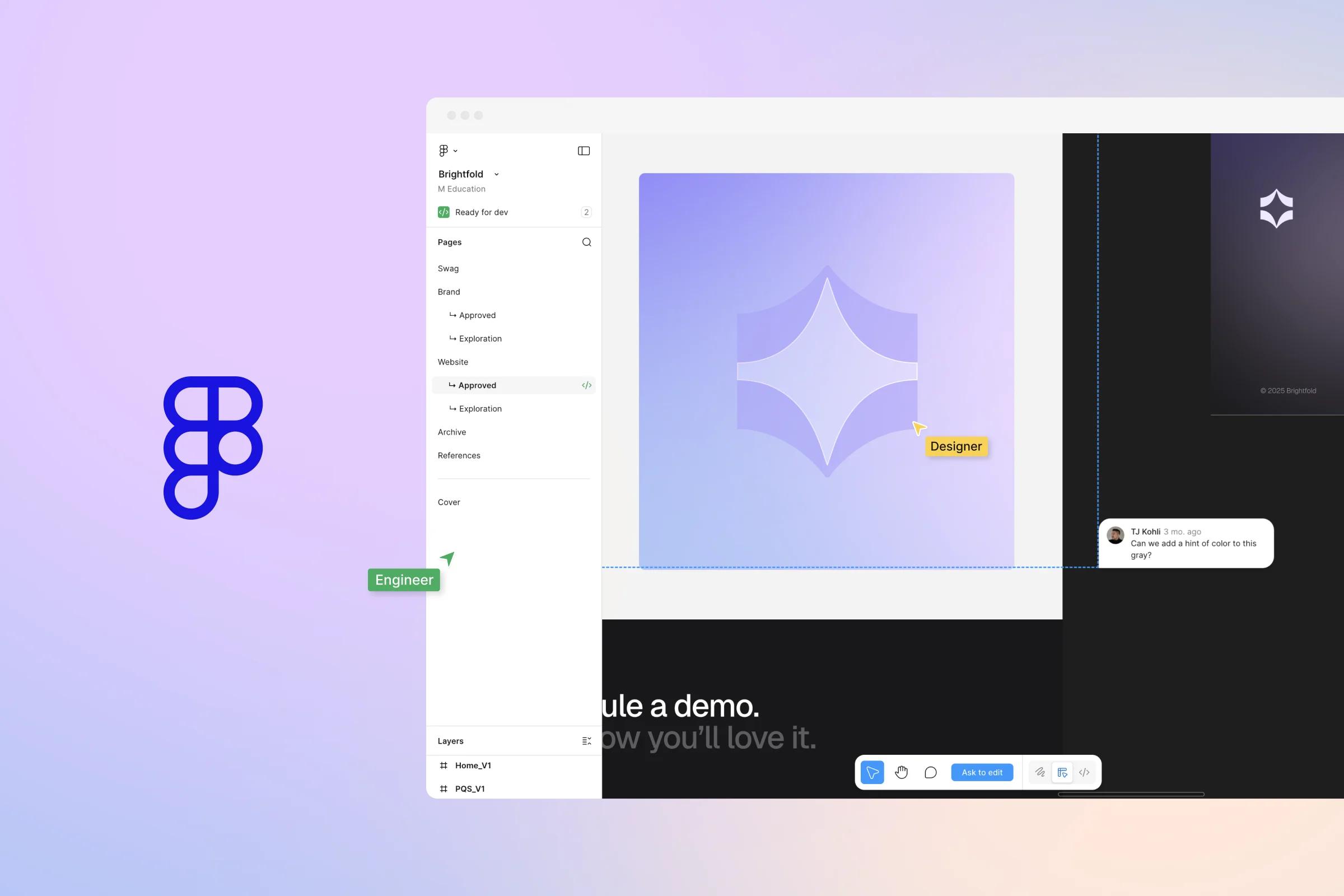
## Designed in Figma
The entire Brightfold platform was designed using Figma, leveraging its collaborative design tools to create a cohesive visual system. The design process utilized Figma's component libraries to establish a scalable design system with reusable UI elements, ensuring consistency across all pages and sections. Design tokens for colors, typography, and spacing were defined using Figma Variables, enabling seamless translation from design to code. Interactive prototypes were built in Figma to validate user flows and interactions before development, while Figma Dev Mode facilitated smooth handoff between designers and developers, providing precise specifications, measurements, and code snippets.
## Powered by Payload
Brightfold's content management is powered by Payload, a headless CMS built with TypeScript that provides a flexible, developer-friendly content editing experience. Payload's self-hosted architecture gives Brightfold full control over their content infrastructure, while its intuitive admin interface enables non-technical team members to easily manage and update website content. The CMS's type-safe API and seamless Next.js integration ensure that content updates are reflected instantly across the platform, maintaining both developer productivity and content editor autonomy.

## Modern Development Stack
The platform leverages a modern development stack to deliver performance and developer experience. Vercel provides edge deployment and global CDN for fast load times. Tailwind CSS enables rapid, consistent styling with utility classes. Raster streamlines image optimization and asset delivery. Basin handles form submissions and data collection. Together with Next.js and Payload, this stack supports a scalable, maintainable platform that grows with Brightfold's needs.
## What Makes Brightfold
Central to the Brightfold brand is the logo mark consisting of a book, representing the foundational knowledge and the continuous journey of learning at the heart of education, and a star, symbolizing the bright potential of every student and educator. The Brightfold logo as a whole embodies a commitment to integrating AI-powered innovation with the fabric of education, empowering schools to shine.

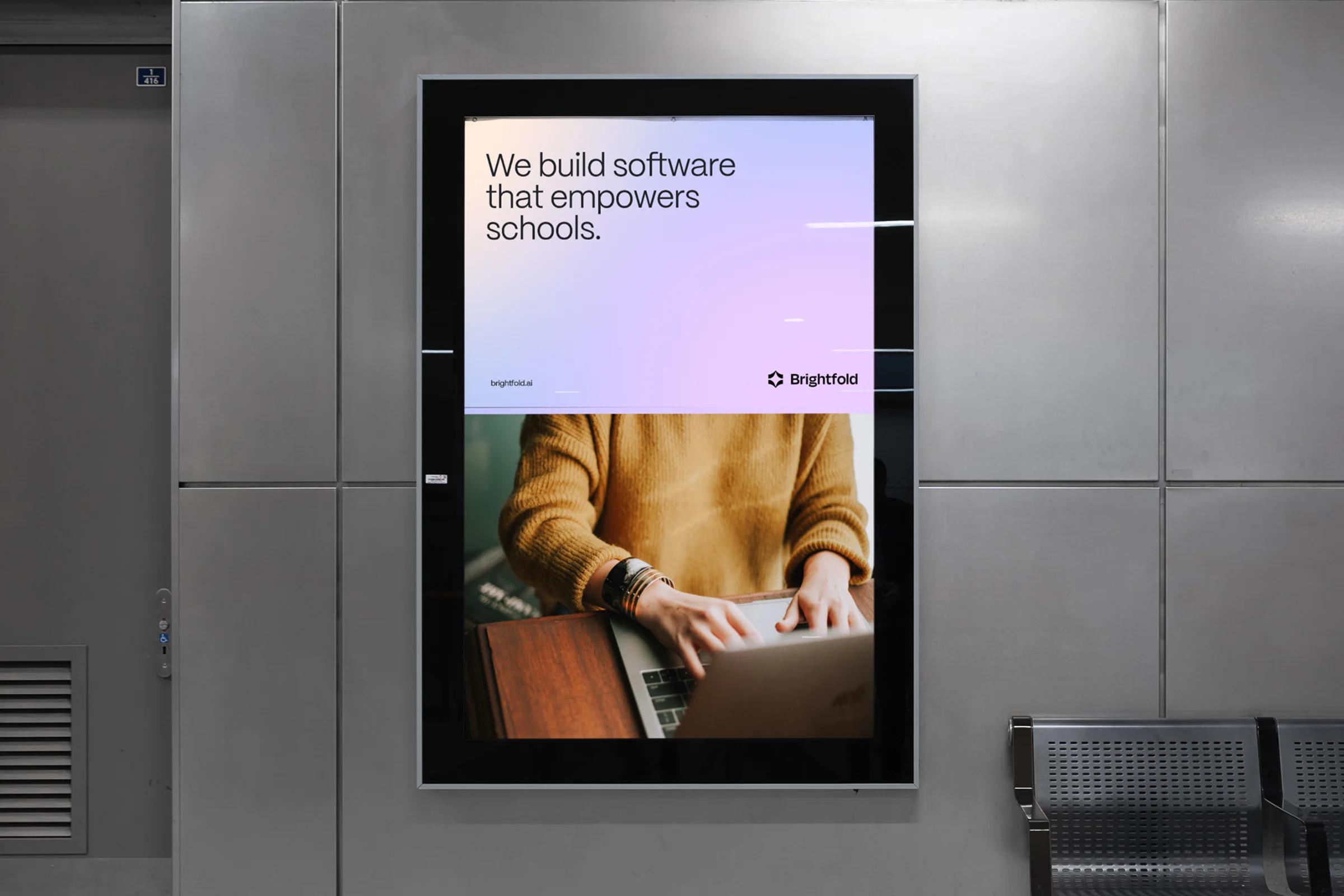
## Going Forward
Brightfold's tech stack is built for long-term growth. Next.js and Tailwind CSS provide a scalable, maintainable foundation. Vercel enables fast deployments and global performance. Payload CMS supports flexible content management as the product suite expands. Figma keeps design and development aligned. Raster streamlines asset management, and Basin handles form submissions. This stack positions Brightfold to scale as they add AI education products, with a solid base that adapts to new features and growing traffic.

---
**View Project:** [Brightfold AI](https://brightfold.ai/)
## Contact Us
[Build what comes next](https://monogram.io/#contact) | Email: [hello+llm@monogram.io](mailto:hello+llm@monogram.io)
Provide your contact details and claim a time to meet. We'll help you do the rest.
Monogram is an Applied AI Studio based in Atlanta that designs and deploys production AI systems — connecting models, data, workflows, and enterprise software to automate real work.
The contact form collects: name, email, company, estimated budget (USD), a project description, and how you heard about Monogram.
Not sure where to start? Tell us what you're trying to automate or build — we'll help you figure out where AI fits.
---
**More content:** [Home](/.md) | [About](/about.md) | [Blog](/blog.md) | [Engineering](/engineering.md)
Monogram helps companies, organizations, and firms adopt AI by designing and building proof of concepts (POCs), MVPs, intelligent workflows, and production-ready AI applications.
Website designed and developed by [Monogram](https://monogram.io)
---
# LeVar Burton
**Scope:** uiUxDesign, development
---
## Technologies
GitHub, Basin
## Sectors
Education
---
**View Project:** [LeVar Burton](https://levarburton.com/)
## Contact Us
[Build what comes next](https://monogram.io/#contact) | Email: [hello+llm@monogram.io](mailto:hello+llm@monogram.io)
Provide your contact details and claim a time to meet. We'll help you do the rest.
Monogram is an Applied AI Studio based in Atlanta that designs and deploys production AI systems — connecting models, data, workflows, and enterprise software to automate real work.
The contact form collects: name, email, company, estimated budget (USD), a project description, and how you heard about Monogram.
Not sure where to start? Tell us what you're trying to automate or build — we'll help you figure out where AI fits.
---
**More content:** [Home](/.md) | [About](/about.md) | [Blog](/blog.md) | [Engineering](/engineering.md)
Monogram helps companies, organizations, and firms adopt AI by designing and building proof of concepts (POCs), MVPs, intelligent workflows, and production-ready AI applications.
Website designed and developed by [Monogram](https://monogram.io)
---
# Angular Demo for Google I/O
**Client:** Angular
**Scope:** uiUxDesign, frontEndDevelopment, backEndDevelopment
---
"Rock, paper, scissors... shoot!" This phrase is recognized and chanted worldwide to initiate the iconic game of rock-paper-scissors, enjoyed for its simplicity and pure chance for many generations.
The Angular team asked us to implement a version of rock-paper-scissors for Google I/O participants to play and challenge Gemini as their opponent. Monogram worked closely with the Angular team to design and develop this game, with the basis for our application being a game created by [Regan Henke](https://tensorflowrockpaperscissors.web.app/).
## Technologies
Angular, Firebase, Gemini, Tensorflow
## Sectors
AI

## The Rules
For the sake of formality, let's briefly recall the rules of the game. Rock paper scissors is played between two people. Each player simultaneously forms one of three shapes with an outstretched hand:
1. Rock (a closed fist)
1. Paper (an open hand)
1. Scissors (a fist with the index and middle fingers extended, forming a V)
The rules determining the outcome are straightforward:
- Rock crushes** **Scissors (Rock wins)
- Scissors cuts Paper (Scissors win)
- Paper covers Rock (Paper wins)
## The Strategy
When the game starts, a countdown is visible in the middle between the cards. A second before the end of the countdown, a request is sent to the AI to propose a gesture that will beat the player's gesture (taking into account the strategy chosen).
Once we know the outcome of the game, we can look below the cards where the conversation with the AI is located, see what prompt message was sent to Gemini (taking into account the selected strategy), what gesture the artificial intelligence proposed, and an explanation of why this particular gesture was chosen. From this, we are able to understand why the AI proposed a given gesture.

[Video](https://vimeo.com/984454805/6568631e35?share=copy)
## Lets Play!
To make the game more intricate, the player can choose one of four possible strategies used by the AI:
- Random - AI chooses a random game move with equal probability
- Conditional - This approach assumes the player is following the common win-stay, lose-shift strategy. This means the player selects their move based on what would defeat their previous move.
- Markov - This strategy employs a Markov chain to forecast the player's next move based on their prior choices. For instance, if the player typically selects 'paper' after 'rock' and their last move was 'rock', we can predict that their next move will likely be 'paper'.
- Anticipate - This gives Gemini a slight advantage by processing data from the webcam during the countdown. It analyzes the most frequently seen gesture and predicts that the player will use that gesture.
After choosing a strategy, the player shows his hand on the camera, marked with pink vector lines representing the arrangement of the fingers. The application uses [Tensorflow.Js](https://www.tensorflow.org/), a machine learning library. The [hand pose detection](https://github.com/tensorflow/tfjs-models/tree/master/hand-pose-detection) model is able to detect hand keypoints based on the player's camera. On the right side, there is a card indicating the gesture proposed by AI. The [fingerpose](https://www.npmjs.com/package/fingerpose) library was used to identify what gesture (rock, paper or scissors) the player showed.
## Technical Overview
Our goal was to write an application using the latest version of Angular in order to utilize signals, new control flow, etc.
The application is hosted on Firebase Hosting. In order to protect the Gemini API key, we have created Firebase Cloud Function, which acts as a proxy between the application and Gemini. We decided to use Gemini not only in the application but also during programming. We asked questions, asked for code snippets, etc.
Hundreds of participants of Google I/O 2024 and Google I/O Connect in Berlin had the opportunity to challenge Gemini in rock-paper-scissors at the Angular team stand. It was an honor to be a part of this project and see our work come to life!


## Contact Us
[Build what comes next](https://monogram.io/#contact) | Email: [hello+llm@monogram.io](mailto:hello+llm@monogram.io)
Provide your contact details and claim a time to meet. We'll help you do the rest.
Monogram is an Applied AI Studio based in Atlanta that designs and deploys production AI systems — connecting models, data, workflows, and enterprise software to automate real work.
The contact form collects: name, email, company, estimated budget (USD), a project description, and how you heard about Monogram.
Not sure where to start? Tell us what you're trying to automate or build — we'll help you figure out where AI fits.
---
**More content:** [Home](/.md) | [About](/about.md) | [Blog](/blog.md) | [Engineering](/engineering.md)
Monogram helps companies, organizations, and firms adopt AI by designing and building proof of concepts (POCs), MVPs, intelligent workflows, and production-ready AI applications.
Website designed and developed by [Monogram](https://monogram.io)
---
# Milvet Angels
**Client:** Milvet Angels
**Scope:** uiUxDesign, frontEndDevelopment
---
MilVet Angels brings together an extraordinary community of veterans, civil servants, and public service leaders dedicated to shaping the future of national security and technological innovation. When they partnered with us, their request was clear: create a digital platform that feels as mission-driven, future-forward, and community-first as the people it represents.
## Technologies
Next.js, Vercel, DatoCMS, Tailwind CSS, Raster, GraphQL, React, Node.js
## Sectors
Public Sector Leadership


## Built to Scale Purpose
To support MilVet Angels’ growing impact, we built a platform designed to scale—balancing storytelling, events, programs, and community recognition in one cohesive experience. Using a modern, modular tech stack, we delivered a fast, flexible, and easy-to-manage site. The result is a performant, content-rich platform powered by technologies like Next.js, DatoCMS, TailwindCSS, and Vercel—built to evolve alongside MilVet’s mission.
## Modular Programs, Seamless Navigation
MVA’s four core programs—Powering Business, Transition, Recognition, and Unity—each have unique goals, audiences, and formats. We designed a flexible module system that adapts to the needs of each program, with options for expandable text, visual components, and subpages.
This structure ensures that as MilVet Angels evolves, the site can scale alongside it—adding new program content without requiring structural overhauls.
*[Video content]*
*[Video content]*
## An Event System Built for Growth
MVA’s events range from intimate fireside chats to large-scale galas. We implemented a highly flexible event infrastructure — enabling the team to feature select events on the homepage, aggregate all past and future events on a dedicated page, and spin up visually engaging event pages with one-click links to ticketing platforms like Eventbrite. With strong visual templates, dynamic filtering, and integrated CTAs, the event system acts as both a publishing tool and growth engine.
## Honoring Service, Fueling the Future
Just as the MVA community honors the legacy of public service while building the future of innovation, this new platform balances tradition with ambition. The final product is clean, mission-aligned, and ready to serve.

## Contact Us
[Build what comes next](https://monogram.io/#contact) | Email: [hello+llm@monogram.io](mailto:hello+llm@monogram.io)
Provide your contact details and claim a time to meet. We'll help you do the rest.
Monogram is an Applied AI Studio based in Atlanta that designs and deploys production AI systems — connecting models, data, workflows, and enterprise software to automate real work.
The contact form collects: name, email, company, estimated budget (USD), a project description, and how you heard about Monogram.
Not sure where to start? Tell us what you're trying to automate or build — we'll help you figure out where AI fits.
---
**More content:** [Home](/.md) | [About](/about.md) | [Blog](/blog.md) | [Engineering](/engineering.md)
Monogram helps companies, organizations, and firms adopt AI by designing and building proof of concepts (POCs), MVPs, intelligent workflows, and production-ready AI applications.
Website designed and developed by [Monogram](https://monogram.io)
---
# CLS Health
**Client:** CLS Health
**Scope:** uiUxDesign, development
---
CLS Health needed a website that would effectively showcase their healthcare services and provider network while overcoming the limitations of their outdated web platform. They partnered with Monogram to create a solution that transformed both their visual presence and content management approach. The result: a modern, patient-centered website with streamlined provider data management.
## Technologies
Vercel, Next.js, Prismic, Tailwind CSS, Kyruus Health, Node.js, React
## Sectors
Healthcare

*[Video content]*
## Design
Monogram’s redesign for CLS Health preserved the brand’s signature navy and teal while introducing a more refined, user-focused design system. The team elevated the visual presentation with consistent components, improved typography, and thoughtful spacing, creating a clear hierarchy that helps visitors find information quickly. The result balances clinical professionalism with a warm, approachable feel that makes healthcare content more accessible to patients.
## Automated Provider Data Integration
Keeping provider information accurate across systems is a common challenge for healthcare organizations. Monogram addressed this for CLS Health by integrating the Kyruus Health API with Prismic CMS using integration fields, syncing data every 30 minutes. This pulls in specialties, credentials, and contact info, with direct links to call or view full profiles—ensuring consistency across systems and simplifying content management.


## Comprehensive Healthcare Search
Healthcare decisions shouldn’t be delayed by complex navigation, so Monogram built a universal search that puts CLS Health’s entire provider network at patients’ fingertips. A prominent homepage search box lets visitors find doctors by name, specialty, condition, or location, with real-time results powered by the Kyruus API. Patients are just one click away from full provider profiles or contact options—turning a potentially frustrating search into a direct path to care.
## Technology & Performance
Monogram built CLS Health’s website using a modern stack focused on performance and maintainability, with Next.js App Router and Vercel for fast, SEO-friendly page loads. Static generation with automatic revalidation ensures visitors always see up-to-date content without requiring full site rebuilds. Prismic CMS powers an intuitive editing experience for non-technical users, and the new architecture offers major performance gains over their legacy site—while making it easy to evolve and expand in the future.

---
**View Project:** [CLS Health](https://cls.health/)
## Contact Us
[Build what comes next](https://monogram.io/#contact) | Email: [hello+llm@monogram.io](mailto:hello+llm@monogram.io)
Provide your contact details and claim a time to meet. We'll help you do the rest.
Monogram is an Applied AI Studio based in Atlanta that designs and deploys production AI systems — connecting models, data, workflows, and enterprise software to automate real work.
The contact form collects: name, email, company, estimated budget (USD), a project description, and how you heard about Monogram.
Not sure where to start? Tell us what you're trying to automate or build — we'll help you figure out where AI fits.
---
**More content:** [Home](/.md) | [About](/about.md) | [Blog](/blog.md) | [Engineering](/engineering.md)
Monogram helps companies, organizations, and firms adopt AI by designing and building proof of concepts (POCs), MVPs, intelligent workflows, and production-ready AI applications.
Website designed and developed by [Monogram](https://monogram.io)
---
# UPLIFT Desk
**Client:** UPLIFT Desk
**Scope:** uiUxDesign
---
UPLIFT Desk set the standard for ergonomic workspaces; our task was to elevate how that promise shows up on the very first page. We partnered with UPLIFT Desk to design a new landing experience that clarifies value, showcases stability and control, and anticipates personalization for different kinds of workers and workflows. Focusing on strategy, UX, and high-fidelity visual design, we delivered a system that’s ready for handoff and built to scale.
## Technologies
Figma, Contentful
## Sectors
Retail


## Composed For Confidence
Smart features deserve smart storytelling. We created visual patterns to communicate steadiness: detail views that highlight engineering, scenes that imply motion without wobble, and space for performance proof points. Components are built to support specs, certifications, or comparative messaging as needed, keeping the story credible and consistent.
## Personalization
The experience is designed to speak to different lifestyles and goals. We introduced personalization-ready layouts and imagery. Wellness, focus, creativity, and more— so the page can adapt by audience, environment, or use case. From a quiet home office to a collaborative studio to a gaming setup, each variation stays on-brand while tailoring the story to the viewer.


## Decisions by Design
Control isn’t just a feature, it’s a feeling. The landing page hands visitors the wheel from the first scroll with clear choices, confident hierarchy, and obvious next steps. By translating complexity into legible pathways, the design makes progress feel immediate and intentional on any device.
## Form & Finish
Every desk becomes a reflection of the person using it. We designed sections that showcase finishes, accessories, and layout ideas through lifestyle vignettes and clean, scannable modules. The system supports curated presets and “build-your-own” paths alike, helping shoppers imagine their ideal setup and move confidently toward configuration.


## Precision in motion
The result is a landing experience that reflects UPLIFT Desk’s leadership in ergonomics while opening space for richer stories—stability, control, personalization, and durability— told with clarity and intention. It honors what customers already love and makes the next step obvious: explore, configure, and get to work.
---
**View Project:** [UPLIFT Desk](https://www.upliftdesk.com/)
## Contact Us
[Build what comes next](https://monogram.io/#contact) | Email: [hello+llm@monogram.io](mailto:hello+llm@monogram.io)
Provide your contact details and claim a time to meet. We'll help you do the rest.
Monogram is an Applied AI Studio based in Atlanta that designs and deploys production AI systems — connecting models, data, workflows, and enterprise software to automate real work.
The contact form collects: name, email, company, estimated budget (USD), a project description, and how you heard about Monogram.
Not sure where to start? Tell us what you're trying to automate or build — we'll help you figure out where AI fits.
---
**More content:** [Home](/.md) | [About](/about.md) | [Blog](/blog.md) | [Engineering](/engineering.md)
Monogram helps companies, organizations, and firms adopt AI by designing and building proof of concepts (POCs), MVPs, intelligent workflows, and production-ready AI applications.
Website designed and developed by [Monogram](https://monogram.io)
---
# Canvas Medical
**Client:** Canvas Medical
**Scope:** development, apiIntegration
---
In the rapidly evolving world of healthcare technology, staying ahead requires constant innovation and adaptability. To achieve this, Canvas Medical partnered with Monogram to leverage modern web technologies and in under three weeks, both developed and launched a comprehensive and interactive platform for various medical resources using Next.js, Tailwind CSS, Prismic, Algolia, and Vercel. By harnessing these tools, the website provides a seamless and efficient experience and allows healthcare professionals to easily access medical resources.
## Technologies
Next.js, Tailwind CSS, Algolia, Prismic, Vercel, GitHub, Node.js, React
## Sectors
Healthcare


## AI-Powered Protocols
The introduction of a medical protocol builder powered by artificial intelligence streamlined the scalability of the Canvas Protocols library. Users can select from various large language models (LLMs) to build custom protocols, which dynamically fill out content fields, reducing manual input and ensuring accuracy. This automation allows healthcare professionals to focus more on patient care by pre-filling information, saving valuable time. Integrating AI keeps Canvas Medical at the forefront of innovation, providing cutting-edge tools for the optimal accessibility of healthcare resources.
## Next-Level Medical Resources
The new Canvas Medical website was developed, tested, and deployed using Next.js and Vercel to organize and facilitate access to protocols and prebuilt electronic medical records (EMRs). Additional functionality includes interactive discussions powered by Giscus, enhancing user engagement and support. Next.js was instrumental in building a scalable, server-rendered user experience, critical for handling high traffic volumes and ensuring rapid page loads. Paired with Vercel’s robust deployment solutions, the platform delivers unmatched reliability and performance, allowing medical professionals to access vital resources at any time and without delays.


## Content at the Core
The new Canvas Medical website is powered by Prismic CMS, employing a headless CMS architecture that separates content management from the application’s user interface. This separation is essential for ensuring the accuracy and timeliness of content—critical factors in the healthcare industry. Prismic enables non-technical staff to update important information effortlessly, without having to touch a single line of code. This capability ensures that essential marketing and medical resources remain current and accessible, supporting the needs of a modern healthcare environment.
## Quick Queries
Algolia's powerful search capabilities are integrated into the Canvas Medical platform, providing fast, relevant, and intuitive search and filtering for a number of medical resources. This integration helps users quickly find the information they need, from open source protocols to EMRs, enhancing the usability of the platform. Algolia’s real-time search functionality means that updates and new entries are immediately available, making the platform highly responsive to user queries and interactions.


## Syncing Search Results
The search functionality of the new Canvas Medical website is powered by a dynamic integration between Prismic CMS and Algolia. Changes made in Prismic trigger a webhook, activating a serverless function. This function then fetches the updated data, prepares it, and syncs it with Algolia, ensuring that Canvas Medical's users always retrieve the most up-to-date information in their search results.
## Testimonial
> I couldn’t ask for a better partner than Monogram — they’re experts in their craft, masters of their tools, and reliable in communication and delivery. Our projects have been under tight deadlines, and we still managed to have a lot of fun working together and getting the job done.
**— Andrew Hines, CEO at Canvas Medical**
---
**View Project:** [Canvas Medical](https://www.canvasmedical.com)
## Contact Us
[Build what comes next](https://monogram.io/#contact) | Email: [hello+llm@monogram.io](mailto:hello+llm@monogram.io)
Provide your contact details and claim a time to meet. We'll help you do the rest.
Monogram is an Applied AI Studio based in Atlanta that designs and deploys production AI systems — connecting models, data, workflows, and enterprise software to automate real work.
The contact form collects: name, email, company, estimated budget (USD), a project description, and how you heard about Monogram.
Not sure where to start? Tell us what you're trying to automate or build — we'll help you figure out where AI fits.
---
**More content:** [Home](/.md) | [About](/about.md) | [Blog](/blog.md) | [Engineering](/engineering.md)
Monogram helps companies, organizations, and firms adopt AI by designing and building proof of concepts (POCs), MVPs, intelligent workflows, and production-ready AI applications.
Website designed and developed by [Monogram](https://monogram.io)
---
# Multi-agent AI solution generator for a developer platform at scale
**Completed:** 2027
**Scope:** ai-agent-development, gcp-cloud-architecture, ai-powered-coding-assistant, llm-integration
---
A developer platform with millions of monthly visitors needed to compress weeks of API evaluation into minutes. We built a nine-agent AI pipeline that takes a natural language description of a use case, retrieves live documentation through MCP-connected knowledge tools, and delivers a complete working prototype (production-ready code, interactive preview, and implementation guide) in under four minutes.
## Technologies
Gemini, Model Context Protocol, BigQuery, Google Cloud, TypeScript
## Sectors
AI Agents
## Metrics
**<4 min**
from prompt to working prototype, live preview, and implementation guide
**2 wks → minutes**
collapsed evaluation cycle for new developers
**73%**
reduction in token cost per request
**70%**
faster evaluation cycles after model tiering
## The Problem
Developer platforms with broad API portfolios face a conversion problem: millions of visitors evaluate the platform each month, but only a fraction convert to active users.
The gap isn't interest, it's friction.
Developers spend weeks reading documentation, comparing APIs, and assembling proof-of-concept code before they can even determine whether the platform meets their needs.
Static documentation, sample code, and starter guides serve the patient developer. The modern developer expects instant, personalized answers. The journey from consideration to evaluation to integration used to take weeks.
> The goal: Compress it to minutes.
## Sector
API Platform
## Scopes
- Multi agent architecture
- LLM performance engineering
- Google Cloud architecture
- MCP tool integration
## Technologies
- ADK (Agent Development Kit)
- Model Context Protocol
- Terraform
- TypeScript
- Python
## GCP Services
- Vertex AI Agent Engine
- Cloud Run
- Cloud Build
- Artifact Registry
- BigQuery
- Secret Manager
- Cloud Logging
## Models
- Gemini 2.5 Pro
- Gemini 2.5 Flash
## What We Built
A nine-agent AI system that handles the full developer journey from prompt to working prototype.
A developer describes their intent in natural language and the system orchestrates a pipeline of specialized agents: an analysis agent validates feasibility by querying live documentation through MCP tools, a styling pipeline generates and validates visual configuration assets, a code generation pipeline writes, evaluates, and refines production-ready code using extended reasoning capabilities, and a programmatic agent compiles an implementation guide with API documentation links, setup instructions, and pricing guidance. The entire pipeline streams results back to the user in real time, completing in under four minutes.
The output (working code, live preview, and implementation guide) is designed for developers to copy, test, and integrate immediately, reducing the evaluation phase from a multi-week research project to a single conversation.
## Multi-Agent Orchestration
The core innovation is a nine-agent pipeline where each agent has a single responsibility, clear input/output contracts, and a dedicated model assignment optimized for its task.
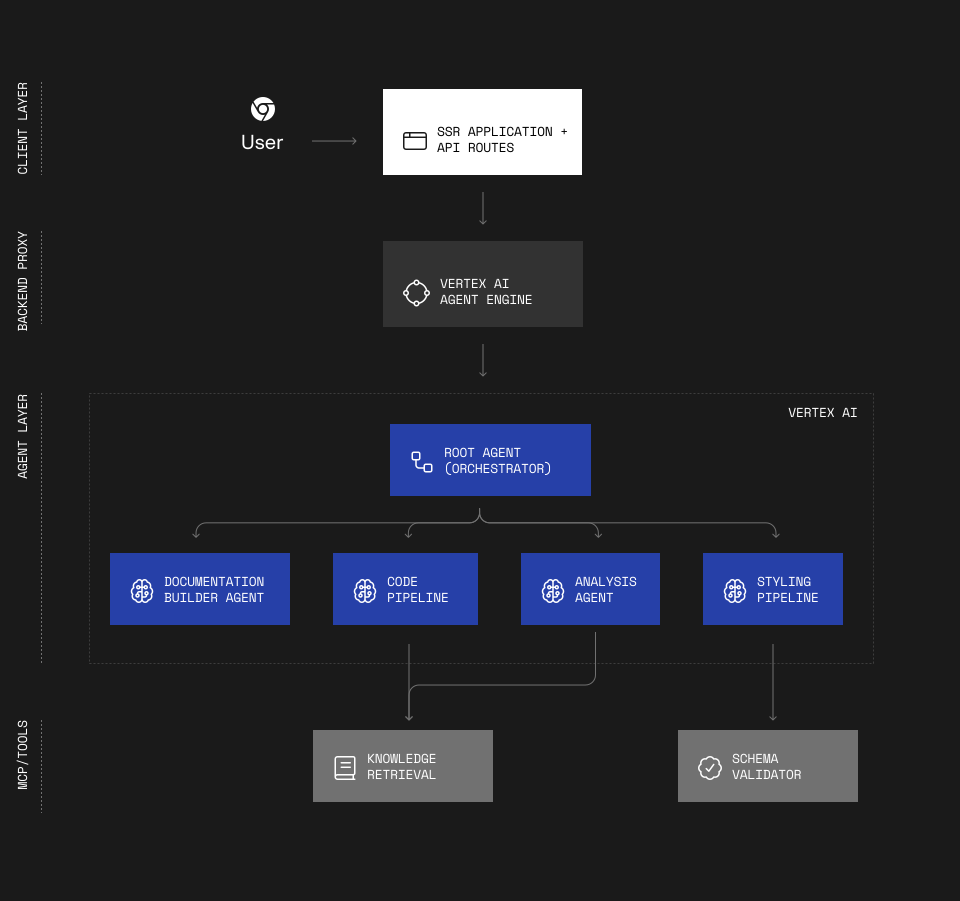
## Dig deeper: how each agent works
### 01. Root Agent
🤖 gemini-2.5-flash
The orchestrator. Manages session state, conversation routing, and dynamic instruction composition. It delegates to specialized sub-agents based on the user's request and injects context gathered from upstream analysis into downstream agents at runtime.
### 02. Analysis Agent
🤖 gemini-2.5-flash
Validates feasibility before any code is generated. Queries live documentation through MCP tools to determine which APIs and capabilities match the developer's intent, producing a structured analysis that shapes every downstream agent's instructions.
### 03. Style Generator + Schema Validator + Style Refiner
🤖 gemini-2.5-flash + Programmatic
A three-agent styling pipeline. The generator translates visual descriptions into structured configuration (deciding whether to generate, update, preserve, or skip styling). The validator is fully programmatic: deterministic schema validation with zero LLM cost. When validation fails, the refiner receives specific error messages and produces a corrected output. This loop runs up to three iterations.
### 04. Code Generator
🤖 gemini-2.5-pro
The primary development agent and the only one running on the Pro-tier model. Uses extended thinking for complex reasoning, MCP documentation access for API reference, and dynamically injected canonical examples to ensure correct API usage patterns. Outputs are structured against an enforced schema to guarantee consistent, parseable results.
### 05. Code Evaluator + Code Refiner
🤖 gemini-2.5-flash
An adversarial evaluation pair. The evaluator reviews generated code against best practices, documentation accuracy, and security patterns, all backed by MCP documentation access. The refiner performs surgical code changes targeting only the specific issues flagged by the evaluator. This separation prevents the "grading your own homework" problem that emerges when a single agent generates and evaluates its own output.
## Design Decisions in Agent Orchestration
Why nine agents instead of a monolithic prompt
A single prompt attempting all tasks (analysis, styling, code generation, evaluation, documentation) would exceed context windows and produce unreliable outputs. Decomposition allows each agent to have focused instructions, specialized model selection, and independent iteration loops.
Why programmatic agents
The Schema Validator and Documentation Builder are implemented as programmatic agents (no LLM calls). Schema validation is deterministic, no model needed. The documentation builder detects APIs in the final code and maps them to documentation URLs from a canonical registry. This eliminates two potential points of hallucination and reduces token usage to zero for those pipeline stages.
Why separate evaluator and refiner**
**Combining evaluation and correction in one agent leads to confirmation bias: the agent "grades its own homework." Separating them creates genuine adversarial pressure: the evaluator applies strict rules and security scanning, the refiner responds to specific feedback and performs surgical code changes targeting only the flagged issues.
Why enforced output schemas**
**Every agent that produces code or configuration declares a structured output schema. The model is constrained to generate valid output matching the schema, eliminating freeform prose, reducing token waste from verbose responses, and guaranteeing that downstream agents receive parseable inputs without additional transformation or extraction steps. This also makes the pipeline testable: each agent's output can be validated independently against its schema contract.
## How MCP Connects Agents to Knowledge
The Model Context Protocol gives agents a standardized interface to live API documentation. Three agents in the pipeline (Analysis, Code Generator, and Code Evaluator) use it to query an indexed knowledge base at runtime, with results capped per query to control context window growth. The MCP server runs as an isolated service in its own project, so documentation retrieval never competes with agent LLM calls for API quota. The knowledge base can be updated or expanded without touching agent code, which keeps the system responsive to API changes without redeployment.
But MCP alone is not enough. Tool calls are agent initiated, which means the model decides whether to invoke retrieval. A confident but wrong model skips the call and hallucinates plausible API patterns. To prevent this, canonical examples are injected directly into agent instructions at runtime rather than offered as an optional tool. The analysis phase identifies which APIs the developer needs, and only matching examples flow into downstream instructions. MCP handles open ended retrieval where the agent has discretion. Direct injection handles patterns that must be present unconditionally. The combination eliminates stale documentation and a major class of API hallucinations.
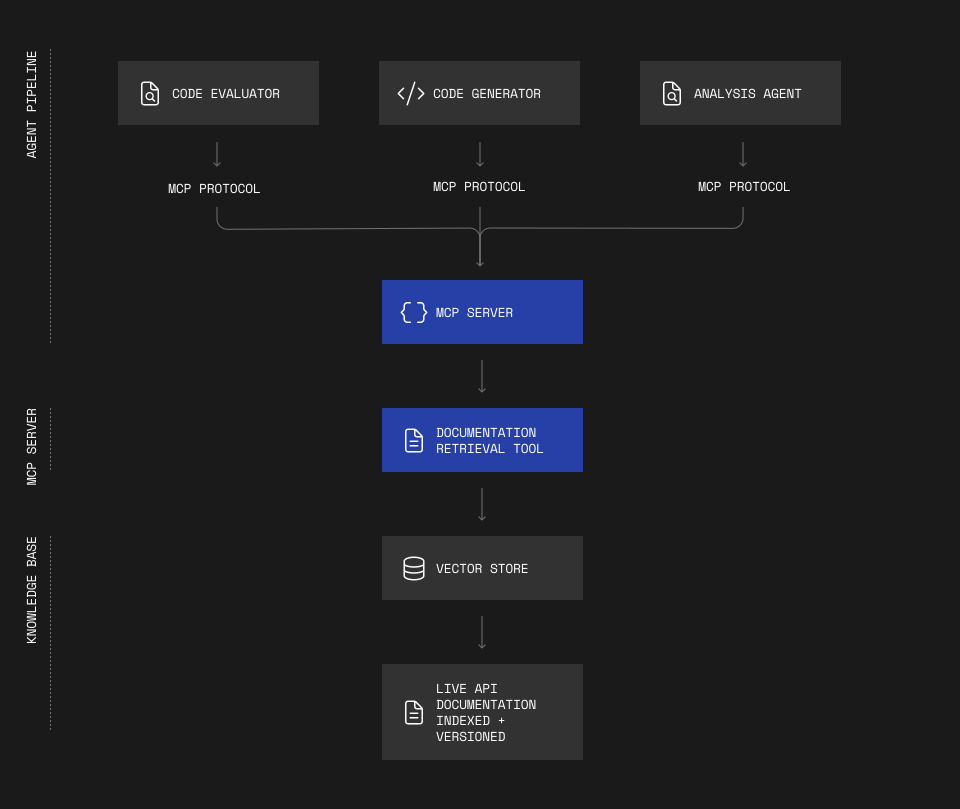
## Iterative Performance Engineering
Building a nine-agent pipeline that performs reliably at scale required multiple development iterations. Each version addressed observed production behavior and introduced targeted refinements that maintained output quality while improving system stability.
Engineering Evolution: From Launch to Production Scale
### 01. Phase 1: Monolithic Pro (Launch)
The initial deployment ran the code generator, evaluator, and refiner on gemini-2.5-pro, the most capable model available. All canonical examples were embedded statically into every prompt, regardless of whether they were relevant to the user's request. The system worked, but at ~30,000 tokens per request and 15-20 Pro-tier calls per pipeline execution, cost and latency were unsustainable at scale.
### 02. Phase 2: Dynamic Instruction Injection (~73% token reduction)
Production logging revealed that most requests only used 2-3 APIs from a catalog of dozens, yet every prompt carried examples for all of them. We restructured the pipeline so the analysis phase identifies which APIs the developer needs, and only matching examples are injected into downstream agent instructions. Token consumption dropped from ~30,000 to ~8,000 per request with no impact on output quality.
### 03. Phase 3: Model Tiering (~70% eval latency reduction)
Evaluation data showed that code evaluation and refinement, while critical for quality, don't require the same reasoning depth as initial code generation. We moved all agents except the code generator to gemini-2.5-flash, reducing evaluation cycle time from ~45-60 seconds to ~12-18 seconds. The code generator retained gemini-2.5-pro with extended thinking for complex reasoning tasks.
### 04. Phase 4: Quota Resilience and Self-Healing
As user traffic scaled, API quota errors (429s) became the primary failure mode. Rather than simply increasing quotas, we implemented a three-layer retry strategy and self-healing behaviors (security auto-fix loops and graceful fallback to previous valid solutions). These changes shifted the user experience from "request failed" to "request takes slightly longer."
### 05. Phase 5: Caching and Budget Controls
The final optimization phase focused on eliminating redundant work. Static instruction content (guidelines, rules, security patterns) is now cached across requests, so only user-specific context is processed fresh per session. The code generator's extended thinking phase is explicitly bounded to prevent runaway token consumption on complex prompts, balancing reasoning depth against resource cost.
## Self-Healing Pipeline
A key differentiator of the system is its ability to detect, recover from, and prevent failures at multiple levels without surfacing errors to the end user. The self-healing behavior built into the pipeline (security auto-fix loops, graceful fallback to previous valid outputs) ensures that issues mid-pipeline don't become user-visible errors.
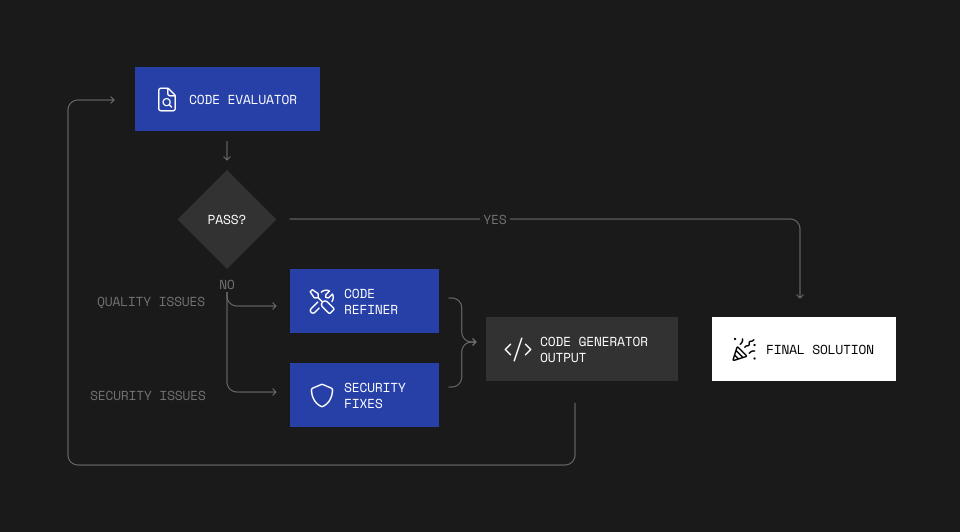
## What Monogram Delivered
PRODUCTION · SERVING THOUSANDS OF DAILY USERS
What used to take weeks of manual evaluation now happens in a single conversation. The outcomes below reflect steady state production behavior.
- Sub-4-minute prototype generation including complete working code, live preview, and implementation guide, replacing a 2+ week manual evaluation process
- ~800-1,000 daily users served with consistent quality, achieved through five phases of iterative performance engineering
- 73% reduction in per-request token consumption through dynamic instruction injection, and ~70% faster evaluation cycles through model tiering, with no measured quality degradation
- Self-healing execution with security auto-fix and three-layer retry so users never encounter raw errors or unsafe code
- Nine-agent pipeline with clear separation of concerns, each agent independently testable, tunable, and backed by enforced output schemas
- Full infrastructure-as-code with Terraform-managed environments (dev/staging/prod), automated CI/CD gates, BigQuery telemetry, and structured observability
> The models are capable. The orchestration frameworks are mature. The remaining challenge is the careful engineering work of making them perform reliably, efficiently, and safely. That's where applied AI studios deliver their value.
## Contact Us
[Build what comes next](https://monogram.io/#contact) | Email: [hello+llm@monogram.io](mailto:hello+llm@monogram.io)
Provide your contact details and claim a time to meet. We'll help you do the rest.
Monogram is an Applied AI Studio based in Atlanta that designs and deploys production AI systems — connecting models, data, workflows, and enterprise software to automate real work.
The contact form collects: name, email, company, estimated budget (USD), a project description, and how you heard about Monogram.
Not sure where to start? Tell us what you're trying to automate or build — we'll help you figure out where AI fits.
---
**More content:** [Home](/.md) | [About](/about.md) | [Blog](/blog.md) | [Engineering](/engineering.md)
Monogram helps companies, organizations, and firms adopt AI by designing and building proof of concepts (POCs), MVPs, intelligent workflows, and production-ready AI applications.
Website designed and developed by [Monogram](https://monogram.io)
---
# Kasada
**Completed:** 2026
**Scope:** design, front-end-development, back-end-development, api-integration, seo-and-structured-data, agent-discovery-surfaces
---
Kasada protects enterprises from automated attacks, account abuse, and emerging AI-driven threats. Its cybersecurity platform combines bot defense, account intelligence, and AI agent trust so legitimate users can move freely across login, checkout, APIs, and content while unwanted automation stays out.
To serve enterprise buyers and intelligent machine consumers alike, Kasada needed a high-performance digital platform capable of exposing structured data for search engines, developers, and AI assistants. Monogram designed and engineered the website end-to-end, combining a Figma-based design system, a modular Sanity CMS, Next.js, HubSpot lead capture, live Lever career listings, and an agent-ready content layer built for both human visitors and LLMs.
## Technologies
Figma, Next.js, Sanity, TypeScript, Tailwind CSS, Vercel, Hubspot, WebMCP, Node.js, React
## Sectors
Cybersecurity, Bot & Fraud Defense, AI, AI Agents
[Video: https://cdn.sanity.io/files/zep746qw/production/d41d50013d1250339e2ea1d7c375f446866eaffc.mp4](https://cdn.sanity.io/files/zep746qw/production/d41d50013d1250339e2ea1d7c375f446866eaffc.mp4)
[Video](https://cdn.sanity.io/files/zep746qw/production/4b65289105287437b2444bde4170d8db7e4b25aa.mp4)
## Designing a Digital System, Not Just a Collection of Pages
Before development began, Monogram established Kasada's visual and interaction language in Figma. Typography, component patterns, spacing, and layouts were designed as a coherent system to keep product stories, security messaging, and enterprise positioning consistent across the homepage, solutions, resources, and campaign pages.
This design system served as the blueprint for the production component library. By directly linking design to engineering, the components available to marketing editors in the CMS reflected the exact patterns defined in Figma, allowing new pages to preserve high visual quality without requiring custom development for each release.
## A Modular Sanity CMS That Marketing Can Own
The website is powered by a modular Sanity CMS architecture, enabling marketing pages to be assembled from structured content rather than rigid, hard-coded templates. Monogram built a flexible section library—including heroes, feature grids, customer stories, FAQs, media, statistics, and product journeys—alongside dedicated content models for blogs, case studies, reports, events, and solutions. Shared settings like navigation, footers, SEO defaults, and site banners are managed centrally as a single source of truth.
This structured content strategy creates the ideal balance between editorial independence and engineering rigor. Marketing teams can freely compose, update, and publish pages in Sanity, while developers maintain strict control over site rendering, performance, web accessibility, and design system integrity.
[Video](https://cdn.sanity.io/files/zep746qw/production/660dee22bc41fe1ea253635837f36f578fafcd16.mp4)
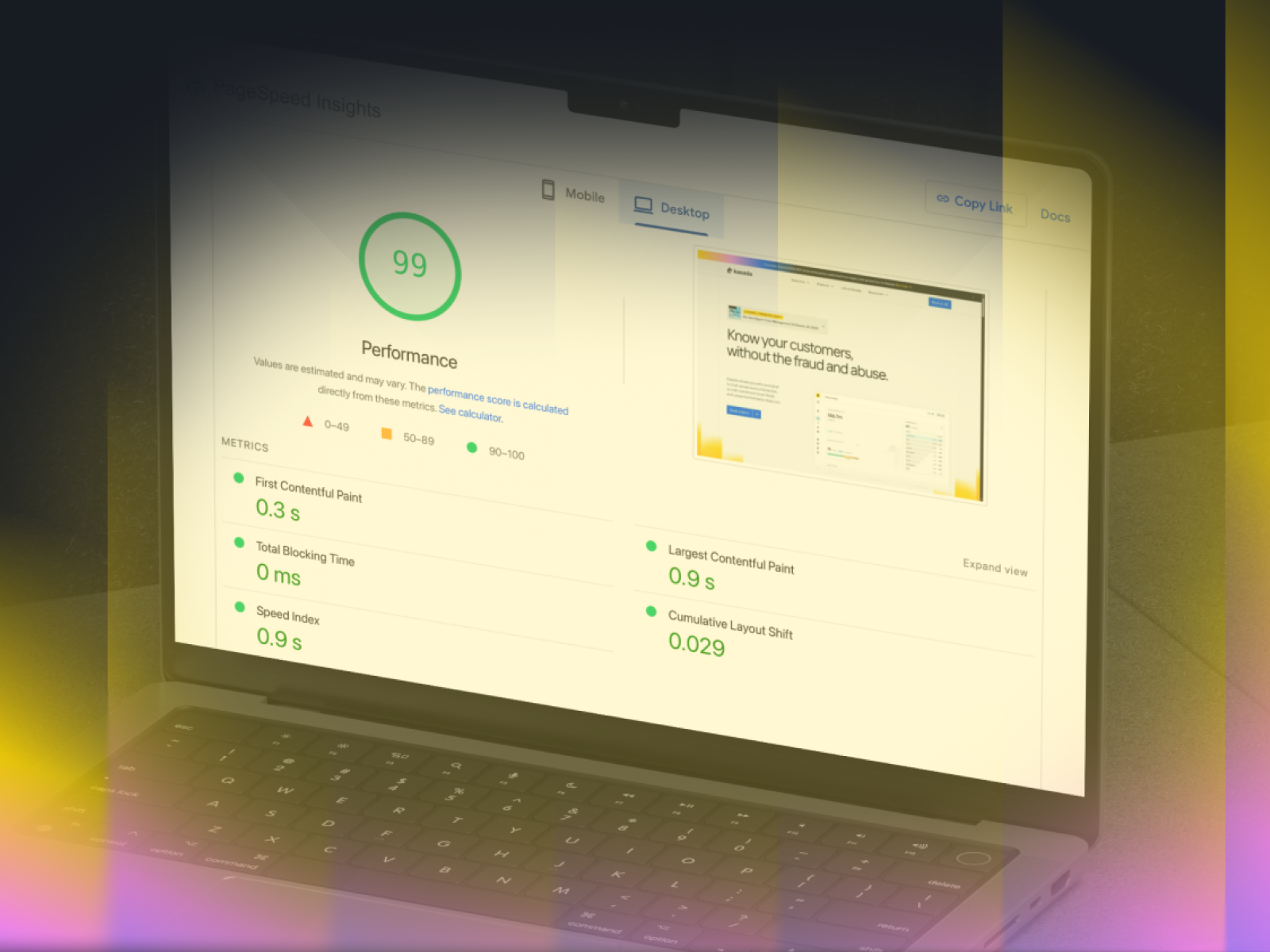
## Next.js Performance Without Sacrificing Editorial Flexibility
The website leverages the Next.js App Router with custom caching and revalidation strategies tailored for a content-heavy marketing platform. This setup provides editors with seamless draft and live preview workflows in Sanity before publishing, while production pages benefit from statically generated routes and optimized asset delivery.
To ensure fast load times, Monogram implemented audit-aware script loading and performance optimizations around hero media, preventing third-party marketing and analytics tools from degrading Core Web Vitals. The resulting architecture allows Kasada to maintain an agile marketing workflow without compromising site speed or technical SEO performance.
## Lead Capture Connected to HubSpot
Lead generation is integrated directly into the website’s content architecture via HubSpot. Rather than relying on isolated or hard-coded forms, Monogram incorporated lead capture components directly into the reusable section library, allowing marketing teams to place conversion-focused forms seamlessly across landing pages, product journeys, and campaign surfaces.
This integrated approach keeps form validation and design aligned with the overall site architecture while routing submissions directly into Kasada's CRM. The result is a unified, scalable lead capture experience across the entire digital ecosystem rather than a collection of disconnected form implementations.
## Built for Humans and Agents
One of the most distinctive features of the platform is its approach to machine-readable content. Monogram engineered the website not just for traditional browsers, but also for AI assistants, crawlers, developers, and autonomous agents that need to discover and consume technical information programmatically.
Instead of forcing these systems to scrape presentation-oriented HTML, the site exposes structured data and standardized discovery surfaces. This creates a direct, reliable bridge between Kasada's underlying technical knowledge and the machine consumers that need to process and cite it.
## Markdown as a First Class Content Format
The website provides clean Markdown alternatives for pages, blog posts, case studies, reports, and resources. Instead of forcing automated systems to parse visual HTML, this structured text format allows content to be consumed directly and efficiently by machines.
To further enhance programmatic navigation, Monogram implemented discovery entry points like llms.txt,sitemap.md, and dedicated documentation. This agent-ready architecture ensures AI assistants, LLMs, and automated tools can easily parse, understand, and accurately cite Kasada’s content.
## Agent Discovery Through Standardized Surfaces
### 01. /.well-known/api-catalog
An API catalog provides a standardized discovery surface for available HTTP services, allowing automated systems to identify relevant capabilities without reverse-engineering the website.
### 02. /.well-known/mcp/server-card.json
A Model Context Protocol server card exposes information about available agent capabilities and provides a standardized discovery mechanism for MCP-aware systems.
### 03. /.well-known/agent-skills/
Agent skills are exposed as structured SKILL.md resources, creating a discoverable layer for systems capable of consuming agent oriented instructions and capabilities.
### 04. OAuth and OpenID discovery
OAuth authorization server metadata and related OpenID discovery surfaces provide standardized information for authentication workflows where protected agent interactions require authorization.
### 05. llms.txt, sitemap.md, and structured navigation
These resources help automated systems understand the site's information architecture and locate relevant content without depending exclusively on traditional HTML navigation.
### 06. Public API documentation and auth.md
Documentation surfaces explain available interfaces and authentication requirements, giving developers and agents a clearer path to understanding and interacting with documented services.
## Results and Business Impact
Kasada needed a website that reflected the technical rigor of its cybersecurity platform while giving its marketing and recruiting teams the flexibility to operate independently.
**Monogram delivered:**
- A complete Figma design system carried through into production.
- A modular Sanity powered content platform with reusable sections and structured content types.
- A Next.js architecture built around caching, revalidation, preview workflows, and performance.
- HubSpot connected lead capture integrated into the site's content system.
- Live career listings synchronized with Lever.
- Production analytics and advertising integrations with environment and audit-aware loading.
- Markdown representations of key content.
- llms.txt, sitemap.md, and multiple .well-known discovery surfaces.
- An architecture designed to make Kasada's content understandable and consumable by search engines, AI assistants, developers, and intelligent agents.
The result is more than a redesigned marketing website.
It is a structured digital platform that reflects Kasada's own approach to the modern internet: know what to trust, make that information accessible, and build systems that can distinguish signal from noise
[Video](https://cdn.sanity.io/files/zep746qw/production/99283aa5dd8a7a5bdc2c7f3d2531035293656d74.mp4)
---
**View Project:** [Kasada](https://kasada.io)
## Contact Us
[Build what comes next](https://monogram.io/#contact) | Email: [hello+llm@monogram.io](mailto:hello+llm@monogram.io)
Provide your contact details and claim a time to meet. We'll help you do the rest.
Monogram is an Applied AI Studio based in Atlanta that designs and deploys production AI systems — connecting models, data, workflows, and enterprise software to automate real work.
The contact form collects: name, email, company, estimated budget (USD), a project description, and how you heard about Monogram.
Not sure where to start? Tell us what you're trying to automate or build — we'll help you figure out where AI fits.
---
**More content:** [Home](/.md) | [About](/about.md) | [Blog](/blog.md) | [Engineering](/engineering.md)
Monogram helps companies, organizations, and firms adopt AI by designing and building proof of concepts (POCs), MVPs, intelligent workflows, and production-ready AI applications.
Website designed and developed by [Monogram](https://monogram.io)
---
# Walden Robotics
**Completed:** 2026
**Scope:** front-end-development, back-end-development, api-integration, seo-and-structured-data, agent-discovery-surfaces
---
Walden Robotics is building the full stack for Physical AI, creating intelligent systems that enable robots to perceive, learn, and operate in the physical world. From hardware and software to frontier models and real world applications, the company is already deploying its technology across manufacturing and logistics environments where reliability matters.
A company shaping the future of Physical AI needs more than a marketing website. It needs a digital platform that reflects the sophistication of its technology, communicates clearly with enterprise buyers, gives marketing teams complete editorial flexibility, and provides structured information that developers, AI systems, and intelligent agents can understand.
Monogram partnered with Walden Robotics to design and engineer that platform from the ground up. The result combines a modular content architecture powered by Prismic, a secure lead generation pipeline, live careers integration, privacy conscious analytics, and a knowledge layer designed for the next generation of AI powered discovery. Every interaction serves a purpose. Every workflow has a single source of truth. Every system was built with both people and intelligent software in mind.
## Technologies
Next.js, Prismic, TypeScript, Tailwind CSS, Vercel, Basin, Rippling, Node.js, React
## Sectors
AI, Robotics
[Video: https://cdn.sanity.io/files/zep746qw/production/afb82debec701786f8825d6797d5584a8a4c98df.mp4](https://cdn.sanity.io/files/zep746qw/production/afb82debec701786f8825d6797d5584a8a4c98df.mp4)
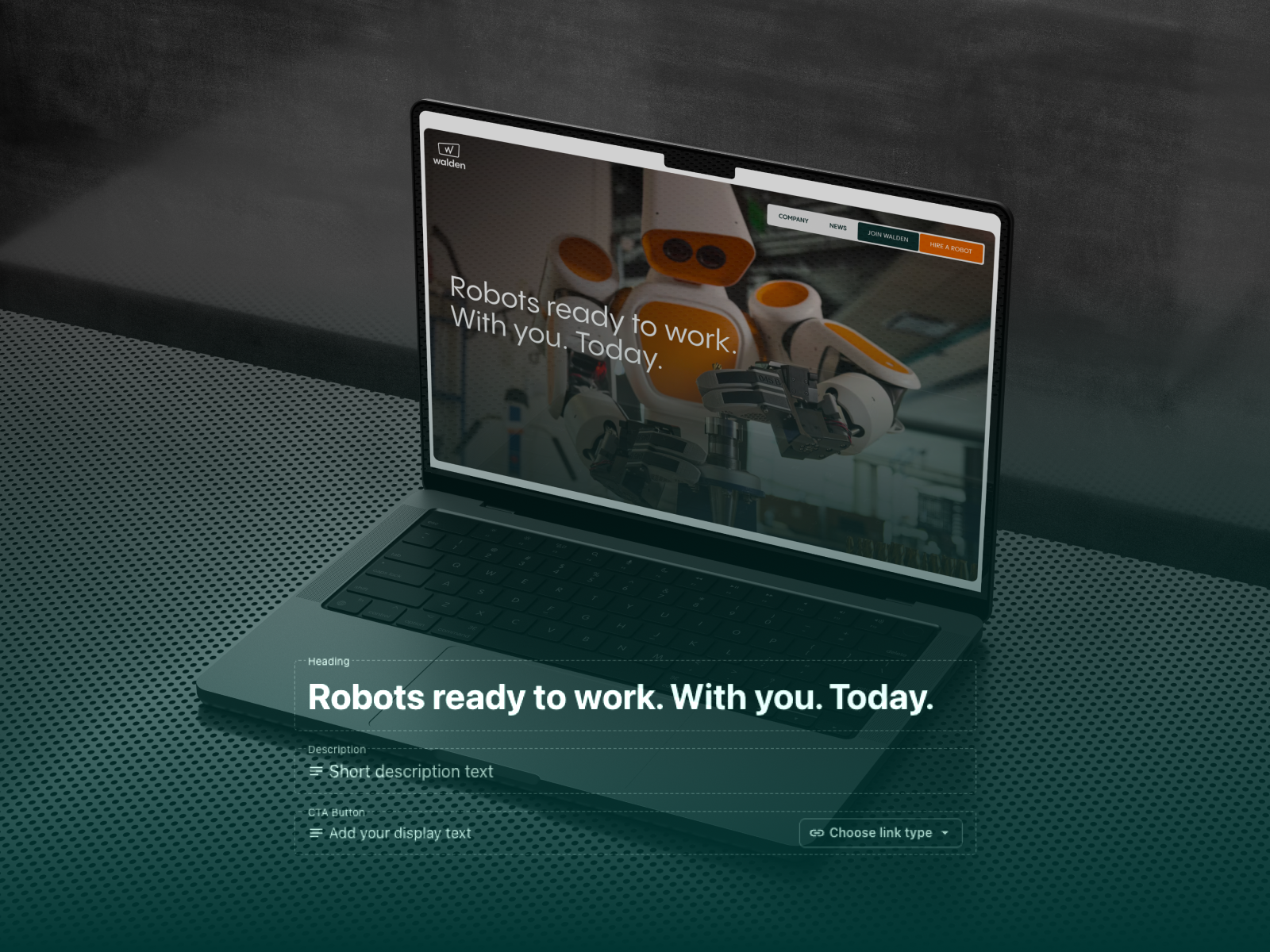
## A Modular Content Platform Built with Prismic
Every page on the Walden Robotics website is assembled from structured content inside Prismic rather than fixed page templates.
Monogram created nineteen reusable Slice Machine components covering the complete marketing experience, including hero sections, calls to action, lead forms, content blocks, navigation, announcements, and supporting layouts.
Editors build pages by combining these reusable sections while developers maintain complete control over rendering, accessibility, search optimization, and visual consistency. Navigation, the footer, SEO defaults, and global announcements all exist as shared content models, creating a single source of truth across the website.
## Fast Where It Matters, Flexible Where It Counts
The platform uses the Next.js App Router together with static generation, intelligent caching, and automatic revalidation whenever content changes inside Prismic.
Editors can preview unpublished work through Draft Mode before publishing, without sacrificing the speed benefits visitors expect from a statically generated website.
Rather than choosing between editorial flexibility and website performance, Walden Robotics benefits from both.
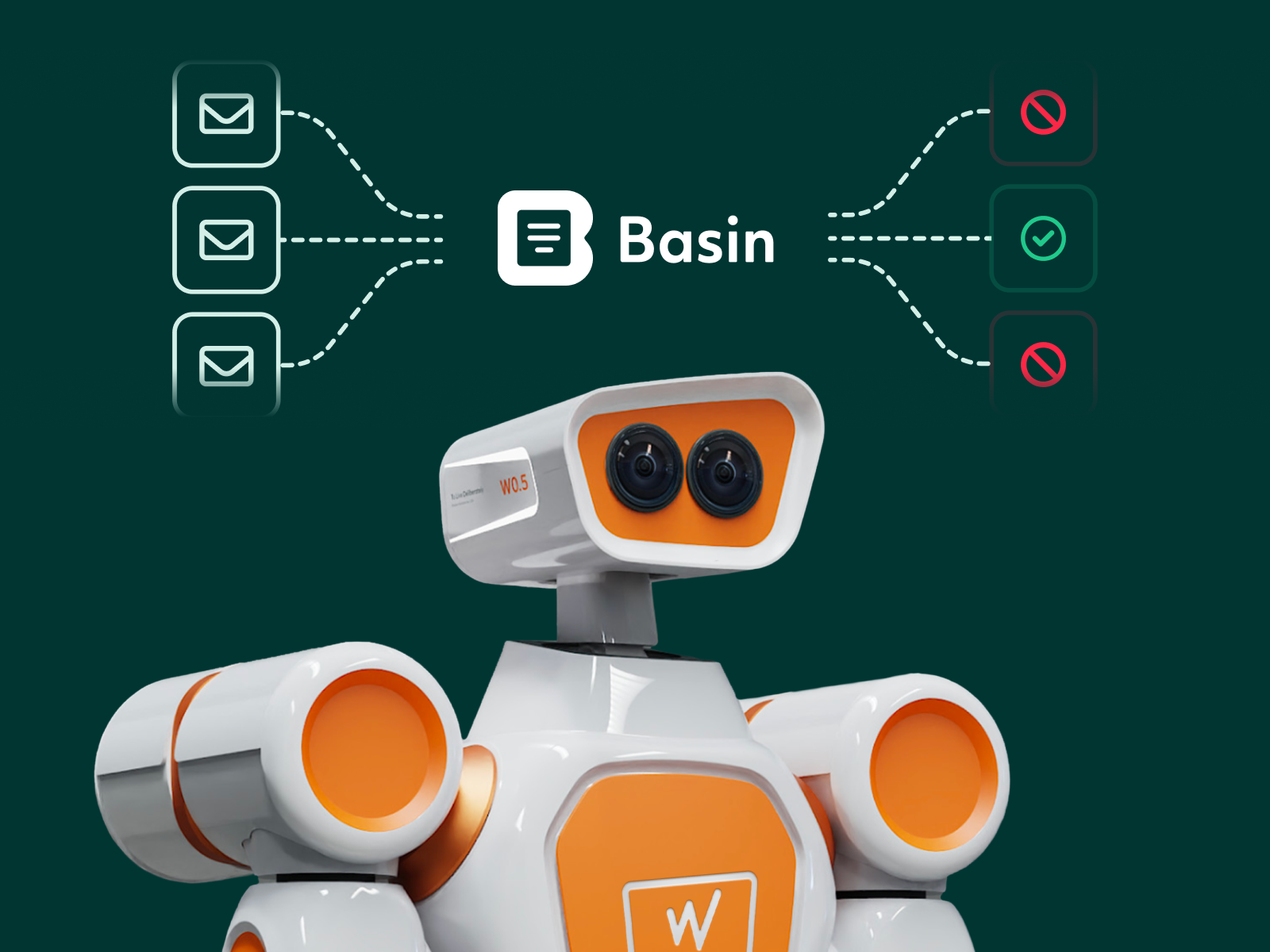
## Secure Lead Generation Built for Enterprise
Lead generation supports both enterprise sales and marketing campaigns through a centralized integration with Basin.
Marketing teams define every form directly inside Prismic, including field types, validation rules, placeholder text, and success messages.
Before those forms ever reach the browser, every field definition is cryptographically signed using HMAC. During submission, validation takes place on the server rather than relying on browser logic that users can modify. Requests are accepted only from approved Basin endpoints, while additional protections such as honeypot fields, request timeouts, and redirect controls help prevent automated abuse and malicious requests.
The same infrastructure powers contact forms, campaign landing pages, and promotional experiences across the site.
## Career Opportunities That Stay in Sync
Recruiting content stays connected directly to Walden Robotics' hiring platform through Rippling's public ATS.
Available positions appear automatically inside the Careers section without requiring manual updates from marketing or engineering.
Recruiters continue managing openings inside Rippling while the website always reflects the latest opportunities.
## Markdown Content for AI Systems
The platform supports HTTP content negotiation, allowing clients to request Markdown instead of HTML whenever structured content is preferred.
News articles, CMS pages, and supporting content can be accessed through dedicated Markdown responses or familiar .md URLs, giving AI systems direct access to clean, structured information.
Additional Markdown resources, including sitemap.md, auth.md, and agent skill documentation, provide standardized entry points for automated systems.
## Testimonial
> One of the best examples I've seen of a web platform built for the next decade of discovery. Search engines, AI assistants, and autonomous agents can all read it natively. This is where the web is going.
**— François Bohyn, CRO, Prismic**
## Discovery Endpoints for Intelligent Agents
### 01. /.well-known/api-catalog
Publishes an API catalog following RFC 9727 so automated systems can discover available services.
### 02. /.well-known/mcp/server-card.json
Allows AI agents to discover capabilities exposed through Machine Context Protocol.
### 03. /.well-known/agent-skills/
Documents agent skills using structured SKILL.md files.
### 04. /.well-known/oauth-authorization-server
Provides standardized OAuth and OpenID Connect metadata for authentication.
### 05. sitemap.md and Link headers
Help AI systems understand the structure of the website and navigate content efficiently.
### 06. /api/news/articles with OpenAPI 3.1
Makes news content available through a documented public API for developers and intelligent systems.
## Results and Business Impact
Walden Robotics needed more than a beautiful website.
The company needed a platform capable of supporting enterprise growth, giving marketing teams editorial independence, protecting lead quality, simplifying hiring workflows, and preparing its digital presence for a future where AI systems interact with websites as frequently as people do.
Monogram delivered:
- A modular marketing platform powered by Prismic that scales through reusable Slice Machine components.
- Fast, reliable website performance through Next.js, intelligent caching, and automated content updates.
- A secure lead generation pipeline with cryptographic form protection, server validation, and centralized campaign management.
- Live career listings synchronized directly from Rippling.
- Privacy conscious analytics built around visitor consent.
- Structured content, Markdown delivery, and discovery endpoints that allow search engines, AI assistants, and autonomous agents to understand the platform through open standards.
The result does not simply communicate what Walden Robotics is building.
It reflects the same engineering philosophy behind the company's products: thoughtful systems, clear architecture, structured information, and technology designed to help both people and intelligent machines understand the world a little better.
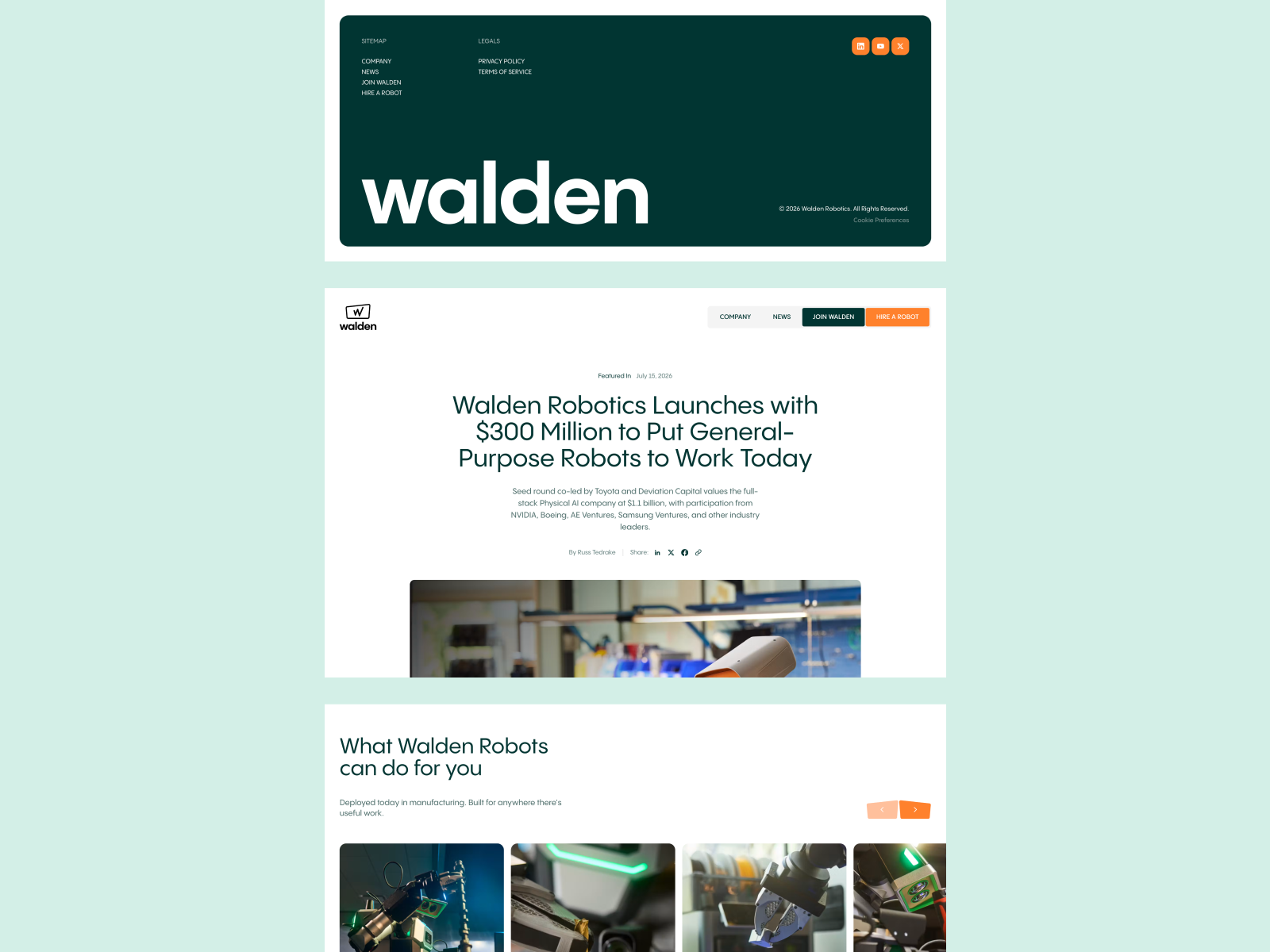
---
**View Project:** [Walden Robotics](https://waldenrobotics.com)
## Contact Us
[Build what comes next](https://monogram.io/#contact) | Email: [hello+llm@monogram.io](mailto:hello+llm@monogram.io)
Provide your contact details and claim a time to meet. We'll help you do the rest.
Monogram is an Applied AI Studio based in Atlanta that designs and deploys production AI systems — connecting models, data, workflows, and enterprise software to automate real work.
The contact form collects: name, email, company, estimated budget (USD), a project description, and how you heard about Monogram.
Not sure where to start? Tell us what you're trying to automate or build — we'll help you figure out where AI fits.
---
**More content:** [Home](/.md) | [About](/about.md) | [Blog](/blog.md) | [Engineering](/engineering.md)
Monogram helps companies, organizations, and firms adopt AI by designing and building proof of concepts (POCs), MVPs, intelligent workflows, and production-ready AI applications.
Website designed and developed by [Monogram](https://monogram.io)
---
# CrewAI
**Completed:** 2026
**Scope:** design, front-end-development, back-end-development, data-pipeline-development, content-migration, api-integration
---
CrewAI is the operating system for enterprise agentic automation, giving organizations a platform to build, orchestrate, and deploy teams of autonomous AI agents at scale. With adoption across 63% of the Fortune 500, CrewAI sits at the center of a generational shift from single model assistants to coordinated teams of intelligent agents working together.
Leading a category requires more than rapid product innovation. It requires a digital experience that reflects the sophistication of the platform itself, one that speaks just as naturally to an executive evaluating an Agent Management Platform as it does to the engineer building a first production crew.
Monogram partnered with CrewAI to design and engineer that next generation digital ecosystem: a marketing platform powered by Contentful, a developer portal built for modern AI integrations, and an automated publishing infrastructure capable of evolving as quickly as the product itself. The result is [crewai.com](https://crewai.com/), a platform where every interaction feels intentional, every data flow has a purpose, and every experience is designed for both people and intelligent systems.
## Technologies
Next.js, Contentful, Vercel, GraphQL, TypeScript, Figma, Ghost CMS, HubSpot Marketing Forms API, Zod, OAuth 2.0, OpenAPI 3.1, Model Context Protocol, Node.js, React
## Sectors
AI, Developer Tooling
[Video: https://cdn.sanity.io/files/zep746qw/production/f388218d18a494e27acb2e425cf7f83b904e4fd9.webm](https://cdn.sanity.io/files/zep746qw/production/f388218d18a494e27acb2e425cf7f83b904e4fd9.webm)
## Designed in Figma
The CrewAI experience began in Figma as a complete design system rather than a collection of individual pages. Every component was designed as part of a visual language that reflects the confidence and precision expected from an enterprise AI platform.
Monogram created a library of reusable components including hero layouts, platform diagrams, pricing sections, feature grids, statistics modules, tabbed content, media blocks, and technical documentation. Every visual element follows the same design principles, making the experience feel cohesive regardless of where visitors enter the site.
Each component maps directly to structured models inside Contentful. Marketing teams compose pages using reusable content blocks, while developers render every layout through GraphQL with strong type safety that keeps designs consistent across the platform.
## A Modular Content Platform
CrewAI had outgrown its previous content management system.
Monogram migrated the platform to Contentful and replaced individual page templates with a flexible content architecture built from reusable sections. Every page is assembled from structured content instead of embedded HTML or custom page layouts.
This approach allows marketing teams to move independently while engineering continues to govern layout integrity, analytics, search optimization, third party integrations, and long term maintainability.
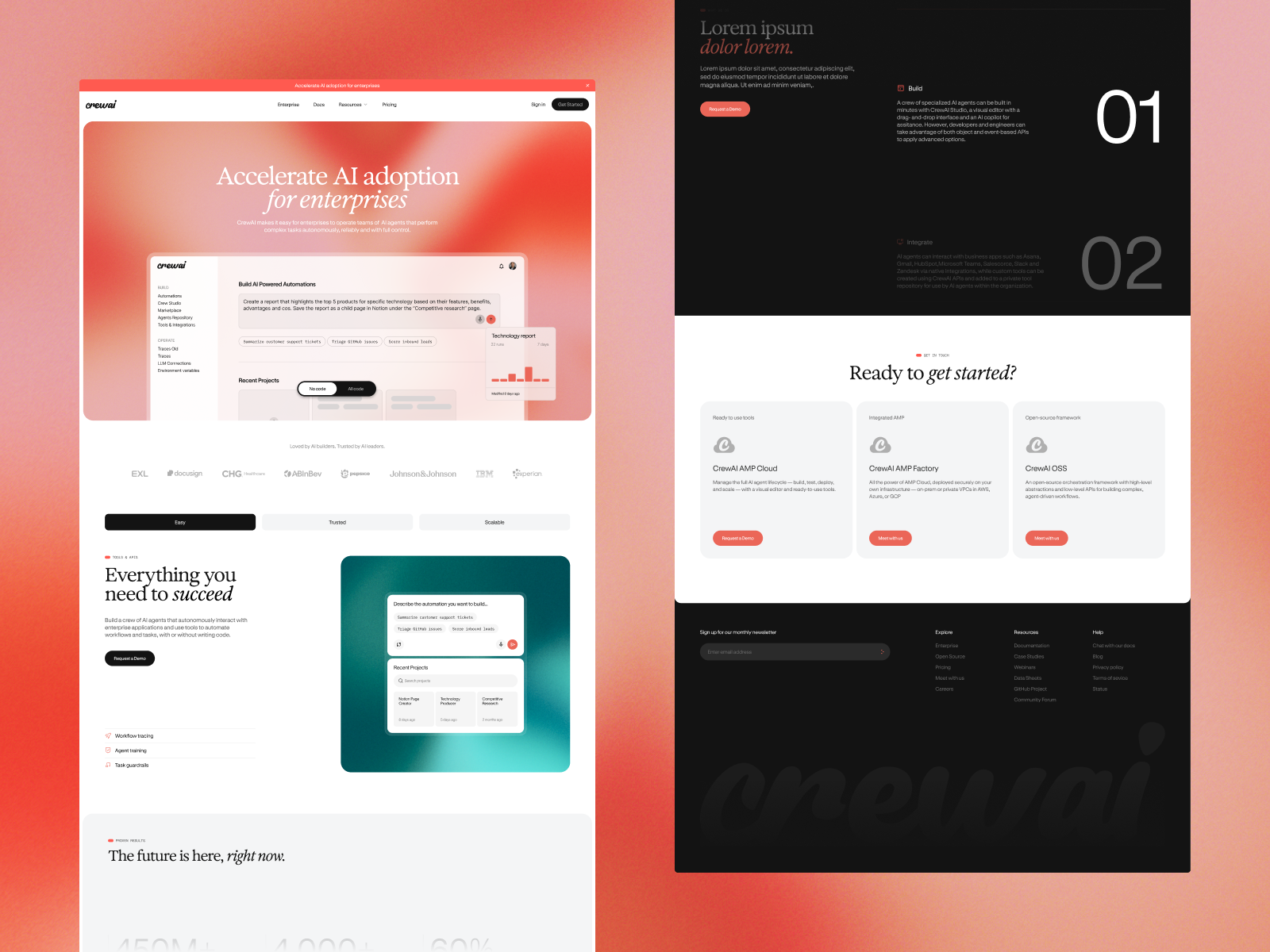
## An Automated Publishing Workflow
CrewAI's editorial team writes every article in Ghost because it offers an excellent writing experience. The public website, however, depends on Contentful to manage structured content, metadata, and reusable page components.
Rather than forcing writers to work across multiple systems, Monogram built an automated publishing workflow that converts every published Ghost article into a draft inside Contentful.
The workflow intentionally stops before publication.
Ghost remains the place where writers create content. Contentful becomes the place where marketing reviews, enriches, schedules, and publishes that content. Writers continue using the tools they enjoy while marketing gains complete control over SEO, metadata, page composition, and publishing schedules.
## Enterprise Marketing Automation
Lead generation runs through a centralized HubSpot integration built specifically for enterprise sales.
The platform includes:
- Forms that retrieve their structure directly from the HubSpot Marketing Forms API during page rendering
- Validation performed with Zod before every submission reaches HubSpot
- Business email validation that blocks more than forty consumer email providers, including Gmail, Yahoo, and Outlook
- Attribution based on HubSpot cookies, referral information, and page context
- Flexible confirmation flows that support inline success messages, redirects, and embedded Calendly scheduling
Every webinar registration, newsletter subscription, product inquiry, and demo request passes through the same validation and attribution workflow.
## Content Designed for AI Systems
CrewAI's website is more than a marketing destination. It is a structured knowledge source that search engines, AI assistants, developer tools, and autonomous agents can understand and navigate with confidence.
**Markdown Content Delivery**
The platform supports content negotiation so clients requesting Markdown receive clean structured content instead of rendered HTML.
Blog posts, documentation, webinars, case studies, events, and CMS pages can all be accessed as Markdown through dedicated routes or familiar .md URLs. This makes content significantly easier for AI assistants, developer tools, and automation platforms to consume without relying on HTML parsing.
## Discovery Endpoints for AI
### 01. llms.txt
Introduces AI systems to CrewAI's public capabilities, documentation, and integration resources.
### 02. llms-full.txt
Provides a more comprehensive reference for developers and autonomous agents.
### 03. openapi.json
Documents every REST endpoint using the OpenAPI 3.1 specification.
### 04. /.well-known/mcp/server-card.json
Allows AI systems to discover CrewAI's Machine Context Protocol server.
### 05. /.well-known/oauth-authorization-server
Publishes OAuth metadata using the RFC 8414 standard.
### 06. sitemap.md
Helps AI systems understand the structure of the website using Markdown.
### 07. /brand/knowledge-graph
Exposes structured information describing CrewAI, its products, and their relationships.
## Model Context Protocol Integration
The platform includes an implementation of Model Context Protocol that mirrors CrewAI's public REST APIs through a consistent collection of tools.
AI agents can discover available capabilities, authenticate using OAuth, and retrieve blog posts, webinars, events, case studies, and developer resources through a standard protocol designed specifically for intelligent systems.
When supported by the browser, WebMCP also enables AI interactions directly inside the page, allowing assistants to retrieve information without requiring additional server requests.
## Results and Business Impact
CrewAI needed a digital platform capable of serving enterprise buyers, developers, content teams, and AI systems without compromising the experience for any audience.
Monogram delivered:
- A sophisticated design system with cinematic motion, immersive product storytelling, interactive diagrams, and reusable components built for long term growth.
- A modular content platform powered by Contentful that allows marketing teams to publish independently while preserving engineering governance.
- An automated publishing workflow connecting Ghost and Contentful without disrupting editorial processes.
- A centralized HubSpot integration with dynamic forms, business email validation, attribution tracking, and embedded meeting scheduling.
- A developer experience built around Model Context Protocol, OpenAPI specifications, OAuth authentication, Markdown content delivery, and structured discovery endpoints for AI systems.
- An architecture designed for enterprise workloads with comprehensive testing, strong security practices, and consistent performance.
The platform does not simply explain CrewAI's vision for agentic automation.
It embodies that vision through orchestrated systems, structured content, governed data flows, and experiences that feel just as natural for intelligent systems as they do for the people building the future of AI.
---
**View Project:** [CrewAI](https://crewai.com)
## Contact Us
[Build what comes next](https://monogram.io/#contact) | Email: [hello+llm@monogram.io](mailto:hello+llm@monogram.io)
Provide your contact details and claim a time to meet. We'll help you do the rest.
Monogram is an Applied AI Studio based in Atlanta that designs and deploys production AI systems — connecting models, data, workflows, and enterprise software to automate real work.
The contact form collects: name, email, company, estimated budget (USD), a project description, and how you heard about Monogram.
Not sure where to start? Tell us what you're trying to automate or build — we'll help you figure out where AI fits.
---
**More content:** [Home](/.md) | [About](/about.md) | [Blog](/blog.md) | [Engineering](/engineering.md)
Monogram helps companies, organizations, and firms adopt AI by designing and building proof of concepts (POCs), MVPs, intelligent workflows, and production-ready AI applications.
Website designed and developed by [Monogram](https://monogram.io)
---
# Meritech
**Completed:** 2026
**Scope:** design, front-end-development, video-production, branding
---
## Technologies
Claude, ChatGPT, Gemini, Figma, Framer, Final Cut Pro
## Sectors
Financial
## The Portfolio Speaks First
Meritech Capital Partners has spent over two decades backing some of the most defining companies in technology such as Salesforce, Datadog, Roblox, and beyond. As a late-stage venture firm, their portfolio doesn't need explanation. It speaks. Our job was to build a web presence that lets it.
## Less Noise, More Signal
The goal wasn't reinvention, it was clarity. We refreshed their existing content with a minimal, modern, and intentional visual language: light, open, and precise.
Deliverables included a full Figma design system, updated brand assets, and a production-ready PowerPoint deck.
For the homepage, we produced a [custom video](https://monogram.io/blog/meritech-capital) that showcases some of the companies Meritech is currently working with. To bring visual cohesion to the founders section, we used AI image generation to unify the founders portraits.
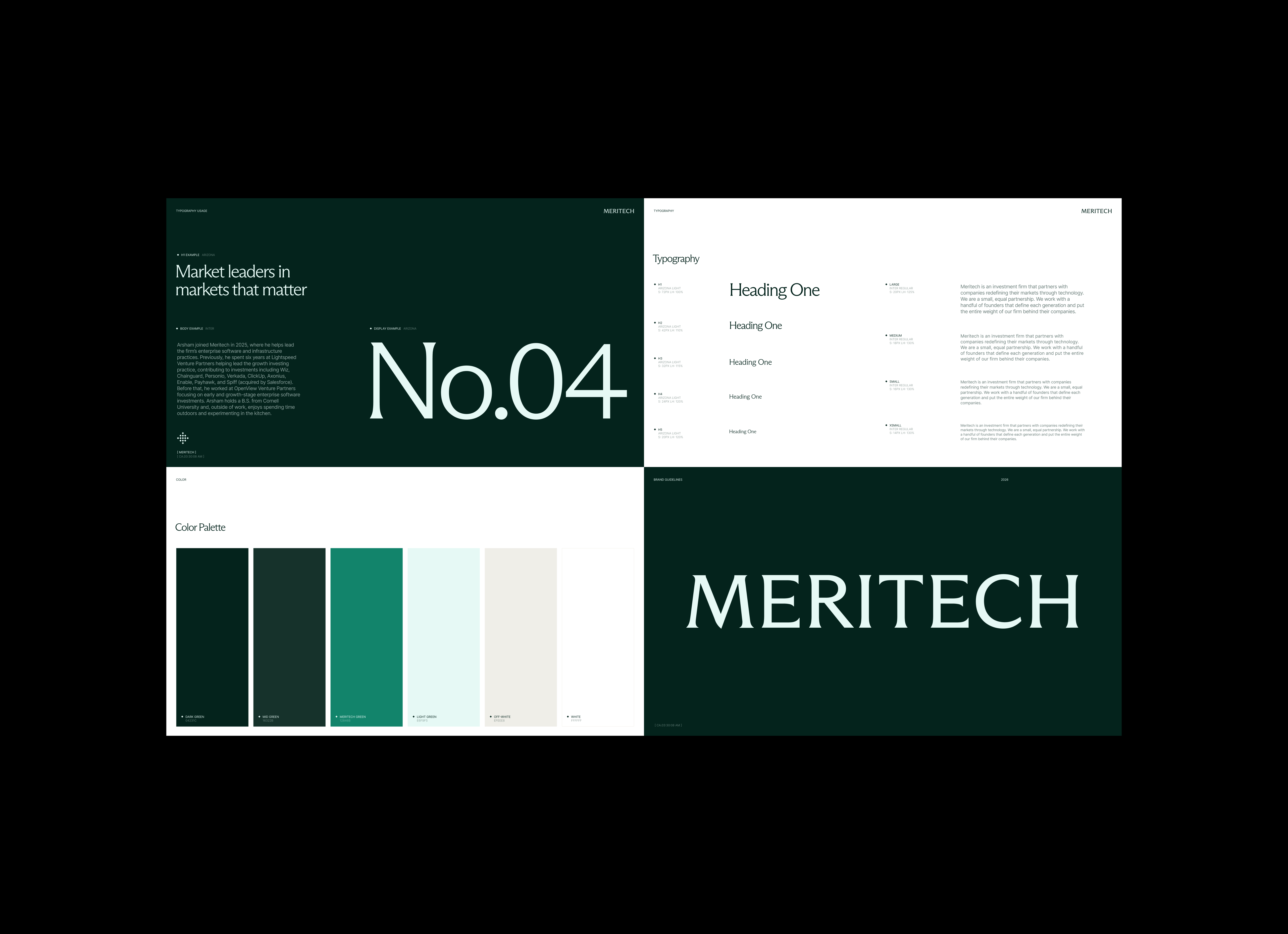
## Built on Conviction
We built the site in [Framer](https://www.framer.com/) and the choice wasn't arbitrary. Meritech has led two funding rounds for Framer, most recently a $100M Series D that valued the company at $2B. They know what Framer is capable of. So do we.
For a firm like Meritech, whose marketing team needs to move quickly without touching code or design files, Framer's built-in CMS is a genuine unlock. Content updates happen directly in the browser with no developer, handoff or friction. At the same time, Framer doesn't constrain what's possible on the build side. Custom components and code overrides give developers room to go beyond templates when a moment calls for something bespoke. Add built-in animation tooling and real-time collaboration, and you have a platform that earns its place on both sides of the table.
Underneath it all, reusable components create a scalable foundation that’s easy to maintain as the site grows. And when it’s time to ship, deployment is as simple as a single click.
## The Result
Meritech came to Monogram with a clear brief: a site that reflects the caliber of their work without overstating it. That's exactly what we built together. A refined digital home for a firm that has never needed to shout, just to show up well.
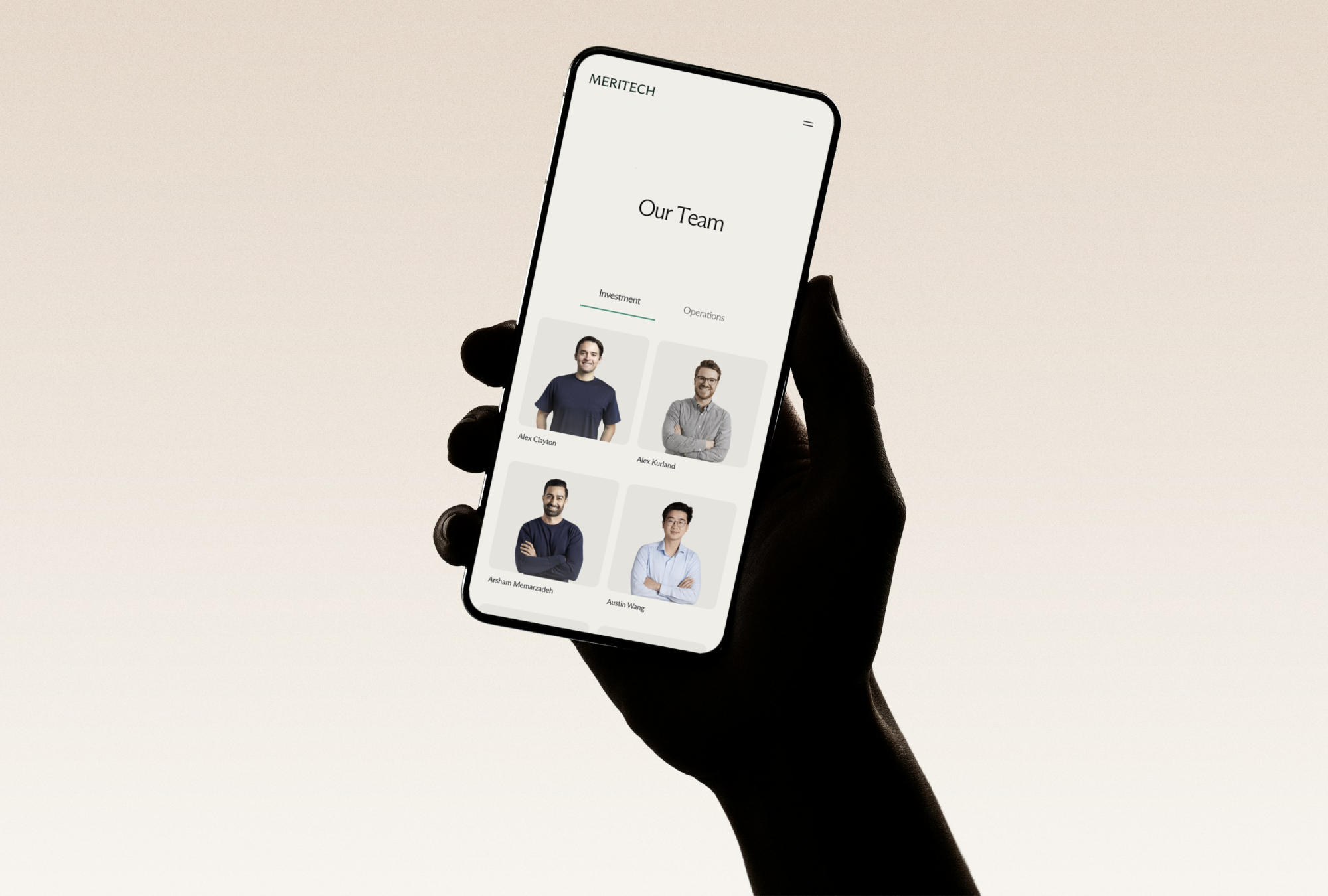
---
**View Project:** [Meritech](https://www.meritechcapital.com/)
## Contact Us
[Build what comes next](https://monogram.io/#contact) | Email: [hello+llm@monogram.io](mailto:hello+llm@monogram.io)
Provide your contact details and claim a time to meet. We'll help you do the rest.
Monogram is an Applied AI Studio based in Atlanta that designs and deploys production AI systems — connecting models, data, workflows, and enterprise software to automate real work.
The contact form collects: name, email, company, estimated budget (USD), a project description, and how you heard about Monogram.
Not sure where to start? Tell us what you're trying to automate or build — we'll help you figure out where AI fits.
---
**More content:** [Home](/.md) | [About](/about.md) | [Blog](/blog.md) | [Engineering](/engineering.md)
Monogram helps companies, organizations, and firms adopt AI by designing and building proof of concepts (POCs), MVPs, intelligent workflows, and production-ready AI applications.
Website designed and developed by [Monogram](https://monogram.io)
---
# Agentic AI for Customer Journey Intelligence
**Completed:** 2026
**Scope:** ai-agent-development, ai-powered-coding-assistant, llm-integration, aws-cloud-architecture
---
A major US airline support operation needed to understand what was happening across thousands of customer conversations, not the fraction of 1% a human team could read by hand. We built a batch analysis platform that stitches the full customer journey together from fragmented backend systems, transcribes voice, strips PII, and scores every conversation against the client's own quality rubrics with Claude Sonnet. Leadership now asks questions in plain language and gets same-day answers grounded in 100% of conversations.
## Technologies
Claude, AWS, TypeScript, Angular
## Sectors
AI Agents
## Metrics
**100%**
conversations analyzed, vs under 1% reviewed by hand
**2 wks → same day**
answers that used to sit in the analyst queue
**~85%**
agreement with human analyst scoring on the calibration set
**100x**
analysis throughput, ~2,000 per run vs ~20 a day by hand
## Ask a question, get an answer the same day
A planning lead asks in plain language: *"Why did call volume increase last week?"* Same-day answer, grounded in every conversation, not a sample:
> "23% increase, driven by disconnect callbacks following the Tuesday outage."
Leadership now sees across 100% of customer conversations, versus under 1% when a human team scored them by hand. Questions that used to sit in an analyst queue for two weeks get answered the same day.
## Sector
Customer Experience
## Scopes
- Multi-source data stitching
- LLM-as-evaluator
- Batch pipeline architecture
- Conversational query agent
- PII redaction
- AWS cloud architecture
## Technologies
- Angular
- TypeScript
- REST API
- JSON / CSV ingest
## AWS Services
- Amazon Bedrock
- Amazon Transcribe
- API Gateway
- AWS Lambda
- DynamoDB
- Amazon S3
- CloudFront
## Models
- Claude Sonnet
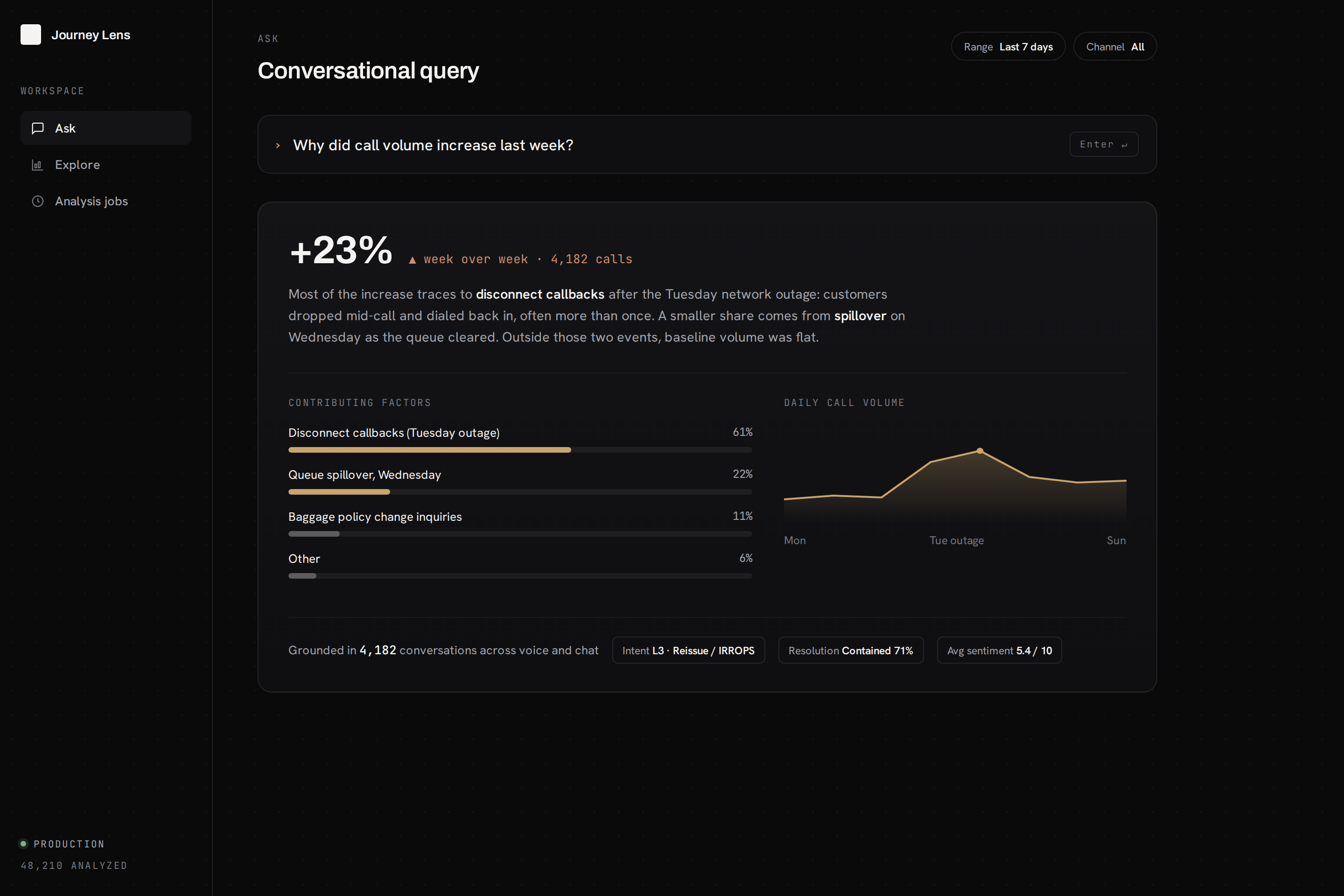
## The problem it removes
The data existed but was scattered: chat logs, voice recordings, conversation attributes, routing events, and agent interaction logs in separate systems. No single view of what happened from the moment a customer entered to the moment they left.
Analysts assembled it by hand and got through roughly 20 conversations/day. Reporting ran on tiny samples, insights lagged by weeks, and systemic problems stayed invisible until they became escalations.
The goal: make 100% of conversations answerable in plain language.
## How it works
Two phases, and the split is what makes it fast.
Analysis -> scheduled. Backend tables are joined on a common conversation ID (named differently per environment, mapped during integration), voice is transcribed via Amazon Transcribe, and PII is stripped. The reconstructed journey is scored by Claude Sonnet against the client's rubrics.
A run does roughly 2,000 conversations in a few hours.
Answers -> interactive. The dashboard, data explorer, and conversational agent read those pre-analyzed results. The agent searches and synthesizes but never re-runs analysis, so answers come back in seconds.
Metrics scored: intent (L1 to L5), sentiment (1 to 10), urgency (1 to 10), resolution (contained or escalated), compliance adherence, specialist performance. All rubric-driven, so the criteria stay in the client's hands.
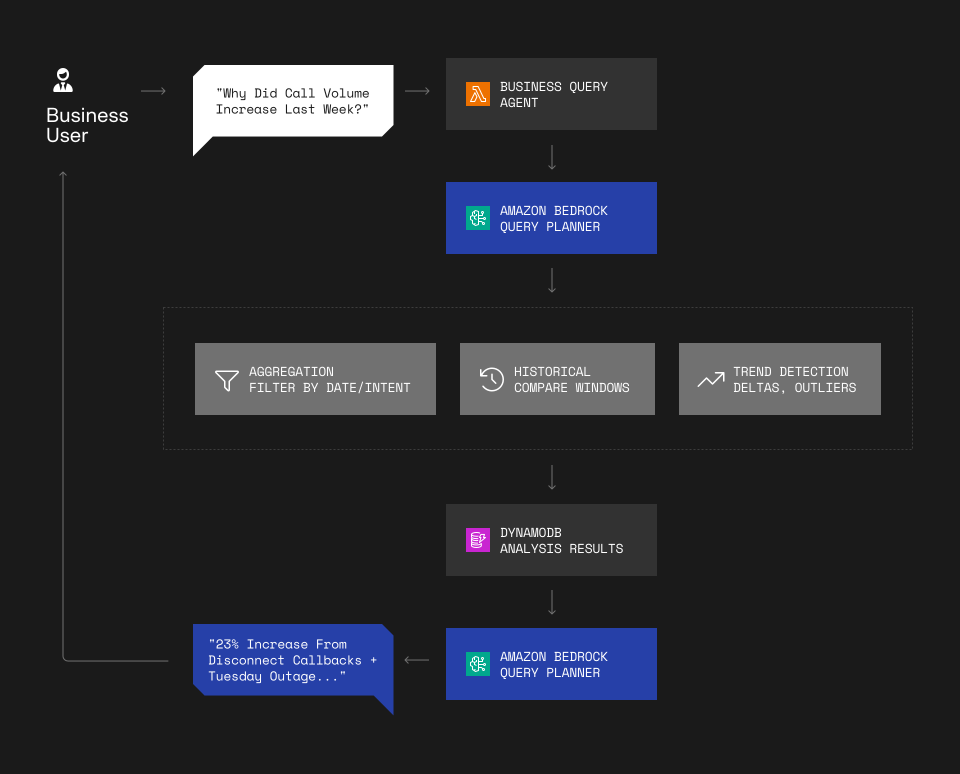
## Can you trust the answer
Model output was compared against conversations the client's analysts had already scored, and the rubrics were refined where they diverged. Exact agreement on the calibration set is ~85%, rising above 90% once scores within one point on the 1-to-10 scales count as matches.
The scores track the client's existing quality framework, not the model's instincts. And because criteria live in a rubric, the client changes them by editing a prompt, not by retraining a model.
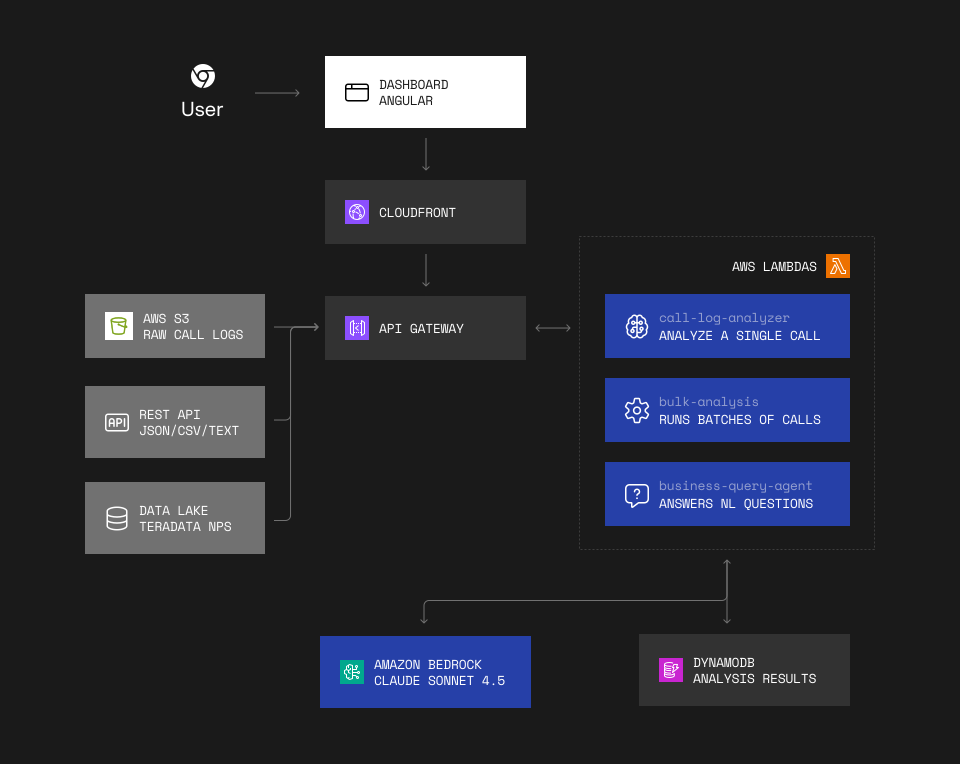
## Why we built it this way
Why batch, not real-time?
The use cases are reporting, incident investigation, and trend analysis, none of which need per-second latency. Batch keeps compute right-sized and LLM costs predictable, and the job runner scopes each run, a 50-conversation incident dive versus a 2,000-conversation monthly review. Real-time is supported if the need shows up.
Why an LLM evaluator, not a fine-tuned model?
A fine-tuned model bakes evaluation criteria into weights and needs retraining, and fresh training data, every time the rubric changes. Scoring against prompt-encoded rubrics keeps that control in the client's hands. Sonnet was chosen over cheaper models because quality on nuanced criteria (sentiment trajectory across a multi-turn conversation, escalation appropriateness) dropped off sharply with smaller models.
Why strip PII before the model, not after?
Redaction runs on the assembled journey before anything reaches the model. It's deterministic, runs on every conversation, costs zero tokens, and means nothing sensitive ever lands in a prompt or a stored result.
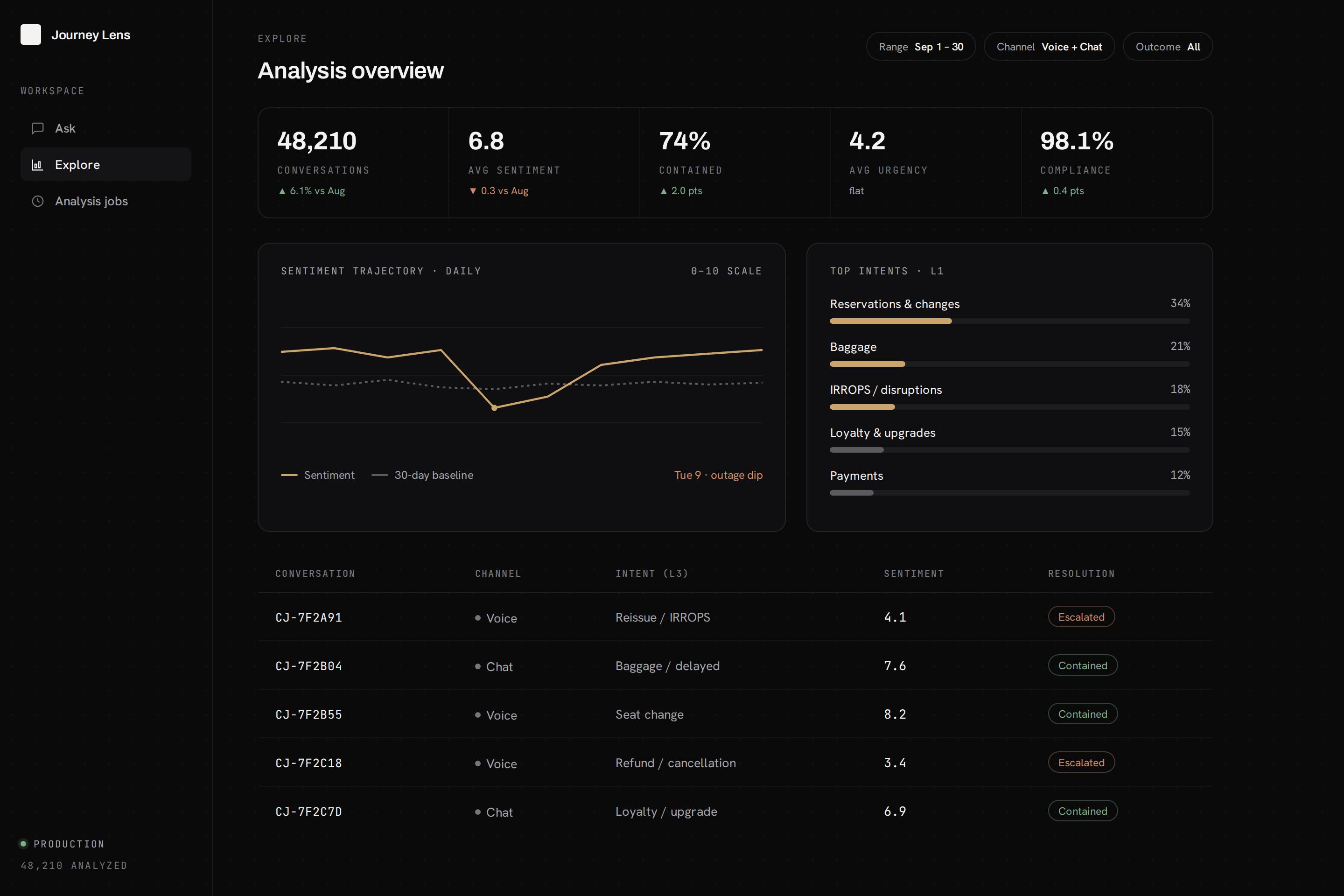
## The hard part, stitching the journey
The AI scoring is the visible layer. The harder problem was reconstructing a coherent journey from tables that were never designed to be joined.
The same conversation lives in five places: chat logs, conversation attributes, voice recordings, agent interaction logs, and routing events. Each environment names the shared conversation identifier differently, so the first integration step is finding and mapping that key per environment. Event timestamps don't always line up across systems. Voice and chat logs arrive at different granularity. A normalization layer maps each environment's schema to one unified journey model, ordering every event, message, transfer, hold, and resolution chronologically across channels.
This is the layer everything else depends on. Score a conversation before it's stitched and the model is grading fragments, not the experience. Get the key mapping and the timeline right and the rest of the pipeline (transcription, redaction, scoring, retrieval) has something real to work on.
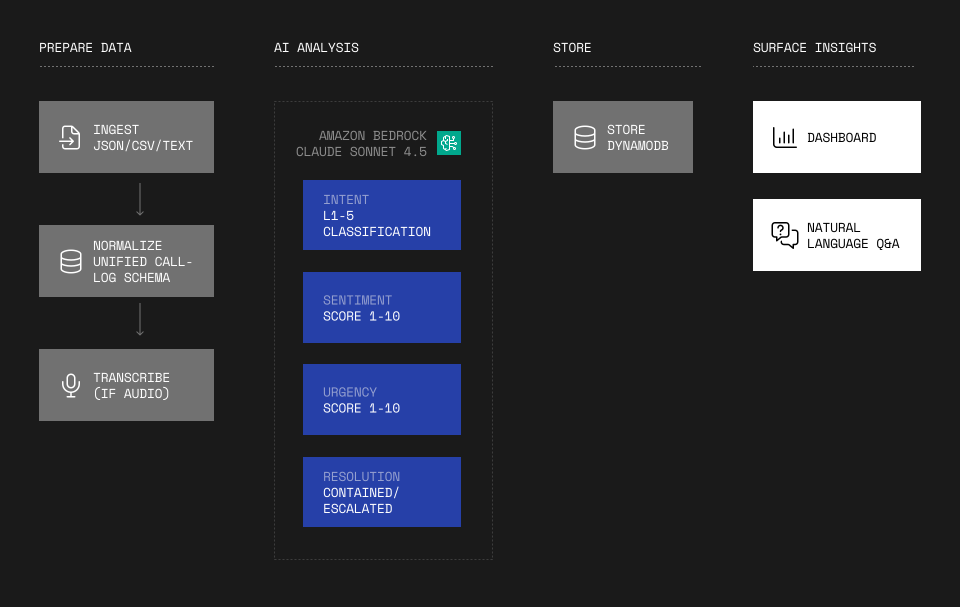
## Dig deeper, how each stage works
### 01. Data Stitching Layer
🤖 PROGRAMMATIC
Joins fragmented backend tables on a common conversation ID, mapped per environment. Reconciles mismatched ID names, misaligned timestamps, and different granularity between voice and chat into one unified journey model. Without it, everything downstream scores fragments instead of experiences.
### 02. Transcription
🤖 AMAZON TRANSCRIBE
Converts voice recordings to text so calls and chats sit in the same journey on equal footing. Runs inside the scheduled batch, not at query time.
### 03. PII Redaction
🤖 PROGRAMMATIC
Strips personally identifiable information from the assembled journey before anything reaches the model. Deterministic, runs on every conversation, zero LLM cost.
### 04. Evaluation Agent
🤖 CLAUDE SONNET 4.5
Scores each reconstructed journey against the client's rubrics: intent (L1 to L5), sentiment, urgency, resolution, compliance, specialist performance. The rubrics encode existing quality frameworks, so criteria change by editing a prompt, not retraining a model.
### 05. Query Planner
🤖 CLAUDE SONNET 4.5
Turns a plain-language question into a retrieval plan over pre-analyzed results: aggregation by date or intent, historical window comparison, trend and outlier detection. Reads the store, never re-runs analysis.
### 06. Answer Synthesis
🤖 CLAUDE SONNET 4.5
Assembles the planner's retrieved data into a direct answer with the numbers behind it. This is the "23% increase from disconnect callbacks" step. Returns in seconds because the heavy analysis already ran.
"We used to argue about what was happening in our contact center based on the handful of calls someone had time to listen to. Now we ask a question and get an answer grounded in all of it, the same day. It changed what we even think to ask."
Director, Reservations
## Why it worked
The win was not the model. It was making every conversation reachable.
By solving journey reconstruction first, and treating Claude Sonnet as a configurable evaluator rather than a fixed black box, the platform turned a two-week sampling exercise into a question you can ask in plain language and answer the same day.
Coverage went from under 1% to 100%. The analyst's job moved from assembling data to acting on it. And because the client owns the rubrics, the system sharpens as the criteria sharpen instead of going stale. Full coverage, fast answers, and client-controlled evaluation is the combination that made it stick.
## Contact Us
[Build what comes next](https://monogram.io/#contact) | Email: [hello+llm@monogram.io](mailto:hello+llm@monogram.io)
Provide your contact details and claim a time to meet. We'll help you do the rest.
Monogram is an Applied AI Studio based in Atlanta that designs and deploys production AI systems — connecting models, data, workflows, and enterprise software to automate real work.
The contact form collects: name, email, company, estimated budget (USD), a project description, and how you heard about Monogram.
Not sure where to start? Tell us what you're trying to automate or build — we'll help you figure out where AI fits.
---
**More content:** [Home](/.md) | [About](/about.md) | [Blog](/blog.md) | [Engineering](/engineering.md)
Monogram helps companies, organizations, and firms adopt AI by designing and building proof of concepts (POCs), MVPs, intelligent workflows, and production-ready AI applications.
Website designed and developed by [Monogram](https://monogram.io)
---
# Real-Time Collaboration in a Cloud IDE
**Completed:** 2026 | **Client:** Google
**Scope:** userTesting, uiUxDesign, development, frontEndDevelopment, backEndDevelopment, apiIntegration, webAppDevelopment
---
As part of our engagement with Google, we built real-time collaboration into their cloud-based IDE. Multiple developers editing the same workspace simultaneously, with live cursors, presence indicators, and a shared experience that just worked.
This is how we pulled it off.
## Technologies
TypeScript, Node.js, Google, Firebase Hosting, Figma
## Sectors
Developer Tooling, Engineering, SaaS
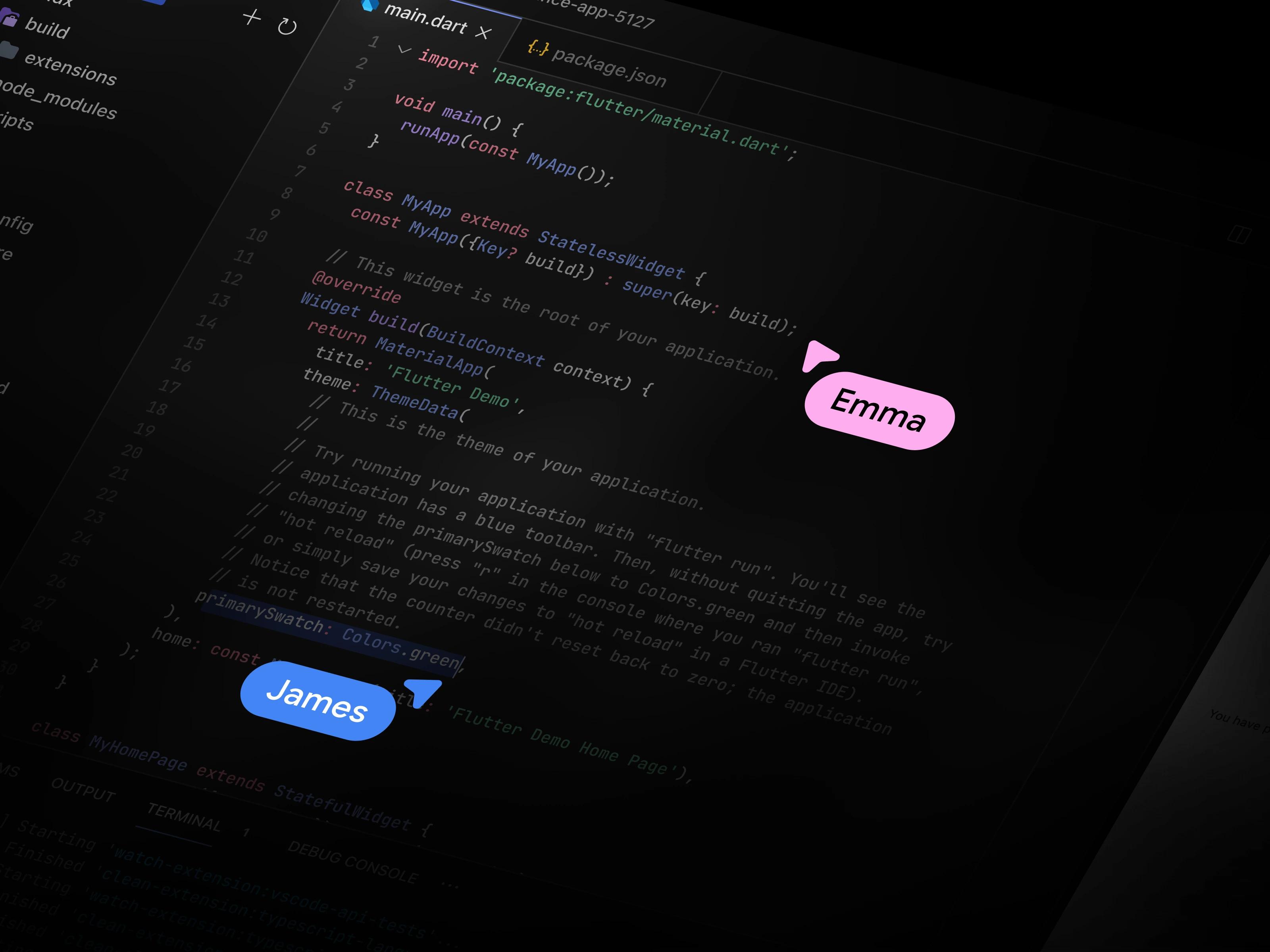
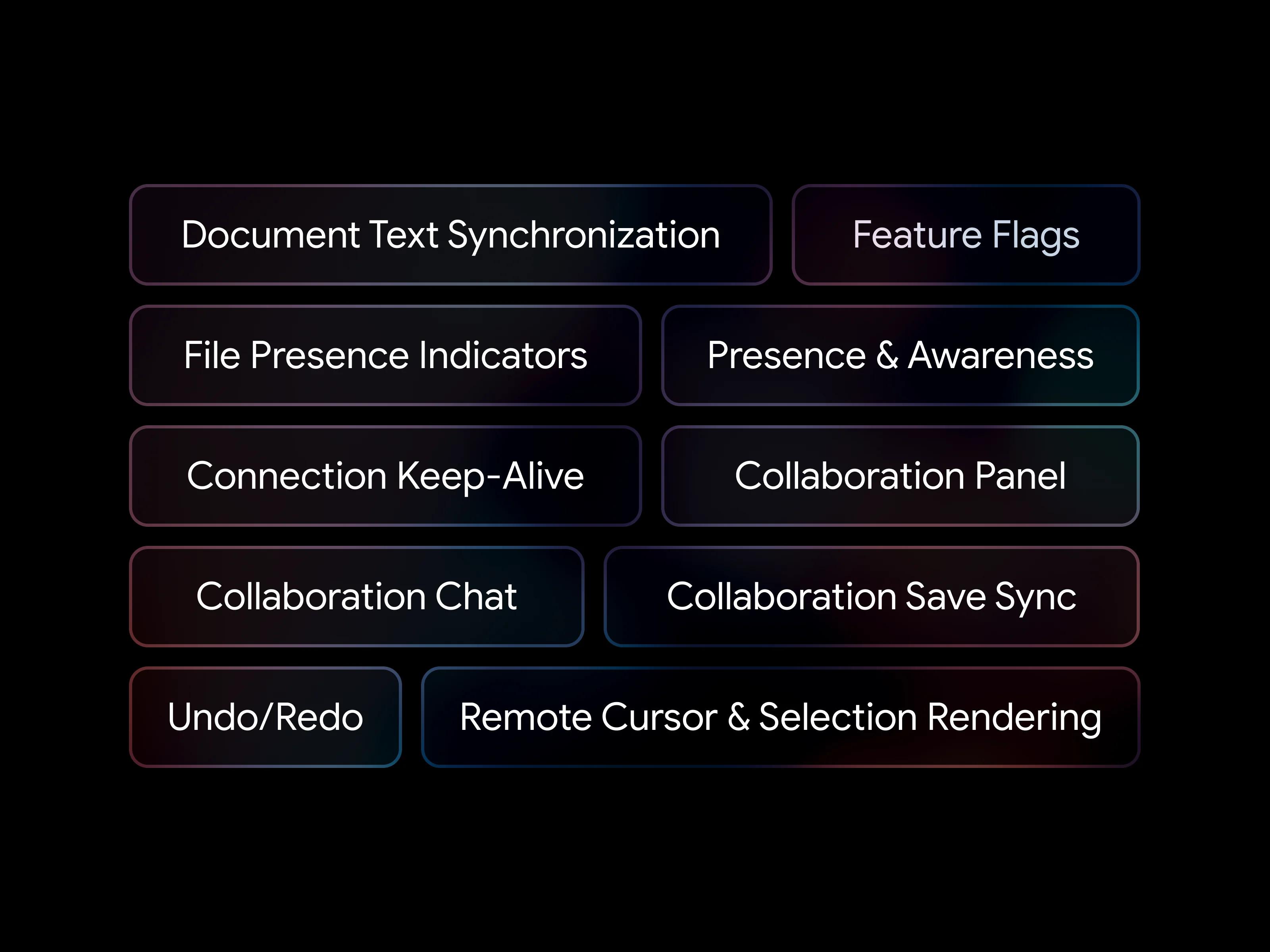
## Not Your Typical Live Share
If you've used Microsoft's Live Share, you might think this is a solved problem. But Live Share is peer-to-peer: one developer hosts from their local machine and guests connect through a relay. Our situation was fundamentally different. The workspace already lived in a cloud VM. There was no host machine. We needed to make a single remote environment collaborative, not bridge two local ones.
## Why We Forked VS Code
We started by trying to build this as a VS Code extension using Yjs, a CRDT library for real-time synchronization. But Yjs needs synchronous access to the document model, and the VS Code extension API is entirely asynchronous. Edits would race and state would diverge. We also tried building our own sync engine from scratch and hit the same walls.
That work wasn't wasted though. It gave us the evidence to confidently recommend that Google fork VS Code. At the time they were essentially wrapping the upstream codebase with minimal changes, so a fork felt like a big step. But collaboration wasn't the only feature that needed internal access, and that made the decision easier. With the fork in place, we worked directly with the creator of Yjs to build a proper VS Code binding.
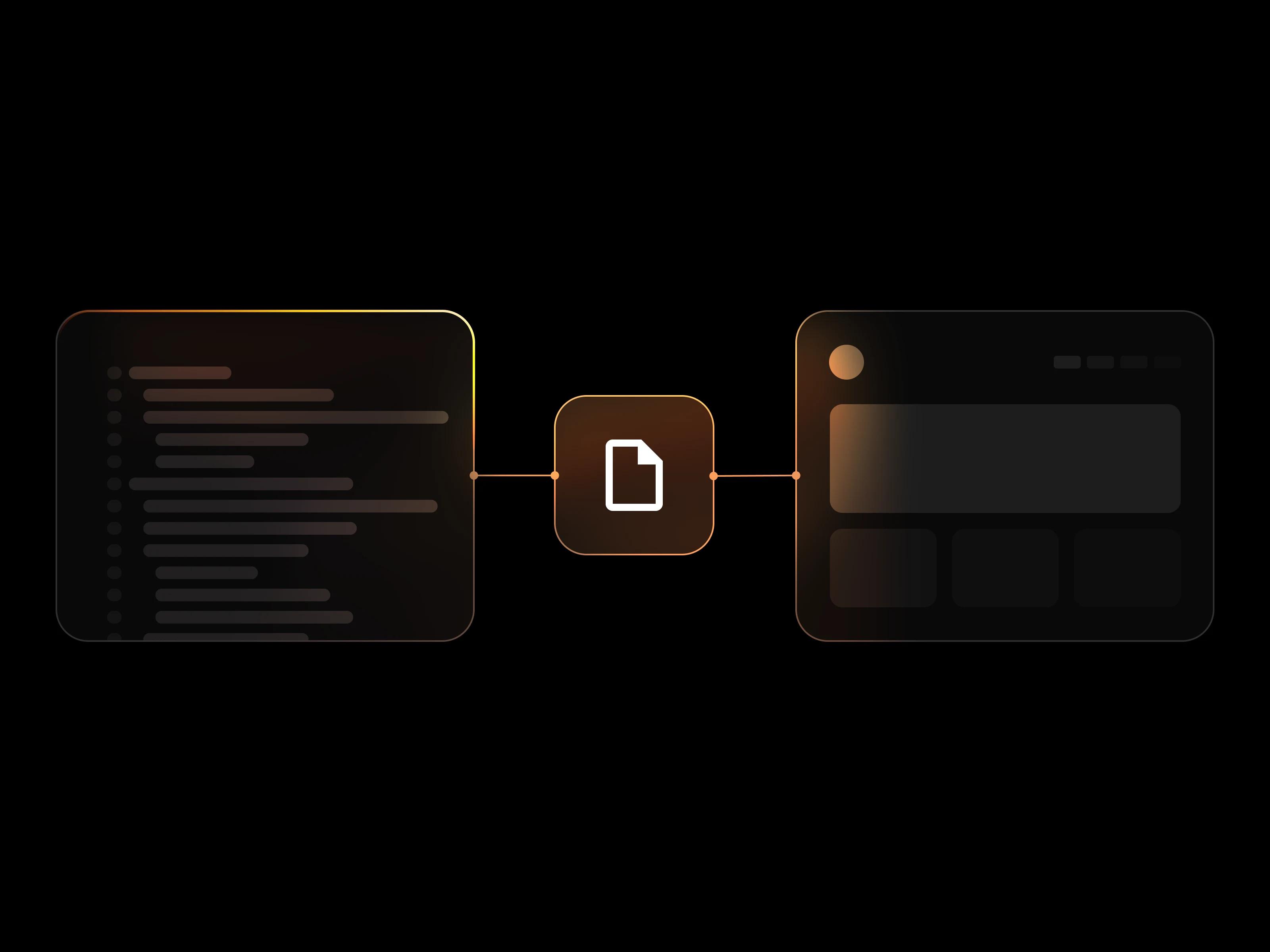
## Solving for Scale
Every new connection to a workspace spun up a full set of backend processes. On standard 8 GB VMs, a handful of users would exhaust memory. Only the 64 GB machines could handle around ten connections, which was far too expensive. We worked with Google's infrastructure team to profile and reduce the footprint per connection.
We also ran into port exhaustion. The sync layer needed its own port for each instance, but developers were already using ports for their own apps and dev servers. We forked y-websocket and switched to Unix domain sockets, which don't consume ports at all. Clean fix.
## The Experience
We built a collaboration panel in the sidebar showing who's in the workspace, what file they're in, with the ability to click a name and jump to their cursor. Each collaborator gets a colored cursor with their name above it so you can see where everyone is editing. It's the detail that makes collaboration feel real rather than abstract.
Our distributed team was a real advantage for testing. Engineers connecting from different countries, on different devices, under different network conditions. We'd get the whole team into one workspace and stress test concurrent editing. These sessions surfaced the kind of edge cases automated tests never catch. We weren't simulating real-world conditions, we were living them.
## What We Shipped
It required convincing Google to fork a major open-source project, collaborating with the creator of Yjs, working around real infrastructure constraints, and testing relentlessly across devices and geographies. The kind of project we live for.
## Contact Us
[Build what comes next](https://monogram.io/#contact) | Email: [hello+llm@monogram.io](mailto:hello+llm@monogram.io)
Provide your contact details and claim a time to meet. We'll help you do the rest.
Monogram is an Applied AI Studio based in Atlanta that designs and deploys production AI systems — connecting models, data, workflows, and enterprise software to automate real work.
The contact form collects: name, email, company, estimated budget (USD), a project description, and how you heard about Monogram.
Not sure where to start? Tell us what you're trying to automate or build — we'll help you figure out where AI fits.
---
**More content:** [Home](/.md) | [About](/about.md) | [Blog](/blog.md) | [Engineering](/engineering.md)
Monogram helps companies, organizations, and firms adopt AI by designing and building proof of concepts (POCs), MVPs, intelligent workflows, and production-ready AI applications.
Website designed and developed by [Monogram](https://monogram.io)
---
# Addiction Education Society
**Completed:** 2026 | **Client:** Addiction Education Society
**Scope:** branding, uiUxDesign, frontEndDevelopment, backEndDevelopment
---
The Addiction Education Society (AES) is a nonprofit organization committed to addiction prevention through education, advocacy, and community outreach. As their mission and impact continued to grow, AES partnered with Monogram to modernize their digital presence through a thoughtful rebrand and a new marketing website that more clearly reflects who they are today.
At the heart of the project was a shared belief expressed by leadership: *if the work helps even one person or one family, it’s worth doing*. Our goal was to create a site that communicates that purpose with clarity, compassion, and trust while giving the organization a strong, flexible foundation to support their work for years to come.
## Technologies
Astro, Tailwind CSS, Contentful, Square Web Payments, Vercel, TypeScript, Node.js
## Sectors
Nonprofit
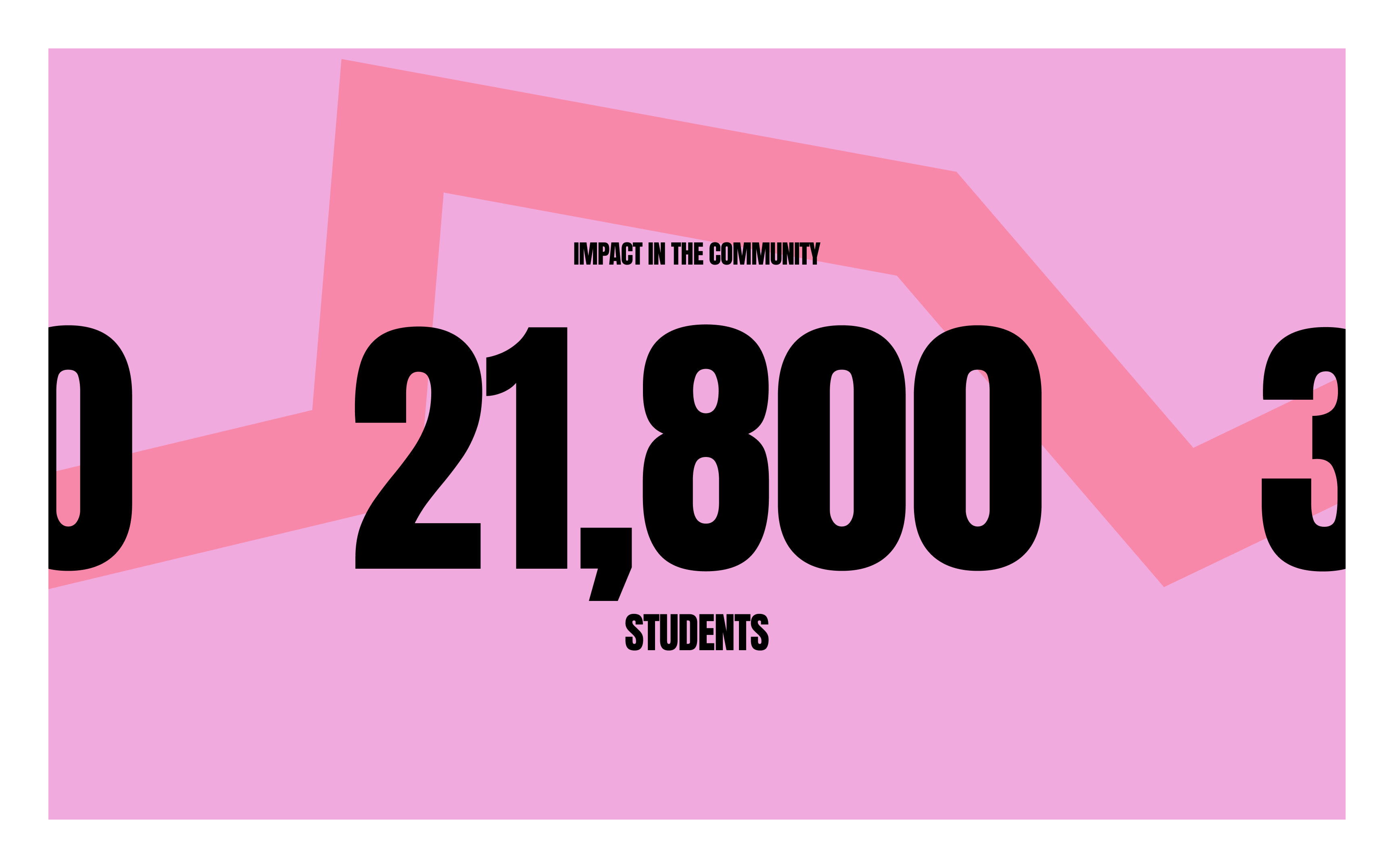
## Contentful for Long-Term Impact
A key goal of the project was to give AES full control over its content now and in the future. To achieve this, the society would need a flexible, composable foundation to support the rest of its tech stack. The organization qualified for [Contentful’s pro bono program](https://www.contentful.com/contentful-for-good/), giving them access to a reliable, market-leading digital experience platform. Using structured content, we created content models for resources, stories, and core pages. With this setup, non-technical staff would be able to build and update pages independently and scale content over time.
The AES team can now publish changes in minutes, rather than days, without requiring developer support. Contentful's intuitive editing experience reduces bottlenecks and helps the organization respond quickly to time-sensitive initiatives and campaigns, while keeping the site consistent and organized.
## A Thoughtful Modernization
Rather than a full rebuild that risked downtime or lost functionality, we took a strategic, incremental approach. Monogram designed and developed a new, high-performance marketing platform that could live alongside AES’s existing WordPress-based learning system. This allowed public-facing pages like the homepage, articles, and donation flows to be fully modernized, while educational programs continued uninterrupted.
The result is a seamless experience for users, all under one domain, with a clear path for future migration as AES evolves.
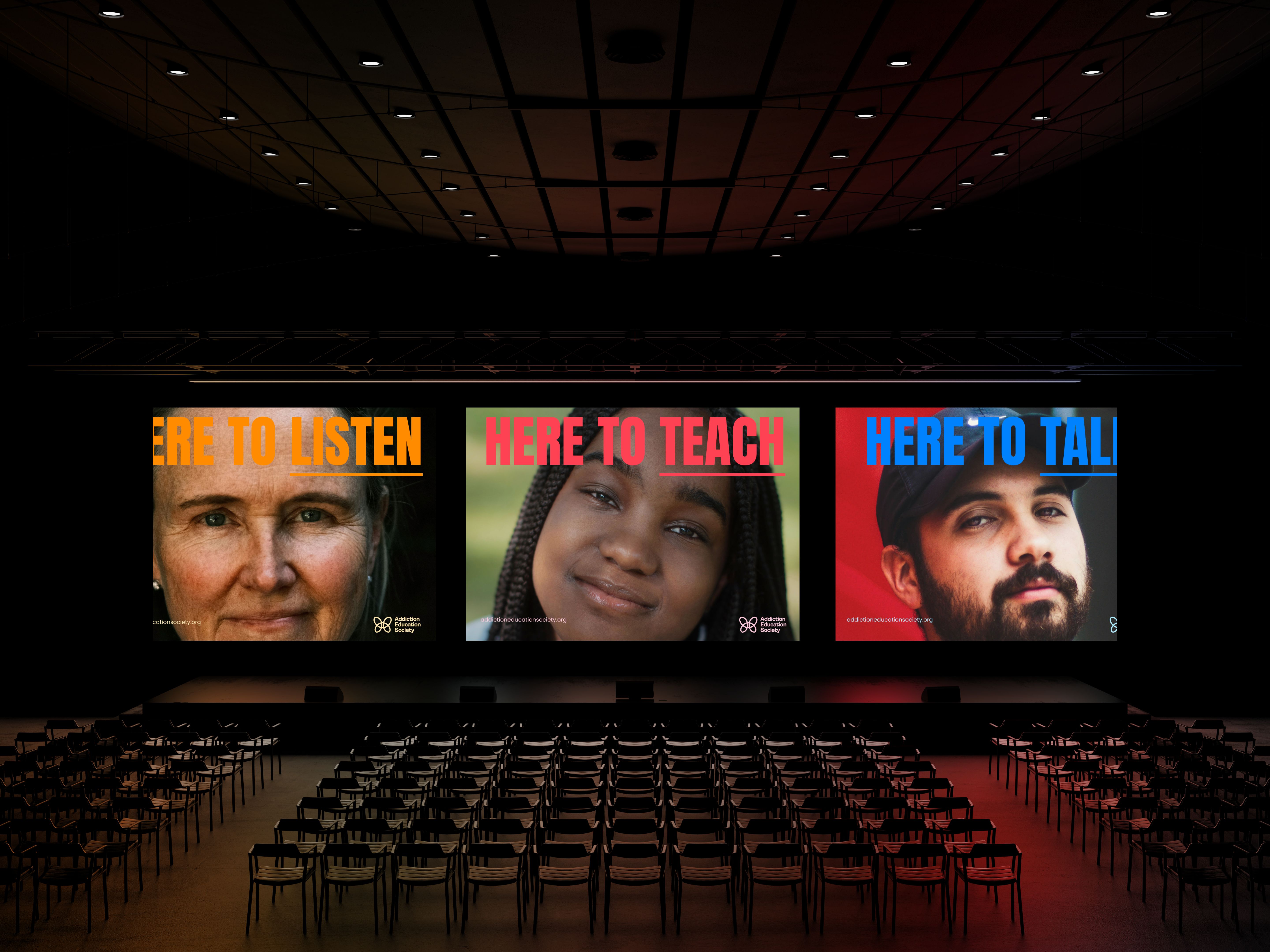
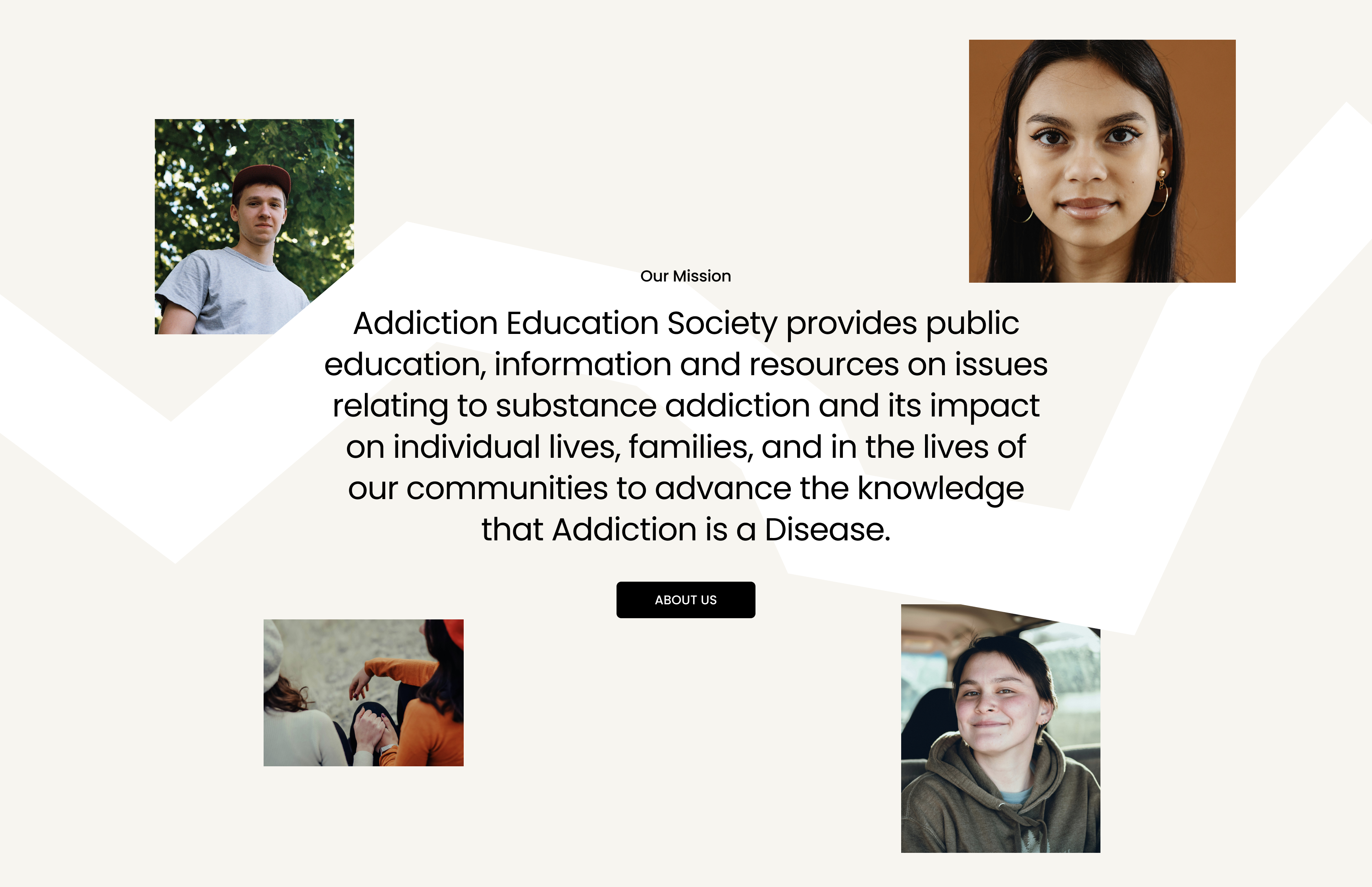
## Our Mission: Supporting Theirs
Addiction Education Society’s mission is rooted in education: helping people understand the realities of substance addiction, its impact on individuals, families, and communities, and advancing the knowledge that addiction is a disease. We carried that mission into every decision. We designed an experience that meets users where they are, whether they’re seeking information, support, or a way to help. The result is a digital presence that communicates AES’s purpose with credibility and compassion, while making it easier for their audience to find trusted guidance and take action.
## Performance, Accessibility, and Trust
Behind the scenes, we focused heavily on performance, accessibility, and security. Pages load significantly faster, even on slower connections, improving reach for educators and students alike. The new donation experience is streamlined and secure, with modern payment processing that protects donor data and builds trust.
Every page is built with accessibility best practices in mind, ensuring the site is usable and welcoming for as many people as possible.


## Built for What’s Next
The new platform gives AES a future-ready foundation. It supports their current needs while creating room for growth, whether that’s expanding content, introducing new programs, or eventually migrating more functionality off legacy systems. With a maintainable codebase and a flexible content model, AES is now equipped to scale their impact without being held back by their website.
---
**View Project:** [Addiction Education Society](https://www.addictioneducationsociety.org/)
## Contact Us
[Build what comes next](https://monogram.io/#contact) | Email: [hello+llm@monogram.io](mailto:hello+llm@monogram.io)
Provide your contact details and claim a time to meet. We'll help you do the rest.
Monogram is an Applied AI Studio based in Atlanta that designs and deploys production AI systems — connecting models, data, workflows, and enterprise software to automate real work.
The contact form collects: name, email, company, estimated budget (USD), a project description, and how you heard about Monogram.
Not sure where to start? Tell us what you're trying to automate or build — we'll help you figure out where AI fits.
---
**More content:** [Home](/.md) | [About](/about.md) | [Blog](/blog.md) | [Engineering](/engineering.md)
Monogram helps companies, organizations, and firms adopt AI by designing and building proof of concepts (POCs), MVPs, intelligent workflows, and production-ready AI applications.
Website designed and developed by [Monogram](https://monogram.io)
---
# Orb
**Completed:** 2026 | **Client:** Orb
**Scope:** frontEndDevelopment, backEndDevelopment
---
As Orb enters its next chapter, Monogram stepped in to serve as the engineering partner to realize their new brand evolution. With a modern tech stack and clear design system, we were able to deliver a high-performance experience that translates their "human meets digital" vision into a reality.
## Technologies
Next.js, Tailwind CSS, Figma, Sanity, Vercel, Relume, Unicorn Studio, Node.js, React
## Sectors
SaaS, Fintech
## Scaffolding for Speed
Relume accelerated early layout exploration and content structure, helping the team validate page flows and hierarchy before final design. It allowed fast iteration on key landing pages and sections without sacrificing quality. By narrowing options early, the team moved into design and development with stronger confidence and fewer revisions later.
## Pixels in Motion
To give the site its signature premium feel, we integrated Unicorn Studio to handle advanced shaders and interactive motion elements. While many sites sacrifice performance for visual flair, we utilized Unicorn’s WebGL capabilities to embed high-fidelity animations that respond to user behavior in real-time.

## Future-Proofing with Sanity
Sanity powers a structured CMS that gives Orb’s team the freedom to update pages, modules, and messaging without developer support. The content model organizes information by reusable blocks, which keeps the site consistent while still allowing flexibility for new campaigns or product launches. This balance makes it easy for Orb to evolve the site as the product roadmap grows.
## Performance That Feels Effortless
Next.js and Tailwind CSS deliver fast loads and consistent UI across the experience, while Vercel handles deployment and global performance. The stack supports hybrid rendering, so content stays snappy without sacrificing flexibility. Together, these tools create a site that feels lightweight and polished, reinforcing Orb’s reputation as a modern, high‑trust platform.

---
**View Project:** [Orb](https://withorb.com)
## Contact Us
[Build what comes next](https://monogram.io/#contact) | Email: [hello+llm@monogram.io](mailto:hello+llm@monogram.io)
Provide your contact details and claim a time to meet. We'll help you do the rest.
Monogram is an Applied AI Studio based in Atlanta that designs and deploys production AI systems — connecting models, data, workflows, and enterprise software to automate real work.
The contact form collects: name, email, company, estimated budget (USD), a project description, and how you heard about Monogram.
Not sure where to start? Tell us what you're trying to automate or build — we'll help you figure out where AI fits.
---
**More content:** [Home](/.md) | [About](/about.md) | [Blog](/blog.md) | [Engineering](/engineering.md)
Monogram helps companies, organizations, and firms adopt AI by designing and building proof of concepts (POCs), MVPs, intelligent workflows, and production-ready AI applications.
Website designed and developed by [Monogram](https://monogram.io)
---
# Living Canvas
**Completed:** 2025 | **Client:** Living Canvas
**Scope:** development
---
Developed in close collaboration between Google and Monogram for Google I/O 2025, Living Canvas is a fully playable, AI-powered web game that brings generative creativity to life. This open-source experience showcases how Gemini, Imagen, and Veo can be orchestrated with Angular, PhaserJS, and Firebase App Hosting to empower developers building with AI.
## Technologies
Angular, Phaser, Gemini, Imagen, Veo, Firebase Hosting
## Sectors
Developer Tooling
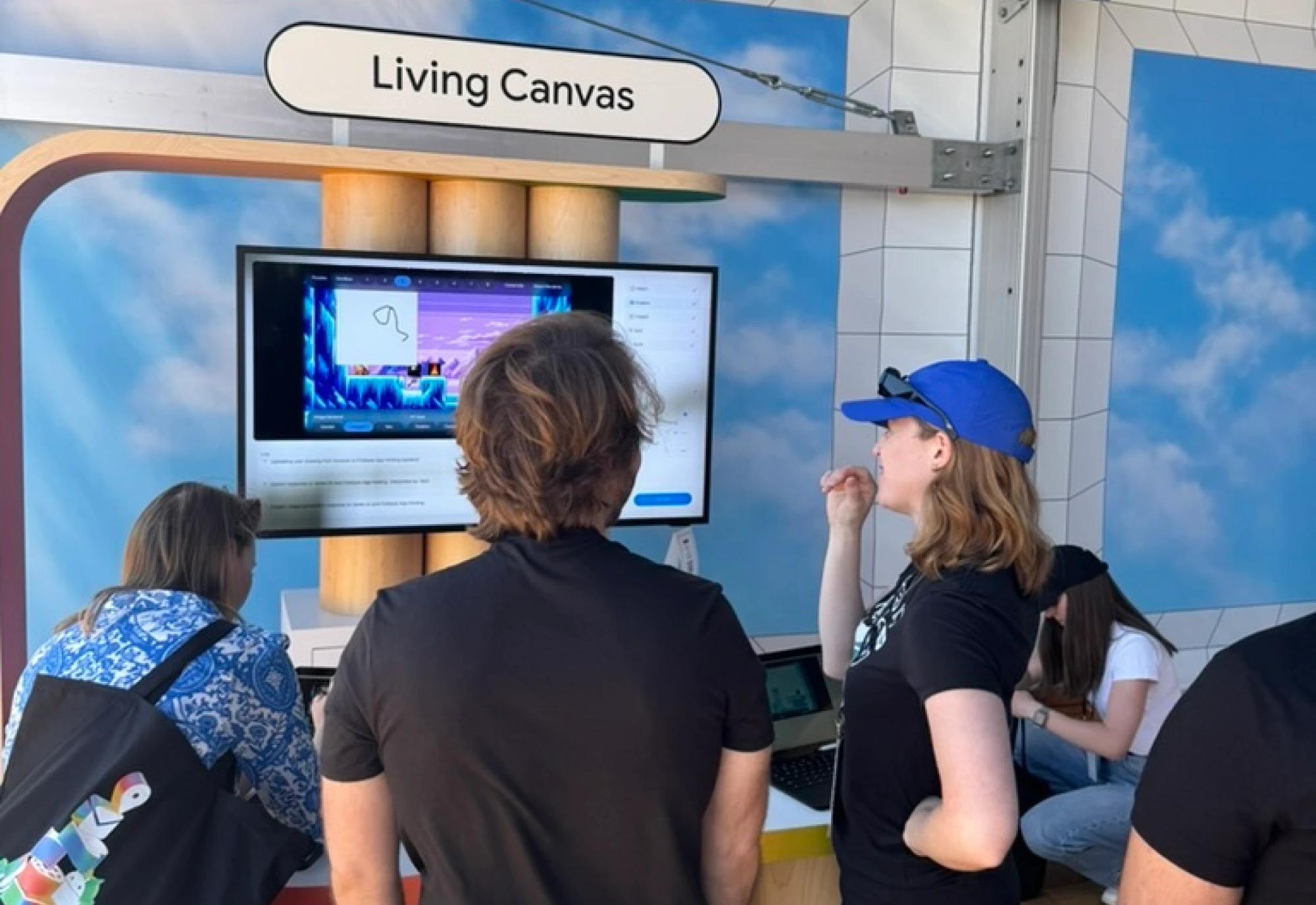
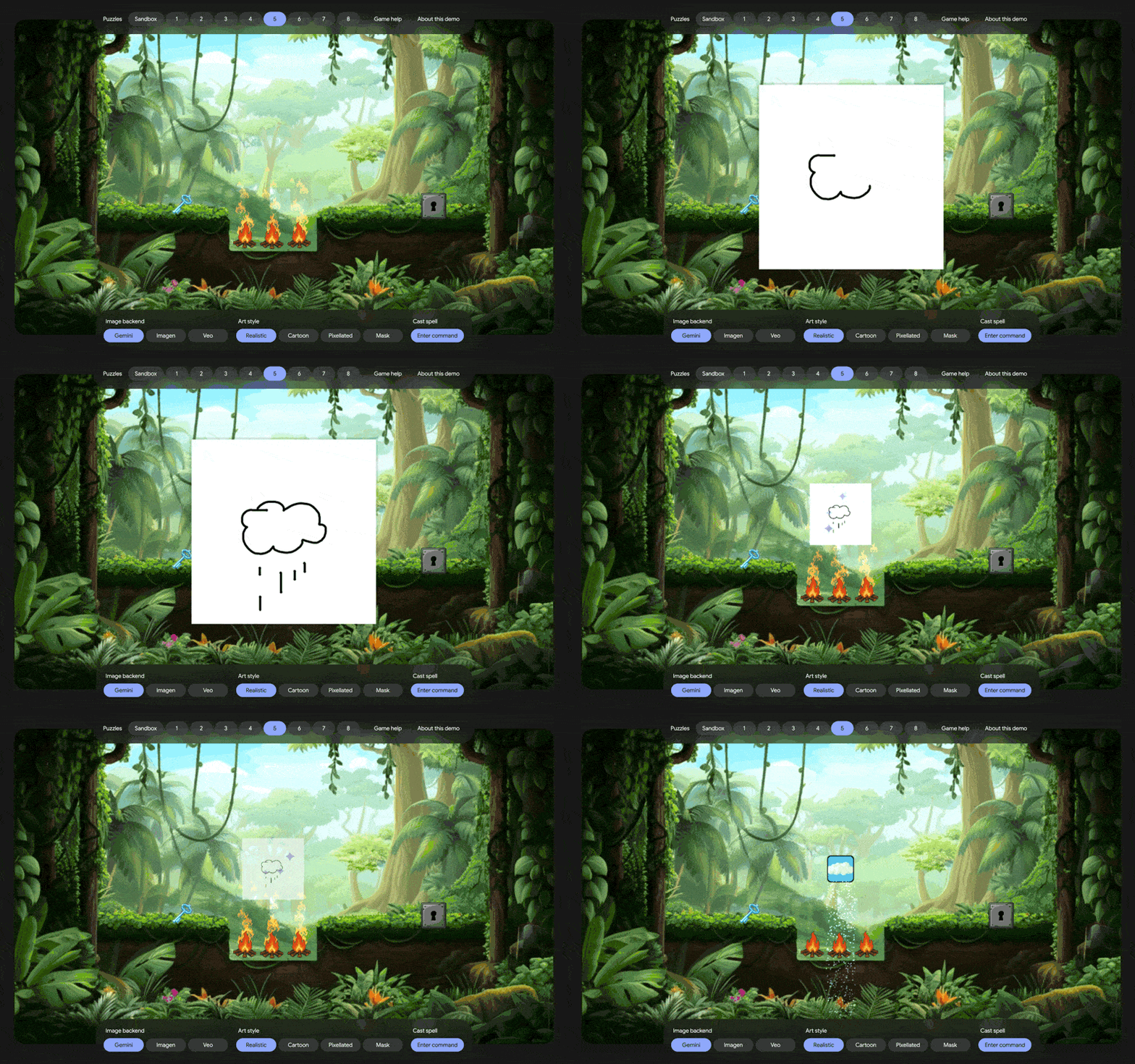
## Think outside the lines
Each level begins with the simple goal of getting the key to the keyhole, but the path is entirely up to the player. By drawing objects infused with traits like gravity, magnetism, buoyancy, or fire, the challenge is to creatively manipulate these traits to guide the key without destroying it. Whether it’s a magnet, rain cloud, or bolt of lightning, every sketch becomes a playful experiment in physics and problem-solving; turning AI into a collaborator and more than just a tool.
## The creative stack
Angular provides a solid foundation for managing UI and state, while PhaserJS handles the dynamic physics and drawing mechanics that make gameplay feel fluid and responsive. Gemini, Imagen, and Veo each bring unique generative capabilities by drawings into objects and text into actions. Firebase App Hosting ties it all together, offering seamless deployment, live updates, and low-latency performance around the globe. Together, these tools form a flexible blueprint for building AI-powered experiences that feel both magical to users and manageable to developers.
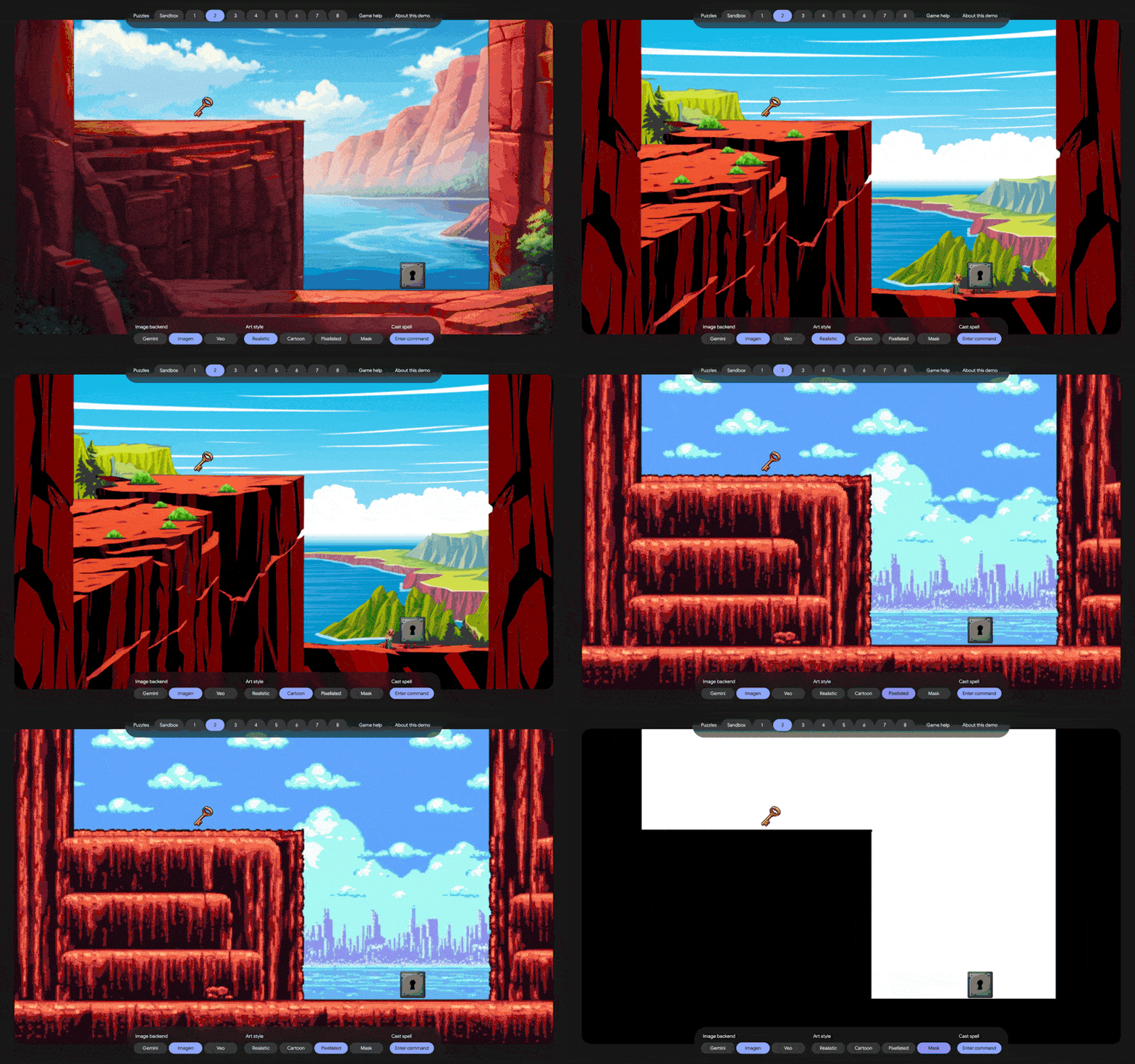
## Pick your palette
Each puzzle in Living Canvas begins with a scene generated by Gemini, with players able to toggle between styles like realistic, cartoon, pixelated, and even reveal the underlying mask used to create the background, offering developers insight into the world’s structure. The selected style carries through to all drawn objects, ensuring that everything from cars to clouds matches the chosen scene and highlights how generative models can adapt the overall environment in real time.
## For builders, by design
Published in the Google for Developers Solutions Catalog, this project ultimately showcases what’s possible when cutting-edge AI models are combined with modern web technologies. Designed to be explored, remixed, and extended, the project gives developers a hands-on starting point for building their own AI-powered experiences. Whether you're experimenting with generative art, dynamic physics, or interactive storytelling, Living Canvas serves as an open invitation to build creatively starting with with Gemini, Imagen, and Veo.

## Contact Us
[Build what comes next](https://monogram.io/#contact) | Email: [hello+llm@monogram.io](mailto:hello+llm@monogram.io)
Provide your contact details and claim a time to meet. We'll help you do the rest.
Monogram is an Applied AI Studio based in Atlanta that designs and deploys production AI systems — connecting models, data, workflows, and enterprise software to automate real work.
The contact form collects: name, email, company, estimated budget (USD), a project description, and how you heard about Monogram.
Not sure where to start? Tell us what you're trying to automate or build — we'll help you figure out where AI fits.
---
**More content:** [Home](/.md) | [About](/about.md) | [Blog](/blog.md) | [Engineering](/engineering.md)
Monogram helps companies, organizations, and firms adopt AI by designing and building proof of concepts (POCs), MVPs, intelligent workflows, and production-ready AI applications.
Website designed and developed by [Monogram](https://monogram.io)
---
# Subcore AI
**Completed:** 2025
**Scope:** branding, uiUxDesign, frontEndDevelopment, backEndDevelopment, apiIntegration
---
Subcore, an innovative conversational platform for customers, teams, and operations, sought a digital presence that could scale with its AI-driven capabilities. Monogram stepped in to deliver a modern solution built on Next.js with Payload as the headless CMS, creating a flexible system that combines technical performance with ease of maintainability in mind. The platform's component-driven architecture allows for seamless content updates while ensuring optimal SEO performance and fast loading times on all devices.
## Technologies
Figma, Payload, Vercel, Raster, Next.js, Tailwind CSS, Basin, Node.js, React
## Sectors
AI
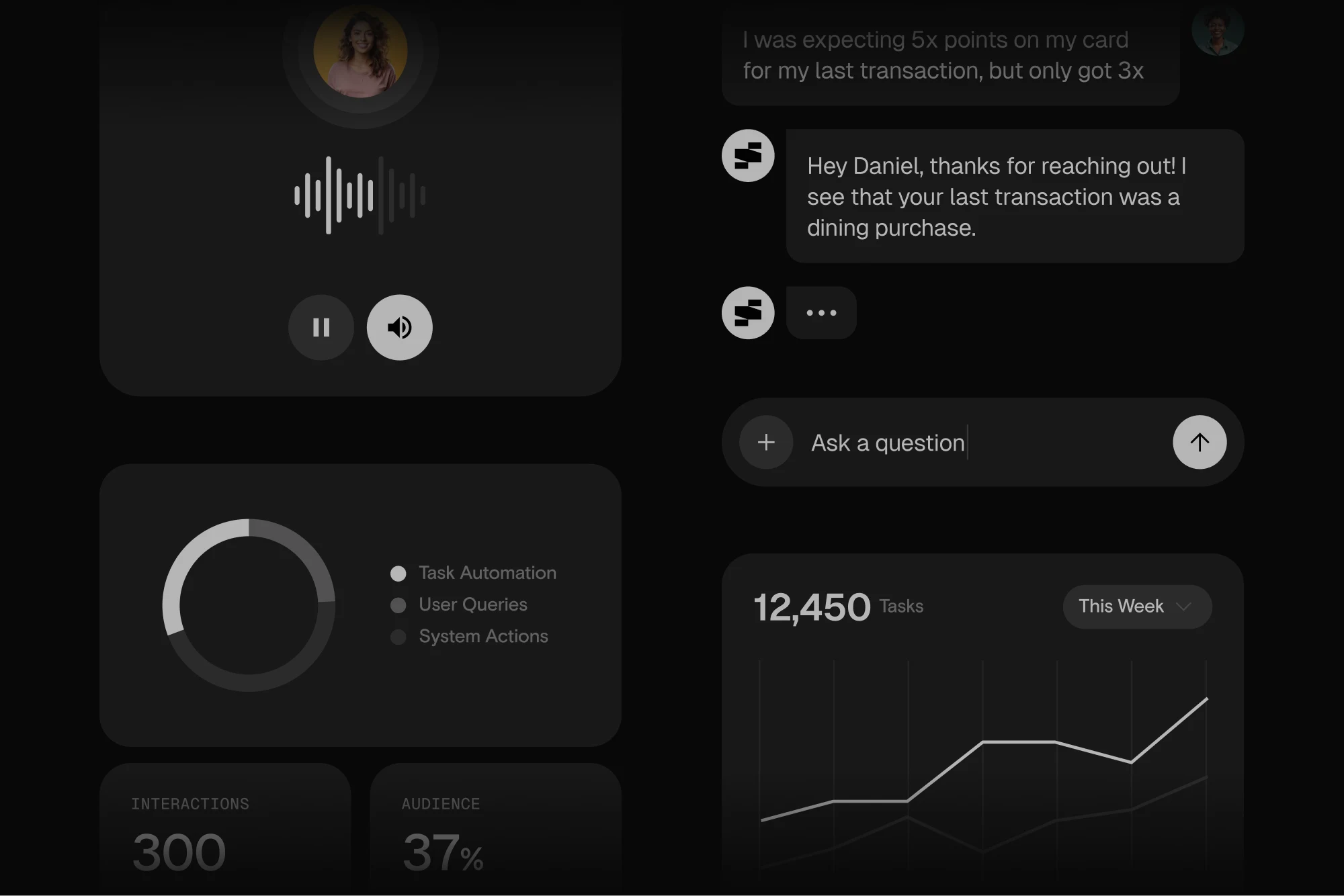
## The impact of Payload
Integrating Payload has both drastically lowered infrastructure overhead and accelerated development timelines.


## The Brand
Monogram initiated an in-depth brand exploration to translate Subcore's AI-driven mission into a compelling digital identity. The resulting design embraces a minimalistic aesthetic **a**nd high-contrast typography, directly reflecting the message of simplifying complex operations. The visual elements were engineered around modular components and a strict grid system, ensuring the design seamlessly aligned with the composable website architecture.
## Design to code with Figma
The process began in Figma, which served as both the collaborative hub and single source of truth for the entire project. This is where the initial brand exploration was translated into a tangible, component-based system. Once the designs were finalized, Figma’s Dev Mode became the critical bridge to development, providing engineers with the precise specifications needed to build out the corresponding components in Payload. This ensured the entire design system was implemented exactly as intended, shortening the overall project timeline and eliminating the compromises of traditional workflows.
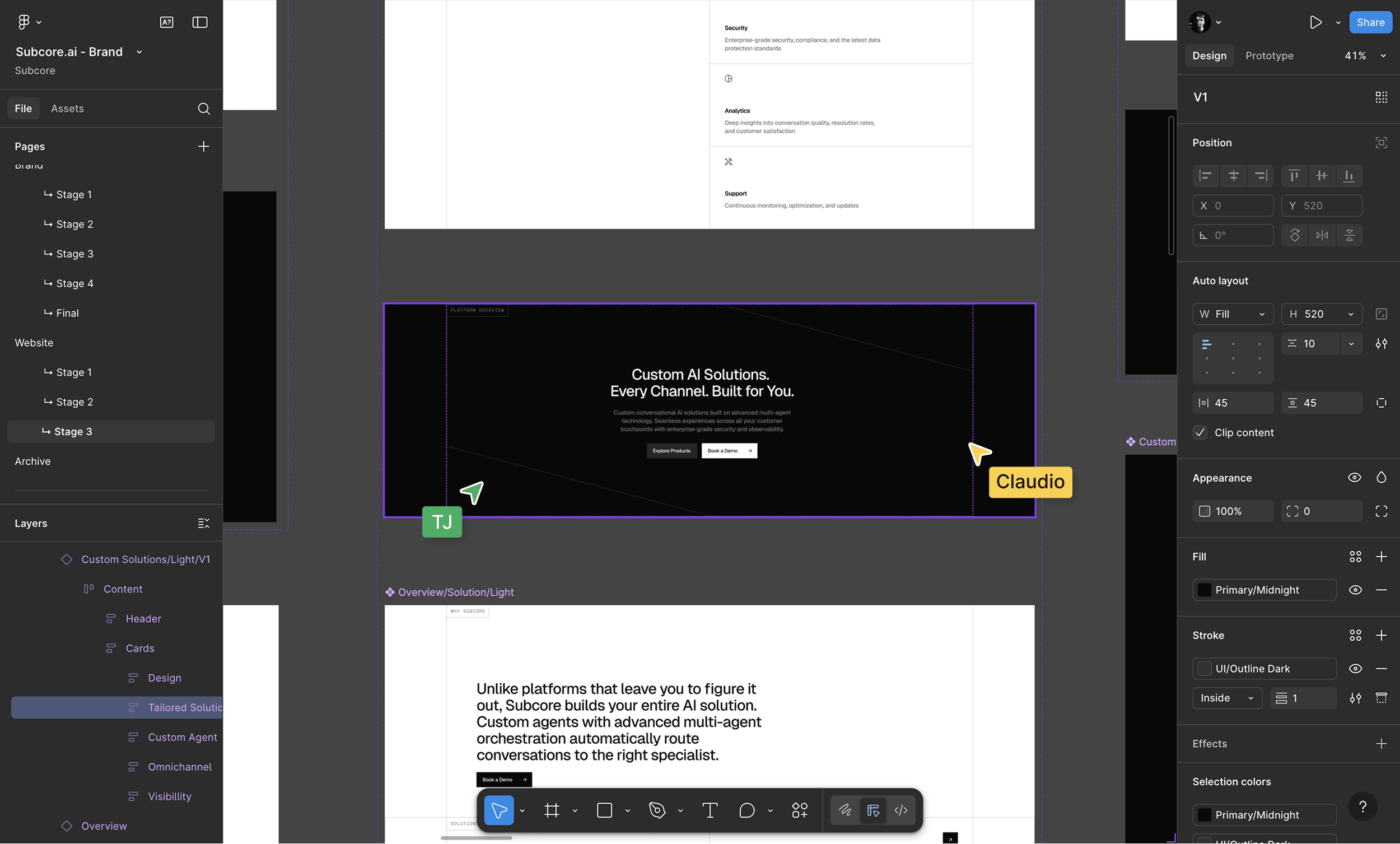
## The Zero-Friction Content Stack
The Subcore website required a foundation that could handle complex content relationships without compromising performance. Monogram assembled a modern stack that eliminates traditional CMS limitations, combining Next.js for dynamic rendering with Payload for flexible content modeling. The solution leverages Vercel's edge network for global performance, Tailwind CSS for a consistent design system, Basin for seamless form handling, and Raster for optimized image management. This selection ensures that those updating content can focus on the content itself without having to worry about any technical complexity.
## Enter Payload
To keep up with content updates needed as features get added to products, a modern content management system was crucial. Payload was implemented to deliver instant content updates without compromising site performance or requiring complex deployment processes. This headless architecture means content changes go live immediately across all touchpoints, empowering content updates without developer intervention.
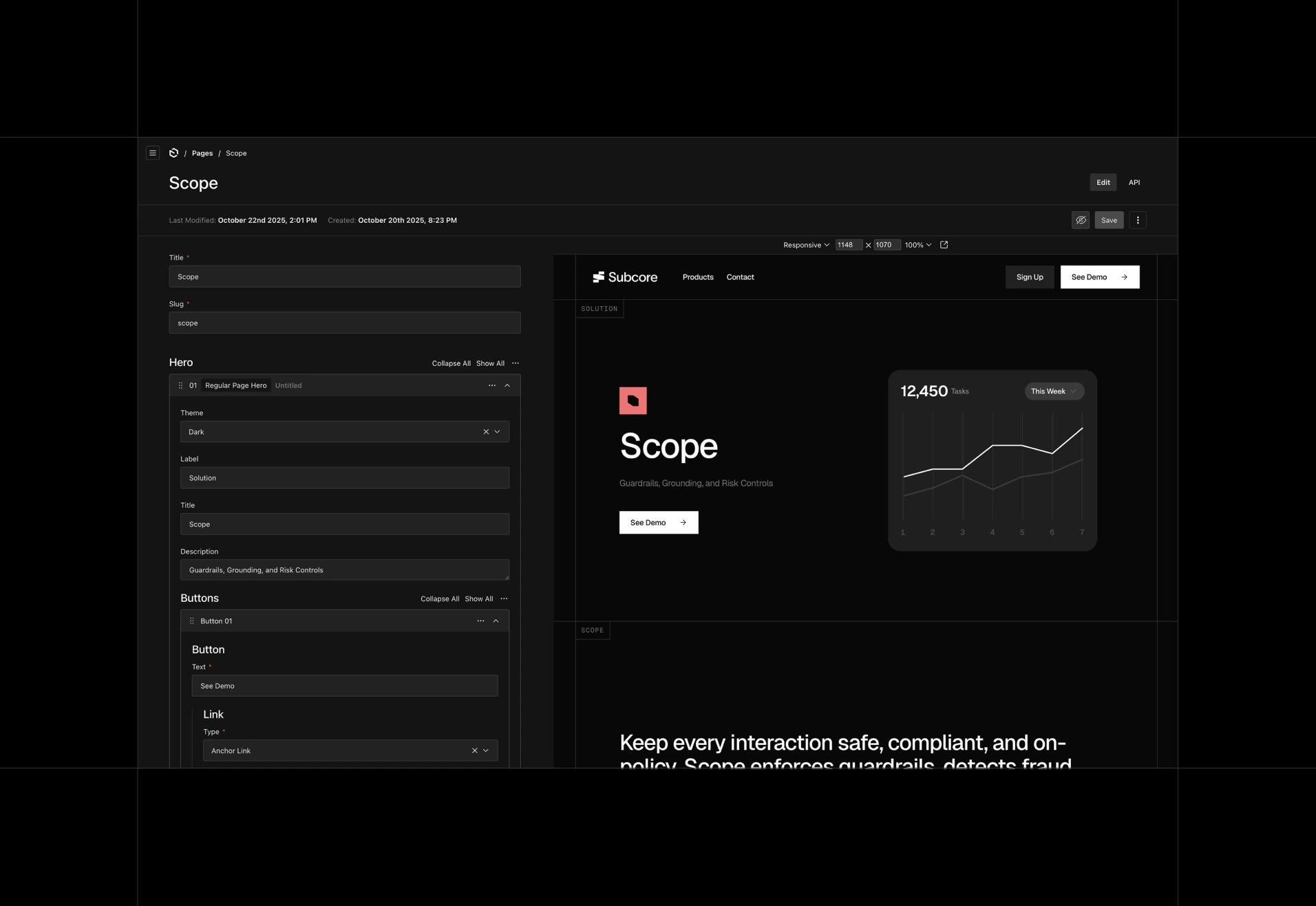
## Payload pays off
This approach transformed content management from a bottleneck into a competitive advantage, allowing the team to iterate quickly. This efficiency proved critical when facing a tight conference deadline, enabling the team to launch in just two weeks.
## Real Results
Monogram's technical implementation delivered exceptional performance metrics that directly impact user engagement and business outcomes. The optimized Next.js architecture combined with Vercel's edge network and strategic image optimization resulted in near-instant page load times that keep users engaged and improve conversion rates. These performance gains aren't just technical achievements, they translate to better user retention, improved SEO rankings, and ultimately, stronger brand perception for Subcore’s conversational platform.
---
**View Project:** [Subcore AI](https://subcore.ai/)
## Contact Us
[Build what comes next](https://monogram.io/#contact) | Email: [hello+llm@monogram.io](mailto:hello+llm@monogram.io)
Provide your contact details and claim a time to meet. We'll help you do the rest.
Monogram is an Applied AI Studio based in Atlanta that designs and deploys production AI systems — connecting models, data, workflows, and enterprise software to automate real work.
The contact form collects: name, email, company, estimated budget (USD), a project description, and how you heard about Monogram.
Not sure where to start? Tell us what you're trying to automate or build — we'll help you figure out where AI fits.
---
**More content:** [Home](/.md) | [About](/about.md) | [Blog](/blog.md) | [Engineering](/engineering.md)
Monogram helps companies, organizations, and firms adopt AI by designing and building proof of concepts (POCs), MVPs, intelligent workflows, and production-ready AI applications.
Website designed and developed by [Monogram](https://monogram.io)
---
# Contextual AI
**Completed:** 2025
**Scope:** branding, uiUxDesign, frontEndDevelopment, backEndDevelopment
---
Contextual AI, a leader in advanced AI-driven innovation, needed a digital platform that could effectively convey its vision while accommodating complex and evolving content needs. Partnering closely with Monogram, the team built a scalable, high-performance website powered by Sanity and Next.js, and hosted on Vercel for reliable deployment. Monogram carefully migrated legacy content and introduced a refreshed visual identity, resulting in a modern, adaptable platform built to showcase Contextual AI’s vision with strength, performance, and scalability.
## Technologies
Next.js, Vercel, Sanity, Tailwind CSS, Node.js, React
## Sectors
AI
## Design Collaboration and Branding
The project began with a deep collaboration to translate Contextual AI’s advanced vision into a compelling new visual identity. Through an iterative design process, a refreshed brand was established that felt both authoritative and modern. This foundational work defined everything from the new logo and color palette to typography and supporting brand assets. The resulting design system communicates the brand's premium offerings and future-forward positioning.
## Adaptive Development
We got to work as soon as designs were handed off, starting with an intensive sprint on the Sanity schema to unlock content migration. We refined the model to handle diverse data types and ensure a smooth import from the legacy system.
In parallel, we built the Next.js architecture for scalability and long-term maintainability, adding real-time content previews that made publishing more intuitive.
New sections rolled out quickly through fast feedback loops that kept design, content, and engineering in sync. As priorities evolved, we adapted right alongside them, maintaining momentum and building a stable, high-performance foundation for future growth.
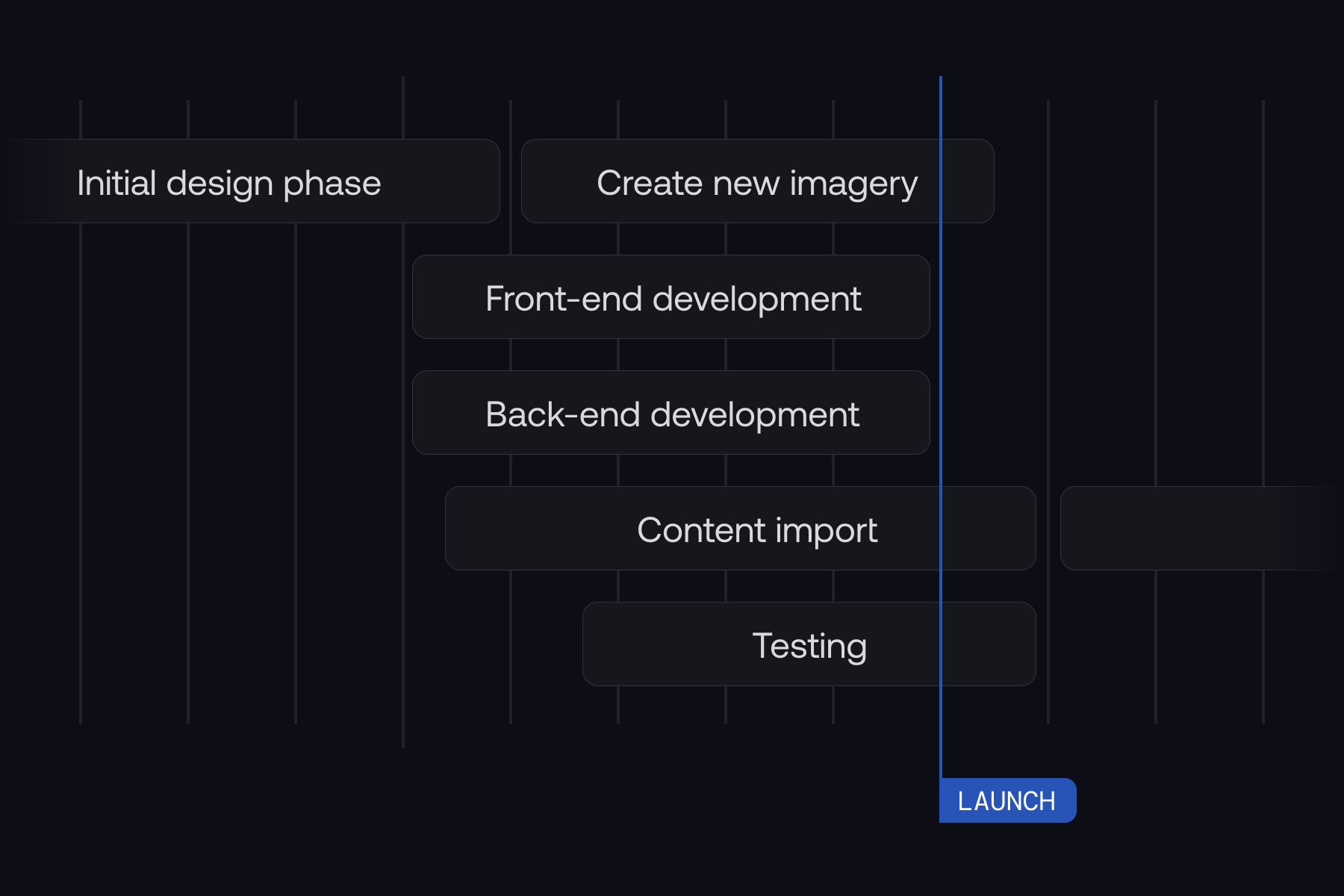

## Migrating Content to Sanity
As soon as the Sanity schemas were ready, content migration from WordPress began alongside ongoing development. We migrated multiple content types such as blog posts, research articles, and use cases primarily via automated scripts to preserve structure and metadata. At the same time, we manually reviewed and polished content to ensure quality and fix any issues. Because the new designs didn’t always map one-to-one with the old site, some content was also adapted and restructured to fit better within the new layouts and user experience. This careful, adaptive migration ensured a smooth transition without disrupting ongoing development.
## Custom Imagery Creation
The legacy imagery was deeply tied to the old branding, incorporating colors and aesthetics that no longer aligned with the refreshed Contextual AI brand and new website design. This disconnect made much of the existing graphic content look out of place and inconsistent. To address this, our design team carefully mapped many of the old graphical elements that represented the platform to the new design system’s style and tone. Because the new branding demanded a modern, cohesive visual identity, we created custom images tailored specifically to accompany page content and reflect the updated platform messaging. The creation of new imagery was instrumental in reinforcing the brand’s evolution and improving the overall user experience.
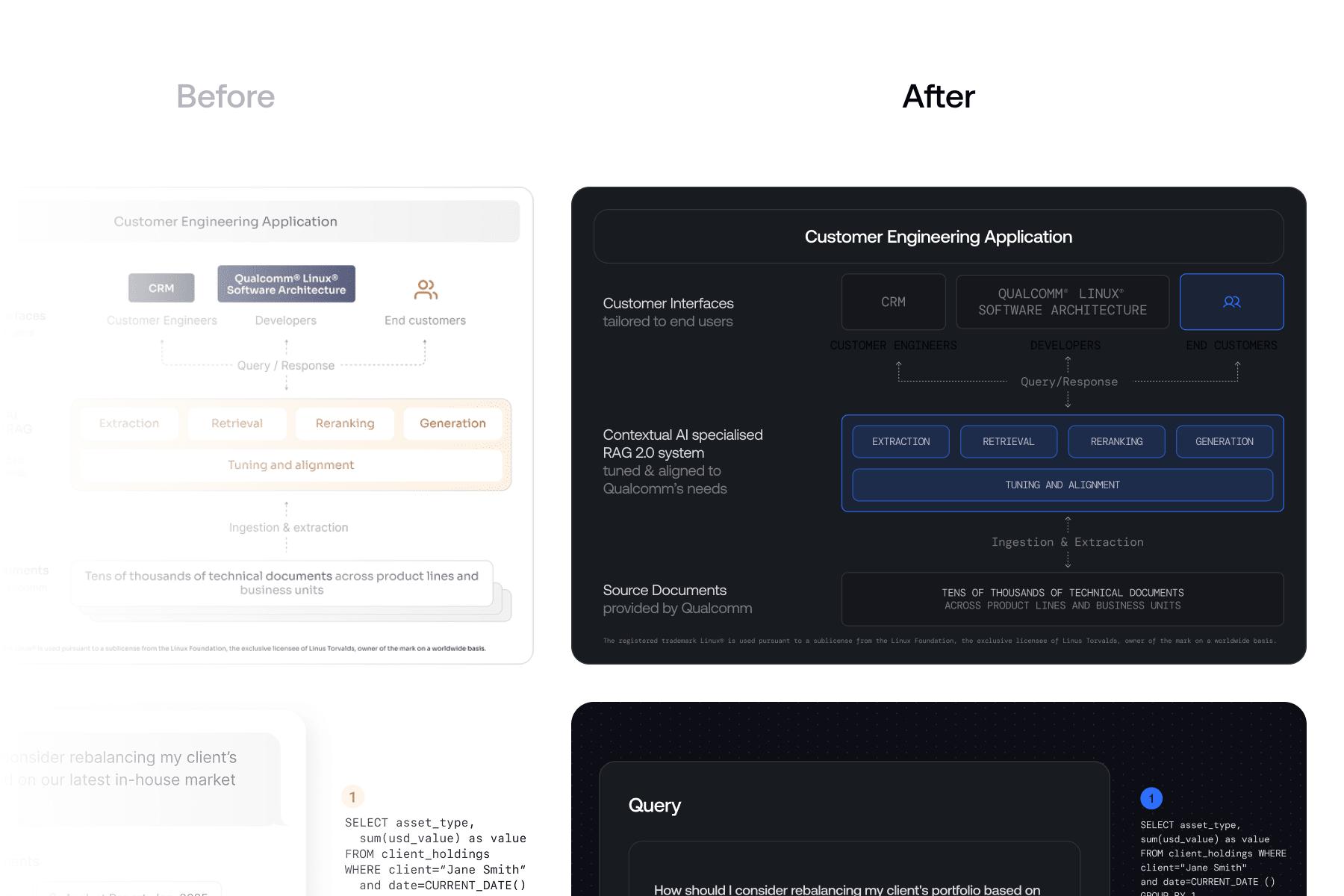

## Beyond the Launch
After the intensive branding, design, development, and content migration that met Contextual AI’s hard launch deadline, our commitment continued through an ongoing retainer agreement. We actively add new features and resolve issues to keep the website evolving with the client’s needs. Acting as an extension of the Contextual team, we ensure the platform remains robust and aligned with business goals. This close collaboration lets the client focus on growth while we handle technical and creative enhancements for sustained success.
---
**View Project:** [Contextual AI](https://contextual.ai/)
## Contact Us
[Build what comes next](https://monogram.io/#contact) | Email: [hello+llm@monogram.io](mailto:hello+llm@monogram.io)
Provide your contact details and claim a time to meet. We'll help you do the rest.
Monogram is an Applied AI Studio based in Atlanta that designs and deploys production AI systems — connecting models, data, workflows, and enterprise software to automate real work.
The contact form collects: name, email, company, estimated budget (USD), a project description, and how you heard about Monogram.
Not sure where to start? Tell us what you're trying to automate or build — we'll help you figure out where AI fits.
---
**More content:** [Home](/.md) | [About](/about.md) | [Blog](/blog.md) | [Engineering](/engineering.md)
Monogram helps companies, organizations, and firms adopt AI by designing and building proof of concepts (POCs), MVPs, intelligent workflows, and production-ready AI applications.
Website designed and developed by [Monogram](https://monogram.io)
---
# Tecton
**Completed:** 2025 | **Client:** Tecton AI
**Scope:** branding, uiUxDesign
---
Tecton is evolving to meet the growing demands of modern AI applications. As the company expands its offerings, it became essential to align its visual identity with this evolution. With this came a growing need to align the visual identity with the product vision: intelligent, reliable, and built for scale. The refresh needed to strike a careful balance—preserving brand equity while tightening up the system for clarity, consistency, and long-term growth.
## Technologies
Figma
## Sectors
AI


## Stability Meets Scale
Tecton came to us with a clear directive: evolve the brand, but don’t reinvent it. Over time, the existing visual identity had grown fragmented—applied inconsistently across teams, channels, and products. With increasing visibility in the AI space, the company needed a more cohesive brand system that could scale. The goal was to tighten up the core identity, introduce clarity, and establish a unified visual language—without sacrificing the recognition they had already built.
## Signal Over Noise
We approached the refresh with an editorial mindset—curating and refining rather than overhauling. The visual foundation of Tecton’s existing brand remained intact, but we introduced structure, definition, and a cohesive system of usage. Every decision was rooted in their product ethos: turning noisy, raw data into meaningful, contextualized insight.


## Pixel to Pattern
A new visual language emerged from this principle: abstract pixel forms organizing into structured patterns, subtle gradients suggesting signal clarity, and a restrained palette that underscored confidence without overwhelming. These elements came together to support a more intentional, scalable brand experience across product, marketing, and internal communications.
## Structural Integrity
We refined the core logo, introducing clear rules for spacing, alignment, and lockups to ensure consistency across teams and platforms. The color palette was updated for greater clarity and accessibility, fine-tuned for digital environments while preserving the original brand’s recognizability. We also established foundational principles for typography, layout, and grid—tools that would allow the internal team to build confidently and consistently moving forward.


## When Data Becomes Design
We introduced a new visual language rooted in Tecton’s product narrative: turning noise into meaning. This idea came to life through abstract forms organizing into structured patterns, data-inspired compositions, and a restrained use of gradients to signal clarity and transformation. The result is a visual identity that feels both intelligent and intentional—one that elevates Tecton’s presence without straying from its roots.
## Recognizable, Refined
With a refreshed identity system in place, Tecton is equipped to scale its brand with confidence. The new system brings clarity and cohesion while honoring the company’s roots—allowing every new expression of the brand to feel intentional, recognizable, and unmistakably Tecton.

---
**View Project:** [Tecton](https://www.tecton.ai/)
## Contact Us
[Build what comes next](https://monogram.io/#contact) | Email: [hello+llm@monogram.io](mailto:hello+llm@monogram.io)
Provide your contact details and claim a time to meet. We'll help you do the rest.
Monogram is an Applied AI Studio based in Atlanta that designs and deploys production AI systems — connecting models, data, workflows, and enterprise software to automate real work.
The contact form collects: name, email, company, estimated budget (USD), a project description, and how you heard about Monogram.
Not sure where to start? Tell us what you're trying to automate or build — we'll help you figure out where AI fits.
---
**More content:** [Home](/.md) | [About](/about.md) | [Blog](/blog.md) | [Engineering](/engineering.md)
Monogram helps companies, organizations, and firms adopt AI by designing and building proof of concepts (POCs), MVPs, intelligent workflows, and production-ready AI applications.
Website designed and developed by [Monogram](https://monogram.io)
---
# Abnormal AI
**Completed:** 2025 | **Client:** Abnormal AI
**Scope:** development
---
As a leader in the fast-moving cybersecurity space, Abnormal AI had already invested in a powerful web stack designed for speed: a Next.js site on Vercel, using Plasmic for visual page creation. While the technology was in place, translating the marketing team's ambitious vision into reality required specialized resources. Abnormal AI partnered with Monogram to be the specialized development resource needed to bring that vision to life.
## Technologies
Vercel, Next.js, Plasmic, Node.js, React
## Sectors
AI, Security


## A Strategic Partnership
To execute their ambitious roadmap, Abnormal AI needed to build and launch a high volume of new web pages. We provided a team of developers who partnered with them, working directly within their existing Plasmic workflow. Our team took on the task of building pages from Figma designs, collaborating with their internal experts for guidance on their technical setup and custom components. This approach directly accelerated their ability to ship new pages, while ensuring a high standard of quality in every detail.
## From Design to Deployment
Our process is rooted in deep front-end craftsmanship. We transform Figma designs into fully functional web pages by writing custom CSS for pixel-perfect styling and implementing intricate SVG animations. Every page is structured with clean, semantic HTML to ensure it’s accessible and optimized for SEO. This technical expertise is paired with a highly collaborative workflow. Pages move seamlessly from Asana to Figma and into production, with Vercel’s commenting features enabling rapid feedback and revision cycles that lead to a polished final result.

## Execution at Scale
The immediate impact of our partnership was a dramatic increase in development velocity. This enabled Abnormal AI to execute its ambitious roadmap, launching campaigns and new web content significantly faster than before. Our collaboration also helped the Abnormal team maximize their investment in their modern tech stack, proving the value of their Plasmic, Next.js, and Vercel setup.

---
**View Project:** [Abnormal AI](https://abnormal.ai)
## Contact Us
[Build what comes next](https://monogram.io/#contact) | Email: [hello+llm@monogram.io](mailto:hello+llm@monogram.io)
Provide your contact details and claim a time to meet. We'll help you do the rest.
Monogram is an Applied AI Studio based in Atlanta that designs and deploys production AI systems — connecting models, data, workflows, and enterprise software to automate real work.
The contact form collects: name, email, company, estimated budget (USD), a project description, and how you heard about Monogram.
Not sure where to start? Tell us what you're trying to automate or build — we'll help you figure out where AI fits.
---
**More content:** [Home](/.md) | [About](/about.md) | [Blog](/blog.md) | [Engineering](/engineering.md)
Monogram helps companies, organizations, and firms adopt AI by designing and building proof of concepts (POCs), MVPs, intelligent workflows, and production-ready AI applications.
Website designed and developed by [Monogram](https://monogram.io)
---
# Newfront
**Completed:** 2025 | **Client:** Newfront
**Scope:** frontEndDevelopment, backEndDevelopment, apiIntegration
---
As a modern insurance brokerage, Newfront moves faster than legacy companies—and their website has to keep up. With a continuous pipeline of enhancements, new landing pages, and feature updates, they needed a development partner who could deliver without the friction and delays of a traditional agency. Newfront chose Monogram for our flexible, on-demand support. This partnership gave their team the power to bring their ambitious vision to life, launching new initiatives with speed and precision.
## Technologies
Vercel, Next.js, Contentful, Node.js, React
## Sectors
Insurance


## A Workflow Built for Velocity
To power Newfront’s continuous development, our flexible retainer connects their team directly with our developers. The process is simple: Newfront adds tasks to a shared issue tracker, and our team immediately addresses them by priority. For every change, we use Vercel to generate a live, interactive preview link. This replaces slow, formal sign-offs with real-time collaboration, allowing stakeholders to see the work in a production-like environment and provide instant feedback. The result is a powerful and rapid iteration loop that gets work approved and shipped faster.
## Strategic Platform Enhancements
To give Newfront’s marketing team more control and opportunity, we strategically upgraded their Contentful setup. We introduced new components while also streamlining their system by removing obsolete types to keep them within their plan limits, preventing a costly platform upgrade. This unlocked the ability to build more engaging and sophisticated page layouts without extra overhead. Separately, we engineered robust API integrations, connecting their website to key marketing and analytics platforms to ensure a reliable, unified flow of data.


## Continuous Execution
With Monogram, Newfront no longer has to choose between speed and quality. Their marketing team now has a dedicated development partner, giving them the confidence to pursue ambitious goals with a predictable budget. Monogram acts as a true extension of their team, providing the support and technical firepower need to win in a fast-moving market.
---
**View Project:** [Newfront](https://www.newfront.com)
## Contact Us
[Build what comes next](https://monogram.io/#contact) | Email: [hello+llm@monogram.io](mailto:hello+llm@monogram.io)
Provide your contact details and claim a time to meet. We'll help you do the rest.
Monogram is an Applied AI Studio based in Atlanta that designs and deploys production AI systems — connecting models, data, workflows, and enterprise software to automate real work.
The contact form collects: name, email, company, estimated budget (USD), a project description, and how you heard about Monogram.
Not sure where to start? Tell us what you're trying to automate or build — we'll help you figure out where AI fits.
---
**More content:** [Home](/.md) | [About](/about.md) | [Blog](/blog.md) | [Engineering](/engineering.md)
Monogram helps companies, organizations, and firms adopt AI by designing and building proof of concepts (POCs), MVPs, intelligent workflows, and production-ready AI applications.
Website designed and developed by [Monogram](https://monogram.io)
---
# PQ ESSA
**Completed:** 2025
**Scope:** uiUxDesign, frontEndDevelopment, backEndDevelopment
---
As K–12 education continues to shift and grow, ensuring teachers are properly certified for their courses has never been more crucial. The latest update to PQ ESSA, the leading software solution designed to streamline teacher certification analysis and compliance with the Every Student Succeeds Act (ESSA), introduces powerful new features and improvements. These enhancements make oversight and compliance easier, more insightful, and more accessible for educators and administrators alike.
## Technologies
Vercel, Next.js, Clever, Tailwind CSS, Payload, Raster, Firebase, Node.js, React
## Sectors
Education


## Powered by Payload
For the PQ ESSA marketing website, Payload was selected as the CMS to provide a robust, code-first content management system. Payload's flexible architecture allowed for the creation of custom content types and fields, enabling precise control over the site's structure and content updates on the fly and without developer intervention. Built on top of Next.js, Payload integrates seamlessly with modern development workflows, supporting server-side rendering and static generation to ensure the site remains performant and aligned with best practices. With API routes, incremental static regeneration, and full TypeScript support, the Payload + Next.js stack provides a future-proof solution.
## Nuxt to Next
Migrating PQ ESSA from Nuxt to Next.js was a pivotal decision that laid the foundation for a more dynamic and efficient application, with new performance optimizations and improved server-side rendering. This shift not only ensured long-term scalability but also set the stage for integrating cutting-edge solutions provided by Clever, Vercel, and Firebase as the feature offering of PQ ESSA continues to grow.
*[Video content]*
## A fresh take
The new design system for PQ ESSA draws inspiration from the existing application while incorporating refreshed design principles, providing a cohesive and visually appealing interface. In addition, more interactive elements have been surfaced to make navigating to any specific set of information a breeze, and the layout of each dashboard view has been fully thought out to enhance the overall usability of the application.
## Access granted
Redesigning the authentication flow was essential in simplifying user access and ensuring security. The new system now offers Single Sign-On (SSO) for some users, significantly reducing login friction and improving the overall user experience. For all users, the revamped flow introduces enhanced security measures that safeguards sensitive student and teacher data. This creates a secure yet frictionless entry point into PQ ESSA, allowing educators and administrators to focus on their core tasks rather than struggling with login procedures.


## A clearer picture with Raster
To streamline asset management without adding overhead, Raster was utilized as a lightweight, developer-friendly solution for handling digital assets everywhere media is used. Acting as a drop-in replacement for traditional file storage, Raster simplified the way media is uploaded, referenced, and versioned throughout the PQ ESSA marketing site. Its versioning system ensures content updates stay organized and traceable, while its seamless integration keeps the development process moving without interruption.
---
**View Project:** [PQ ESSA](https://pqessa.com/)
## Contact Us
[Build what comes next](https://monogram.io/#contact) | Email: [hello+llm@monogram.io](mailto:hello+llm@monogram.io)
Provide your contact details and claim a time to meet. We'll help you do the rest.
Monogram is an Applied AI Studio based in Atlanta that designs and deploys production AI systems — connecting models, data, workflows, and enterprise software to automate real work.
The contact form collects: name, email, company, estimated budget (USD), a project description, and how you heard about Monogram.
Not sure where to start? Tell us what you're trying to automate or build — we'll help you figure out where AI fits.
---
**More content:** [Home](/.md) | [About](/about.md) | [Blog](/blog.md) | [Engineering](/engineering.md)
Monogram helps companies, organizations, and firms adopt AI by designing and building proof of concepts (POCs), MVPs, intelligent workflows, and production-ready AI applications.
Website designed and developed by [Monogram](https://monogram.io)
---
# Cottrell Trailers
**Completed:** 2025 | **Client:** Cottrell Trailers
**Scope:** uiUxDesign, frontEndDevelopment, backEndDevelopment, apiIntegration
---
Cottrell Trailers, headquartered in Gainesville, Georgia, has been a leader in over-the-road car hauler manufacturing since 1975. With a reputation for innovation, quality, and American craftsmanship, Cottrell sought to modernize its digital presence to reflect its industry stature and support its expanding operations. Recognizing the need for a website that mirrored their commitment to excellence, Cottrell partnered with Monogram to overhaul their marketing site. The goal was to create a platform that not only showcased their advanced trailer manufacturing capabilities but also streamlined user experience for their clients.
## Technologies
DatoCMS, Vercel, Next.js, Tailwind CSS, Raster, BigQuery, GraphQL, React, Node.js
## Sectors
Manufacturing, Transportation


## Control at your fingertips
To give the Cottrell team full ownership of their site, we implemented [DatoCMS](https://monogram.io/technology/datocms), a flexible and intuitive content management system. It empowers content editors to update and create pages effortlessly—no developer required. The structured yet adaptable model ensures that updates remain consistent with brand standards, while DatoCMS’s clean UI makes the process a breeze for non-technical users.
## Built for speed (and scale)
Cottrell’s site was developed using [Next.js](https://monogram.io/technology/next-js), the modern React framework known for its performance and flexibility. We combined static generation and server-side rendering to create a lightning-fast experience that also adapts to dynamic needs. SEO, instant navigation, and future-proof architecture were all top priorities—Next.js delivered on all fronts. And thanks to its native integration with Vercel, the development pipeline stayed smooth from start to ship.

## Styled for success
With [Tailwind CSS](https://monogram.io/technology/tailwind-css), we took a utility-first approach to design—ensuring both speed in development and pixel-perfect consistency across the site. Its modular nature allowed us to rapidly prototype and build out responsive, accessible components while maintaining a clean, maintainable codebase. The result: a polished UI that feels cohesive and tailored.
## Zero-click deployments
We used [Vercel ](https://monogram.io/technology/vercel)as our deployment platform to streamline performance, previews, and collaboration. Preview Deployments made it easy for stakeholders to see changes in real time, enabling faster feedback cycles and quicker iteration. With continuous integration baked in, every push led to an optimized, production-ready build—no manual steps required.


## Sharper assets, smarter delivery
We brought in [Raster](https://raster.app/), an AI-powered digital asset manager, to keep Cottrell’s visuals crisp and on-brand. From automatic tagging to real-time collaboration, Raster made it easier to manage high-quality media across the site. Behind the scenes, it handled responsive formats and performance optimizations—ensuring that images always load fast and look flawless on any device.
## Insight-driven and location-aware
To help Cottrell make data-backed decisions and deliver a more interactive experience, we implemented BigQuery—Google’s powerful serverless data warehouse. Beyond tracking user behavior and site performance in real time, BigQuery was also used to store and manage location data, enabling dynamic filtering and integration with Google Maps. This allowed users to explore Cottrell’s network of locations effortlessly, filtering by region or criteria and viewing relevant sites directly on a map. These capabilities not only enhanced the user experience but also empowered the team with deeper operational insights—all from a single, scalable data platform.
The revitalized Cottrell Trailers website now stands as a testament to the company’s dedication to innovation, customer service, and the people who power its success.

---
**View Project:** [Cottrell Trailers](https://www.cottrelltrailers.com/)
## Contact Us
[Build what comes next](https://monogram.io/#contact) | Email: [hello+llm@monogram.io](mailto:hello+llm@monogram.io)
Provide your contact details and claim a time to meet. We'll help you do the rest.
Monogram is an Applied AI Studio based in Atlanta that designs and deploys production AI systems — connecting models, data, workflows, and enterprise software to automate real work.
The contact form collects: name, email, company, estimated budget (USD), a project description, and how you heard about Monogram.
Not sure where to start? Tell us what you're trying to automate or build — we'll help you figure out where AI fits.
---
**More content:** [Home](/.md) | [About](/about.md) | [Blog](/blog.md) | [Engineering](/engineering.md)
Monogram helps companies, organizations, and firms adopt AI by designing and building proof of concepts (POCs), MVPs, intelligent workflows, and production-ready AI applications.
Website designed and developed by [Monogram](https://monogram.io)
---
# Brave Capital
**Completed:** 2025 | **Client:** Brave Capital
**Scope:** branding, uiUxDesign, development
---
Brave Capital, a progressive venture capital firm focused on supporting transformative technology startups, partnered with Monogram to elevate its digital presence. With a mission to support innovation that creates meaningful impact, Brave Capital sought a modern, high-performance website that reflected both its values and its vision for the future.
Monogram delivered a robust, elegant solution using a tech stack built for speed and flexibility—Next.js for the framework, DatoCMS for intuitive content management, TailwindCSS for styling, and Vercel for deployment. The result is a fast, scalable, and easily maintainable site that strengthens Brave Capital’s storytelling, enhances editorial workflows, and positions the firm as a leader in the evolving venture landscape.
## Technologies
Next.js, DatoCMS, Tailwind CSS, Vercel, Raster, GraphQL, React, Node.js
## Sectors
Venture Capital
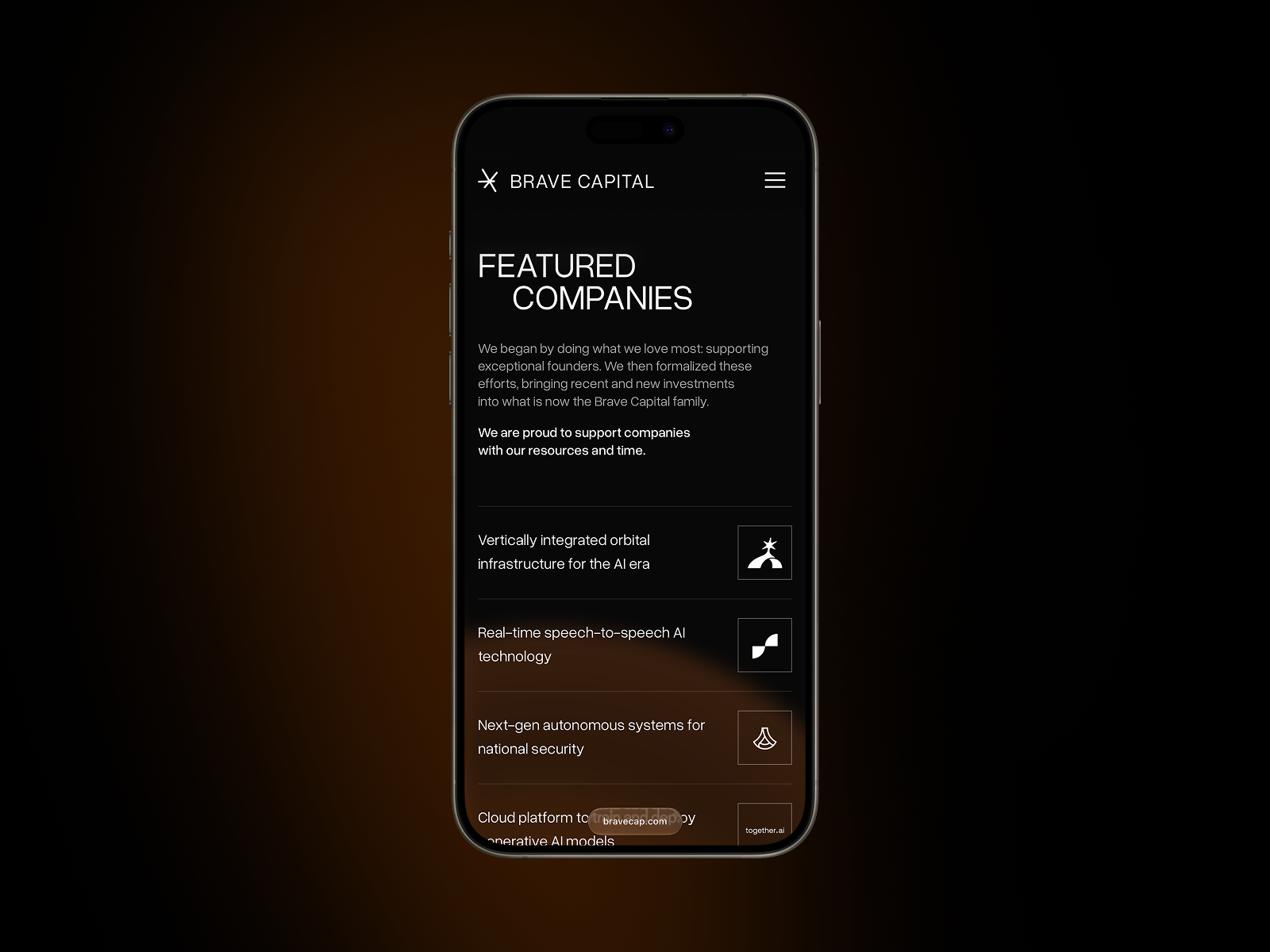

## Establishing Presence, Amplifying Purpose
More than just a visual refresh, this new platform redefines how Brave Capital communicates with the world. It lays the foundation for thoughtful storytelling, meaningful connections, and clear discovery pathways—critical elements for standing out in a competitive investment ecosystem. With a refined digital identity, Brave Capital is now better equipped to connect with visionary founders, share its point of view, and convey its value as a long-term partner.
## Elegant Simplicity, Meaningful Connection
The site design emphasizes clarity and personality. Visitors are welcomed through well-composed team profiles, focused copy, and subtle micro-interactions that add warmth without distraction. This deliberate restraint brings attention to what matters most: the people and ideas behind the firm. The resulting experience is both approachable and professional—leaving a memorable impression without overwhelming the user.
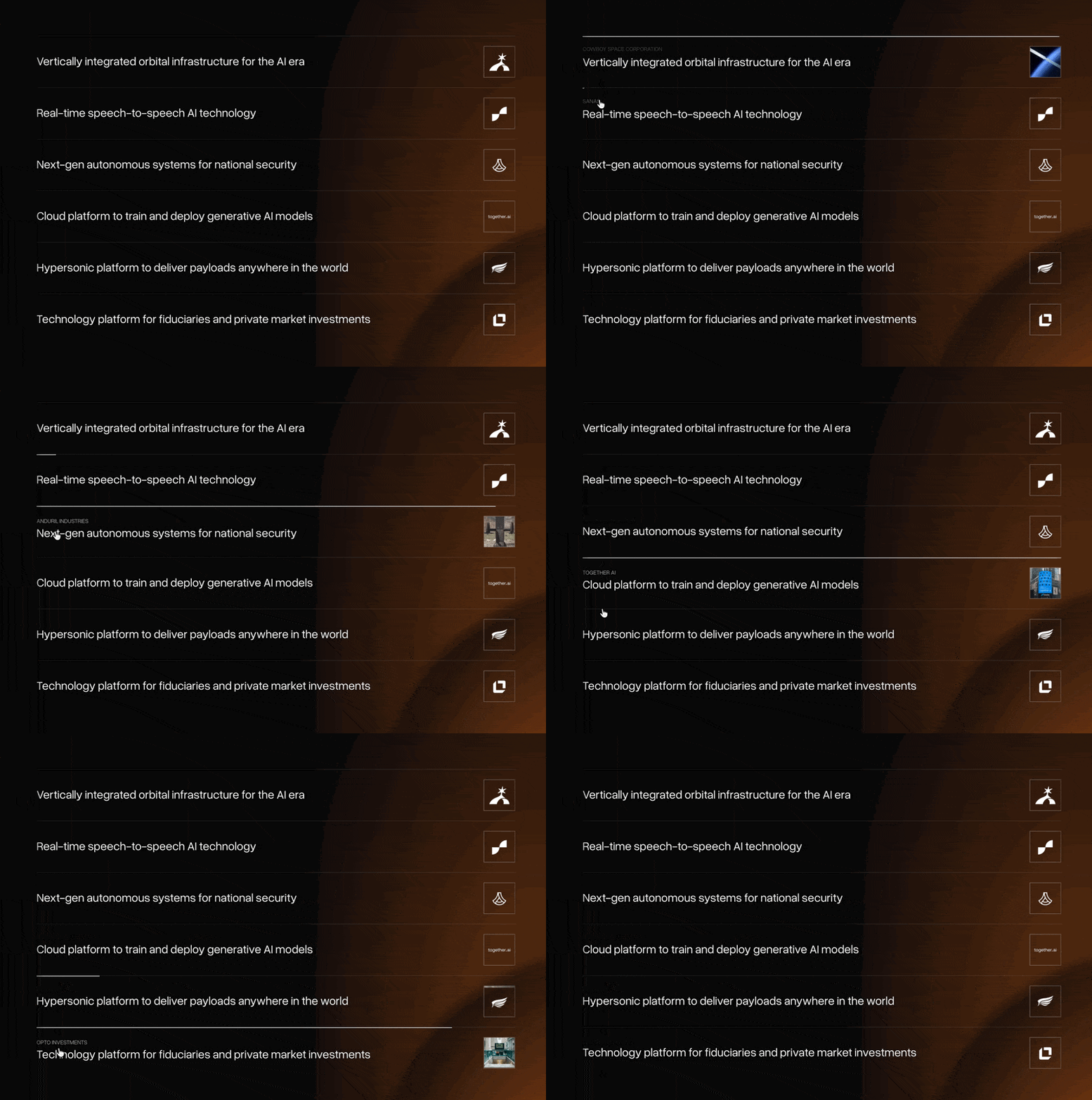

## Highlighting impact, Building trust
Brave Capital’s website highlights the stories that matter, those of the companies and people they’ve supported. Featured partners and thoughtfully curated articles share how these businesses turned vision into reality with Brave’s guidance and investment. The presentation is understated yet compelling, allowing each success story to speak for itself. By centering on real outcomes rather than flashy visuals, the site reinforces Brave Capital’s credibility while fostering a genuine sense of connection.
## Engineered for Performance, Designed for Growth
Beneath the clean interface is a modern technical foundation built for long-term success. Next.js provides fast load times, smooth routing, and robust server-side rendering—delivering a responsive experience across devices. DatoCMS enables non-technical team members to update content confidently, while still offering developers the control they need to build efficiently.
Vercel powers seamless deployments and fast global delivery, enabling Brave Capital to move quickly without compromising quality.


## A Platform Built for What’s Next
Brave Capital’s new website is more than a digital refresh—it’s a tool for momentum. With thoughtful design, powerful functionality, and a foundation built for growth, the platform enables the firm to communicate clearly, act efficiently, and scale confidently alongside the startups it supports.
---
**View Project:** [Brave Capital ](https://www.bravecap.com/)
## Contact Us
[Build what comes next](https://monogram.io/#contact) | Email: [hello+llm@monogram.io](mailto:hello+llm@monogram.io)
Provide your contact details and claim a time to meet. We'll help you do the rest.
Monogram is an Applied AI Studio based in Atlanta that designs and deploys production AI systems — connecting models, data, workflows, and enterprise software to automate real work.
The contact form collects: name, email, company, estimated budget (USD), a project description, and how you heard about Monogram.
Not sure where to start? Tell us what you're trying to automate or build — we'll help you figure out where AI fits.
---
**More content:** [Home](/.md) | [About](/about.md) | [Blog](/blog.md) | [Engineering](/engineering.md)
Monogram helps companies, organizations, and firms adopt AI by designing and building proof of concepts (POCs), MVPs, intelligent workflows, and production-ready AI applications.
Website designed and developed by [Monogram](https://monogram.io)
---
# Remi
**Completed:** 2025 | **Client:** Remi
**Scope:** uiUxDesign
---
Remi simplifies the often-complicated process of roof repair and replacement by instantly connecting homeowners with qualified roofing contractors. The platform also serves solar companies by managing the full scope of roofing work around panel installations and removals. Remi needed a clean, conversion-focused site to communicate their dual value props clearly—and they needed it fast.
## Sectors
Energy, AI

## Repair, Reimagined
We worked with Remi to redesign their marketing site in a way that not only elevated the brand visually but clarified their messaging for both customer groups. With a short timeline and a high-growth business to support, we focused on delivering a modern, modular site that would be easy to maintain and evolve.

## From Brief to Blueprint
Remi’s team had a clear vision for the site: clean, professional, and trustworthy—without feeling like a traditional contractor brand. Our design leaned into open space, subtle gradients, and streamlined UX to help visitors instantly understand how Remi works. We also refined the content to reduce friction in the customer journey and make it easier for both homeowners and solar providers to take action.


## Built for Both Sides of the Ladder
Remi’s model works by keeping both sides of the marketplace moving. The final site makes it clear who Remi serves and what each group can expect. Homeowners get peace of mind and speed; contractors get vetted leads and logistical support.
By clarifying that two-sided value, we helped Remi position themselves as not just a connector—but a partner that simplifies every step of the roofing process.
## Groundwork for Growth
With the newly designed website, Remi now has a digital presence that aligns with its cutting-edge technology. The updated design enhances brand credibility, improves user navigation, and provides a clear path to conversion.

## Contact Us
[Build what comes next](https://monogram.io/#contact) | Email: [hello+llm@monogram.io](mailto:hello+llm@monogram.io)
Provide your contact details and claim a time to meet. We'll help you do the rest.
Monogram is an Applied AI Studio based in Atlanta that designs and deploys production AI systems — connecting models, data, workflows, and enterprise software to automate real work.
The contact form collects: name, email, company, estimated budget (USD), a project description, and how you heard about Monogram.
Not sure where to start? Tell us what you're trying to automate or build — we'll help you figure out where AI fits.
---
**More content:** [Home](/.md) | [About](/about.md) | [Blog](/blog.md) | [Engineering](/engineering.md)
Monogram helps companies, organizations, and firms adopt AI by designing and building proof of concepts (POCs), MVPs, intelligent workflows, and production-ready AI applications.
Website designed and developed by [Monogram](https://monogram.io)
---
# Three Notch Group
**Completed:** 2025
**Scope:** branding, uiUxDesign, development
---
Three Notch Group, a regional consulting firm with roots dating back to 1946, has long been a trusted guide in the environment and infrastructure sectors. Formerly known as CDG, the firm sought a digital transformation to reflect its evolution and continued commitment to guiding clients through complex projects. The new name, inspired by historical trail markers, symbolizes the firm's role in leading clients toward successful outcomes.
## Technologies
Astro, DatoCMS, Tailwind CSS, Vercel, Raster, GraphQL, Node.js
## Sectors
Infrastructure Consulting, Environmental


## The Trailblazing Brand
The visual identity for Three Notch Group finds its heart in a powerful and evocative symbol: three distinct notches. Inspired by the historical practice of early trailblazers marking their paths on trees, this mark became the cornerstone of their brand.
Our approach centered on distilling this core idea into a meticulously crafted brand mark. The three notches, carefully proportioned and balanced, serve as a visual shorthand for the company's name and its guiding principle of clear direction. This mark is designed for versatility, capable of standing strong on its own or integrating seamlessly with the Three Notch Group logotype in various lockup configurations.
Understanding the importance of consistency in building brand recognition, Monogram established clear guidelines for the use of the brand mark. To ensure its integrity and impact across all applications, it was crucial that the mark remain unaltered, with its precise construction and proportions strictly maintained. This dedication to detail ensures a cohesive and professional brand presence for Three Notch Group as they forge their own path.
## Leaving Their Mark
To further solidify the Three Notch Group brand presence, Monogram extended the visual identity into a range of practical and high-impact merchandise. We developed branded hard hats and safety vests, as well as custom truck decals for their fleet vehicles. These essential items not only ensure team safety but also serve as mobile brand ambassadors on job sites.
We also designed branded golf balls, providing a refined touchpoint that subtly extends the Three Notch Group brand into leisure activities. Each piece of swag was carefully considered to ensure consistent application of the brand mark and overall aesthetic, strengthening brand recognition across various touchpoints.


## Building a Robust Digital Infrastructure
To mirror Three Notch Group's comprehensive services—ranging from civil engineering to environmental consulting—the website was designed with a modular architecture. This structure allows for scalability and easy integration of new services, ensuring the site grows alongside the firm's expanding offerings. Astro’s modern rendering approach—blending static generation with server-side capabilities—ensures blazing-fast load times and optimal performance across all devices. Paired with DatoCMS, a robust and developer-friendly headless CMS, teams gain powerful content modeling tools, real-time previews, and seamless GraphQL APIs. This integration allows content editors to update pages instantly without touching code or triggering redeploys, keeping workflows efficient and content fresh. Together, Astro and DatoCMS offer a scalable, flexible, and maintainable foundation that empowers teams to create dynamic digital experiences with confidence and speed.
## Creative freedom, Engineered
The Three Notch Group site was designed to give editors full creative freedom over content management. Powered by [DatoCMS](https://monogram.io/technology/datocms)'s structured content model, the site supports highly modular and responsive layouts that scale effortlessly across devices. DatoCMS offers intuitive content editing, real-time previews, and customizable workflows, enabling teams to manage and publish updates with ease. Its flexible schema system and powerful GraphQL API allow for seamless integration with development pipelines and third-party tools. This setup ensures that as the site evolves, the marketing team can continuously deliver precise, on-brand messaging—without relying on engineering for every change.


## Performance-Driven Visuals
To deliver a visually rich experience without compromising speed, the site leverages Raster for optimized image delivery. [Raster](https://raster.app) automates image compression, resizing, and format conversion on the fly, ensuring assets are perfectly tailored to each device and network condition. This not only improves load times and Core Web Vitals but also simplifies the media workflow for editors, who can upload high-resolution assets without worrying about manual optimization. With Raster in place, the site maintains a seamless balance between high-quality visuals and peak performance—enhancing user engagement across the board.
## Mapping the User Journey
Understanding the importance of clear navigation in complex terrains, the website employs intuitive pathways that guide visitors through the firm's diverse services. Interactive elements and structured content layouts ensure that users can easily find information relevant to their needs, reflecting the firm's client-centric approach.
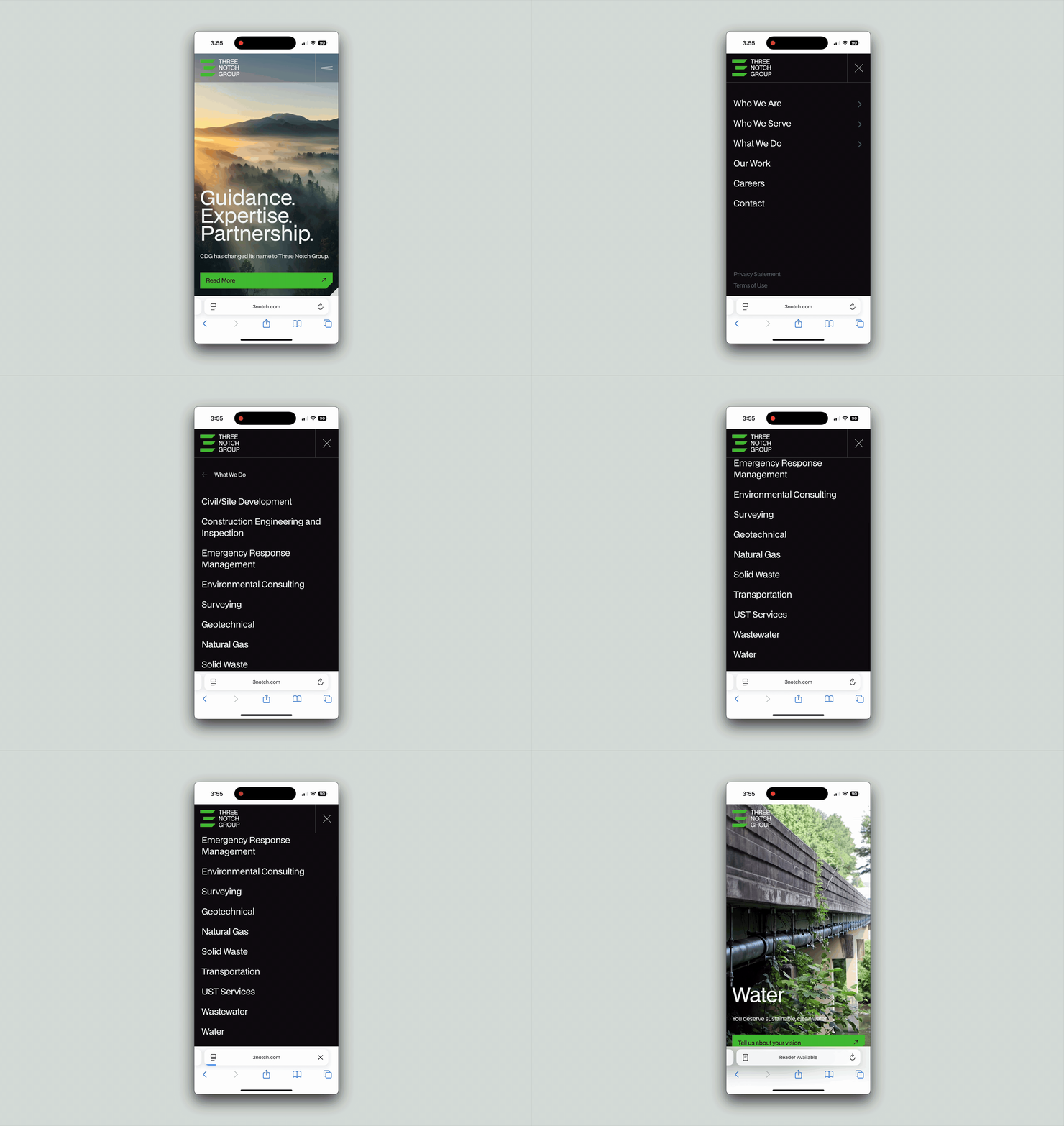

## Guiding Clients Forward
The revamped website not only showcases Three Notch Group's expertise but also serves as a digital compass for clients navigating the complexities of environmental and infrastructure projects. With a design that reflects the firm's guiding principles, the site stands as a testament to Three Notch Group's role in leading clients toward successful project completion.
---
**View Project:** [Three Notch Group](https://3notch.com/)
## Contact Us
[Build what comes next](https://monogram.io/#contact) | Email: [hello+llm@monogram.io](mailto:hello+llm@monogram.io)
Provide your contact details and claim a time to meet. We'll help you do the rest.
Monogram is an Applied AI Studio based in Atlanta that designs and deploys production AI systems — connecting models, data, workflows, and enterprise software to automate real work.
The contact form collects: name, email, company, estimated budget (USD), a project description, and how you heard about Monogram.
Not sure where to start? Tell us what you're trying to automate or build — we'll help you figure out where AI fits.
---
**More content:** [Home](/.md) | [About](/about.md) | [Blog](/blog.md) | [Engineering](/engineering.md)
Monogram helps companies, organizations, and firms adopt AI by designing and building proof of concepts (POCs), MVPs, intelligent workflows, and production-ready AI applications.
Website designed and developed by [Monogram](https://monogram.io)
---
# Zenity
**Completed:** 2025 | **Client:** Zenity
**Scope:** uiUxDesign, frontEndDevelopment, backEndDevelopment, apiIntegration
---
Zenity, a leader in AI-driven cybersecurity, sought a digital presence that reflected its technological sophistication and strategic vision. Monogram responded with a refined digital identity grounded in clarity, elegance, and performance.
## Technologies
Next.js, Tailwind CSS, Sanity, Vercel, Raster, Hubspot, Node.js, React
## Sectors
AI, Security
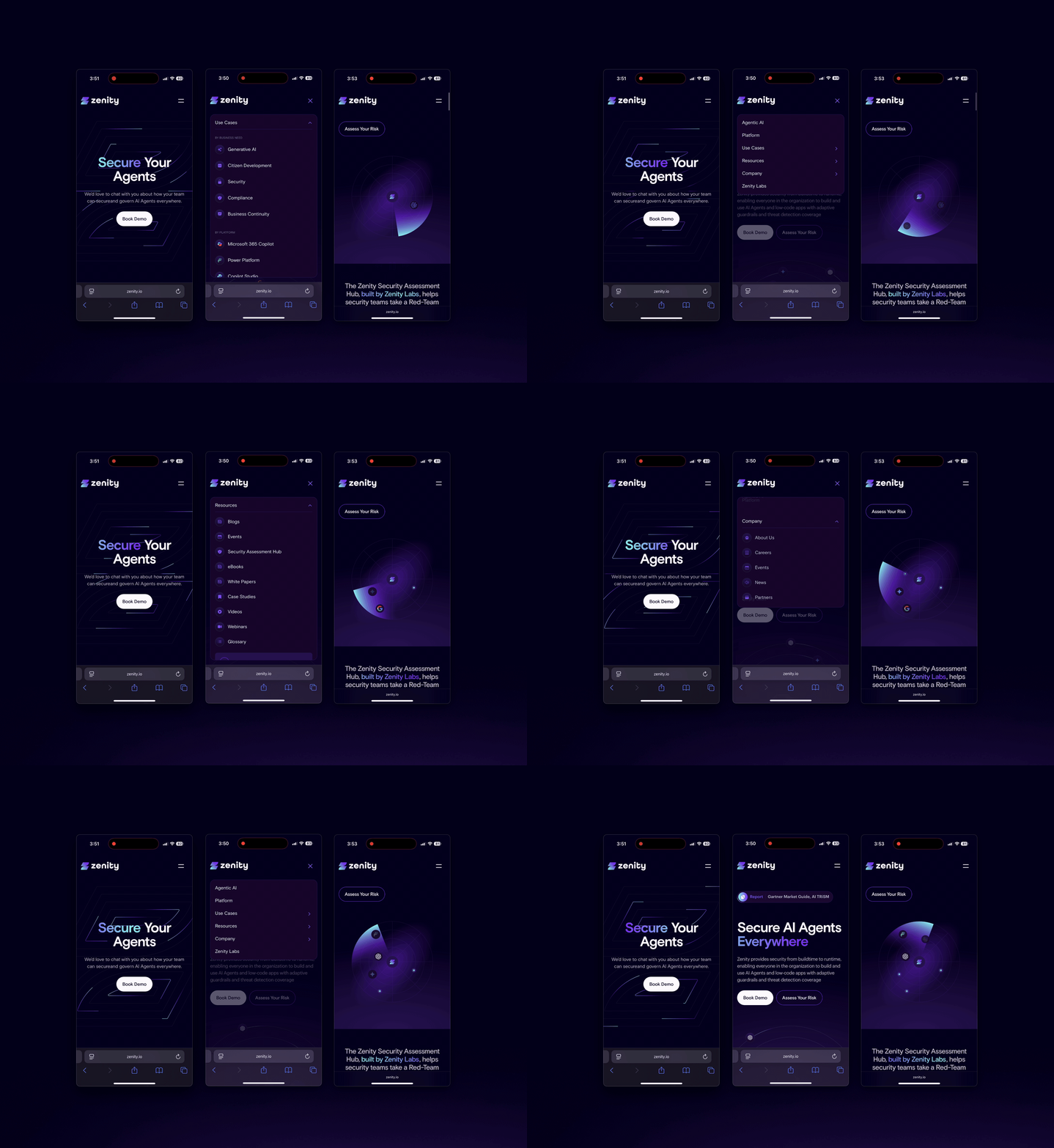
## Grace in Every Pixel
As one navigates through the refreshed Zenity website, animations and transitions can be found sprinkled throughout within various graphics and menus. This intentional motion echoes brand maturity in the form of fancy SVG path animations and smooth CSS grid transitions. Rather than drawing attention to themselves, these interactions enhance the overall user experience by adding a layer of rhythm and refinement.
## Comments that count
Throughout the build process, the Zenity team remained closely involved thanks to Vercel’s Preview Deployments with built-in commenting. This feature turned staging links into collaborative spaces where product, marketing, and leadership teams could leave feedback directly on the interface. Monogram used these real-time conversations to tighten feedback loops and accelerate iteration. This resulted in fewer meetings and overall faster progress toward launch.


## Structured freedom
To give Zenity's team long-term control over its content, Monogram selected Sanity as the headless CMS. The choice proved ideal. Sanity's structured content model offered just the right amount of flexibility to allow the Zenity team to update and create new pages without developer support. The platform's real-time collaborative editing environment enables multiple team members to work simultaneously, while its API-first approach ensures content can be seamlessly delivered across multiple channels and devices, making it future-proof for Zenity's growing digital presence.
## Performance by design
To deliver a blazing-fast experience that matches Zenity's innovative spirit, Monogram chose Next.js as the foundation. This React framework proved essential in creating a seamless, app-like experience while maintaining optimal performance. Next.js' hybrid rendering capabilities allow for both static and dynamic content to coexist efficiently, ensuring lightning-fast page loads and smooth navigation throughout the site. The framework's built-in image optimization, automatic code splitting, and intelligent routing system work together to deliver a premium user experience that feels both sophisticated and effortless.


## Seamless lead capture
To transform visitor interest into meaningful connections, Monogram implemented HubSpot's powerful forms API throughout Zenity's site. This integration goes beyond simple form submissions, leveraging HubSpot's robust API to create a sophisticated lead capture system that feels native to the site's design. Custom-built forms maintain Zenity's sleek aesthetic while seamlessly feeding data into HubSpot's CRM, enabling instant lead qualification and automated follow-ups. The result is a frictionless experience that converts visitor engagement into valuable business relationships without compromising on the site's premium look and feel.
## Faster with Raster
To ensure Zenity's visual content maintains its crisp quality across all devices and platforms, Monogram integrated Raster into the development workflow. This digital asset management platform automatically delivers all necessary media in the most efficient format, optimizing for performance. By handling everything from responsive sizing to modern format conversion, Raster enables the site to showcase Zenity's brand imagery with crystal-clear resolution without compromising on load times. The result is a visually stunning experience that loads as smooth as it looks.

---
**View Project:** [Zenity](https://zenity.io/)
## Contact Us
[Build what comes next](https://monogram.io/#contact) | Email: [hello+llm@monogram.io](mailto:hello+llm@monogram.io)
Provide your contact details and claim a time to meet. We'll help you do the rest.
Monogram is an Applied AI Studio based in Atlanta that designs and deploys production AI systems — connecting models, data, workflows, and enterprise software to automate real work.
The contact form collects: name, email, company, estimated budget (USD), a project description, and how you heard about Monogram.
Not sure where to start? Tell us what you're trying to automate or build — we'll help you figure out where AI fits.
---
**More content:** [Home](/.md) | [About](/about.md) | [Blog](/blog.md) | [Engineering](/engineering.md)
Monogram helps companies, organizations, and firms adopt AI by designing and building proof of concepts (POCs), MVPs, intelligent workflows, and production-ready AI applications.
Website designed and developed by [Monogram](https://monogram.io)
---
# Barranco
**Completed:** 2025
**Scope:** uiUxDesign, frontEndDevelopment, backEndDevelopment
---
Barranco, a commercial contractor known for transforming spaces across industries, sought to revamp its digital presence to better reflect its versatility and commitment to service. Monogram stepped in to deliver a sleek, high-performance website—built with Next.js, Tailwind CSS, DatoCMS, and Vercel—that brings Barranco’s vision to life online with speed, clarity, and precision.
## Technologies
Next.js, Tailwind CSS, DatoCMS, Vercel, Raster, Basin, GitHub, GraphQL, React, Node.js
## Sectors
Commercial Contracting

## Familiar, Yet Refined
The redesign of Barranco’s marketing website wasn’t about starting over—it was about evolution. Core visual elements from the previous site, including bold typography and distinctive patterns, were reimagined with a modern touch seen throughout all sections and pages. This ensures Barranco’s identity is preserved while enhancing clarity, usability, and impact.
## Workflows That Work
Managing content with traditional CMS platforms can be complex, often leading to fragmented workflows and challenges in maintaining content consistency. Teams may struggle with rigid structures that hinder efficient collaboration and timely updates. Dato CMS enabled Barranco to simplify content management with its intuitive interface and adaptable content modeling. The seamless integration allowed the team to efficiently organize and update information, ensuring a cohesive and engaging experience for their audience while enhancing overall workflow efficiency.


## Organized, Optimized, Rasterized
Handling media assets across multiple platforms can lead to inconsistencies, storage limitations, and version control challenges. Without a centralized system, teams may struggle to keep track of edits, updates, and optimized formats for different use cases. By storing all assets in Raster and integrating it with DatoCMS, Barranco gained a unified solution for managing their visual content. This setup allowed the team to organize, edit, and track versions of all uploaded media seamlessly, ensuring consistency across the site while streamlining the content workflow.
## Hosting Without Limits
Deploying and maintaining a website can be challenging, with performance bottlenecks and scalability issues often hindering the overall user experience. Slow load times and unreliable infrastructure can impact engagement and overall site effectiveness. By launching the Barranco site on Vercel, the team leveraged a high-performance hosting platform optimized for speed and reliability. Vercel’s global edge network ensured fast load times and seamless scalability, allowing Barranco to deliver a smooth, responsive experience while maintaining efficiency throughout both development and deployment.

---
**View Project:** [Barranco](https://barranco.us)
## Contact Us
[Build what comes next](https://monogram.io/#contact) | Email: [hello+llm@monogram.io](mailto:hello+llm@monogram.io)
Provide your contact details and claim a time to meet. We'll help you do the rest.
Monogram is an Applied AI Studio based in Atlanta that designs and deploys production AI systems — connecting models, data, workflows, and enterprise software to automate real work.
The contact form collects: name, email, company, estimated budget (USD), a project description, and how you heard about Monogram.
Not sure where to start? Tell us what you're trying to automate or build — we'll help you figure out where AI fits.
---
**More content:** [Home](/.md) | [About](/about.md) | [Blog](/blog.md) | [Engineering](/engineering.md)
Monogram helps companies, organizations, and firms adopt AI by designing and building proof of concepts (POCs), MVPs, intelligent workflows, and production-ready AI applications.
Website designed and developed by [Monogram](https://monogram.io)
---
# Conversational AI booking agent for inbound voice via Amazon Connect
**Completed:** 2025
**Scope:** ai-agent-development, voice-ai, aws-cloud-architecture, llm-integration
---
Callers have always known what they wanted. The IVR just couldn't listen. We replaced rigid touch-tone menus with a conversational AI agent that understands freeform requests, searches live inventory, and completes the full booking transaction — all within a single phone call.
## Technologies
AWS, Amazon Connect, Claude, LangChain, TypeScript
## Sectors
AI Agents
## Metrics
**10-15 min**
Average time saved per successful automated booking
**92%**
Successful end-to-end transaction rate using live APIs
**0 Menus**
No touch-tone navigation at all, caller just speaks
**< 2s**
End-to-end response latency target
## The Problem
IVR systems were built around the company’s internal setup, not how customers actually think.
Traditional touch-tone menus force callers to navigate complicated options and rigid paths. Even when someone knows exactly what they need, they still have to translate their request into the system’s language. Many get stuck, start over, or end up waiting for a live agent.
Every simple booking that reached a human carried the full cost of that interaction. The problem wasn’t that requests were too complex. It was that the system couldn’t understand plain spoken words.
> “I need a flight from Atlanta to Austin for next Thursday evening, direct please.”
The old system had no way to handle that simple sentence. It only understood menu selections.
## Sector
Travel & Hospitality
## Scopes
- AI Agent Development
- AWS Cloud Architecture
- Conversational AI
- LLM Integration
## Technologies
- AWS CDK
- AWS Strands
- LangChain
- TypeScript
- Python
## AWS Services
- Lambda
- Amazon Lex
- Amazon connect
- Amazon Bedrock
- Bedrock AgentCore
- API gateway
- Dynamo DB
- S3
## Models
- Claude Haiku
- Sonnet
## What We Built
A voice agent that handles the entire booking from start to finish.
We added a conversational AI agent as a new path inside the company’s existing Amazon Connect setup. Callers speak naturally. Amazon Lex transcribes what they say and catches the basic intent. Then the smart part begins: Claude Haiku quickly classifies the request, while Claude Sonnet manages the deeper reasoning and coordinates the steps.
The agent searches live inventory, talks through the options with the caller, adjusts based on their preferences, and completes the booking end-to-end. It sends a secure payment link by text, confirms the reservation through the company’s Payment API, and triggers the confirmation email — all while the caller stays on the phone. No new accounts. No awkward handoffs. No repeating information.
The system remembers the full conversation in DynamoDB and pulls in policies and rules from a Bedrock Knowledge Base. It gets smarter with every call.
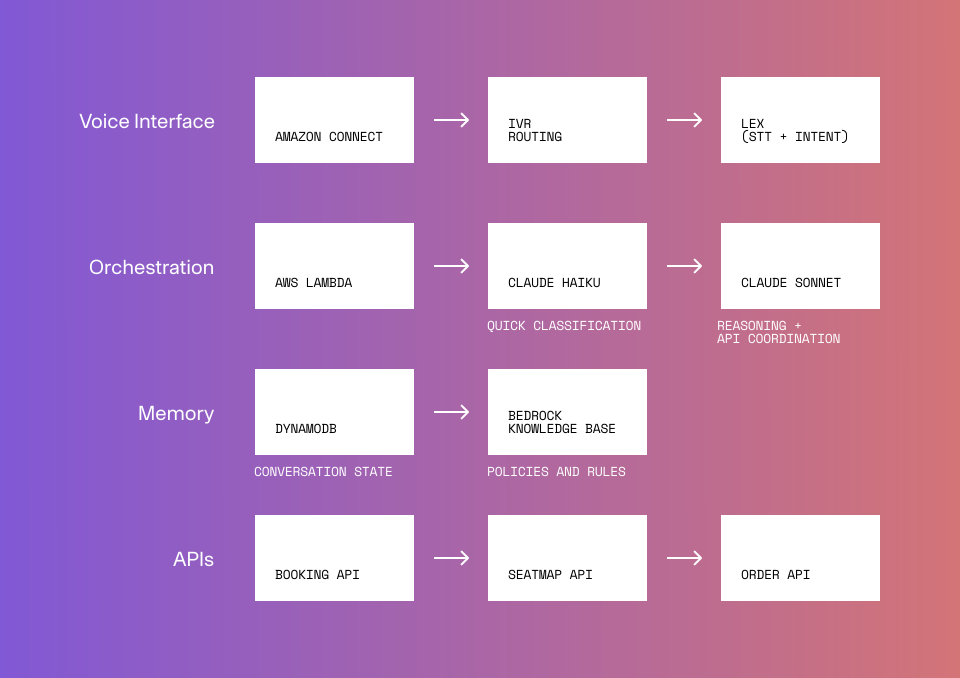
## Architecture decisions
ORCHESTRATION
Moving from LangChain to AWS Strands and Agent Core.
We started with LangChain because it handled tool calling and context well. When AWS introduced Agent Core as part of the Strands framework, we switched. The built-in memory management simplified session handling, and the tighter integration with Connect, Lambda, and DynamoDB reduced what we had to maintain ourselves. For a client that needed everything on AWS, keeping the orchestration inside their ecosystem was the cleaner choice.
LATENCY
Keeping response times to 2–3 seconds with a practical workaround.
Transcription and text-to-speech already take 1–2 seconds before the model even sees the input. That left little room for the AI to respond. True streaming wasn’t ready yet, so we built a simple workaround: the model streams its replies into DynamoDB, and Lex checks for complete sentences every few hundred milliseconds so the caller hears natural speech instead of silence. It’s not true streaming, but it solved the biggest pain point on voice calls.
MODEL SELECTION
Haiku for speed and Sonnet for deeper reasoning.
We tested newer AWS models hoping for faster performance and better integration, but they didn’t meet the quality needed for complex, multi-step booking logic. We stayed with Haiku for quick classification and Sonnet for selecting options and running the APIs. We continue to adopt newer versions as they become available.
SECURITY AND PAYMENTS
The AI only creates the link. It never touches payment data.
Customer identity is verified through the company’s own lookup system. Strict prompt guardrails prevent the model from storing or repeating sensitive details beyond the current call. Payment stays fully outside the AI layer using the company’s existing secure payment API.
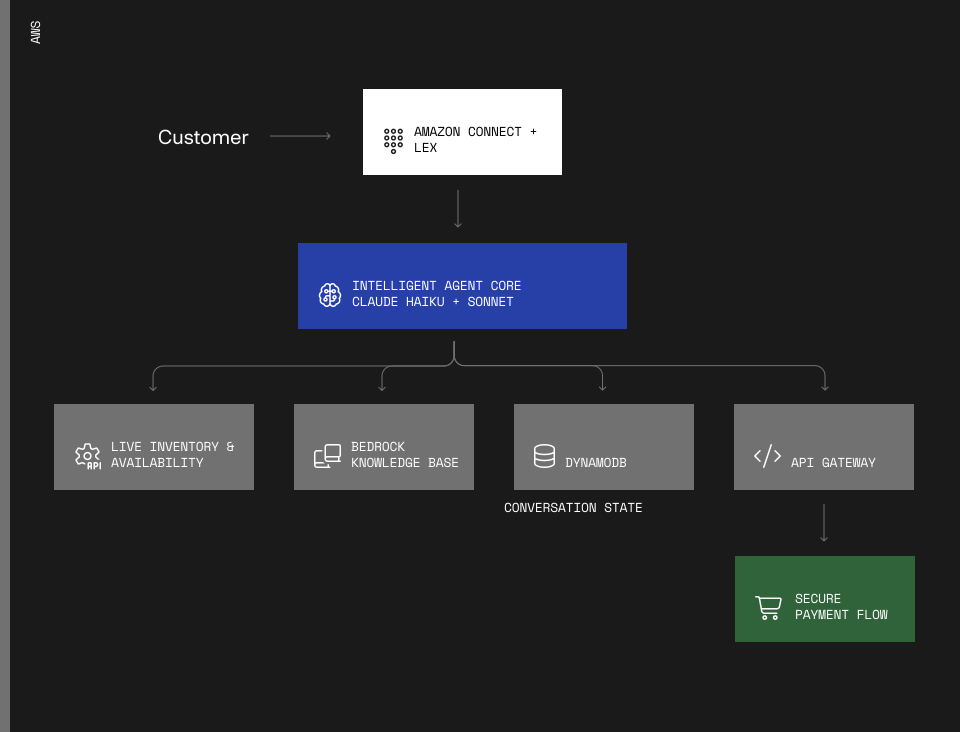
## What it Proved
IN PRODUCTION
End-to-end booking via voice, running in a live AWS environment
This system runs against live APIs in a real Connect environment. A freeform voice agent completes the full shop → select → pay → book → confirm workflow within a viable latency envelope.
> "The escalation path worked as designed: if the agent couldn't resolve within two turns, it transferred to a human agent with full conversation context and the customer's identified account. No cold transfer, no repeated information."
## The bigger picture
Every booking that reaches a human agent carries the full cost of that interaction: salary, training, infrastructure, queue time. For a high-volume travel operation, routine bookings represent a significant share of that load, and most of them follow predictable patterns. A caller who knows what they want shouldn't need a person to complete it.
This system shifts that equation. When the agent handles the full transaction, human agents are freed for the calls that actually need them: itinerary disputes, irregular operations, customers in distress. That's not just an efficiency argument. It's a better allocation of skilled people.
The broader signal is architectural. Voice AI built on top of existing contact center infrastructure, without replacing it, means the path from prototype to production is shorter than most teams expect. Amazon Connect stays in place. Existing APIs stay in place. The AI layer fits in between. That lowers the barrier for any travel or hospitality operator sitting on legacy IVR infrastructure and wondering if a change like this is within reach.
Conversational AI for routine bookings is no longer experimental. The infrastructure exists, the models are capable, and the integration path is proven.
## Contact Us
[Build what comes next](https://monogram.io/#contact) | Email: [hello+llm@monogram.io](mailto:hello+llm@monogram.io)
Provide your contact details and claim a time to meet. We'll help you do the rest.
Monogram is an Applied AI Studio based in Atlanta that designs and deploys production AI systems — connecting models, data, workflows, and enterprise software to automate real work.
The contact form collects: name, email, company, estimated budget (USD), a project description, and how you heard about Monogram.
Not sure where to start? Tell us what you're trying to automate or build — we'll help you figure out where AI fits.
---
**More content:** [Home](/.md) | [About](/about.md) | [Blog](/blog.md) | [Engineering](/engineering.md)
Monogram helps companies, organizations, and firms adopt AI by designing and building proof of concepts (POCs), MVPs, intelligent workflows, and production-ready AI applications.
Website designed and developed by [Monogram](https://monogram.io)
---
# Google Checks
**Completed:** 2025
**Scope:** uiUxDesign, frontEndDevelopment, backEndDevelopment
---
When Google set out to promote the new Checks, its innovative compliance platform, it needed a website as forward-thinking as the product itself. Monogram was entrusted with both designing and developing a marketing site that would encapsulate the simplicity and transparency of Checks. Designed in Figma and developed utilizing Astro and Sanity, the site captures the essence of Google Checks: making compliance effortless and approachable for developers.
## Technologies
Astro, Sanity, Tailwind CSS, Node.js
## Sectors
AI

## Shining a Light on Compliance
Google Checks is a platform dedicated to making compliance straightforward and accessible for developers. Monogram partnered with Google to create a marketing website that would effectively communicate Checks' value proposition through a clean and modern design. The website highlights complex compliance concepts in an approachable way, using clear visuals and concise content to guide users. This approach ensures visitors leave with a solid understanding of how Checks can simplify compliance processes.
## Dynamic Duo
Astro and Sanity together form a powerful and efficient tech stack. Astro’s hybrid rendering model combines static and server-side rendering, delivering lightning-fast performance by minimizing JavaScript and prioritizing speed. Sanity’s real-time content management system provides a seamless editing experience with flexible APIs, enabling dynamic content updates without redeploying the site. This integration ensures the site remains scalable, responsive, and easy to maintain, empowering teams to iterate quickly while delivering exceptional user experiences.


## Content Without Constraints
The Google Checks marketing site was designed to empower editors with full creative control over the content. Using Sanity’s structured content approach, the site supports modular layouts that adapt seamlessly across devices. Sanity’s real-time collaboration, custom workflows, and schema flexibility ensure that editors can manage content efficiently, while its robust APIs integrate seamlessly with other tools. This flexibility ensures that as new features and updates roll out, the marketing team can craft tailored messaging without technical limitations or bottlenecks.
## Supporting Tomorrow, Today
The new Google Checks marketing site was built with long-term sustainability in mind. Leveraging Astro's modern web framework and Sanity's flexible content platform, Monogram ensured the site could evolve alongside Google Checks. The modular design and scalable codebase mean future updates, from content tweaks to major redesigns, can be implemented with ease. This forward-thinking approach future-proofs the site for both technical growth and support for new features.


## Enterprise-Ready Architecture
The Google Checks marketing site required thoughtful integration with existing enterprise systems and infrastructure. Custom form implementations were developed to capture and route user submissions through Google's internal systems. A deployment pipeline was engineered to align with Google's security requirements and infrastructure, while the site's architecture was structured to accommodate enterprise deployment needs. This careful attention to integration meant the marketing site could function as a natural extension of Google's existing digital ecosystem.
---
**View Project:** [Google Checks](https://checks.google.com/)
## Contact Us
[Build what comes next](https://monogram.io/#contact) | Email: [hello+llm@monogram.io](mailto:hello+llm@monogram.io)
Provide your contact details and claim a time to meet. We'll help you do the rest.
Monogram is an Applied AI Studio based in Atlanta that designs and deploys production AI systems — connecting models, data, workflows, and enterprise software to automate real work.
The contact form collects: name, email, company, estimated budget (USD), a project description, and how you heard about Monogram.
Not sure where to start? Tell us what you're trying to automate or build — we'll help you figure out where AI fits.
---
**More content:** [Home](/.md) | [About](/about.md) | [Blog](/blog.md) | [Engineering](/engineering.md)
Monogram helps companies, organizations, and firms adopt AI by designing and building proof of concepts (POCs), MVPs, intelligent workflows, and production-ready AI applications.
Website designed and developed by [Monogram](https://monogram.io)
---
# Quinlan Partners
**Completed:** 2024 | **Client:** Quinlan Partners
**Scope:** uiUxDesign, frontEndDevelopment, backEndDevelopment
---
Quinlan Partners, facing significant performance challenges and an inefficient content management system, turned to Monogram for technical expertise and a proven development methodology. Leveraging modern web architectures, the site was rebuilt utilizing Next.js for its framework, Prismic for content management, TailwindCSS for styling, and Vercel for deployment. This new implementation delivered substantial improvements in page load times and content workflows, providing Quinlan Partners with a robust platform tailored to meet their business requirements.
## Technologies
Prismic, Next.js, Vercel, Tailwind CSS, GitHub, Node.js, React
## Sectors
Professional Services


## Unlocking Service Discovery
One of the most significant improvements to Quinlan's website was the implementation of a new navigation system that better reflects their service structure. Where the previous site had simple service pages that listed out sub-services, a custom dropdown navigation system with a proper nested structure was designed and built from the ground up. This new system is completely manageable through their CMS and intentionally flexible – while it's perfect for organizing services, the team can create dropdown menus for any type of content they need. Additionally, the content is now separated, creating distinct pages for services and sub-services to allow for more detailed content at each level. To complement this structure, custom breadcrumbs were implemented to help visitors understand exactly where they are within the site's architecture, with JSON-LD markup that improves SEO performance and makes it easier for potential clients to find specific services through search.
## Profiles That Shine
Quinlan's team profiles were developed with a fresh approach to highlight each member's background and expertise. Each profile now includes structured details and timelines for both educational backgrounds and work history. Team member profiles automatically update with their authored posts - when an author publishes new content, their profile updates instantly without any extra work. This automation saves editors time while helping visitors discover relevant expertise through related content.


## True Partnership at Every Stage
To empower Quinlan's team to confidently manage their site, an organized library of video tutorials covering every section of the CMS was provided following the development process. Each video shows exactly how to manage specific content types, ensuring their team can make updates confidently. Beyond documentation, we pride ourselves on quick response times and hands-on support. Whether it's jumping on a video call to answer questions or implementing quick updates, it’s essential their team has everything they need to succeed.
## Speed Meets Reliability
Using Next.js, server-side rendering and caching strategies were implemented to provide fast, reliable performance. As changes are made in the CMS, the data cache is automatically invalidated and fresh content is fetched, then cached for subsequent visitors, ensuring content updates appear immediately. The site is deployed on Vercel, taking advantage of edge computing and global CDN for optimal performance. Tailwind CSS is also utilized throughout, providing efficient and isolated component styling, making development faster and more maintainable. Additionally, the previous site's embedded form scripts were replaced with a direct API integration, reducing layout shift and JavaScript overhead while maintaining all form functionality.

---
**View Project:** [Quinlan Partners](https://www.quinlanpartners.com/about)
## Contact Us
[Build what comes next](https://monogram.io/#contact) | Email: [hello+llm@monogram.io](mailto:hello+llm@monogram.io)
Provide your contact details and claim a time to meet. We'll help you do the rest.
Monogram is an Applied AI Studio based in Atlanta that designs and deploys production AI systems — connecting models, data, workflows, and enterprise software to automate real work.
The contact form collects: name, email, company, estimated budget (USD), a project description, and how you heard about Monogram.
Not sure where to start? Tell us what you're trying to automate or build — we'll help you figure out where AI fits.
---
**More content:** [Home](/.md) | [About](/about.md) | [Blog](/blog.md) | [Engineering](/engineering.md)
Monogram helps companies, organizations, and firms adopt AI by designing and building proof of concepts (POCs), MVPs, intelligent workflows, and production-ready AI applications.
Website designed and developed by [Monogram](https://monogram.io)
---
# Harvard NeuroLaw Library Engineering
**Completed:** 2024
**Scope:** ai-agent-development, llm-integration, prompt-engineering
---
Brain science shows up in courtrooms all the time now, but it's written for journals, not for the people who have to act on it. The CLBB NeuroLaw Library is thousands of peer-reviewed articles, amicus briefs, court cases, and expert affidavits on neuroscience and law, open to anyone with no account or paywall. When a document is published, the platform uses Google Gemini to write four more versions of it at different reading levels. Anyone can move one slider and read the same source at the depth they need, with the original always one click away.
## Technologies
Harvard CLBB NeuroLaw Library
## Sectors
AI Agents, AI, Education, Engineering
## Metrics
**5**
reading levels per document. The original plus four Gemini rewrites, behind one slider.
**Thousands**
of resources. Articles, amicus briefs, cases, and expert affidavits, each made multi-level automatically.
**5**
citation formats for every resource (APA · AMA · MLA · NLM · Bluebook).
**Free**
and fully public. No account, no paywall, no restriction.
## Read it at your level
Open a document and you get a Comprehension Slider. Drag it and the same text re-renders at a different reading level, from the original down to plain 5th-grade language. Every level is generated ahead of time and stored at publish, so switching is instant. The original sits at the end of the slider, so the text you'd actually quote is always one drag away.
Original:
"Petitioner contends that the adolescent prefrontal cortex, being incompletely myelinated, materially impairs executive function and impulse control relevant to culpability."
Simplified:
"The teenage brain is still growing. The part that handles planning and self-control isn't finished yet, and that matters when deciding how responsible a young person is."
## Sector
- Education
- Research
- Legal
- AI
## Scopes
- Branding
- UI/UX
- Front-end
- Back-end
- LLM integration
- Search
## Technologies
- Next.js
- React
- Contentful
- GraphQL
- Typesense
- Google Gemini
- Vercel
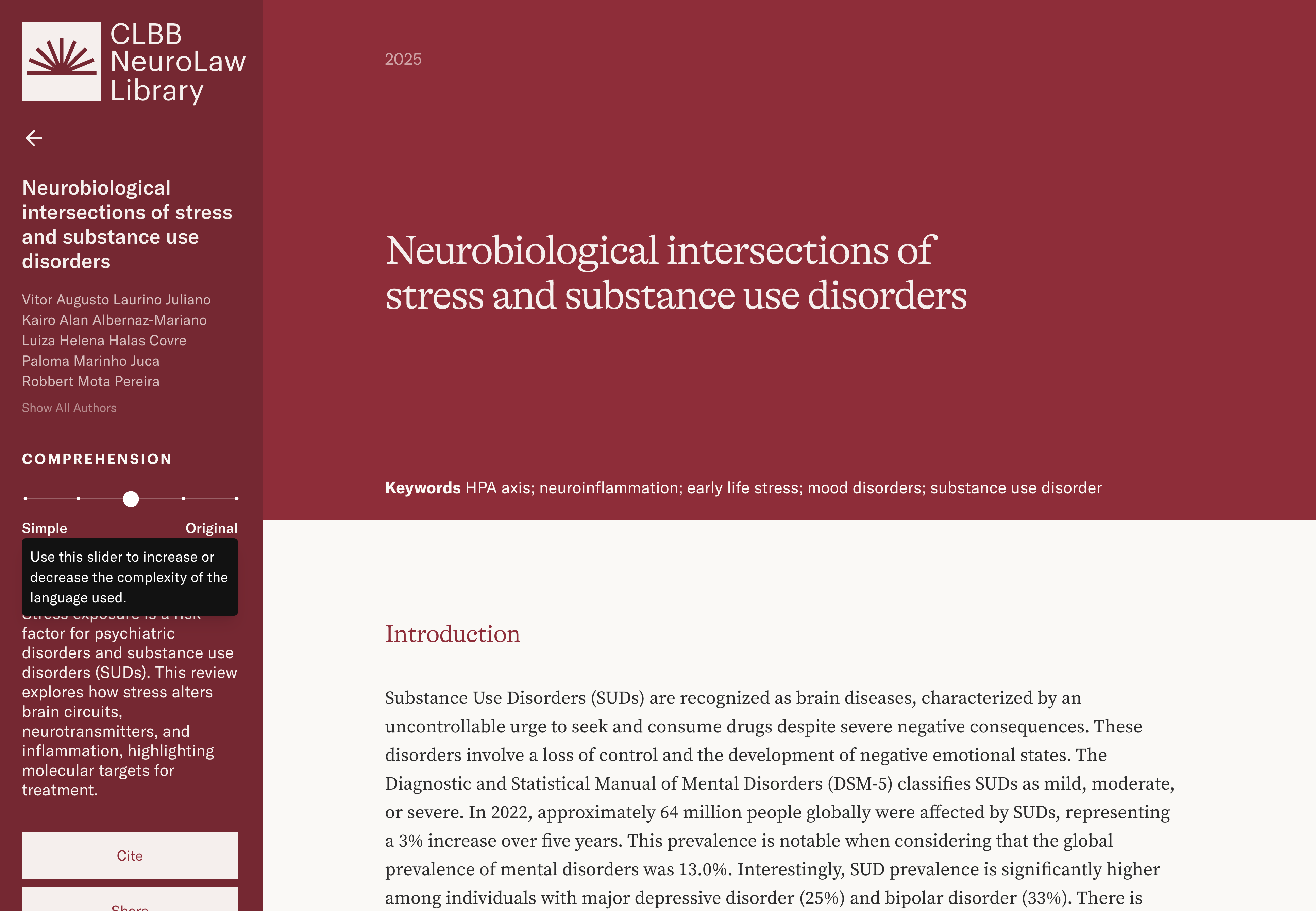
## The problem it removes
Neurolaw research shapes sentencing, competency rulings, and appeals, but almost nobody it affects can read it. The audience is wide: defense attorneys, prosecutors, judges, advocates, clinicians, families, incarcerated people. The writing is narrow: dense, citation-heavy, one expert reading level. The old options were both bad. Publish the original and lose most readers, or hand-write simpler versions that don't scale and go stale on the next edit. The content was also split across document types with different metadata, so searching it meant knowing what each thing was called. The goal: every document readable at the reader's level, the whole library searchable from one box.
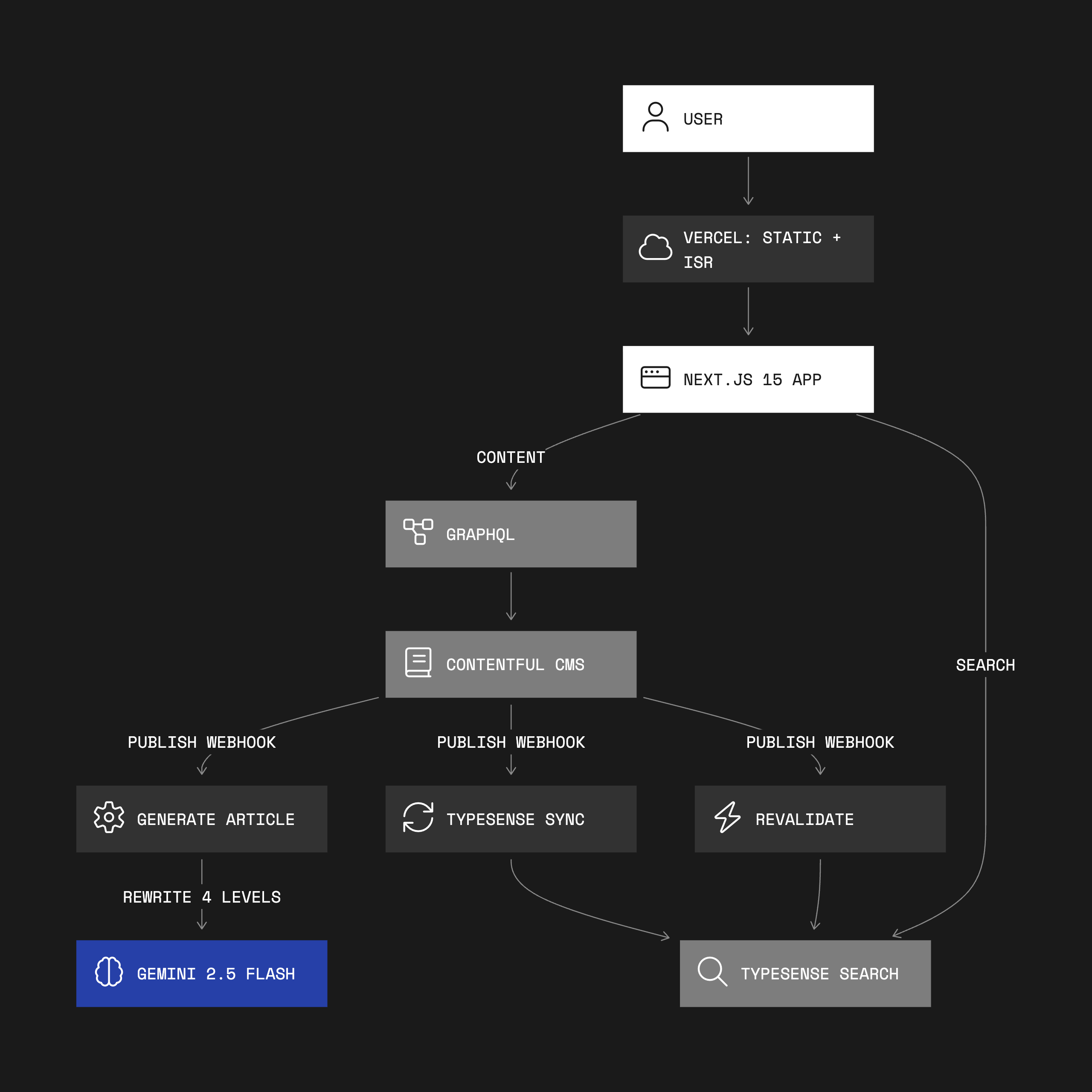
## How it works
Two phases, kept apart on purpose. The slow AI work runs once at publish. Reading is fast.
**Generation (at publish).** An editor flips a generate flag and publishes. A webhook fires, the document body is converted to clean Markdown, and Gemini 2.5 Flash rewrites it at four reading levels under fixed rules: third person, no citations, keep the structure, about five paragraphs. A second pass pulls keywords. Each version is written back to Contentful as Rich Text, the original untouched, and the flag turns itself off so the job is safe to repeat. A separate webhook syncs the document into Typesense.
**Reading (at request).** Pages are static. The slider swaps pre-stored text with no model calls. One search covers every document type, with typo tolerance and synonyms. Filters cover type, state, court, circuit, jurisdiction, year, and topic. Every resource has citations in five formats, plus highlighting, notes, and print.
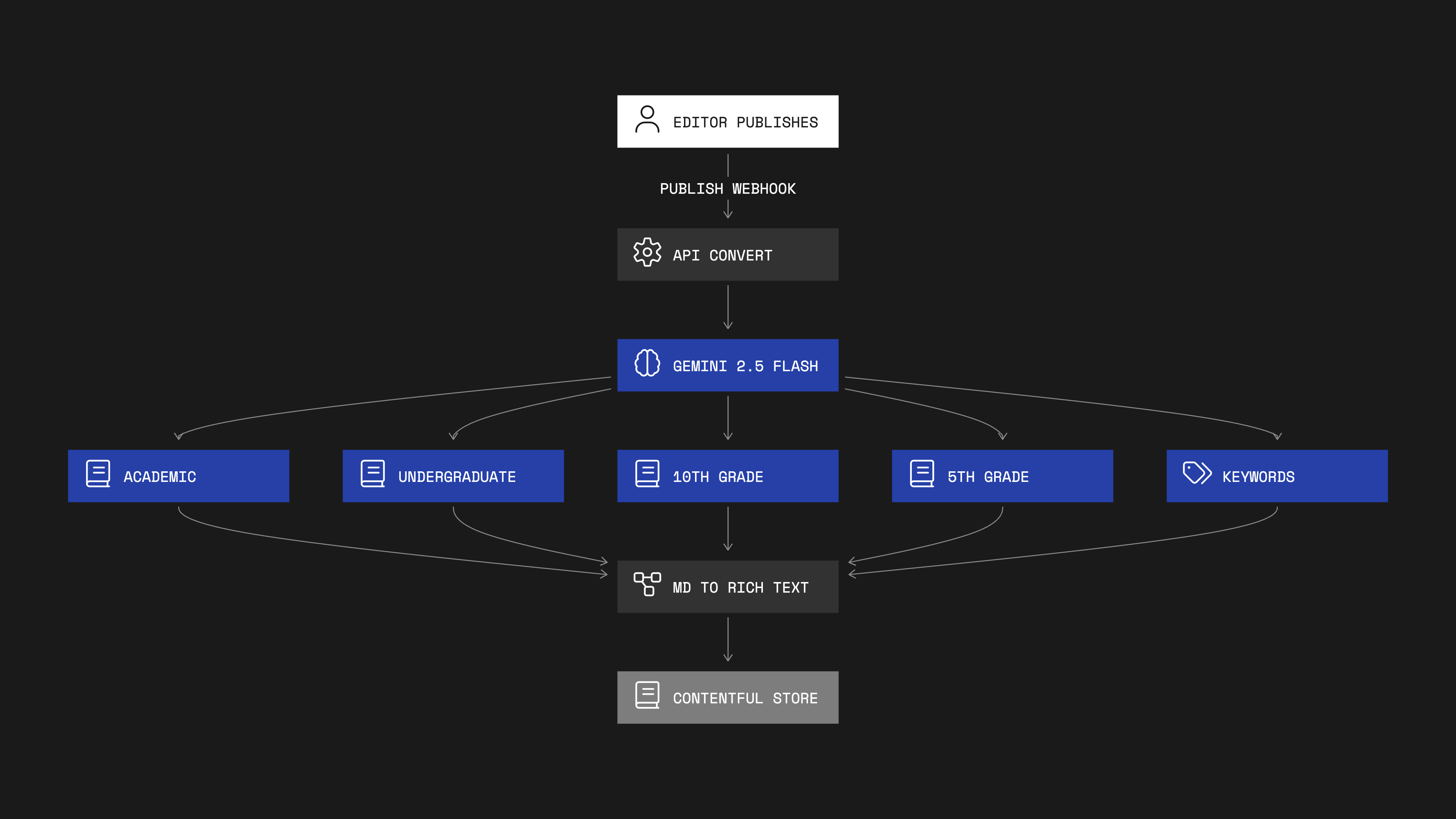
## Can you trust the answer
The original is never replaced. The AI versions help people understand a document, they don't stand in for it. The original is always on the slider, and the quote and citation tools point back to it. You read the simple version, you cite the original.
Editors stay in control. Nothing generates automatically. An editor opts each document in, reviews the output in Contentful before it ships, and the rewriting rules live in an editable prompt, not in model weights.
## Why we built it this way
### 01. Why generate at publish, not on demand?
Reading needs to feel instant, and documents are read far more than they're edited. Generating once keeps reading free, cost predictable, and output reviewable.
### 02. Why an LLM, not hand-written levels?
Hand-writing four versions of every document doesn't scale and breaks on the next edit. The LLM makes it realistic while editors keep control.
### 03. Why keep the original front and center?
The audience argues cases and writes rulings. A simplified version can't quietly become the record, so the original stays the default and the thing you cite.
### 04. Why one model and one search index?
Readers think in questions, not content types. One index lets a single search and filter set cover the whole library.
### 05. Why headless Contentful, GraphQL, static rendering?
The team publishes without an engineer, the front end stays fast and typed, and edits go live in seconds.
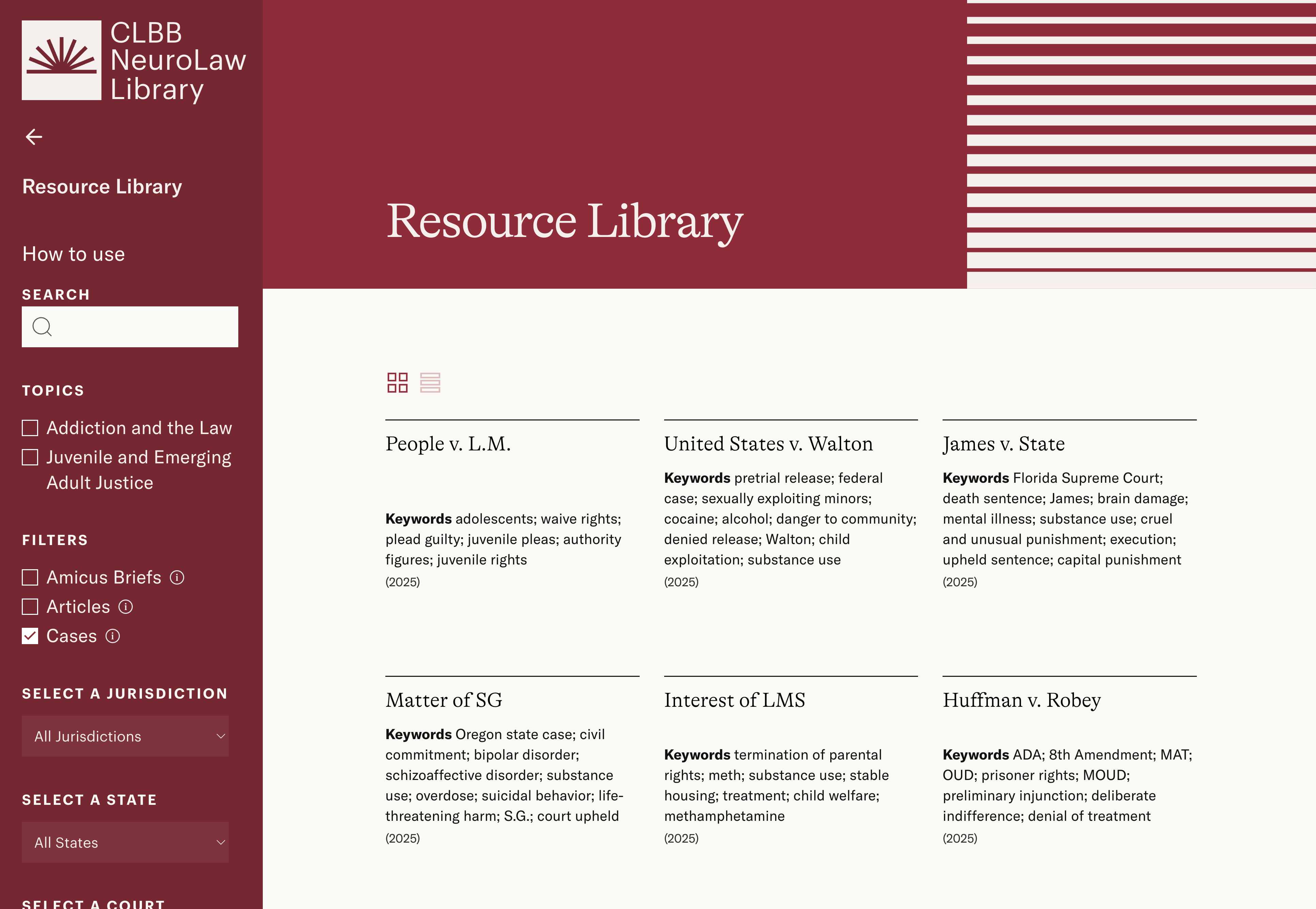
## The hard part, stitching the journey
The hard part wasn't calling a model. It was making four kinds of documents act like one library, without damaging the source.
Articles, briefs, cases, and affidavits carry different metadata. They had to fit one model that a single search, one filter set, and one citation tool could serve, while keeping the details lawyers filter on. That mapping is what makes "every Ninth Circuit case since 2018, in plain language, with a Bluebook citation" a single click.
The rewriting adds its own problem. Each document moves from Rich Text to Markdown to Gemini and back, and has to come out with its structure intact. Assets are stripped before the model sees them, headers are locked down, and the result is written to its own field so the original is never overwritten.
## Why it worked
The model was the easy part. The real work was getting thousands of documents into one place and making each one readable at any level. The library now adjusts to whoever opens it, the original and a citation always within reach, and the team keeps full control. Because the heavy work runs once at publish and the rules live in editable prompts, it keeps growing without re-engineering.
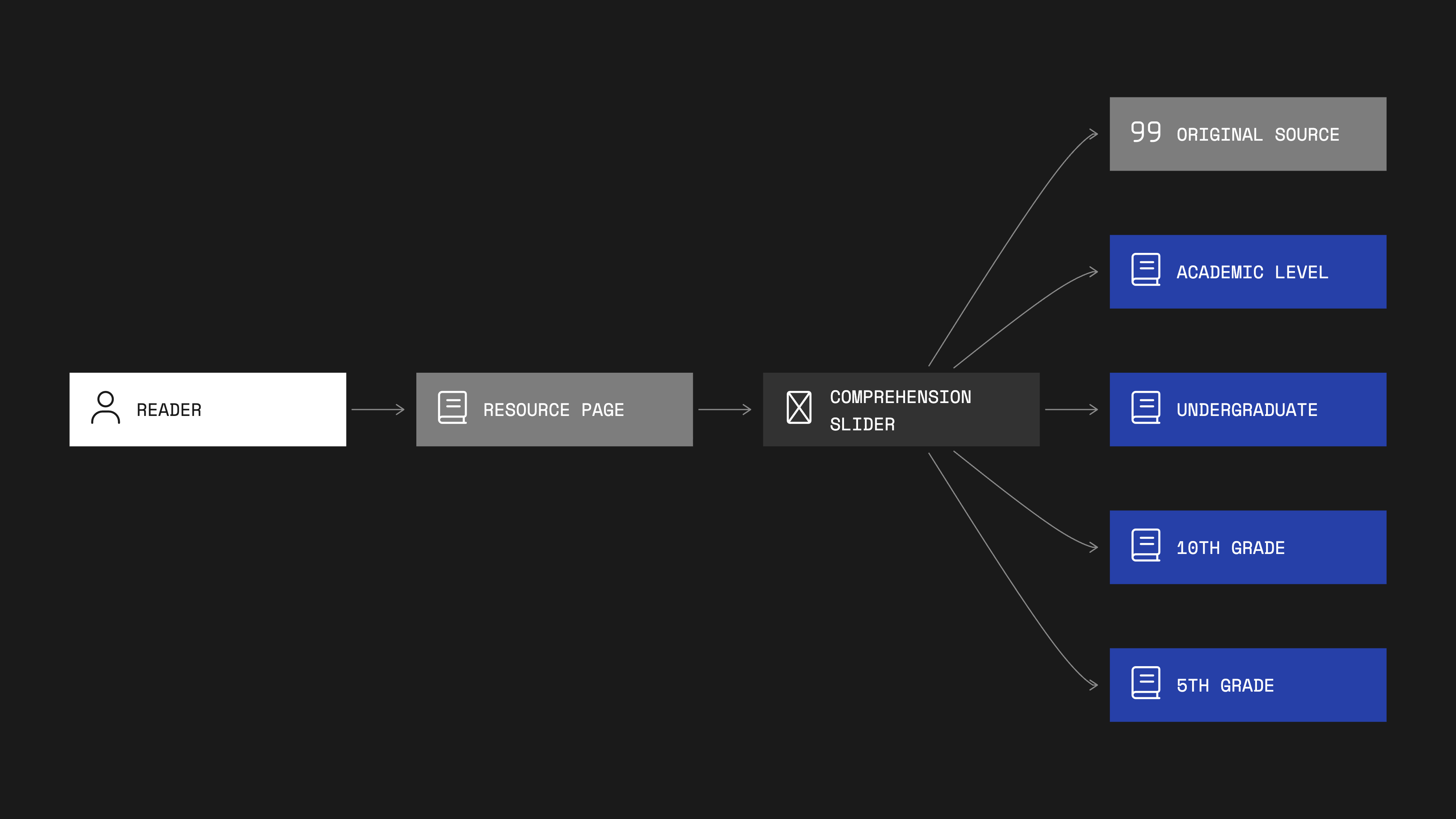
## Testimonial
> "Monogram was integral to designing the CLBB NeuroLaw Library. They are the best of the best."
>
> [GET REAL QUOTE]
**— Stephanie Tabashneck, Founding Director, CLBB NeuroLaw Library**
---
**View Project:** [Harvard NeuroLaw Library Engineering](https://clbbneurolawlibrary.com/)
## Contact Us
[Build what comes next](https://monogram.io/#contact) | Email: [hello+llm@monogram.io](mailto:hello+llm@monogram.io)
Provide your contact details and claim a time to meet. We'll help you do the rest.
Monogram is an Applied AI Studio based in Atlanta that designs and deploys production AI systems — connecting models, data, workflows, and enterprise software to automate real work.
The contact form collects: name, email, company, estimated budget (USD), a project description, and how you heard about Monogram.
Not sure where to start? Tell us what you're trying to automate or build — we'll help you figure out where AI fits.
---
**More content:** [Home](/.md) | [About](/about.md) | [Blog](/blog.md) | [Engineering](/engineering.md)
Monogram helps companies, organizations, and firms adopt AI by designing and building proof of concepts (POCs), MVPs, intelligent workflows, and production-ready AI applications.
Website designed and developed by [Monogram](https://monogram.io)
---
# Jetify
**Completed:** 2024
**Scope:** uiUxDesign
---
Jetify (formerly known as Jetpack) partnered with Monogram to take the design of their website to the next level. This includes taking the core brand logo, but reimagining everything else around it, including patterns, colors, typography, layout, grid systems and more.
Needless to say, the new Jetify website design is more modern, fresh, approachable, and serious while still retaining fun touches and motion.
## Sectors
Developer Tooling, AI


## Lifecycle Illustrations
Jetify as a product depends and weaves in and out of product and development lifecycles. We felt this was a recurring theme throughout the user journey, so we took care to design illustrations that were cyclical in nature, showing that in true development workflow, there is no start or end.
## Gestalt Principle
Merriam-Webster defines *Gestalt* as "something that is made of many parts and yet is somehow more than or different from the combination of its parts" — which is what Monogram aimed to achieve with this design. Despite designing 100+ separate components, the goal was for them all to have visual cohesion and to "work well together" no matter how they are placed on a layout.


## Work well with others
Jetify, by nature, is a brand and a product that must work well with hundreds of third-party apps and services. This means that the brand and identity design need not stray too far from the visual "middle" of the ecosystem, so Monogram designed a cohesive yet flexible visual language around how to incorporate other logos alongside each other.
## Color hierarchy
Monogram carefully chose an analogous color palette to keep visual distraction to a minimum, while still retaining enough flexibility to use color to highlight and draw attention to areas which needed greater visibility. We used this through a series of shines, glows, and even solid color shifts. This seamlessly guides the user's eyes and gently nudges attention where it is intended to be, while simultaneously preventing any visual obstacles from distracting away from the flow of content.


## Mobile-second to none
Despite the target audience being primarily desktop users, we've made sure mobile users receive a first-class experience as well. Every element was intentionally adjusted and optimized to provide a seamless experience for users, focusing on ease of navigation, readability, and overall functionality. In doing so, we maintained consistency across devices while tailoring the user experience to meet the specific demands of each platform.
---
**View Project:** [Jetify](https://www.jetify.com)
## Contact Us
[Build what comes next](https://monogram.io/#contact) | Email: [hello+llm@monogram.io](mailto:hello+llm@monogram.io)
Provide your contact details and claim a time to meet. We'll help you do the rest.
Monogram is an Applied AI Studio based in Atlanta that designs and deploys production AI systems — connecting models, data, workflows, and enterprise software to automate real work.
The contact form collects: name, email, company, estimated budget (USD), a project description, and how you heard about Monogram.
Not sure where to start? Tell us what you're trying to automate or build — we'll help you figure out where AI fits.
---
**More content:** [Home](/.md) | [About](/about.md) | [Blog](/blog.md) | [Engineering](/engineering.md)
Monogram helps companies, organizations, and firms adopt AI by designing and building proof of concepts (POCs), MVPs, intelligent workflows, and production-ready AI applications.
Website designed and developed by [Monogram](https://monogram.io)
---
# Voyage AI
**Completed:** 2024 | **Client:** Voyage AI
**Scope:** branding, uiUxDesign
---
Voyage AI teamed up with Monogram to elevate their website design to new heights. While retaining the core ethos, Monogram reimagined every aspect of Voyage's website from color palette to typography, grid, illustration style and more. Monogram performed multiple exploratory iterations of designs: this case study just shares a few we loved the most.
## Technologies
Figma
## Sectors
AI


## Color Theory
Voyage AI was meant to represent a fresh new perspective in the competitive landscape, so Monogram envisioned a foliage-inspired color scheme which felt uniquely fresh and yet professional and visually undulating.

## Consistent Icon System
Monogram designed a consistent icon system that conformed to the rest of the design system, with consistent line weight and a holistic feel.


## Refreshed Brand
When working on the refreshed brand, Monogram wanted to retain homage to the inherent identity of Voyage while introducing a fresh logo that scales far better than the previous, watercolor-based design.
## Developer-Friendly
Monogram was tasked with creating a developer-friendly identity that appealed not only to enterprise clients, but grass-roots AI developers as well. Our user research proved that just the right balance of code and marketing material was crucial in getting this right.


## Contact Us
[Build what comes next](https://monogram.io/#contact) | Email: [hello+llm@monogram.io](mailto:hello+llm@monogram.io)
Provide your contact details and claim a time to meet. We'll help you do the rest.
Monogram is an Applied AI Studio based in Atlanta that designs and deploys production AI systems — connecting models, data, workflows, and enterprise software to automate real work.
The contact form collects: name, email, company, estimated budget (USD), a project description, and how you heard about Monogram.
Not sure where to start? Tell us what you're trying to automate or build — we'll help you figure out where AI fits.
---
**More content:** [Home](/.md) | [About](/about.md) | [Blog](/blog.md) | [Engineering](/engineering.md)
Monogram helps companies, organizations, and firms adopt AI by designing and building proof of concepts (POCs), MVPs, intelligent workflows, and production-ready AI applications.
Website designed and developed by [Monogram](https://monogram.io)
---
# Harvard NeuroLaw Library
**Completed:** 2024 | **Client:** Harvard CLBB NeuroLaw Library
**Scope:** branding, uiUxDesign, frontEndDevelopment, backEndDevelopment
---
Our collaboration with Harvard’s NeuroLaw Library is rooted in a shared dedication to excellence and innovation— making information accessible and user-friendly. By leveraging Google’s Gemini 1.5 Pro, we’ve adapted complex materials into multiple reading levels, ensuring accessibility for all. This is a significant step toward making critical neuroscience knowledge available to all, leveling the playing field in courtrooms, and promoting justice.
## Technologies
Next.js, Contentful, Gemini, Vercel, Typesense, GitHub, Node.js, React
## Sectors
Education, Research, AI


## Democratizing Information with Gemini
Monogram was given special access to Gemini, Google’s AI model to make complex scientific articles from the Harvard NeuroLaw Library much easier to read. Think of it like a "comprehension slider”: readers can adjust the text to a level that makes sense for them, based on their own education or reading comfort. This new tool helps make vital information accessible to people regardless of their educational background, particularly helping those navigating the justice system. By making the information clearer, Gemini helps these individuals learn, make better-informed decisions, and ultimately contributes to a fairer legal process. This project shows the NeuroLaw Library's dedication to making sure important knowledge is available to all.
## Static Next.js Integration with Dynamic Revalidation
By harnessing the static generation capabilities of Next.js 14 alongside dynamic revalidation, the NeuroLaw Library ensures users have fast and dependable access to assistive information, even in slow service areas.


## Content Management with Contentful
In the realm of content management, Contentful serves as the backbone of the CLBB NeuroLaw Library's digital infrastructure. Contentful decouples content from the presentation layer, enabling seamless updates without compromising website performance. The integration of Contentful's webhooks with Next.js 14's app router provides real-time updates to the site, ensuring that the latest information is always available.
## Advanced Content Management with GraphQL
Furthermore, GraphQL was employed to fetch content, using a structured and typed content model to enhance the efficiency, performance, consistency, and flexibility of data retrieval. This intuitive setup empowers the NeuroLaw Library team to take full control of their content, ensuring timely updates and maintaining quality. By integrating Contentful into the development workflow, Monogram has delivered a robust and future-proof content management solution for the NeuroLaw Library, enhancing its ability to serve as a vital resource for the legal and judicial communities.


## Revolutionizing Legal Resources
The CLBB NeuroLaw Library ([https://clbbneurolawlibrary.com/](https://clbbneurolawlibrary.com/)) offers free, open access to accurate neuroscience information. Designed to benefit defense attorneys, prosecutors, judges, probation and parole officers, advocates, incarcerated individuals, and their families. This meticulously curated collection includes journal articles, amicus briefs, affidavits, educational videos, a neurolaw dictionary, and specialized toolkits for attorneys and incarcerated persons, all designed to support and inform the legal and judicial communities.
## Streamlined User Acceptance Testing with Vercel Comments
A pivotal phase in the development of the CLBB NeuroLaw Library's website was the User Acceptance Testing (UAT) process, which was seamlessly facilitated by Vercel Comments. This innovative tool empowered stakeholders to provide feedback directly within the deployment environment, streamlining communication and collaboration. Team members could pinpoint specific elements on the website, leave feedback, and track changes without ever leaving the deployment environment. By reducing the feedback loop and expediting the implementation process, Vercel Comments played a crucial role in ensuring that the final website met both the design and functional benchmarks set by the NeuroLaw Library.


## Final Thoughts
The partnership between Monogram and the CLBB NeuroLaw Library showcases the potential of combining expertise, innovation, and advanced technology. By leveraging modern tools, we have crafted an engaging and user-friendly platform that transforms how legal and judicial information is accessed. This initiative highlights our collective dedication to quality and the accessibility of crucial neuroscience data. Ultimately, we have developed an invaluable resource that caters to legal professionals, justice-involved individuals, incarcerated persons, and anyone in need of legal information, establishing a new benchmark for digital excellence and public service. For more information on how Monogram is using AI to empower incarcerated youth, read the full [Inc article here](https://www.inc.com/chloe-aiello/how-monogram-is-using-ai-to-help-empower-incarcerated-youth.html).
## Testimonial
> Monogram was integral to designing the CLBB NeuroLaw Library at Massachusetts General Hospital. They are the best of the best.
**— Stephanie Tabashneck, Founding Director, CLBB NeuroLaw Library**
---
**View Project:** [Harvard NeuroLaw Library](https://clbbneurolawlibrary.com/)
## Contact Us
[Build what comes next](https://monogram.io/#contact) | Email: [hello+llm@monogram.io](mailto:hello+llm@monogram.io)
Provide your contact details and claim a time to meet. We'll help you do the rest.
Monogram is an Applied AI Studio based in Atlanta that designs and deploys production AI systems — connecting models, data, workflows, and enterprise software to automate real work.
The contact form collects: name, email, company, estimated budget (USD), a project description, and how you heard about Monogram.
Not sure where to start? Tell us what you're trying to automate or build — we'll help you figure out where AI fits.
---
**More content:** [Home](/.md) | [About](/about.md) | [Blog](/blog.md) | [Engineering](/engineering.md)
Monogram helps companies, organizations, and firms adopt AI by designing and building proof of concepts (POCs), MVPs, intelligent workflows, and production-ready AI applications.
Website designed and developed by [Monogram](https://monogram.io)
---
# Gateway First Bank
**Completed:** 2024 | **Client:** Gateway First Bank
**Scope:** marketResearch, uiUxDesign, development, apiIntegration, devOps
---
Gateway First Bank, a prominent financial institution in the United States, recognized the importance of aligning their digital identity with the excellence of their services. Despite their continuous growth, their marketing website fell short of representing the caliber of their expansive operations.
In a strategic move towards digital innovation, Gateway First Bank partnered with Monogram for a comprehensive marketing website re-design and re-development. This collaboration aimed not only to bridge the existing gap but to propel the bank into a new era of online excellence.
## Technologies
Contentful, Next.js, Vercel, Tailwind CSS, GitHub, Node.js, React
## Sectors
Financial

## Revitalizing the Gateway Marketing Site
Monogram meticulously crafted a redesigned marketing site that remains aligned with the essence of Gateway's trusted identity in the banking industry. Recognized as a leader, Gateway serves as a beacon of trust for numerous individuals and businesses. Understanding the significance of preserving the company's design integrity, our approach focused on refreshing the site without compromising the established visual identity. Our design philosophy was anchored in user-centric principles, ensuring every aspect of the website is accessible. Simultaneously, we dedicated ourselves to creating an aesthetically pleasing interface, harmonizing functionality with visual appeal. The redesigned Gateway marketing site stands as a testament to our commitment to enhancing the user experience while upholding the esteemed reputation of Gateway in the financial landscape.
## Component-level architecting
At Monogram, we excel in the art of architecting composable products, a process that begins at the design phase. Here, we meticulously craft components and their variants, providing our developers with a streamlined foundation for transforming design concepts into functional code. This seamless integration ensures that controls can be effortlessly passed on to the content curator, granting them precise control over section order and any variants that developers have made accessible. Our approach establishes a fluid, composable pipeline where designers, developers, and content editors converge with a shared language.


## Interactive Solutions
At Monogram, our commitment to technological innovation aligns seamlessly with business needs. One notable example of this approach is our design and development of a custom calculator component. This feature empowers users to effortlessly adjust values and receive live feedback on rates. The result is an interactive experience, strategically designed to eliminate barriers for potential customers, thus expanding access to Gateway’s premier services across a broader audience, all at their fingertips.
## Enterprise-level Technology
Recognizing that reliability is paramount for a banking company, we opted for a tech stack employed by some of the world's most prominent and trusted brands—integrating Vercel, Next.js, and Contentful. The result is a remarkably fast and dependable site, seamlessly integrated for optimal performance and a superior user experience. Noteworthy improvements include a remarkable 10x reduction in site build time—from 20 minutes to just 2 minutes. This significant enhancement has expedited the process from content publication to the content being live on the site.


## Incremental Adoption
Facing tight deadlines, Monogram introduced an incremental adoption strategy to address the considerable challenge of transitioning from an outdated site with hundreds of broken pages. The approach involved systematically constructing new sections of the site, allowing them to go live alongside existing pages. This facilitated the rapid launch of new pages and immediate integration of site improvements. The migration process continued incrementally, gradually enhancing the overall site with each step.
## Accessibility
Monogram prioritized accessibility, aligning with Web Content Accessibility Guidelines (WCAG) to enable access to a diverse range of users with different abilities and needs. Using semantic HTML we support easy navigation for users relying on screen readers. Keyboard navigation features were implemented, enhancing accessibility for individuals with motor disabilities. We included alt text for images, ensuring a comprehensive experience for users with visual impairments. Thorough testing with assistive technologies validated and refined the site's accessibility features, reinforcing Gateway's commitment to an inclusive online experience.

## Testimonial
> I needed a new agency that understood headless / serverless websites. Monogram exceeded my expectations in their ability to deliver a high-quality project that was on time and on budget. I've worked with a lot of agencies, but none have delivered like Monogram. I value their advice and coaching when it comes to not settling for mediocre code or design. They are a true partner in every sense of the word.
**— Ben Aggus, Senior Manager, Digital Solutions at Gateway**
---
**View Project:** [Gateway First Bank](https://www.gatewayfirst.com/)
## Contact Us
[Build what comes next](https://monogram.io/#contact) | Email: [hello+llm@monogram.io](mailto:hello+llm@monogram.io)
Provide your contact details and claim a time to meet. We'll help you do the rest.
Monogram is an Applied AI Studio based in Atlanta that designs and deploys production AI systems — connecting models, data, workflows, and enterprise software to automate real work.
The contact form collects: name, email, company, estimated budget (USD), a project description, and how you heard about Monogram.
Not sure where to start? Tell us what you're trying to automate or build — we'll help you figure out where AI fits.
---
**More content:** [Home](/.md) | [About](/about.md) | [Blog](/blog.md) | [Engineering](/engineering.md)
Monogram helps companies, organizations, and firms adopt AI by designing and building proof of concepts (POCs), MVPs, intelligent workflows, and production-ready AI applications.
Website designed and developed by [Monogram](https://monogram.io)
---
# DomeTag
**Completed:** 2024 | **Client:** DomeTag
**Scope:** uiUxDesign, development, frontEndDevelopment, backEndDevelopment
---
Monogram worked closely with DomeTag to refresh its digital presence with a website redesign featuring a more visual brand identity and easy-to-navigate information. Through strategic design and development, Monogram created a website that not only highlights DomeTag's offerings but also enhances user experience by making information about products, services, and company values readily accessible.
## Technologies
Svelte, Vercel, DatoCMS, Tailwind CSS, GitHub, GraphQL, Node.js
## Sectors
Manufacturing

## First Impressions Stick
The brand refresh for DomeTag was a comprehensive process that began with a deep dive into the product at its core and extended to the visual and interactive elements that constitute its online identity. The focus was on developing a cohesive brand language that appeals directly to their target market—businesses in search of durable, attractive, and high-quality labels. Through carefully chosen color schemes, typography, and imagery, Monogram created a visual narrative that connects with potential customers, encouraging exploration and interaction with the content.
## Beyond the Surface
Leveraging the capabilities of Vercel and Tailwind CSS, along with SvelteKit and DatoCMS, Monogram enabled high performance, rapid load times, and enhanced SEO. SvelteKit's innovative and lightweight framework allowed Monogram to design an immersive user experience that is both visually appealing and fast, while DatoCMS’s flexible content management system made it a breeze to manage both website content and SEO settings. By prioritizing performance, Monogram transformed DomeTag's website into a powerful tool for attracting and retaining customers.


## Tailoring Your Tag
A visual configurator was introduced, empowering users to effortlessly design their perfect DomeTag. This interactive component streamlines the process of choosing shapes, print surfaces, and additional features, providing customers with a better idea of what their final domed labels will look like.
## The Help Center
To compliment the simplified ordering process, an information help center was created using the powerful features offered by DatoCMS. This documentation-style section offers an easily navigable resource for all DomeTag-related information, including label options, ordering, file preparation, and more. The Help Center is organized to provide quick answers to common queries, detailed guides on product selection and design, and tips for optimizing the ordering process. By making this information readily available, customers can now find solutions quickly and independently, improving the overall support experience.

## Testimonial
> Working with Monogram was a game-changer for our online presence. From the initial consultation to the final deployment, Monogram's professionalism shone through. We couldn’t be happier with the outcome and highly recommend Monogram to anyone looking to elevate their web presence.
**— Ralph West, Vice President at DomeTag**
---
**View Project:** [DomeTag](https://dometag.com)
## Contact Us
[Build what comes next](https://monogram.io/#contact) | Email: [hello+llm@monogram.io](mailto:hello+llm@monogram.io)
Provide your contact details and claim a time to meet. We'll help you do the rest.
Monogram is an Applied AI Studio based in Atlanta that designs and deploys production AI systems — connecting models, data, workflows, and enterprise software to automate real work.
The contact form collects: name, email, company, estimated budget (USD), a project description, and how you heard about Monogram.
Not sure where to start? Tell us what you're trying to automate or build — we'll help you figure out where AI fits.
---
**More content:** [Home](/.md) | [About](/about.md) | [Blog](/blog.md) | [Engineering](/engineering.md)
Monogram helps companies, organizations, and firms adopt AI by designing and building proof of concepts (POCs), MVPs, intelligent workflows, and production-ready AI applications.
Website designed and developed by [Monogram](https://monogram.io)
---
# Alchemy
**Completed:** 2024 | **Client:** Alchemy
**Scope:** development, apiIntegration
---
By leveraging the principles of high-performance development and the creativity of Alchemy's skilled design team, we’ve set a new benchmark for user-centric digital platforms in the blockchain industry. In collaboration with Alchemy, Monogram embarked on a transformative journey to develop a website that embodies innovation and delivers an unparalleled user experience. At the heart of this endeavor lies Alchemy's commitment to excellence in the Platform as a Service (PaaS) and Blockchain Development sectors.
## Technologies
Vercel, DatoCMS, Next.js, Tailwind CSS, GitHub, GraphQL, React, Node.js
## Sectors
Web3, Blockchain

## Embracing Atomic Design
The success of Alchemy's new website hinged on adopting the atomic design methodology. This philosophy involves breaking down design elements into their smallest parts (atoms) and assembling them into larger, reusable components (molecules and organisms). This approach provided a solid foundation for a cohesive and scalable design system. Alchemy's design team diligently crafted designs using this methodology, ensuring consistency and efficiency in the development process. These designs were seamlessly translated into dynamic, composable Next.js components by Monogram's development team, prioritizing performance and scalability.
## Revitalizing Alchemy's Digital Experience with Next.js
In the dynamic landscape of web development, the latest iteration of the Next.js App Router has catalyzed a wave of innovation for Alchemy's online presence. Leveraging the advanced functionalities of the App Router, Alchemy now employs dynamic routing and enhanced performance optimizations, promising a seamless and captivating user journey. With the integration of Next.js, Monogram has engineered a robust and forward-looking content management solution tailored to Alchemy's needs.


## Utilizing DatoCMS
In the realm of content management, DatoCMS emerged as the backbone of Alchemy's digital infrastructure. As a headless CMS solution, DatoCMS provided unparalleled flexibility in managing and delivering content across various digital channels. Decoupling content from the presentation layer, DatoCMS enabled seamless content updates without compromising website performance. Its intuitive interface empowered Alchemy's team to take full control of their content, ensuring timely updates and maintaining brand consistency. By integrating DatoCMS into the development workflow, Monogram ensured a robust and future-proof content management solution for Alchemy.
## Tailwind CSS for Seamless Styling
To ensure design consistency and streamline styling, Monogram utilized Tailwind CSS. This utility-first CSS framework enabled rapid prototyping and iterative design adjustments, empowering the team to iterate swiftly without compromising precision. Leveraging Tailwind CSS's extensive utility classes facilitated the creation of pixel-perfect designs while reducing the reliance on custom CSS. This approach accelerated development and maintained design consistency across various screen sizes and devices, enhancing the overall user experience.


## User Acceptance Testing with Vercel Comments
A pivotal phase in the development of Alchemy's marketing website was the User Acceptance Testing (UAT) process, which was seamlessly facilitated by Vercel Comments. This innovative tool empowered stakeholders to provide feedback directly within the deployment environment, streamlining communication and collaboration. Team members could pinpoint specific elements on the website, leave feedback, and track changes without ever leaving the deployment environment. By reducing the feedback loop and expediting the implementation process, Vercel Comments played a crucial role in ensuring that the final website met both the design and functional benchmarks set by Alchemy.
## Summary
Through a harmonious blend of cutting-edge technologies and meticulous design methodologies, Monogram has successfully transformed Alchemy's digital presence. By embracing atomic design principles, leveraging innovative tools like Vercel Comments, harnessing the power of DatoCMS, and adopting Tailwind CSS for seamless styling, Alchemy's new website not only showcases their expertise but also delivers an unparalleled user experience. As Alchemy continues to innovate and push boundaries, Monogram stands ready to support their digital journey every step of the way.

---
**View Project:** [Alchemy](https://www.alchemy.com/)
## Contact Us
[Build what comes next](https://monogram.io/#contact) | Email: [hello+llm@monogram.io](mailto:hello+llm@monogram.io)
Provide your contact details and claim a time to meet. We'll help you do the rest.
Monogram is an Applied AI Studio based in Atlanta that designs and deploys production AI systems — connecting models, data, workflows, and enterprise software to automate real work.
The contact form collects: name, email, company, estimated budget (USD), a project description, and how you heard about Monogram.
Not sure where to start? Tell us what you're trying to automate or build — we'll help you figure out where AI fits.
---
**More content:** [Home](/.md) | [About](/about.md) | [Blog](/blog.md) | [Engineering](/engineering.md)
Monogram helps companies, organizations, and firms adopt AI by designing and building proof of concepts (POCs), MVPs, intelligent workflows, and production-ready AI applications.
Website designed and developed by [Monogram](https://monogram.io)
---
# IBM AI Alliance
**Completed:** 2024 | **Client:** IBM
**Scope:** branding, uiUxDesign, development, frontEndDevelopment
---
IBM and Meta led the creation of the global AI Alliance, a community of technology creators, developers, and adopters collaborating to advance safe, responsible AI rooted in open innovation. The Alliance is at the forefront of building a more collaborative and open AI ecosystem. Their complex mission spans advocacy, education, research, and community building, requiring a digital platform that could both showcase their breadth of initiatives and engage a diverse audience of researchers, policymakers, and the public. Monogram partnered with the AI Alliance to bring this vision to life, developing a platform that could effectively communicate their mission and foster a vibrant community around their work.
## Technologies
Prismic, Next.js, Vercel, Three.js, WebGL, GitHub, Node.js, React
## Sectors
AI


## Designing the Future of Collaborative AI
Bold typography guides the user through the site, drawing attention to key messages and calls to action. Dynamic layouts, showcasing a thoughtful interplay of grid structures and white space, create a visually engaging and balanced experience. Interactive elements, including advanced filtering and sorting options for the blog and project sections, subtle animations, and an immersive background that reacts to scrolling, create a unique and engaging user experience. The result is a website that not only informs visitors about the AI Alliance's mission but also inspires them to take action, join the conversation, and actively contribute to shaping a more collaborative and responsible AI ecosystem

## A Foundation for Speed and Scalability
We built the AI Alliance's website using Next.js, a framework that combines the best of React with a focus on performance. This means pages load quickly, improving the user experience and ensuring the AI Alliance's message reaches a wider audience. Next.js also provides the flexibility needed to adapt and grow with the organization's evolving content.


## Streamlining content management
With Prismic as the foundation of their content management system, the AI Alliance team is empowered to maintain full control of their website's content and design. Through Prismic's user-friendly interface, updates and new features are implemented seamlessly, without the need for technical expertise. We worked closely with the AI Alliance to create a library of custom components using Prismic's Slice Machine tool. This provides them with the flexibility to create unique page layouts and tailor the website's look and feel to their exact specifications, ensuring a consistent brand experience for their visitors.

## A High Performance Home for the AI Alliance
Vercel is the hosting platform that streamlines development and management of the AI Alliance's website, allowing our team to focus on creating an exceptional user experience. Built specifically for modern web frameworks like Next.js, Vercel complements Prismic, the AI Alliance's content management system, by facilitating seamless content updates and ensuring optimal website performance. Vercel's optimized infrastructure, designed for high-performance websites, ensures that the AI Alliance's website loads quickly and reliably for visitors around the world.

[Video](https://vimeo.com/981362946/f8ca869fe0?share=copy)
## The Background "Blobs"
For the immersive background we adapted the [three.js marching cubes example](https://threejs.org/examples/webgl_marchingcubes.html) (also referred to as [metaballs](https://en.wikipedia.org/wiki/Metaballs)), combined with scroll-based movements and a custom shader that colors the metaballs based on the distance from the camera.
The "blobs" are moved away from the camera as you scroll down the page with a grayscale effect, making it easier to read the content of the site, and back again when you reach the bottom.
We developed a prototype for this one to experiment with the colors and speed of the blobs. Check out the [prototype](https://blobs.monogram.dev/) yourself!
---
**View Project:** [IBM AI Alliance](https://thealliance.ai)
## Contact Us
[Build what comes next](https://monogram.io/#contact) | Email: [hello+llm@monogram.io](mailto:hello+llm@monogram.io)
Provide your contact details and claim a time to meet. We'll help you do the rest.
Monogram is an Applied AI Studio based in Atlanta that designs and deploys production AI systems — connecting models, data, workflows, and enterprise software to automate real work.
The contact form collects: name, email, company, estimated budget (USD), a project description, and how you heard about Monogram.
Not sure where to start? Tell us what you're trying to automate or build — we'll help you figure out where AI fits.
---
**More content:** [Home](/.md) | [About](/about.md) | [Blog](/blog.md) | [Engineering](/engineering.md)
Monogram helps companies, organizations, and firms adopt AI by designing and building proof of concepts (POCs), MVPs, intelligent workflows, and production-ready AI applications.
Website designed and developed by [Monogram](https://monogram.io)
---
# ACR
**Completed:** 2024
**Scope:** marketResearch, uiUxDesign
---
Monogram leveraged a new brand identity for AmerCareRoyal to design a brand new world-class website and ecommerce experience for one of the world's largest packaging manufacturers.
## Technologies
Figma


## Next-level e-commerce
We designed each and every interaction for maximum efficiency and recognizability. A website shopping experience, no matter how niche or industrial, should not require a user manual to operate. Which is why we adopted the best practices from world-class consumer brands to the ACR brand as well.
## A new perspective on product photography
After many internal explorations, Monogram settled on providing creative direction for isometric/perspective 3D renders or photography for AmerCareRoyal products. This set a tone of organization, cleanliness, and professionalism even before one word was written.


## Marketing insights, delivered
One of the goals of the project was to increase visibility into ACR's market prowess, something the old website simply did not do. Monogram designed a beautiful visual language for ACR to be able to share market statistics, awards, success stories, and more without appearing too sales-y.

## A case for mobile
Despite what seemed intuitive, over 2/3 of measured web traffic was mobile, so emphasis was placed on providing a world-class mobile experience, from browsing and comparing products, viewing dimensions and material details, and searching. There was 1:1 feature parity between the desktop and mobile designs.


## Contact Us
[Build what comes next](https://monogram.io/#contact) | Email: [hello+llm@monogram.io](mailto:hello+llm@monogram.io)
Provide your contact details and claim a time to meet. We'll help you do the rest.
Monogram is an Applied AI Studio based in Atlanta that designs and deploys production AI systems — connecting models, data, workflows, and enterprise software to automate real work.
The contact form collects: name, email, company, estimated budget (USD), a project description, and how you heard about Monogram.
Not sure where to start? Tell us what you're trying to automate or build — we'll help you figure out where AI fits.
---
**More content:** [Home](/.md) | [About](/about.md) | [Blog](/blog.md) | [Engineering](/engineering.md)
Monogram helps companies, organizations, and firms adopt AI by designing and building proof of concepts (POCs), MVPs, intelligent workflows, and production-ready AI applications.
Website designed and developed by [Monogram](https://monogram.io)
---
# BigCommerce
**Completed:** 2024 | **Client:** BigCommerce
**Scope:** development, frontEndDevelopment, backEndDevelopment, apiIntegration, devOps
---
BigCommerce, seeking to enhance its content management and user experience, partnered with Monogram for a comprehensive website redevelopment. Monogram devised a phased migration plan to ensure seamless updates with minimal disruption. Central to this plan was leveraging both Contentful and Makeswift to capitalize on their core features—Contentful for robust content infrastructure and Makeswift for intuitive visual editing tools. We leveraged Next.js for advanced front-end capabilities and hosted the project on Vercel. This combination accelerated development, optimized performance, and streamlined workflows. This transformative project resulted in a significantly enhanced platform for BigCommerce, enabling faster, more efficient content updates and an improved user experience.
## Technologies
Next.js, Makeswift, Contentful, Vercel, Algolia, Tailwind CSS, Smartling, GitHub, Node.js, React
## Sectors
SaaS


## Makeswift & Contentful
Makeswift empowers marketing teams with an intuitive visual editor, enabling them to create and update web experiences without needing technical skills. The drag-and-drop builder integrates with existing tools and APIs, improving efficiency, reducing developer dependency, and enhancing page performance and SEO scores.
Contentful’s headless CMS capabilities enable scalable, omnichannel experiences with advanced flexibility and seamless integration with existing tools and APIs. It supports complex workflows, detailed user roles, and extensive localization, making it ideal for managing content across multiple brands and channels.
We combined Contentful’s headless CMS with Makeswift to streamline content workflows for BigCommerce, improving efficiency and content agility. Custom content models ensured seamless handling of rich content elements and robust API connections.

## Vercel
Leveraging Vercel streamlined our development process and provided significant benefits to the project and the client. The ability to bypass managing CI/CD pipelines allowed us to focus entirely on building the product, accelerating development and ensuring higher quality outputs. Each commit providing a live version of the site enabled immediate testing, sharing, and iteration, leading to faster feedback cycles and more refined results.
Running code on-demand without managing infrastructure saved valuable time and resources, ensuring the project remained within budget and on schedule. The built-in commenting on deployments facilitated direct engagement with client feedback, allowing us to gather insights and make necessary refinements quickly. Granular site performance insights and the ability to instantly update or revert changes ensured the site's performance and stability were consistently optimized.
## Localization
BigCommerce continued using Smartling’s Global Delivery Network for localization, integrating it with Contentful for a streamlined translation process. This approach leveraged existing translations, ensuring continuity and reducing costs during the CMS migration.


## Content Migration
Monogram's phased approach to migrating tens of thousands of pages from Craft CMS and WordPress to Contentful ensured minimal disruption. By consolidating legacy and unstructured content into Contentful, we preserved data integrity and content fidelity and enabled teams to continue operations seamlessly while unlocking the flexibility of a modern composable stack.


## Algolia
Implementing Algolia enhanced site-wide search, providing fast and relevant search experiences. We used Contentful webhooks and Vercel cron jobs for synchronization, ensuring search results reflected the latest data, with robust facet filters for refined searches.
## Testing
Testing was crucial for the BigCommerce migration. We used Playwright for end-to-end tests and Jest with Testing Library for unit tests, ensuring all functionalities, content, and SEO meta tags worked as intended post-migration.


## Documentation
Monogram delivered comprehensive documentation for the BigCommerce migration, including developer resources, user guides, and training materials. This ensured smooth adaptation to the new content system and empowered the BigCommerce team to maximize Contentful’s capabilities.
## Trials
Monogram created a multi-step form for BigCommerce, guiding users through the account creation process and incorporating various elements like loading messages, legal disclaimers, and SKU configurations. This facilitated seamless access to BigCommerce’s suite of ecommerce tools.

---
**View Project:** [BigCommerce](https://www.bigcommerce.com/)
## Contact Us
[Build what comes next](https://monogram.io/#contact) | Email: [hello+llm@monogram.io](mailto:hello+llm@monogram.io)
Provide your contact details and claim a time to meet. We'll help you do the rest.
Monogram is an Applied AI Studio based in Atlanta that designs and deploys production AI systems — connecting models, data, workflows, and enterprise software to automate real work.
The contact form collects: name, email, company, estimated budget (USD), a project description, and how you heard about Monogram.
Not sure where to start? Tell us what you're trying to automate or build — we'll help you figure out where AI fits.
---
**More content:** [Home](/.md) | [About](/about.md) | [Blog](/blog.md) | [Engineering](/engineering.md)
Monogram helps companies, organizations, and firms adopt AI by designing and building proof of concepts (POCs), MVPs, intelligent workflows, and production-ready AI applications.
Website designed and developed by [Monogram](https://monogram.io)
---
# M8
**Completed:** 2024
**Scope:** uiUxDesign, development
---
As the eighth iteration of Monogram’s website, M8 reflects our ongoing evolution in design and development. The name combines “M” for Monogram with “8” to signify this latest version. For this iteration, we introduced an entirely new design aesthetic and four key improvements: adopting a monorepo architecture with Turborepo, transitioning to a new headless CMS architecture, implementing a vector database-powered AI chat interface, and adding custom WebGL animations. The new architecture emphasizes performance and maintainability while enabling more dynamic user interactions.
## Technologies
Next.js, Turborepo, Sanity, Vercel, Tailwind CSS, Pinecone, OpenAI, WebGL, Basin, Raster, GitHub, Shopify Hydrogen, Shopify Plus, Remix, Claude, Node.js, React
## Sectors
Engineering, AI


## M8 Design
The foundation of M8's visual system is built around exposing our grid layout rather than hiding it - a deliberate choice that reflects our engineering ethos. We implemented a modular design pattern where page sections are clearly delineated by borders, enabling content blocks to be reordered and recombined while preserving visual consistency. The visual language is defined by a custom glitch effect shader applied selectively to images and icons, along with our exposed grid system. We also solved a long-standing technical challenge with our brand identity by replacing our signature gold (which had inconsistent rendering across different screens and color spaces) with a carefully calibrated yellow that maintains brand recognition while ensuring predictable digital display.
## Monorepo Setup with Turbo
For M8 we adopted [Turborepo](https://turbo.build/repo/docs) to manage our monorepo. Turborepo enables us to share styling, components, icons, and Tailwind configuration across all projects in our repository. Beyond solving immediate workflow challenges, the monorepo structure positions us to efficiently scale - new projects can leverage our shared component library and established build processes without duplicating core resources.


## WebGL Animations
There are two background animations on the [AI page](https://monogram.io/ai). First the background hero of ellipse shapes are procedurally generated, and then in keeping with the glitch effect theme we’ve added a mouse-based distortion with chromatic aberration, based on the [Fluid Distortion](https://oframe.github.io/ogl/examples/?src=post-fluid-distortion.html) example from [OGL](https://github.com/oframe/ogl). Second, further down the page are a scrolling list of suggested AI prompts, with a wireframe sphere spinning in the background. The wireframe, line animations and glitch effects compliment the developer and engineering-focused design.
## AI Chatbot
The first version of this ran on GPT-3.5 with vector search across our case studies. In 2026 we rebuilt it as a grounded assistant on Claude Haiku 4.5, on Vercel's Eve runtime, with cross vendor fallback through the AI Gateway.
Retrieval is hybrid. Dense vectors in Pinecone run alongside a lexical index over the same corpus, and a cross encoder reranks the candidates before anything reaches the model. Rebuilding ingestion around header aware chunking and Anthropic's contextual retrieval technique took source recall from 68 percent to 88 percent.
Grounding is server authoritative. Citations are assembled from the chunks actually retrieved rather than from whatever the model says it used, and the context block is signed so anything injected on the client is stripped before the model sees it. Evals covering grounding, scope, security and tool use run against changes, judged by a model from a different family than the one under test.


## M8 Shop
The M8 shop combines Shopify Hydrogen with [Builder.io](http://builder.io/) to create an optimized storefront that reduces maintenance complexity. Hydrogen, built on Remix, provides a framework for creating custom storefronts that connect directly with Shopify's commerce data. We leverage [Builder.io](http://builder.io/)'s Shopify plugin to automatically sync product data between platforms, enabling dynamic product showcases throughout the site. [Builder.io](http://builder.io/) offers visual content management capabilities, allowing for quick updates to layouts and product displays without requiring developer time. This architecture gives us both the technical foundation needed for a high-performing storefront and the flexibility to manage content efficiently.
## End-to-End Confidence
We built our end-to-end test suite with Playwright, focusing on key user stories. The tests simulate real user journeys through M8, ensuring critical flows and functionality work as expected. This approach helps us catch issues early and maintain confidence when shipping new features.


## Content Management with Sanity
We built M8's content management system using Sanity's headless CMS architecture. GROQ queries handle our data transformations and content retrieval, while live previews let content creators see changes in real-time. We use Sanity Typegen to automatically generate TypeScript types from our GROQ queries, streamlining development by ensuring our content models match our codebase.
---
**View Project:** [M8](https://monogram.io/)
## Contact Us
[Build what comes next](https://monogram.io/#contact) | Email: [hello+llm@monogram.io](mailto:hello+llm@monogram.io)
Provide your contact details and claim a time to meet. We'll help you do the rest.
Monogram is an Applied AI Studio based in Atlanta that designs and deploys production AI systems — connecting models, data, workflows, and enterprise software to automate real work.
The contact form collects: name, email, company, estimated budget (USD), a project description, and how you heard about Monogram.
Not sure where to start? Tell us what you're trying to automate or build — we'll help you figure out where AI fits.
---
**More content:** [Home](/.md) | [About](/about.md) | [Blog](/blog.md) | [Engineering](/engineering.md)
Monogram helps companies, organizations, and firms adopt AI by designing and building proof of concepts (POCs), MVPs, intelligent workflows, and production-ready AI applications.
Website designed and developed by [Monogram](https://monogram.io)
---
# Hy-Vee
**Completed:** 2023 | **Client:** Hy-Vee
**Scope:** uiUxDesign, development
---
Hy-Vee, a prominent Midwest supermarket chain, partnered with Monogram to design and develop not one, but three impactful websites: Hy-Vee Red Media, Hy-Vee Opportunity Summit, and Hy-Vee KidsFit.
Our collaboration with Hy-Vee went beyond mere website development; it was a dedicated effort to craft digital experiences that deeply resonate with their audience. The overarching goal was to infuse creativity, functionality, and a user-centric approach into each project.
Through a successful partnership, Monogram's expertise in design and development brought these projects to life, ensuring their continued success.
## Technologies
Next.js, Sanity, Tailwind CSS, Vercel, GitHub, Basin, Node.js, React
## Sectors
Food, Retail

## RedMedia
We utilized vibrant, abstract imagery to build an environment, and responsive content to ensure visitors find what they need for their platform of choice. The resulting website is beautiful and lightning-fast.


## Designed for Success
During the design phase, Monogram diligently went through several iterations, fine-tuning each detail to ensure a seamless integration of Hy-Vee's branding into the RedMedia site. The result is a visually captivating website that strikes the perfect balance between familiarity and modernity.
## The Development Journey
While building the RedMedia website, Monogram placed performance at the forefront, prioritizing speed and functionality. Employing cutting-edge technologies like Tailwind CSS and Next.js, the result is a site that not only ensures swift loading times but also delivers impeccable functionality


## OpportUNITY Summit
Hy-Vee's OpportUNITY Summit is multiple events across the Midwest, dedicated to supporting local minority and women-owned businesses. It features a Pitch competition with cash prizes, networking opportunities with Hy-Vee, and a free full-day of networking and professional development. This initiative highlights Hy-Vee's commitment to empowering and giving back to the community. Monogram has closely collaborated with Hy-Vee, ensuring the success of four OpportUNITY Summits held in Madison, Minneapolis, Kansas City, and Cedar Rapids, empowering numerous business owners throughout the journey.
## The Artistry Behind OpportUNITY
In bringing the OpportUNITY Summit to life, Monogram placed a premium on engaging local business owners while staying faithful to the essence of the Hy-Vee brand. The design is not just visually appealing; it's a seamless blend of aesthetics and functionality, providing easy access to vital information for a user-friendly experience.


## Architecting OpportUNITY
Monogram developed a beautiful website for the OpportUNITY Summit, providing reliable handling of applications and registrations while ensuring synchronization between Hy-Vee's team and attendees. The site's high reusability and easy content changes offer flexibility and fast updates as the Summit moves across the Midwest and as new requirements arise.

## KidsFit
Hy-Vee KidsFit is an innovative health and wellness program designed to educate and encourage children and families to make healthy choices and lead active lifestyles. Hy-Vee recognized the evolving needs of their audience, thus the KidsFit website underwent a strategic redesign and redevelopment to enhance user experience, provide valuable resources, and encourage lasting healthy habits.


## Harmonizing Innovation and Familiarity
Monogram revamped the KidsFit platform by integrating elements from the previous site design in innovative ways. The team carefully reimagined the categorization of resources, providing users with enhanced control and a more personalized experience when engaging with KidsFit content. In this harmonious dance between innovation and familiarity, Monogram has elevated the KidsFit experience, ensuring a vibrant and tailored journey for every user.
## Technological Precision
The transformation of the KidsFit site was driven by a cutting-edge tech stack, featuring Sanity for it’s content management system, Next.js for dynamic web development, Tailwind CSS for sleek styling, and Vercel for seamless deployment. Harnessing Sanity's powerful query language, Groq, we developed highly dynamic resource filters that enhance the overall user interaction. Additionally, our integration with the YouTube API revolutionized content management. Now, editors can simply add a YouTube video URL within Sanity, and our system seamlessly retrieves thumbnails, titles, descriptions, and more from each video. This innovative approach not only saves time for editors, but also ensures consistency across platforms.


## Synchronized Collaboration
We harnessed the power of Vercel's comments to streamline interactions between teams as we approached the project's completion. Vercel's comment feature became a game-changer, providing a direct channel for feedback within the website's UI. This innovative approach ensures both developers and stakeholders are on the same page by capturing crucial context, including screen size, browser details, and operating system information. Armed with these insights, our development team initiates the debugging process with a substantial head start, minimizing confusion and accelerating the feedback cycle.

---
**View Project:** [Hy-Vee](https://hy-vee.com)
## Contact Us
[Build what comes next](https://monogram.io/#contact) | Email: [hello+llm@monogram.io](mailto:hello+llm@monogram.io)
Provide your contact details and claim a time to meet. We'll help you do the rest.
Monogram is an Applied AI Studio based in Atlanta that designs and deploys production AI systems — connecting models, data, workflows, and enterprise software to automate real work.
The contact form collects: name, email, company, estimated budget (USD), a project description, and how you heard about Monogram.
Not sure where to start? Tell us what you're trying to automate or build — we'll help you figure out where AI fits.
---
**More content:** [Home](/.md) | [About](/about.md) | [Blog](/blog.md) | [Engineering](/engineering.md)
Monogram helps companies, organizations, and firms adopt AI by designing and building proof of concepts (POCs), MVPs, intelligent workflows, and production-ready AI applications.
Website designed and developed by [Monogram](https://monogram.io)
---
# Hypermode
**Completed:** 2023 | **Client:** Hypermode
**Scope:** branding, uiUxDesign, development
---
Monogram undertook the creative and technical challenge of bringing hypermode.com to life. This project was envisioned as a landing page from space, designed to captivate users with its celestial aesthetics while guiding them through a fun and interactive journey to assess their Hypermode readiness. The goal was to merge cutting-edge web technologies with imaginative design to create an unforgettable user experience, resulting in a fun and engaging website.
## Technologies
Vercel, Next.js, Tailwind CSS, Three.js, WebGL, GitHub, Node.js, React
## Sectors
AI

## Intergalactic Design
To encapsulate the vastness and wonder of the cosmos within the confines of a web page, a palette of deep space hues were mocked up and the website’s flow was carefully crafted to transport users through space. Additionally, floating elements create a sense of weightlessness as if the UI elements are suspended in the cosmic expanse, similar to the experience offered by the Apple Vision Pro. This coupled with the thematic approach makes the exploration of the site a delightful experience.
## The Portal
Central to our design concept is “The Portal,” a WebGL-powered sphere that forms the dynamic backdrop of the entire website, complemented by 3D-rendered stars that twinkle and drift across the screen and follow the cursor. This immersive background is not just a static image but a living, moving entity that responds to user interaction, creating a sense of depth and vastness.


## Personalized OG Image
Made possible by the innovative opengraph-image file convention introduced in Next.js 13, dynamic OG images were created to share the score results on social media platforms. These images dynamically display the user's Hypermode readiness score, submitted domain, theming that aligns with the score, and a custom message indicating the user's readiness for Hypermode. This functionality allows for a personalized representation of their assessment results when shared online, utilizing the latest web technologies to promote the Hypermode platform through visually rich, shareable content.
## Beyond the Numbers
Rather than simply presenting a static score, the page employs a dynamic theme applied based on the user's Hypermode readiness score, transforming raw data into an immersive, interactive visual narrative. This detail combined with the use of CSS perspective animations to display tilted cards containing similar domains along with potential use cases for Hypermode, creates an engaging experience that invites users to request access to Hypermode and explore ways to improve their score.

[Video](https://vimeo.com/933732513/41d752f813)
## The Stars
The space scene (or [starfield](https://en.wikipedia.org/wiki/Glossary_of_astronomy#starfield) as it's sometimes called) moves slowly towards the camera, and the number of particles (stars) generated is a fixed amount for performance.
## The Stars part 2
While the camera moves through the stars though, you'll eventually run out of visible particles. To solve this problem we're using an “infinite grid” technique where there are 3 blocks of stars/particles the camera is moving through.
When the first block passes out of the camera's view, it's then moved to the back of the stack (also outside of the camera's visible distance).
Which in-turn gives the effect of an infinite starfield, that seemingly goes on forever, but is really just the same 3 blocks of stars repeated over time.
[Video](https://vimeo.com/933734081/f55fc3196c)

## The Clouds
As an additional layer to the 2D composite above, a purple nebula-like glow is blended additively, creating more movement and depth to the scene, though all 2D.
Technically, the clouds/nebula effect is really just tiling [Perlin noise](https://en.wikipedia.org/wiki/Perlin_noise), moving from top-right to bottom-left. If you watch it long enough you can see the repeated pattern.
Finally, [dithering](https://en.wikipedia.org/wiki/Dither) is applied to the output colors to keep the gradients looking as smooth as possible. Without dithering, you can sometimes see color banding between the subtle changes of gradients.
## React Integration
Here we're using a custom [MVC design pattern](https://en.wikipedia.org/wiki/Model%E2%80%93view%E2%80%93controller) for vanilla [three.js](https://threejs.org/), where each of the methods can be called from the React frontend via a global store.
```javascript
'use client'
import { useEffect, useRef } from 'react'
import store from '@lib/store'
import ThreeCanvas from '../canvas/ThreeCanvas'
export default function Canvas() {
const canvasRef = useRef(null)
useEffect(() => {
store.canvas = new ThreeCanvas(canvasRef.current!)
const loadCanvas = async () => {
if (store.canvas) {
await store.canvas.ready()
store.canvas.animateIn()
}
}
loadCanvas()
return () => {
if (store.canvas) {
store.canvas = store.canvas.destroy()
}
}
}, [canvasRef])
return (
)
}
```
[Video](https://vimeo.com/933735577/7d920f9bba)
## The Portal
With the sphere (or “portal”) at the center of the scene, and the camera that also rotates around the center of the scene (an orbit camera), we can get away with the sphere being 2D, as it will always look the same from every angle. So in this case the effect is actually 2D, rendered over-top of the space scene as a 2D composite.
---
**View Project:** [Hypermode](https://hypermode.com/launch)
## Contact Us
[Build what comes next](https://monogram.io/#contact) | Email: [hello+llm@monogram.io](mailto:hello+llm@monogram.io)
Provide your contact details and claim a time to meet. We'll help you do the rest.
Monogram is an Applied AI Studio based in Atlanta that designs and deploys production AI systems — connecting models, data, workflows, and enterprise software to automate real work.
The contact form collects: name, email, company, estimated budget (USD), a project description, and how you heard about Monogram.
Not sure where to start? Tell us what you're trying to automate or build — we'll help you figure out where AI fits.
---
**More content:** [Home](/.md) | [About](/about.md) | [Blog](/blog.md) | [Engineering](/engineering.md)
Monogram helps companies, organizations, and firms adopt AI by designing and building proof of concepts (POCs), MVPs, intelligent workflows, and production-ready AI applications.
Website designed and developed by [Monogram](https://monogram.io)
---
# Angular
**Completed:** 2023 | **Client:** Angular
**Scope:** branding, uiUxDesign, frontEndDevelopment, backEndDevelopment, apiIntegration
---
At Monogram, blending aesthetic design with technical expertise is fundamental to our approach. This unique capability captured Google's attention for an ambitious project: transforming the Angular documentation site. The goal was to use our team’s design engineering skills to reinvent a crucial resource for Angular developers in time for the release of Angular 17.
## Technologies
Angular, GitHub, Algolia, Firebase, WebGL
## Sectors
Developer Tooling

## Brand Strategy to Reboot
When Monogram sought to help revamp Angular's new brand, Monogram worked closely with the Google Brand Design team and painstakingly discussed every detail of the implementation, from mapping the proper colors across a gradient mesh to converting them from print to use on the high-fidelity web canvas.

## Homepage, Redefined
Monogram worked closely with the Angular product team to design and develop a unique home page experience unlike no other. With an ambitious design and a "scrollytelling" timeline, Monogram utilized deep expertise in WebGL and custom shaders to tweak the experience to the exacting standards of both the Monogram and the Google Brand design teams. [Learn about our WebGL approach in detail](https://monogram.io/blog/how-monogram-built-animations-for-angular-part-1).


## Extending Material Design
When working with Angular, Monogram had to stretch the boundaries of [Material 3](https://m3.material.io/) to coalesce within the new brand system. This included augmenting design patterns for buttons, dropdowns, tabs, and more, but also included extending Material Icons with 20+ new icons just for Angular to illustrate complex concepts like components, directives, signals, hydration, routing, lazy loading, server-side rendering, and more.
## Bespoke Illustrations
To create visually rich developer docs also requires abstraction in imagery, which is why Monogram worked closely with the Angular core team to design and implement dozens of bespoke illustrations that illustrated concepts and headed key parts of the docsite. These illustrations were implemented with CSS variables to automatically switch between light and dark modes without loading a different image for each mode.


## Meet the "Embedditor"
The [embedded editor](https://angular.dev/playground) was an ambitious idea to allow developers to run and test Angular applications in the browser, with an experience as close as possible to the local development cycle. With a simple and intuitive user interface, the challenges were shifted to the engineering team, and many web firsts have taken place here, including the first production-scale TypeScript Language Server in-the-browser, a full Node.js dependency install, CodeMirror, WebContainers API, and much more.
## Algolia Search
The documentation also has a new, more intuitive search engine powered by Algolia. The solution is designed for speed, providing near-instantaneous search results. The [Angular.dev](http://angular.dev/) website uses algoliasearch-lite which is a search-only version of the Algolia JS API client. Users have the ability to explore any phrase through the [search dialog](https://github.com/angular/dev-infra/blob/main/docs/components/search-dialog/search-dialog.component.ts). Following the user's interaction with the UI, a request is sent to the Algolia API and search results are immediately visible to the user.

[Video](https://vimeo.com/960653889)
## Angular's Teaser Video
Partnering with Angular, we developed a teaser video to build excitement and anticipation for the launch of Angular 17. By combining striking visuals, compelling sound design, and an air of mystery, we successfully sparked curiosity and generated buzz within the Angular community.
## Angular's Launch Video
To complement the teaser campaign and coincide with the release of Angular 17, we produced a high-impact launch video showcasing a reimagined resource designed specifically for Angular developers.
[Video](https://vimeo.com/960649413)
## Testimonial
> Monogram helped Angular take our new brand identity and build Angular.dev — rethinking how Angular’s documentation can explain and teach the latest in modern Angular development. Monogram’s collaboration put Angular developers first and created a user experience and design that captures the new brand perfectly.
**— Emma Twersky, Senior Developer Relations Engineer, Angular**

---
**View Project:** [Angular](https://angular.dev/)
## Contact Us
[Build what comes next](https://monogram.io/#contact) | Email: [hello+llm@monogram.io](mailto:hello+llm@monogram.io)
Provide your contact details and claim a time to meet. We'll help you do the rest.
Monogram is an Applied AI Studio based in Atlanta that designs and deploys production AI systems — connecting models, data, workflows, and enterprise software to automate real work.
The contact form collects: name, email, company, estimated budget (USD), a project description, and how you heard about Monogram.
Not sure where to start? Tell us what you're trying to automate or build — we'll help you figure out where AI fits.
---
**More content:** [Home](/.md) | [About](/about.md) | [Blog](/blog.md) | [Engineering](/engineering.md)
Monogram helps companies, organizations, and firms adopt AI by designing and building proof of concepts (POCs), MVPs, intelligent workflows, and production-ready AI applications.
Website designed and developed by [Monogram](https://monogram.io)
---
# Checkly
**Completed:** 2023 | **Client:** Vercel
**Scope:** branding, uiUxDesign, development
---
Checkly, offering cutting-edge monitoring and testing tools, partnered with us to undergo a rebranding exercise and establish an efficient marketing website.
Checkly recognized the need to refresh its brand identity and revamp its marketing website to effectively communicate its offerings to target audiences. They also sought a solution that would allow non-technical team members to easily update content on the site. Furthermore, Checkly aimed to improve website performance and load times to enhance the overall user experience.
## Technologies
Next.js, Prismic, Vercel, Tailwind CSS, GitHub, Basin, Node.js, React
## Sectors
Developer Tooling

## Raccoon, Reimagined
Monogram began by conducting an in-depth analysis of Checkly's existing brand and its positioning in the market. Collaborating closely with Checkly's team, Monogram crafted a more mature and refined brand identity that aligned with Checkly's business objectives and values. This involved designing a new logo, selecting a color palette, and defining typography guidelines that conveyed professionalism and reliability. Monogram crafted playful animations that aligned with Checkly's brand image while adding a touch of humor and creativity - extending to a delightful 404 page! - while ensuring consistency across various brand touchpoints, including the marketing website, social media profiles, and marketing collateral.
## A Solid Design
Monogram designed a world-class website with dynamic light and dark modes for various slices. Devising a unique light vs. dark design language dubbed internally as \"Radar\" — Monogram collaborated closely with the Checkly Marketing and Executive team to finalize and commit to a beautiul set of components that set the path for a solid composable website for years to come.


## Prismic CMS Integration
To empower Checkly's team to independently manage and update content on the marketing website, Monogram implemented Prismic CMS. Prismic offers a user-friendly interface that allows non-technical users to create, edit, and publish content independently. We collaborated closely with Checkly's team to define the content structure and set up the necessary templates and fields within Prismic. This integration relieved Checkly's dependency on developers for routine content updates, significantly reducing time-to-market for new content.

## Enhanced Performance
Monogram leveraged Next.js and Tailwind CSS to build the new marketing site. This approach resulted in a highly performant and responsive website that delivered a superior user experience. Utilizing Next.js, implements server-side rendering and optimizes the site's performance through code splitting and caching. Tailwind CSS downloads styles up front on site load, and then caches for every page visit. As a result, Checkly's website exhibited improved loading times, increased accessibility, and enhanced search engine optimization.


## RSS for Content Syndication
To expand Checkly's reach and improve content distribution, Monogram integrated an RSS feed into the website. This allowed visitors to subscribe to Checkly's blog, ensuring they received the latest updates and articles directly in their preferred RSS reader. The RSS feed also facilitated content syndication across other platforms, enhancing Checkly's visibility and driving organic traffic to the website.
## Meet the new Checkly.
Partnering with Checkly, we produced a launch video incorporating the new branding, and website. The video showcased Checkly's brand personality and innovative product with a touch of humor.
[Video](https://vimeo.com/monogramdesign/checkly?share=copy)
## Testimonial
> Monogram's deep understanding of Checkly led to an elevated, scalable design capturing our mission to transform the development workflow with a code-based monitoring process. Not only is it aesthetically pleasing, but robust, boosting website speed, performance, and user experience. The positive feedback received affirms Monogram's ability to deliver transformative, enduring brand experiences.
**— Cinthia Portugal, CMO at Checkly**

---
**View Project:** [Checkly](https://checklyhq.com/)
## Contact Us
[Build what comes next](https://monogram.io/#contact) | Email: [hello+llm@monogram.io](mailto:hello+llm@monogram.io)
Provide your contact details and claim a time to meet. We'll help you do the rest.
Monogram is an Applied AI Studio based in Atlanta that designs and deploys production AI systems — connecting models, data, workflows, and enterprise software to automate real work.
The contact form collects: name, email, company, estimated budget (USD), a project description, and how you heard about Monogram.
Not sure where to start? Tell us what you're trying to automate or build — we'll help you figure out where AI fits.
---
**More content:** [Home](/.md) | [About](/about.md) | [Blog](/blog.md) | [Engineering](/engineering.md)
Monogram helps companies, organizations, and firms adopt AI by designing and building proof of concepts (POCs), MVPs, intelligent workflows, and production-ready AI applications.
Website designed and developed by [Monogram](https://monogram.io)
---
# Calyptia
**Completed:** 2023 | **Client:** Calyptia
**Scope:** uiUxDesign, development, frontEndDevelopment, backEndDevelopment
---
Monogram embarked on an exciting venture to revamp Calyptia's online presence. Their existing website struggled to keep up with their aspirations and it faced several typical challenges that hindered its growth and effectiveness.
The transformation of Calyptia's website with NextJS, Tailwind CSS, Basin forms, DatoCMS, and Vercel showcases the immense advantages of embracing modern web technologies. Monogram's expertise in composable websites empowered Calyptia to achieve exceptional performance, streamlined communication, effortless content management, and scalable deployment. This success story serves as a testament to the transformative power of leveraging cutting-edge technologies to elevate a brand's online presence. Partner with Monogram to unlock the full potential of your digital journey.
## Technologies
Next.js, DatoCMS, Tailwind CSS, Vercel, Basin, GitHub, GraphQL, React, Node.js
## Sectors
Developer Tooling


## Leaving the Past Behind
Calyptia found itself trapped in the constraints of an outdated content management system. The limitations of this legacy platform hampered their growth and left them yearning for a more dynamic digital experience.


## Empowering Effortless Content Management
Traditional CMSes can be cumbersome, users may face difficulties in organizing and updating content, resulting in inefficient workflows and potential inconsistencies.
DatoCMS provided Calyptia's team with a user-friendly interface and flexible content modeling capabilities. The streamlined content management process empowered Calyptia to deliver timely and consistent information to their audience, ensuring a seamless browsing experience.
## Unleashing Creativity and Consistency
Tailwind CSS empowered our designers to create a visually stunning and highly customizable website, tailored to Calyptia's unique brand identity. Designers and developers achieved the perfect harmony of aesthetics and functionality, seamlessly adapting the website's appearance across various devices.


## Agile Deployment for Scalability and Reliability
Monogram deployed Calyptia's website to Vercel, offering agile deployment, seamless scalability, and hassle-free maintenance. Vercel's infrastructure provides a secure and reliable online presence, allowing Calyptia to focus on delivering an exceptional user experience.

---
**View Project:** [Calyptia](https://calyptia.com)
## Contact Us
[Build what comes next](https://monogram.io/#contact) | Email: [hello+llm@monogram.io](mailto:hello+llm@monogram.io)
Provide your contact details and claim a time to meet. We'll help you do the rest.
Monogram is an Applied AI Studio based in Atlanta that designs and deploys production AI systems — connecting models, data, workflows, and enterprise software to automate real work.
The contact form collects: name, email, company, estimated budget (USD), a project description, and how you heard about Monogram.
Not sure where to start? Tell us what you're trying to automate or build — we'll help you figure out where AI fits.
---
**More content:** [Home](/.md) | [About](/about.md) | [Blog](/blog.md) | [Engineering](/engineering.md)
Monogram helps companies, organizations, and firms adopt AI by designing and building proof of concepts (POCs), MVPs, intelligent workflows, and production-ready AI applications.
Website designed and developed by [Monogram](https://monogram.io)
---
# Pathpoint
**Completed:** 2023
**Scope:** frontEndDevelopment, backEndDevelopment, apiIntegration
---
Pathpoint is a leading E&S insurance platform that offers a wide range of services for agents, underwriters, and insureds. While Pathpoint continued to blaze trails in the insurance industry, their existing website began to feel outdated and wasn’t meeting their requirements.
Pathpoint teamed up with Monogram to develop a new website that has a seamless editing experience, reduces the need to manually synchronize data, and is blazingly fast.
## Technologies
Next.js, Prismic, Tailwind CSS, Vercel, GitHub, Node.js, React
## Sectors
Insurance


## Streamlined Editing
Monogram used Prismic’s SliceMachine to power Pathpoint’s content editing experience. Slicemachine makes it easy for content editors to quickly shuffle through all slices and see a preview image of what each slice variation looks like. Now Pathpoint can easily construct pages that are built from individual sections in Prismic. Pathpoint’s content editors have never had so much power and flexibility without having to involve the engineering team!
## Automating Content
One major goal of Pathpoint’s new website was to automate as much of the content as possible. Monogram set up simple to use drop-downs in Prismic where content editors can choose from a list of datasets to auto-populate that page section with external data. This saves Pathpoint a ton of time and mental overhead, as they know when their data changes in other places, their site will automatically sync up with it.


## Data in Motion
Transitioning to a modern tech stack opened up the world of possibilities in terms of how Pathpoint’s data can be displayed and interacted with. From dynamically changing graphs, to filterable cards and tables, we made sure that the user experience is top notch!
## Speed without limits
Utilizing Next.js to build the new Pathpoint website gave Monogram a running start when it comes to speed and performance. Out of the box Next.js handles a lot of performance optimizations, like prefetching internal links on hover, and image optimization. As Pathpoint continues to grow, they can move forward with confidence knowing that their site will remain fast and that it is capable of handling all new business requirements.

---
**View Project:** [Pathpoint](https://www.pathpoint.com/)
## Contact Us
[Build what comes next](https://monogram.io/#contact) | Email: [hello+llm@monogram.io](mailto:hello+llm@monogram.io)
Provide your contact details and claim a time to meet. We'll help you do the rest.
Monogram is an Applied AI Studio based in Atlanta that designs and deploys production AI systems — connecting models, data, workflows, and enterprise software to automate real work.
The contact form collects: name, email, company, estimated budget (USD), a project description, and how you heard about Monogram.
Not sure where to start? Tell us what you're trying to automate or build — we'll help you figure out where AI fits.
---
**More content:** [Home](/.md) | [About](/about.md) | [Blog](/blog.md) | [Engineering](/engineering.md)
Monogram helps companies, organizations, and firms adopt AI by designing and building proof of concepts (POCs), MVPs, intelligent workflows, and production-ready AI applications.
Website designed and developed by [Monogram](https://monogram.io)
---
# Goodnature
**Completed:** 2023
**Scope:** uiUxDesign, frontEndDevelopment, backEndDevelopment, webAppDevelopment, ecommerceMigration
---
Goodnature is a family-run business that has been manufacturing commercial cold-press juice equipment since 1976. As Goodnature continued to grow, they realized their legacy website had been fully-squeezed of the functionality it could produce, thus a digital refresh was in store.
Goodnature tasked Monogram with designing and building a new commerce site, knowing our expertise in building composable commerce solutions would provide their users with a great experience.
We took Goodnature to the next level.
## Technologies
Vercel, Shopify Plus, Svelte, Prismic, Stripe, Tailwind CSS, Algolia, GitHub, Node.js
## Sectors
Hardware


## New look Grounded roots
Monogram carefully crafted a new site design, that stays true to the Goodnature brand and brings new life to their digital presence. From loading states that mimic the rotation of a juicer motor, to the nature-inspired color palette, you’d be hard-pressed to find a juicier looking site.
## New Tech
We chose to build this project with SvelteKit because of it’s incredible developer experience, and ultra-fast results right out of the box. Svelte feels very bare-bones, without losing out on functionality. Both developers and users love the results.


## API-First Commerce
We utilized Swell as our commerce platform because of their dedication to API first development and out of the box features. We easily set up a store, added products, and even turned on subscriptions, all from the dashboard. Swell makes interfacing with your commerce data seamless, therefore we hit the API, and we were off running, building out a custom commerce experience!
## Ecommerce Migration
The true power of composable architecture lies in its flexibility, a principle proven when we migrated Goodnature's entire ecommerce backend from Swell to Shopify Plus. The stack was designed for this from the start. By using Prismic's Integration Fields to sync product data, we had already established a crucial separation between our content and commerce layers. Because the CMS and frontend were independent, we simply swapped the core ecommerce technology behind the scenes. This allowed us to retain the exact same content, functionality, and user experience, demonstrating the ultimate value and resilience of a well-architected composable stack.


## Future-Proof by Design
The true power of a composable stack is its ability to evolve. As Goodnature continued to scale, their business needs shifted, prompting a migration of their commerce engine from Swell to Shopify Plus. This is where our architectural choices paid off. Because the core application (built with SvelteKit) and the CMS (Prismic) were decoupled from the commerce platform, we could efficiently swap the engine powering their sales. The custom user experience, the lightning-fast performance, and the marketing team's content workflow remained entirely intact. This demonstrates the core benefit of our approach: building flexible, future-proof platforms that allow our clients to adapt their technology without a costly, full-scale rebuild.
## Testimonial
> Working with the Monogram team has felt like a true partnership and more collaborative than I've felt with other agencies. Thank you to Monogram for living up to and beyond our expectations.
**— Charlie Wettlaufer, President & CMO**
---
**View Project:** [Goodnature](https://www.goodnature.com/)
## Contact Us
[Build what comes next](https://monogram.io/#contact) | Email: [hello+llm@monogram.io](mailto:hello+llm@monogram.io)
Provide your contact details and claim a time to meet. We'll help you do the rest.
Monogram is an Applied AI Studio based in Atlanta that designs and deploys production AI systems — connecting models, data, workflows, and enterprise software to automate real work.
The contact form collects: name, email, company, estimated budget (USD), a project description, and how you heard about Monogram.
Not sure where to start? Tell us what you're trying to automate or build — we'll help you figure out where AI fits.
---
**More content:** [Home](/.md) | [About](/about.md) | [Blog](/blog.md) | [Engineering](/engineering.md)
Monogram helps companies, organizations, and firms adopt AI by designing and building proof of concepts (POCs), MVPs, intelligent workflows, and production-ready AI applications.
Website designed and developed by [Monogram](https://monogram.io)
---
# Birchbox
**Completed:** 2022
**Scope:** uiUxDesign, frontEndDevelopment, backEndDevelopment
---
Birchbox teamed up with Monogram to help migrate a legacy monolithic ecommerce solution to a fast, new composable platform. This was a massive project and migration of millions of customers needed to happen seamlessly.
Birchbox trusts Monogram’s expertise in building composable commerce solutions that provide users with a fast, customized, and truly memorable shopping experience.
Needless to say, the project was a huge success.
## Technologies
Vercel, Shopify Plus, Next.js, Stripe, Prismic, Tailwind CSS, GitHub, Node.js, React
## Sectors
Retail


## Effortless Design
Every great composable commerce project starts with a great design. Monogram worked closely with Birchbox’s design team to build a beautiful new design system with Figma components, closely syncing their design with the design of the final Next.js components.

## Subscriptions
At the heart of Birchbox’s business is their subscription beauty boxes. They crafted an intricate subscription flow design and data layer that Monogram brought to life. With custom animations and complex state management, this experience is truly one of a kind.


## Shopify Plus
Shopify proved to be a valuable partner for helping the development team with first-class support while the project was in development, providing guidance over custom requirements, allowing various complex features to be implemented with ease.
## Localization
Birchbox operates in the United States, United Kingdom, and Spain.
We were able to utilize scripts to generate content at build time specific to each locale. This was important because it allowed the application to share components and logic while only serving up data that is relevant to that specific locale, which is a huge performance saver. @

## Testimonial
> Thanks for helping us accomplish the impossible – not once, not twice, but three times. Team Monogram rocks!
**— Brandon Garcia, VP, Product**

---
**View Project:** [Birchbox](https://www.birchbox.com/)
## Contact Us
[Build what comes next](https://monogram.io/#contact) | Email: [hello+llm@monogram.io](mailto:hello+llm@monogram.io)
Provide your contact details and claim a time to meet. We'll help you do the rest.
Monogram is an Applied AI Studio based in Atlanta that designs and deploys production AI systems — connecting models, data, workflows, and enterprise software to automate real work.
The contact form collects: name, email, company, estimated budget (USD), a project description, and how you heard about Monogram.
Not sure where to start? Tell us what you're trying to automate or build — we'll help you figure out where AI fits.
---
**More content:** [Home](/.md) | [About](/about.md) | [Blog](/blog.md) | [Engineering](/engineering.md)
Monogram helps companies, organizations, and firms adopt AI by designing and building proof of concepts (POCs), MVPs, intelligent workflows, and production-ready AI applications.
Website designed and developed by [Monogram](https://monogram.io)
---
# Vercel
**Completed:** 2022 | **Client:** Vercel
**Scope:** uiUxDesign, development
---
Vercel is shaping the future of the web with developers at the forefront. As a longtime partner with Vercel, Monogram has had firsthand experience with how Vercel is building the future of the web. Vercel introduced the idea of Developer Experience to the modern web, which Monogram has taken full advantage of.
Vercel’s marketing team came to Monogram looking for help showcasing its seamless workflow with a mini-site. As partners, Vercel had seen what the Monogram team could accomplish, and knew Monogram could build an exemplary digital experience.
## Technologies
Next.js, Tailwind CSS, Vercel, Contentful, GitHub, Node.js, React
## Sectors
Engineering


## Iteration, Iteration, Iteration
Working closely with Vercel’s engineering and marketing team, Monogram went through multiple design iterations to deliver a high-quality site to users. From abstract art to mysterious moving gradients, we designed and built a fully working demo for each iteration. After many prototypes and proof of concepts, Monogram and Vercel eventually settled on a moving starfield with nebula clouds zooming past as users scroll down.

## Thorough, Thoughtful Development
Simulating an entire galaxy in the browser — and making it loading quickly — isn’t easy. But we pulled it off by using a low-level language that runs on the user’s GPU. Additionally, to ensure a great experience for all users, Monogram implemented accessibility features. If a user prefers Reduced Motion, the starfield and text do not animate. Users who prefer increased contrast are shown a site with deeper blacks and brighter highlights.


## Light Speed Ahead
Developing a site with this many moving parts often sacrifices load time on the page, which can significantly increase bounce rates and lower the number of leads generated. Due to our expertise in Jamstack, however, Vercel’s workflow site is incredibly fast. Then, we optimized fonts and embeds to ensure fast performance while still supporting every feature and allowing for analytics and issue tracking. The result was a perfect PageSpeed Insights score that made no sacrifices to the user’s experience.
## Final Results ✨
Simulating an entire galaxy in the browser — and making it loading quickly — isn’t easy. But we pulled it off by using a low-level language that runs on the user’s GPU. Additionally, to ensure a great experience for all users, Monogram implemented accessibility features. If a user prefers Reduced Motion, the starfield and text do not animate. Users who prefer increased contrast are shown a site with deeper blacks and brighter highlights.


## Testimonial
> Delightful design, exceptional engineering. Monogram’s way of collaborating took our project beyond our hopes. They have a deep understanding of the Web platform and it shows. I will hire them again and again and again!
**— Hank Taylor, VP of Marketing & RevOps at Vercel**
---
**View Project:** [Vercel](https://vercel-workflow.monogram.dev)
## Contact Us
[Build what comes next](https://monogram.io/#contact) | Email: [hello+llm@monogram.io](mailto:hello+llm@monogram.io)
Provide your contact details and claim a time to meet. We'll help you do the rest.
Monogram is an Applied AI Studio based in Atlanta that designs and deploys production AI systems — connecting models, data, workflows, and enterprise software to automate real work.
The contact form collects: name, email, company, estimated budget (USD), a project description, and how you heard about Monogram.
Not sure where to start? Tell us what you're trying to automate or build — we'll help you figure out where AI fits.
---
**More content:** [Home](/.md) | [About](/about.md) | [Blog](/blog.md) | [Engineering](/engineering.md)
Monogram helps companies, organizations, and firms adopt AI by designing and building proof of concepts (POCs), MVPs, intelligent workflows, and production-ready AI applications.
Website designed and developed by [Monogram](https://monogram.io)
---
# Lightcast
**Completed:** 2022
**Scope:** frontEndDevelopment, backEndDevelopment
---
When Emsi Burning Glass went through a major rebrand, newly formed Lightcast, a global leader in labor market data, came to Monogram to build a site that would be able to communicate their core values and services.
Lightcast brought their design to Monogram knowing that our expertise in Composable Architecture would empower them to engage with their audiences through the power of customizable content.
## Technologies
Next.js, DatoCMS, Tailwind CSS, Vercel, GitHub, GraphQL, React, Node.js
## Sectors
Marketing Data


## Building Blocks
Monogram worked with the Lightcast design team to transform their vision into a CMS driven site that is both flexible and enables them to provide different content, and structure to each localized customer base they serve.
## Localization
Lightcast serves an international customer base. They needed a global website with unique localization constraints. Using the advanced middleware capabilities of Next.js, Monogram is able to redirect users to localized pages in mere milliseconds, no matter where they are.


## Performance
As a data aggregate company, Lightcast required dozens of analytics scripts. While collecting useful data, these scripts were making over 2000 requests at page load time. This severely impacted website performance and Google Lighthouse scores. Using the innovative Partytown library, Monogram reduced the performance impact of these 3rd party scripts, keeping the website fast while meeting business requirements.
## Testimonial
> Monogram is a true partner for Lightcast. They hit our aggressive deadlines and the site is outperforming our expectations. We're extremely grateful to have found them.
**— Dave Reinke, VP of Marketing**

---
**View Project:** [Lightcast](https://lightcast.io/)
## Contact Us
[Build what comes next](https://monogram.io/#contact) | Email: [hello+llm@monogram.io](mailto:hello+llm@monogram.io)
Provide your contact details and claim a time to meet. We'll help you do the rest.
Monogram is an Applied AI Studio based in Atlanta that designs and deploys production AI systems — connecting models, data, workflows, and enterprise software to automate real work.
The contact form collects: name, email, company, estimated budget (USD), a project description, and how you heard about Monogram.
Not sure where to start? Tell us what you're trying to automate or build — we'll help you figure out where AI fits.
---
**More content:** [Home](/.md) | [About](/about.md) | [Blog](/blog.md) | [Engineering](/engineering.md)
Monogram helps companies, organizations, and firms adopt AI by designing and building proof of concepts (POCs), MVPs, intelligent workflows, and production-ready AI applications.
Website designed and developed by [Monogram](https://monogram.io)
---
# Magic
**Completed:** 2022
**Scope:** collaborativeDesign, development
---
Magic provides drop-in auth solutions for Web2 & Web3.
Protecting user data is essential to the longevity of any app, and security begins the moment a user logs in. Magic Labs saw an opportunity to create a simple, no-password approach to authenticating web app users.
After cultivating a loyal Web2 user base, they expanded their offering to support Web3 blockchain authentication. As their mission evolved, Magic needed a refreshed website that reflected the core tenets of their product: simplicity, efficiency, and approachability.
Monogram stepped up to the plate to deliver a modern website that can be edited by any team member, regardless of technical skill.
## Technologies
Webflow, GitHub
## Sectors
Engineering


## No Compromises
Monogram prides itself on adapting to the needs of our clients. Magic needed content to be customizable on the fly by designers and copywriters, while keeping the website fast and SEO-friendly. We were asked to build Magic's landing page using Webflow, using it as a headless CMS with a Next.js front-end. The result: a static Jamstack website with a visual editor back-end.
## Making Magic Happen.
Magic happens when users are greeted by fast page load times, engaging graphics, and informative content. When concocting a wonderful web presence, every ingredient matters, from smooth animations to an app-like feel across the entire website. Monogram brought this user experience to the next level with features like an infinite carousel and Lottie animations.

## Testimonial
> The team loves the site! Really appreciate Monogram going above and beyond to help us meet shifting deadlines.
**— Zack, Lead Product Designer**
---
**View Project:** [Magic](https://magic.link/)
## Contact Us
[Build what comes next](https://monogram.io/#contact) | Email: [hello+llm@monogram.io](mailto:hello+llm@monogram.io)
Provide your contact details and claim a time to meet. We'll help you do the rest.
Monogram is an Applied AI Studio based in Atlanta that designs and deploys production AI systems — connecting models, data, workflows, and enterprise software to automate real work.
The contact form collects: name, email, company, estimated budget (USD), a project description, and how you heard about Monogram.
Not sure where to start? Tell us what you're trying to automate or build — we'll help you figure out where AI fits.
---
**More content:** [Home](/.md) | [About](/about.md) | [Blog](/blog.md) | [Engineering](/engineering.md)
Monogram helps companies, organizations, and firms adopt AI by designing and building proof of concepts (POCs), MVPs, intelligent workflows, and production-ready AI applications.
Website designed and developed by [Monogram](https://monogram.io)
---
# GitHub
**Completed:** 2022 | **Client:** GitHub
**Scope:** collaborativeDesign, development, devOps
---
GitHub is where the world builds software.
Millions use GitHub to write software, leveraging its stable and useful core technology along with powerful features like Actions, Codespaces, and Copilot. GitHub Resources provides large organizations with information and tools they need to use GitHub to its full potential. However, GitHub realized that customers had a hard time finding the resources they needed, and the site wasn’t as intuitive, quick, or as scalable as GitHub needed in order to support their customers and content editors.
GitHub came to Monogram to construct a new Resources Hub due to our extensive experience making incredibly fast multifaceted composable websites.
## Technologies
Next.js, Contentful, React, GitHub, Node.js
## Sectors
Engineering


## Pushing the Limits
GitHub’s new Resources Hub uses familiar tools like Next.js and TypeScript, but still stretches the boundaries of what is possible with static sites. To work perfectly with GitHub’s workflow and tools, Monogram pushed the boundaries for what’s possible on a blog, including strategies to make the site fast and still be easily editable by the GitHub team. Monogram also built an impressive CI/CD pipeline using [GitHub Actions](https://github.com/features/actions), to automate builds and deployments and run tests with Playwright and Jest.


## Speed Matters
Users expect pages and page transitions to be instant, especially for a company like GitHub. Monogram knew that a fast site with no sacrifices to user experience was a requirement. To make this a reality, we innovated using a couple of core technologies like PurgeCSS, dynamic imports, and optimized scripts. Ultimately, Monogram was able to produce the final resources hub site an outstanding lighthouse score.
## Going the Extra Mile
Monogram always paints both sides of the fence. The navigation bar, for example, dynamically changes its theme and color based on the page behind it. From an ASCII art 404 page to a bulletproof way for content editors to create forms, Monogram ensured that the new resources hub delivered a great experience for users and content editors.


## Final results
GitHub’s engineering and marketing teams were thrilled with the simplicity of the site, and impressed with the incredible editor experience brought to them. Monogram transformed GitHub Resources from an old-fashioned, unmaintainable website to a modern platform with ultrafast performance and a simple experience for both users and content editors.

---
**View Project:** [GitHub](https://resources.github.com/)
## Contact Us
[Build what comes next](https://monogram.io/#contact) | Email: [hello+llm@monogram.io](mailto:hello+llm@monogram.io)
Provide your contact details and claim a time to meet. We'll help you do the rest.
Monogram is an Applied AI Studio based in Atlanta that designs and deploys production AI systems — connecting models, data, workflows, and enterprise software to automate real work.
The contact form collects: name, email, company, estimated budget (USD), a project description, and how you heard about Monogram.
Not sure where to start? Tell us what you're trying to automate or build — we'll help you figure out where AI fits.
---
**More content:** [Home](/.md) | [About](/about.md) | [Blog](/blog.md) | [Engineering](/engineering.md)
Monogram helps companies, organizations, and firms adopt AI by designing and building proof of concepts (POCs), MVPs, intelligent workflows, and production-ready AI applications.
Website designed and developed by [Monogram](https://monogram.io)
---
# The Decision Lab
**Completed:** 2022
**Scope:** development
---
The Decision Lab is an applied research firm that brings behavioral science to business. They came to Monogram to bring their Wordpress site into the modern age, while retaining the content and character of their current website. All technologies grow old — even the technology that’s used to build websites. Legacy sites, like those built on Wordpress, are slower, larger, and less secure than those built the latest technologies.
## Technologies
Next.js, Prismic, Vercel, GitHub, Basin, Node.js, React
## Sectors
Market Research


## Building the Foundation
Enterprise sites, like The Decision Lab’s, are often thousands of pages and have complex, overlapping “fixes” that have been implemented throughout the site’s tenure.We began by analyzing the site’s construction and content, seeking opportunities for site architecture optimization at every step.

## Design as a System
All content on the current website was converted to slices within a custom CMS. This streamlined setup allows The Decision Lab to manage and edit their website without the need for a design intermediary. The updated website is lightning-fast and identical, on its face, to The Decision Lab’s legacy site.

## Testimonial
> The Monogram team has done a fantastic job of opening our eyes to what JAMStack can do for our platform - the speed, the smoothness, and the great versatility of what they have created for us gives us the confidence that we are well prepared for the future!
**— Dan Pilat, Managing Director**

---
**View Project:** [The Decision Lab](https://thedecisionlab.com/)
## Contact Us
[Build what comes next](https://monogram.io/#contact) | Email: [hello+llm@monogram.io](mailto:hello+llm@monogram.io)
Provide your contact details and claim a time to meet. We'll help you do the rest.
Monogram is an Applied AI Studio based in Atlanta that designs and deploys production AI systems — connecting models, data, workflows, and enterprise software to automate real work.
The contact form collects: name, email, company, estimated budget (USD), a project description, and how you heard about Monogram.
Not sure where to start? Tell us what you're trying to automate or build — we'll help you figure out where AI fits.
---
**More content:** [Home](/.md) | [About](/about.md) | [Blog](/blog.md) | [Engineering](/engineering.md)
Monogram helps companies, organizations, and firms adopt AI by designing and building proof of concepts (POCs), MVPs, intelligent workflows, and production-ready AI applications.
Website designed and developed by [Monogram](https://monogram.io)
---
# GoHealth Urgent Care
**Completed:** 2021 | **Client:** GoHealth Urgent Care
**Scope:** marketResearch, userTesting, uiUxDesign, development, apiIntegration, webAppDevelopment
---
GoHealth Urgent Care brings convenient healthcare to communities nationwide. Following the massive procedural overhauls experienced by healthcare institutions during the COVID-19 pandemic, GoHealth realized that their current website no longer satisfied their needs as an enterprise-level healthcare organization.
GoHealth desired a visual refresh to better appeal to target audiences and reflect the brand, and improvements to the functionality and speed of the website. The cornerstone of this endeavor, however, would be a complete redesign of the online scheduling system to optimize the user experience and promote GoHealth’s new virtual care-first approach.
After successfully launching its website, GoHealth asked Monogram to implement an authentication process into the website to create seamless encounters, provide personalized experiences, and additional patient features. The challenge was to build an independent project while keeping the website and the patient's portal connected through an authentication module.
## Technologies
Next.js, Prismic, Vercel, Turborepo, NextAuth.js, Tailwind CSS, GitHub, Node.js, React
## Sectors
Healthcare


## 10 Minutes to 60 Seconds
The old site worked against GoHealth’s primary goal: driving users to “save their spot” for an appointment. Analytics showed that 80% of traffic came from first-time visitors, and 60% left after 10 seconds on just one page — almost always the homepage, where booking wasn’t even possible. Completing the process elsewhere could take up to 10 minutes.
On the redesigned site, users can now schedule directly from the homepage in under 60 seconds — a tenfold improvement in speed and clarity.


## Art direction
Monogram used GoHealth’s existing brand guide and extensive market research to update GoHealth’s brand presence. Pastel tones of the brand’s primary blue and orange color scheme created a more welcoming, contemporary atmosphere. Custom imagery featured heavily, picturing real people in-clinic interacting with GoHealth Urgent Care professionals.

## Optimized scheduling
Market research and extensive user testing informed the design of a website header that would highlight the Save My Spot widget. The new Save My Spot widget reduced appointment booking time for customers.


## CMS Built for Enterprise
A custom CMS makes all the difference for enterprise-level clients who need speed, simplicity, and quality when it comes to their websites, and GoHealth was no different. All slices were thoughtfully designed to accommodate both content present on GoHealth’s site prior to Monogram’s involvement, and future content for imminent corporate expansion. This system has allowed GoHealth to efficiently edit and add content without the need for a traditional web design intermediary.
## A seamless new patient experience
After successfully building and launching an enterprise website, GoHealth stakeholders decided re-engage with Monogram to build a brand new Patient Portal. A key challenge of this project was to design the user experience in such a way that the Portal experience was seamless to end users, meaning authentication should be shared between the website and the Portal.


## We found a home with Turborepo
To reduce configuration complexity, Monogram converted the current website into a monorepo using Turborepo. This allowed configuration and component sharing between both projects making the code more efficient and improving the developer experience.
## Transparent authentication with NextAuth
Monogram set up Next.js along with NextAuth to provide a seamless shared authentication between the website and the patient's portal and integrate some website functionalities with the new data coming from the portal.


## API-first development workflow
A second large component of this project was the integration into GoHealth’s APIs which handled all the operations on the front end. The users are able to update their profile, view test results, connect their organization account and save their spot at an urgent center of their choice with a few clicks of a button.

## Testimonial
> Monogram built a Gold and Silver Stevie®/2022 American Business Award winning website that has immensely enhanced our customers’ and health system partners’ experience. They are a valued partner.
**— Paula Blomquist, CMO**
---
**View Project:** [GoHealth Urgent Care](https://www.gohealthuc.com/)
## Contact Us
[Build what comes next](https://monogram.io/#contact) | Email: [hello+llm@monogram.io](mailto:hello+llm@monogram.io)
Provide your contact details and claim a time to meet. We'll help you do the rest.
Monogram is an Applied AI Studio based in Atlanta that designs and deploys production AI systems — connecting models, data, workflows, and enterprise software to automate real work.
The contact form collects: name, email, company, estimated budget (USD), a project description, and how you heard about Monogram.
Not sure where to start? Tell us what you're trying to automate or build — we'll help you figure out where AI fits.
---
**More content:** [Home](/.md) | [About](/about.md) | [Blog](/blog.md) | [Engineering](/engineering.md)
Monogram helps companies, organizations, and firms adopt AI by designing and building proof of concepts (POCs), MVPs, intelligent workflows, and production-ready AI applications.
Website designed and developed by [Monogram](https://monogram.io)
---
# Backtrace
**Completed:** 2021
**Scope:** marketResearch, userTesting, uiUxDesign, development
---
Backtrace allows game devs to detect and resolve the errors that impact their players. Backtrace’s quality software put them in the eyes of both members of the game dev community and potential investors. However, Backtrace’s website was severely lagging behind the company’s progress, and an update was paramount.
Above all, Backtrace wanted their user community to be the priority. Through in-depth research, community-centered design, and thoughtful construction, Monogram delivered a website for game devs.
## Technologies
Next.js, Prismic, Vercel, GitHub, Basin, Node.js, React
## Sectors
Gaming Technology


## We <3 Tech
We utilized vibrant, abstract imagery to build an environment, and responsive content to ensure visitors find what they need for their platform of choice. The resulting website is beautiful and lightning-fast.

## Community is Key
Monogram spent time researching, evaluating, and interviewing members of the game dev community to determine key ways to make this website an extension of the things they love. The site features a Discord widget on the homepage, an exhaustive resource library, and code platform-specific blocks on corresponding pages.

## Testimonial
> Monogram took our vision, partnered with us and delivered a website just as we imagined.
**— Patrick Williams, Head of Marketing at Backtrace I/O**

---
**View Project:** [Backtrace](https://backtrace.io/)
## Contact Us
[Build what comes next](https://monogram.io/#contact) | Email: [hello+llm@monogram.io](mailto:hello+llm@monogram.io)
Provide your contact details and claim a time to meet. We'll help you do the rest.
Monogram is an Applied AI Studio based in Atlanta that designs and deploys production AI systems — connecting models, data, workflows, and enterprise software to automate real work.
The contact form collects: name, email, company, estimated budget (USD), a project description, and how you heard about Monogram.
Not sure where to start? Tell us what you're trying to automate or build — we'll help you figure out where AI fits.
---
**More content:** [Home](/.md) | [About](/about.md) | [Blog](/blog.md) | [Engineering](/engineering.md)
Monogram helps companies, organizations, and firms adopt AI by designing and building proof of concepts (POCs), MVPs, intelligent workflows, and production-ready AI applications.
Website designed and developed by [Monogram](https://monogram.io)
---
# MacStadium
**Completed:** 2021 | **Client:** MacStadium
**Scope:** branding, uiUxDesign, development
---
MacStadium is the leading provider of Mac cloud solutions. MacStadium works with companies like Delta Airlines, Capital One, Dropbox, and others to provide cloud solutions for Mac.
Monogram designed and developed a lightning-fast, custom website to provide a fresh interface with their growing client base, introduce new products and services, and provide a new customer portal.
## Technologies
Next.js, Prismic, Tailwind CSS, Vercel, Algolia, GitHub, Node.js, React
## Sectors
Engineering


## Branding + imagery
MacStadium sought a new visual language to both better reflect their brand growth and differentiate them in the tech space. Monogram used MacStadium Orange as a cornerstone and expanded the color palette to include virbant gradients and engaging illustrations.


## Design as a System
The migration to the Jamstack satisfied MacStadium’s need for customization and scalability for the company’s inevitable expansion. The use of custom slices ensured that managing and adding content to the site was simple. Each slice utilized a theme and conditional content, allowing the MacStadium team to make full use of the design system. The resulting number of slice variations was in the millions.
## Performance is King
MacStadium’s website is not only beautifully designed — it’s lightning-fast. The site scores high in all areas of Google Core Web Vitals, demonstrating quality in all areas of performance, accessibility, web best practices, and SEO and ensuring a high Google ranking.


---
**View Project:** [MacStadium](https://macstadium.com)
## Contact Us
[Build what comes next](https://monogram.io/#contact) | Email: [hello+llm@monogram.io](mailto:hello+llm@monogram.io)
Provide your contact details and claim a time to meet. We'll help you do the rest.
Monogram is an Applied AI Studio based in Atlanta that designs and deploys production AI systems — connecting models, data, workflows, and enterprise software to automate real work.
The contact form collects: name, email, company, estimated budget (USD), a project description, and how you heard about Monogram.
Not sure where to start? Tell us what you're trying to automate or build — we'll help you figure out where AI fits.
---
**More content:** [Home](/.md) | [About](/about.md) | [Blog](/blog.md) | [Engineering](/engineering.md)
Monogram helps companies, organizations, and firms adopt AI by designing and building proof of concepts (POCs), MVPs, intelligent workflows, and production-ready AI applications.
Website designed and developed by [Monogram](https://monogram.io)
---
# Bravura
**Completed:** 2020
**Scope:** uiUxDesign, frontEndDevelopment
---
Designed and developed a fast, composable website for a luxury door hardware manufacturer.
## Technologies
Algolia, Vercel, Prismic, GitHub
## Sectors
Hardware
---
**View Project:** [Bravura](https://bravurahardware.com)
## Contact Us
[Build what comes next](https://monogram.io/#contact) | Email: [hello+llm@monogram.io](mailto:hello+llm@monogram.io)
Provide your contact details and claim a time to meet. We'll help you do the rest.
Monogram is an Applied AI Studio based in Atlanta that designs and deploys production AI systems — connecting models, data, workflows, and enterprise software to automate real work.
The contact form collects: name, email, company, estimated budget (USD), a project description, and how you heard about Monogram.
Not sure where to start? Tell us what you're trying to automate or build — we'll help you figure out where AI fits.
---
**More content:** [Home](/.md) | [About](/about.md) | [Blog](/blog.md) | [Engineering](/engineering.md)
Monogram helps companies, organizations, and firms adopt AI by designing and building proof of concepts (POCs), MVPs, intelligent workflows, and production-ready AI applications.
Website designed and developed by [Monogram](https://monogram.io)
---
title: "Spec-Driven Development: Turning AI Coding from Guesswork into Ground Truth"
url: https://monogram.io/blog/spec-driven-development-turning-ai-coding-from-guesswork-into-ground-truth
description: "A practical look at writing specs before code: how the workflow keeps AI agents aligned with intent and makes every feature traceable and easy to maintain."
date: 2026-05-26
authors: ["Leonardo"]
---
# Spec-Driven Development: Turning AI Coding from Guesswork into Ground Truth
**Published:** May 26, 2026 | **Authors:** Leonardo, Senior Engineer | **Categories:** Engineering, AI
---
An agent can build the feature and still have no idea why it exists.
AI has changed how we build software. But for all the speed it gives us, there's still one problem that keeps showing up: the model can move fast, but it doesn't always know *why* a feature exists, what decisions were made, or how the implementation should evolve over time.
That's where spec-driven development comes in.
Instead of starting with code, spec-driven development starts with a written specification. The spec becomes the **source of truth** for the feature: what it should do, how it should behave, what edge cases matter, and how implementation decisions connect back to requirements. In our work, we've been using this approach to make AI-assisted development more reliable, more traceable, and easier to maintain.
## The Problem with AI-Generated Code
Most AI coding workflows are still too ephemeral.
You open Cursor, Claude Code, or another agentic coding tool. You describe what you want. The model plans, writes code, maybe updates a few files, and then the plan disappears. What remains is the implementation — but not the full reasoning behind it.
That creates a few problems:
- The model guesses when requirements are incomplete.
- Important product decisions get buried in code.
- Future changes lack context.
- Bugs become harder to reason about because there's no durable record of intent.
In a traditional workflow, we might accept this because writing detailed specs, tests, and implementation plans takes time. But with AI, that tradeoff changes. The work that used to feel too time-consuming can now become part of the normal development loop.
## What Is Spec-Driven Development?
Spec-driven development is simple in principle:
> Every non-trivial feature gets a spec before code is written.
The spec lives in the codebase, usually as markdown. It is a living document that evolves alongside the feature, not a one-off planning artifact written once and abandoned. In our projects, specs are stored in a dedicated `specs/` folder and become part of the same workflow as code, tests, and implementation tasks.
The point is to give both humans and AI agents a **shared source of truth**, not to produce documentation for its own sake.
A good spec answers:
- What should this feature do?
- What user interactions matter?
- What requirements must be satisfied?
- What technical decisions are required?
- What tests prove the feature works?
- Where should implementation details reference the original requirement?
## The Four-Phase Loop
The workflow follows a four-phase loop:
1. **Requirements**
1. **Design**
1. **Tasks**
1. **Implementation**
Each phase requires human approval before moving to the next. That human-in-the-loop step matters. AI can generate the first draft, but humans still need to validate whether the requirements are correct, whether the technical design makes sense, and whether the implementation plan matches the product intent.
### 1. Requirements
The requirements phase turns a brief feature description into testable acceptance criteria.
For example, when implementing free-tier limits on a recent project, the requirements defined scenarios like what should happen when a free-plan user reaches a storage limit, attempts an upload, or upgrades to a paid plan. Each requirement received a numbered ID, such as `1.1` or `1.3`, which could then be referenced later in tests and implementation code.
This is one of the most important parts of the workflow. If the requirements are vague, the implementation will be vague. If the requirements are clear, the AI has a much stronger foundation to work from.
### 2. Design
Once the requirements are approved, the next phase translates them into technical decisions.
This can include:
- API shape
- database design
- data model changes
- product behavior
- architectural constraints
The design file exists to make implementation decisions explicit before code is generated. That way, the agent follows decisions that have already been reviewed instead of inventing architecture midstream.
### 3. Tasks
The tasks phase breaks the feature into individual implementation steps.
In our workflow, each task can map to a commit, creating a clean connection between the spec, the work performed, and the resulting code history. This part is still evolving. As features grow, tasks can drift or become harder to keep in sync, so we're still evaluating the best structure.
### 4. Implementation
Only after requirements, design, and tasks are approved does implementation begin.
The implementation phase is also mixed with test-driven development. The agent reads the spec, writes tests first, then implements the feature until the tests pass. Once the feature is complete, automated reviewers such as Gemini or Cursor Bug Bot can review the code before local testing.
This flips the usual AI coding flow. Instead of "ask, generate, fix," the process becomes "specify, approve, test, implement, verify."
## Why Requirement IDs Matter
One of the most useful details in this workflow is the use of requirement IDs.
A requirement like `1.1` reaches well beyond the requirements file. It can be referenced in:
- task lists
- tests
- implementation comments
- code paths
- future changes
That gives the codebase **traceability**. If someone sees a piece of logic and wants to understand why it exists, they can follow the requirement ID back to the spec. The code can point to the relevant requirement rather than carrying long comments that try to explain every decision inline.
This is especially valuable in complex product logic. The more edge cases a feature has, the more useful it becomes to separate intent from implementation.
## Specs Should Ship with Code
The most important mindset shift is that specs ship with the code.
They are part of the deliverable, not a separate artifact left behind. That means a feature includes more than code changes:
- requirements
- design decisions
- tasks
- tests
- implementation
Together, these form a durable record of the feature. Future developers — and future AI agents — can see what changed and why.
## Keeping Specs Clean
A spec should describe the feature. It should not become a dumping ground for every coding preference or architectural convention.
For example, if an AI agent notices a TypeScript pattern or database convention, that probably does not belong in the feature spec. General engineering rules should live in separate repo-level instruction files, such as agent rules, skills, or an `agents.md` file. Feature-specific behavior belongs in the spec.
This separation of concerns keeps the system maintainable:
- Specs define feature behavior.
- Rules define general engineering standards.
- Skills define repeatable agent workflows.
- Templates keep spec files consistent.
Without this separation, specs can become noisy and harder for both humans and models to use.
## The Role of Repo Knowledge
A major advantage of this approach is that the AI agent can use the repository itself as **context**.
A well-structured repo might include a `.claude/` folder for agents, rules, hooks, and skills, along with a `specs/` folder and templates for requirements, design, and tasks. Asked to create a new spec, an agent can find the specs folder, follow the existing workflow, and start asking clarifying questions.
That is the difference between a generic prompt and a systemized development environment.
The real prompt becomes the repo itself — its rules, files, conventions, templates, and previous decisions — rather than just the sentence the developer types into the chat.
## A Concrete Example: Notifications
Take a feature like user notifications — letting people know about activity relevant to them, surfacing those alerts in the product, and perhaps delivering them over email.
Because a request like that is intentionally brief, a well-set-up agent does not jump directly into implementation. It begins asking clarifying questions. That is exactly what we want.
For a feature like notifications, there are important decisions to make:
- Should notifications be delivered in real time or batched?
- What events should trigger a notification?
- Should notifications persist, or expire after a while?
- Which channels matter — in-app, email, push?
- How should repository rules guide those choices?
Working through those questions surfaces an important point: not every decision belongs in a feature spec. If we want to explore a broader architectural shift, such as introducing a message queue or a new data store to support delivery, that may require new repo-level rules or skills rather than a single feature spec.
## Why This Matters for AI-Native Teams
AI coding tools are getting better quickly. But better models alone do not solve the core problem of software development: **shared understanding**.
Teams still need:
- clear requirements
- durable context
- reviewable decisions
- testable outcomes
- maintainable systems
Spec-driven development gives AI agents a better operating environment. Instead of relying on one-off prompts, we can build a structured loop where the agent works from approved context and produces code that can be traced back to intent.
That is the real unlock.
## Final Thought
Spec-driven development is not new. The ideas behind requirements, acceptance criteria, and test-driven workflows have existed for a long time. What is new is that AI makes these practices easier to adopt at speed.
The teams that get the most out of AI will be the ones that give it better context, tighter constraints, and stronger feedback loops, not the ones that simply ask models to write more code.
Spec first. Code second.
## Contact Us
[Build what comes next](https://monogram.io/#contact) | Email: [hello+llm@monogram.io](mailto:hello+llm@monogram.io)
Provide your contact details and claim a time to meet. We'll help you do the rest.
Monogram is an Applied AI Studio based in Atlanta that designs and deploys production AI systems — connecting models, data, workflows, and enterprise software to automate real work.
The contact form collects: name, email, company, estimated budget (USD), a project description, and how you heard about Monogram.
Not sure where to start? Tell us what you're trying to automate or build — we'll help you figure out where AI fits.
---
**More content:** [Home](/.md) | [About](/about.md) | [Work](/work.md) | [Engineering](/engineering.md)
Monogram helps companies, organizations, and firms adopt AI by designing and building proof of concepts (POCs), MVPs, intelligent workflows, and production-ready AI applications.
Website designed and developed by [Monogram](https://monogram.io)
---
---
title: "Meritech Capital"
url: https://monogram.io/blog/meritech-capital
description: "Portfolio Reel"
date: 2026-05-22
authors: ["Joseph", "TJ"]
---
# Meritech Capital
**Published:** May 22, 2026 | **Authors:** Joseph, Design Engineer; TJ, Creative Director | **Categories:** Videos
---
Portfolio Reel
[Video](https://rstr.in/monogram/deliverables/3iCg7Qw-kaA)
Portfolio Reel
## Contact Us
[Build what comes next](https://monogram.io/#contact) | Email: [hello+llm@monogram.io](mailto:hello+llm@monogram.io)
Provide your contact details and claim a time to meet. We'll help you do the rest.
Monogram is an Applied AI Studio based in Atlanta that designs and deploys production AI systems — connecting models, data, workflows, and enterprise software to automate real work.
The contact form collects: name, email, company, estimated budget (USD), a project description, and how you heard about Monogram.
Not sure where to start? Tell us what you're trying to automate or build — we'll help you figure out where AI fits.
---
**More content:** [Home](/.md) | [About](/about.md) | [Work](/work.md) | [Engineering](/engineering.md)
Monogram helps companies, organizations, and firms adopt AI by designing and building proof of concepts (POCs), MVPs, intelligent workflows, and production-ready AI applications.
Website designed and developed by [Monogram](https://monogram.io)
---
---
title: "What isitagentready.com Actually Measures"
url: https://monogram.io/blog/what-isitagentready-com-actually-measures
description: "Cloudflare's isitagentready.com scores your site across five categories: Discoverability, Content Accessibility, Bot Access Control, Protocol Discovery, and Commerce. Each one maps to a set of emerging standards that define how well AI agents can find, read, and interact with your platform. We covered the high-level picture in How to get your website agent-ready. This post goes deeper into what each standard is, where it comes from, and how mature it is today."
date: 2026-04-21
authors: ["Leonardo"]
---
# What isitagentready.com Actually Measures
**Published:** Apr 21, 2026 | **Authors:** Leonardo, Senior Engineer | **Categories:** AI
---
Cloudflare's [isitagentready.com](https://isitagentready.com/) scores your site across five categories: Discoverability, Content Accessibility, Bot Access Control, Protocol Discovery, and Commerce. Each one maps to a set of emerging standards that define how well AI agents can find, read, and interact with your platform. We covered the high-level picture in How to get your website agent-ready. This post goes deeper into what each standard is, where it comes from, and how mature it is today.
## Discoverability
Agents need to find your content the same way search engines do, but with stricter expectations.
**robots.txt** is still the first file any crawler reads. Agents look for explicit AI bot rules here — not just legacy Googlebot directives. If your `robots.txt` doesn't mention AI-specific user agents, most bots will default to crawling everything — which means you've given up control without realizing it.
**Sitemap** — a properly maintained XML sitemap lets agents map your content structure in a single request. This is table stakes for SEO and equally important for agents doing structured content discovery.
**Link headers** — HTTP `Link` response headers expose relationships between resources (alternate formats, canonical URLs, pagination) without parsing HTML. Agents use these to navigate between related pages efficiently — particularly useful when combined with Markdown content negotiation.
None of these are new. But most sites have a `robots.txt` written for 2015, not for agents. Updating these three files is the highest-impact, lowest-effort starting point.
## Content Accessibility
Agents perform better with clean, structured text than with full HTML documents full of nav bars, cookie banners, and tracking scripts.
[Markdown content negotiation](https://developers.cloudflare.com/fundamentals/reference/markdown-for-agents/) addresses this directly. When an agent sends a request with `Accept: text/markdown`, your server responds with a Markdown variant of the page instead of full HTML. Less noise, fewer tokens, faster processing.
The implementation can be as simple as a middleware that intercepts the `Accept` header and returns a pre-rendered `.md` version of the page — or as sophisticated as on-the-fly HTML-to-Markdown conversion. Monogram sites ship with Markdown-ready routes by default. You can see it in action by appending `.md` to any URL on [monogram.io](https://monogram.io).
Of all the standards on this list, Markdown negotiation has the most immediate practical value. Agents that can get clean Markdown from your site use fewer tokens processing your content, which makes them more likely to include your information in their responses. Same dynamic as fast-loading pages ranking better in search.
## Bot Access Control
Beyond discoverability, there's the question of control — defining how agents interact with your content after they've found it.
**AI bot rules** — directives in `robots.txt` that go beyond crawl permissions to specify usage intent. You might allow an agent to crawl your docs but block it from using that content for training. The `robots.txt` spec doesn't natively support this distinction well, which is why the next two standards exist.
[**Content Signals**](https://contentsignals.org/) — a Cloudflare proposal that adds a structured layer on top of `robots.txt`. Instead of binary allow/disallow, you can express preferences for how content is used *after* access: allow search indexing but block AI training, permit grounding but not fine-tuning, allow summarization but not verbatim reproduction. It's a more nuanced permission model that reflects how content is actually used today.
[**Web Bot Auth**](https://blog.cloudflare.com/web-bot-auth/) — cryptographic identity for bots. Instead of trusting a user-agent string (which anyone can spoof), agents prove who they are by signing HTTP requests with Ed25519 keys. The verification keys are published at `/.well-known/http-message-signatures-directory`. This lets you make access decisions based on verified identity rather than self-reported names.
Content Signals and Web Bot Auth are both Cloudflare proposals still gaining traction outside their ecosystem. Adoption beyond Cloudflare-powered sites is early. Worth implementing if you're on Cloudflare, worth watching if you're not.
## Protocol Discovery
These standards go further than content access — they let agents discover and use your services programmatically.
[**MCP Server Cards**](https://modelcontextprotocol.io/community/server-card/charter) — a JSON document hosted at `/.well-known/mcp/server-card.json` that declares your MCP server's capabilities. It tells agents what tools you offer, what resources are available, how to authenticate, and which transport protocol to use — all before establishing a full session.
The spec is being drafted as [SEP-2127](https://github.com/modelcontextprotocol/modelcontextprotocol/blob/aa59517442d323a33ed915fc408f1584c4a23dfa/seps/2127-mcp-server-cards.md) by Anthropic and GitHub. A Server Card looks roughly like this:
```json
{
"serverInfo": {
"name": "your-service",
"version": "1.0.0",
"description": "What your service does"
},
"transport": {
"type": "streamable-http",
"url": "https://.com/mcp"
},
"capabilities": {
"tools": ["search", "checkout", "get-inventory"],
"resources": ["products", "categories"]
}
}
```
Agents shouldn't need to initialize a full MCP session just to find out if a server has what they're looking for. The spec is still in draft and reference SDK implementations are on the roadmap, but the pattern is minimal enough that early adoption carries little risk.
[**Agent Skills**](https://agentskills.io/home) — a file-based standard for packaging domain expertise. Sites expose an index at `/.well-known/agent-skills/index.json` that lists available capabilities, each defined as a YAML frontmatter header plus Markdown instructions. Agents can load these on demand based on the task they're working on.
[**WebMCP**](https://webmachinelearning.github.io/webmcp/) — a W3C Community Group draft led by engineers from Microsoft and Google that brings MCP to the browser. Instead of requiring a backend server, web pages declare tools directly via `navigator.modelContext` — agents running in the browser can discover and invoke JavaScript functions on your page. Currently shipping in Chrome Canary, this bridges the gap between server-side MCP and client-side agent interactions.
**API Catalog** — standard API documentation (OpenAPI/Swagger) that agents can parse to understand your available endpoints. If you already have an OpenAPI spec, you're most of the way there.
**OAuth discovery** — standard OAuth 2.0 metadata at `/.well-known/oauth-authorization-server` so agents know how to authenticate programmatically. This matters more as agents move from reading public content to performing authenticated actions on behalf of users.
Most of these are in draft or early adoption. That's exactly when it pays to start implementing — before the ecosystem matures and the early movers have already captured agent traffic.
## Commerce
These protocols enable AI agents to discover products, initiate checkout, and complete purchases autonomously.
[**Agentic Commerce Protocol**](https://agenticcommerce.dev/) (ACP) — developed by Stripe and OpenAI as an open standard under Apache 2.0. It defines how agents interact with merchant checkouts: discovering products, adding items to a cart, and completing payment — all through structured API calls. ChatGPT is the first agent platform implementing it, Stripe the first payment processor. Hard to find stronger backing than that.
[**x402**](https://www.x402.org/) — revives the HTTP `402 Payment Required` status code for machine-native micropayments. An agent hits your endpoint, gets a 402 response with payment instructions, pays (currently via stablecoins), and retries — all within a single HTTP request-response cycle. The protocol design is clean, but the dependency on crypto payment rails limits near-term adoption.
[**UCP**](https://ucp.dev/) (Universal Commerce Protocol) — co-developed by Google, Shopify, and Etsy, with endorsements from Visa, Mastercard, PayPal, and dozens of major retailers. UCP defines building blocks for the full commerce lifecycle — discovery, checkout, identity linking, and order management — and is designed to work alongside MCP and A2A.
Agentic commerce is the furthest out in terms of mainstream readiness, but Stripe and OpenAI backing ACP signals where this is headed. For ecommerce clients, we're already evaluating ACP integration paths.
## Where This Leaves You
Most sites score poorly on the scanner today. The highest-impact changes are also the simplest:
1. Update your `robots.txt` with explicit AI bot rules
1. Serve Markdown variants of your key pages
1. Make sure your sitemap is current and your `Link` headers are present
1. Add a Server Card if you expose any API or service
1. Run the scan at [isitagentready.com](https://isitagentready.com/) and use the generated instructions to close the gaps
The scan generates implementation instructions you can paste directly into tools like Cursor or Claude Code — turning audit results into code changes in minutes.
At Monogram, we've integrated the production-ready standards into our delivery process and we're tracking the rest as they mature.
## Contact Us
[Build what comes next](https://monogram.io/#contact) | Email: [hello+llm@monogram.io](mailto:hello+llm@monogram.io)
Provide your contact details and claim a time to meet. We'll help you do the rest.
Monogram is an Applied AI Studio based in Atlanta that designs and deploys production AI systems — connecting models, data, workflows, and enterprise software to automate real work.
The contact form collects: name, email, company, estimated budget (USD), a project description, and how you heard about Monogram.
Not sure where to start? Tell us what you're trying to automate or build — we'll help you figure out where AI fits.
---
**More content:** [Home](/.md) | [About](/about.md) | [Work](/work.md) | [Engineering](/engineering.md)
Monogram helps companies, organizations, and firms adopt AI by designing and building proof of concepts (POCs), MVPs, intelligent workflows, and production-ready AI applications.
Website designed and developed by [Monogram](https://monogram.io)
---
---
title: "How to get your website agent-ready"
url: https://monogram.io/blog/how-to-get-your-website-agent-ready
date: 2026-04-20
---
# How to get your website agent-ready
**Published:** Apr 20, 2026
---
True growth happens when a brand’s platform scales as fast as its ideas. Today, that means optimizing for AI. Cloudflare’s new [Agent Readiness](https://isitagentready.com) score is the new benchmark for the "machine-read web," and at Monogram, making our clients agent-ready is a **top priority**.
## The Importance of Discoverability
High agent readiness ensures discoverability through emerging standards like [Markdown content negotiation](https://developers.cloudflare.com/fundamentals/reference/markdown-for-agents/) and [MCP Server Cards](https://github.com/modelcontextprotocol/modelcontextprotocol/blob/aa59517442d323a33ed915fc408f1584c4a23dfa/seps/2127-mcp-server-cards.md) to help agents find and interact with your most relevant content, token efficiency by serving clean, structured responses, and even prepares commerce infrastructure for autonomous transactions through protocols like Stripe and OpenAI's [Agentic Commerce Protocol](https://agenticcommerce.dev/).
## What Agents Actually Check
Cloudflare's Agent Readiness scanner evaluates sites across five categories — and the bar is higher than most teams expect. At Monogram, we've already mapped these standards into our delivery process:
- Discoverability — A valid `robots.txt` with AI bot rules, an accessible sitemap, and proper Link response headers so agents can navigate your site programmatically.
- Content Accessibility — Markdown content negotiation, serving clean `.md` variants of your pages so agents don't have to parse heavy HTML. Every Monogram site already ships with Markdown-ready routes.
- Bot Access Control — Content Signals and Web Bot Auth let you define how AI bots interact with your content on your terms.
- Protocol Discovery — MCP Server Cards, Agent Skills, and WebMCP expose structured capabilities so agents know what your site can do, not just what it says.
- Commerce — Protocols like the Agentic Commerce Protocol enable AI agents to initiate checkout and complete purchases on behalf of users.
Most sites today score poorly. We make sure ours don't.
## Where to Start
If you're not working with a team like Monogram yet, here's where to begin on your own:
1. Add AI bot rules to your `robots.txt` — Define which agents can access what, instead of leaving it ambiguous.
1. Serve Markdown variants of key pages — If an agent requests your content with the right Accept header, give it clean Markdown instead of a full HTML payload.
1. Expose a sitemap and Link headers — Let agents discover your content structure without guessing.
1. Run the scan — Paste your URL into [isitagentready.com](https://isitagentready.com/), copy the generated instructions, and drop them into your coding agent to start fixing issues immediately.
The scan even generates implementation instructions you can paste directly into tools like Cursor or Claude Code — turning audit results into code changes in minutes. Of course, if you'd rather have a team that's already done this at scale, that's what we're here for.
## We Lead the Shift
Monogram is shipping at the forefront of agent readiness. We have the technical expertise to implement these emerging standards, ensuring your platform isn't left behind as the web evolves. We're here to do more than build for today, we're here to lead the agents of tomorrow.
## Contact Us
[Build what comes next](https://monogram.io/#contact) | Email: [hello+llm@monogram.io](mailto:hello+llm@monogram.io)
Provide your contact details and claim a time to meet. We'll help you do the rest.
Monogram is an Applied AI Studio based in Atlanta that designs and deploys production AI systems — connecting models, data, workflows, and enterprise software to automate real work.
The contact form collects: name, email, company, estimated budget (USD), a project description, and how you heard about Monogram.
Not sure where to start? Tell us what you're trying to automate or build — we'll help you figure out where AI fits.
---
**More content:** [Home](/.md) | [About](/about.md) | [Work](/work.md) | [Engineering](/engineering.md)
Monogram helps companies, organizations, and firms adopt AI by designing and building proof of concepts (POCs), MVPs, intelligent workflows, and production-ready AI applications.
Website designed and developed by [Monogram](https://monogram.io)
---
---
title: "Kiro: The (Power)ful Agentic IDE"
url: https://monogram.io/blog/kiro-the-powerful-agentic-ide
date: 2026-02-13
authors: ["Paweł "]
---
# Kiro: The (Power)ful Agentic IDE
**Published:** Feb 13, 2026 | **Authors:** Paweł , Engineer | **Categories:** AI
---
*Because an agent without powers is just a very confident autocomplete.*
**Agentic IDEs are everywhere right now.** Most of them promise the same thing: *“Just talk to the AI and it will build things for you.”* Sometimes that works. Often, it doesn’t. And when it fails, you’re usually left wondering **why** the agent hallucinated a fix - or why it did nothing at all.
**Kiro takes a different approach.** It rejects the idea that software development is one long, unstructured chat. Instead, it splits the process into **explicit phases**, gives the agent autonomy with **clear boundaries**, and treats **intent** as a first-class concept. The goal isn’t to provide more magic - it’s to deliver predictability.
*This is where Kiro changes the game.*
## A Quick Look at Agentic IDEs
At a high level, agentic IDEs try to answer one question:
> How do we move from “AI helps me write code” to “AI helps me build software”?
Most current tools in this space share a few ideas. If you’ve used tools like Cursor, GitHub Copilot Chat, Claude Code, or Windsurf, the pattern will feel familiar:
- Conversational Interfaces.
- Codebase Awareness.
- The Ability to generate, refactor, and explain code.
- Some level of task execution.
Where tools differ is **structure**. Some IDEs treat development as a single chat stream. In this model, planning, design, requirements, and implementation all blur together. This can feel fast at first - until requirements grow, edge cases appear, or more people get involved.
**Kiro assumes that structure is not optional.** It designs the whole experience around that assumption.
## Where Kiro Really Shines
Kiro is especially strong when things are already… messy.
Legacy systems, partial knowledge, missing documentation. This is where most agentic IDEs fall short. They are designed to generate code, but they don’t help you **understand** what you’re working with.
**Kiro doesn’t write code; it audits it.** Because Kiro treats requirements and design as explicit artifacts, it can be used to reverse-engineer complex systems, the agent helps you bridge the gap between implementation and intent:
- Read existing implemented code.
- Extract implicit business rules.
- Transform rules into **human-readable documents.**
### Flipping the Workflow
Instead of guessing how a system behaves, the agent helps you:
- Read the implementation and tell you what the code is actually doing.
- It turns that logic into clear, human-readable requirements.
- You can take those requirements to your team or stakeholders and say, *"Is this what we want to do?"*
For teams dealing with legacy code, this is huge. **Documentation stops being a chore you do at the end of a project and becomes a way to discover what you already have.**
Kiro doesn't just help you write new features, it gives you the way to know what should stay, what needs to change, and what should be deleted.
> Recently, this approach was tried on a legacy project where business rules were scattered across multiple services and condition branches. Instead of manually tracing execution paths, Kiro was used to extract requirements directly from the implementation. The result wasn't perfect, but it was good enough to validate assumptions with stakeholders – and that alone saved hours of meetings and digging through code.
## Vibe Mode: Exploration Without Commitment
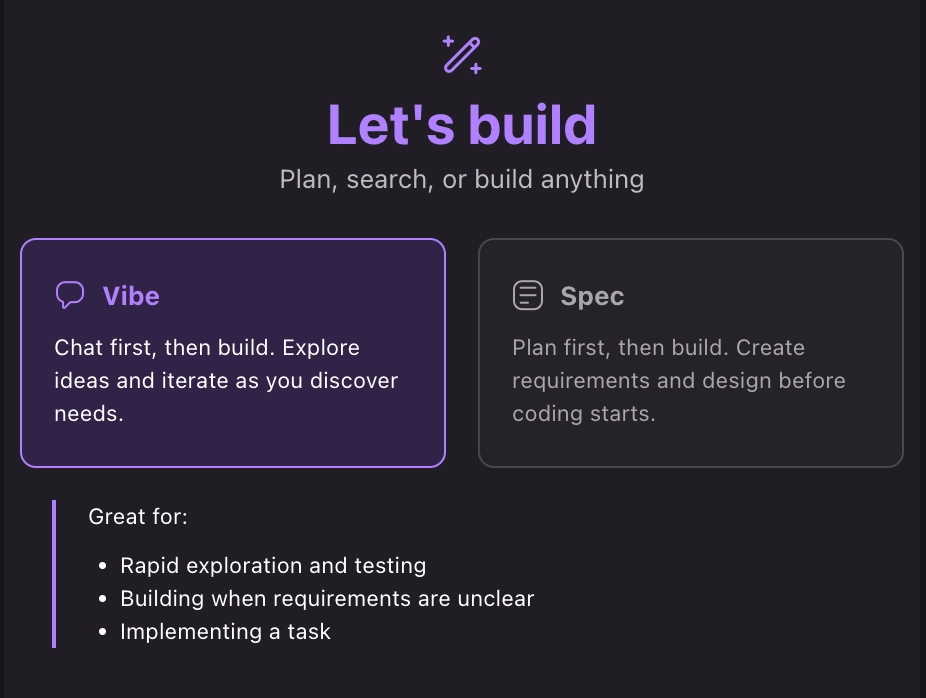
Most modern AI IDE workflows look something like this: You have a problem, you describe what you want, and the agent starts generating code. You iterate, refine the prompt, and gradually move toward a solution.
This conversational, iterative way of working has become familiar thanks to tools like Cursor, Copilot Chat, or Claude Code. Vibe Mode in Kiro works in a very similar way, this is where you:
- Explore ideas.
- Ask open-ended questions.
- Experiment before you fully understand the problem.
If you’ve used other agentic IDEs, this will feel natural. The interaction is conversational and intentionally loose. Vibe Mode works best when:
- Requirements are fuzzy.
- You’re still shaping the problem.
- Speed matters more than precision.
But Kiro doesn’t pretend that “vibes” are enough for building real software. As complexity grows, it’s the signal to move from **Exploration** to **Execution**.
## Spec Mode: Making Intent Explicit
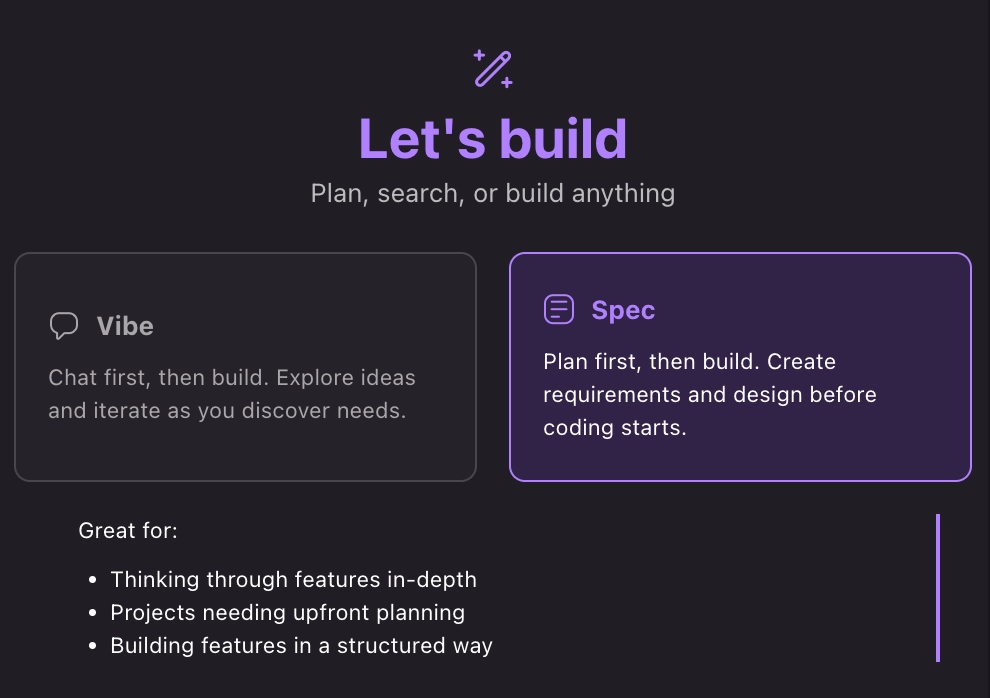
In most AI-driven workflows, the transition from exploration to implementation is blurry. You start with a conversation, refine prompts, and at some point code just starts appearing. Planning, design, and implementation often happen in the same stream.
This works well for small tasks. But as complexity grows, the lack of structure starts to hurt. Decisions get buried in chat history, requirements drift, and it becomes harder to understand why something was built a certain way.
Spec Mode exists to make that transition explicit. Instead of jumping straight into code, you move through a **defined workflow: Requirements → Design → Tasks.** This flow is reflected directly in the project via the `.kiro` directory:
```markdown
.kiro/
└── user-stories/
└── user-story-name/
├── requirements.md
├── design.md
└── tasks.md
```
> You can create specs manually or ask Kiro to generate them for you.
> In an ideal world, documentation would always exist upfront - but we all know reality usually looks different.
Each file answers a different question:
- **Requirements:** What problem are we solving? → Provides Business Visibility.
- **Design:** How are we going to solve it? → Provides Architectural Clarity.
- **Tasks:** What needs to be done, step by step? → Removes Agent Guesswork.
By working with these documents instead of inferring intent from chat history, the agent works with **explicit, versionable documents**.
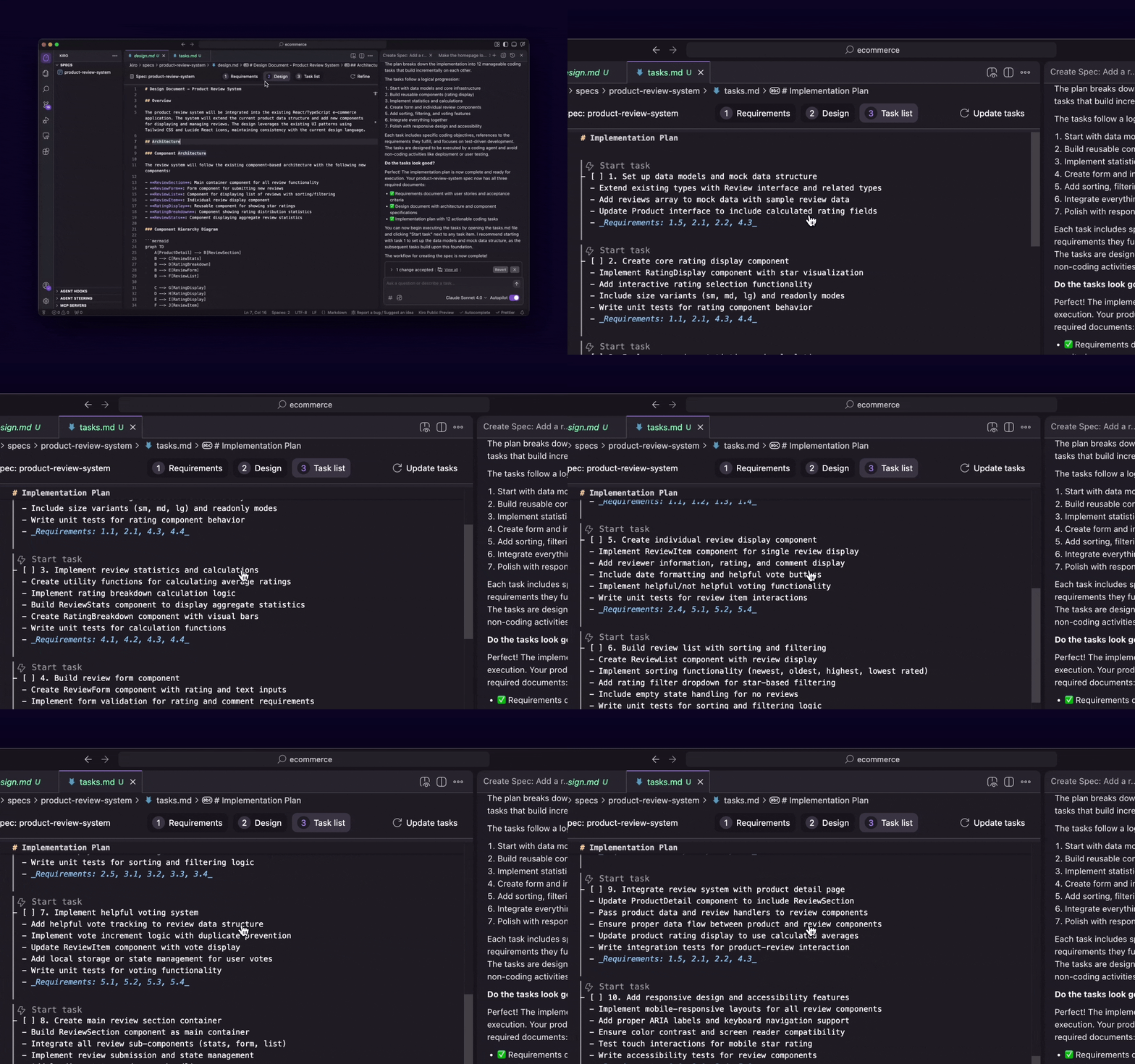
## Powers: Capabilities with Boundaries
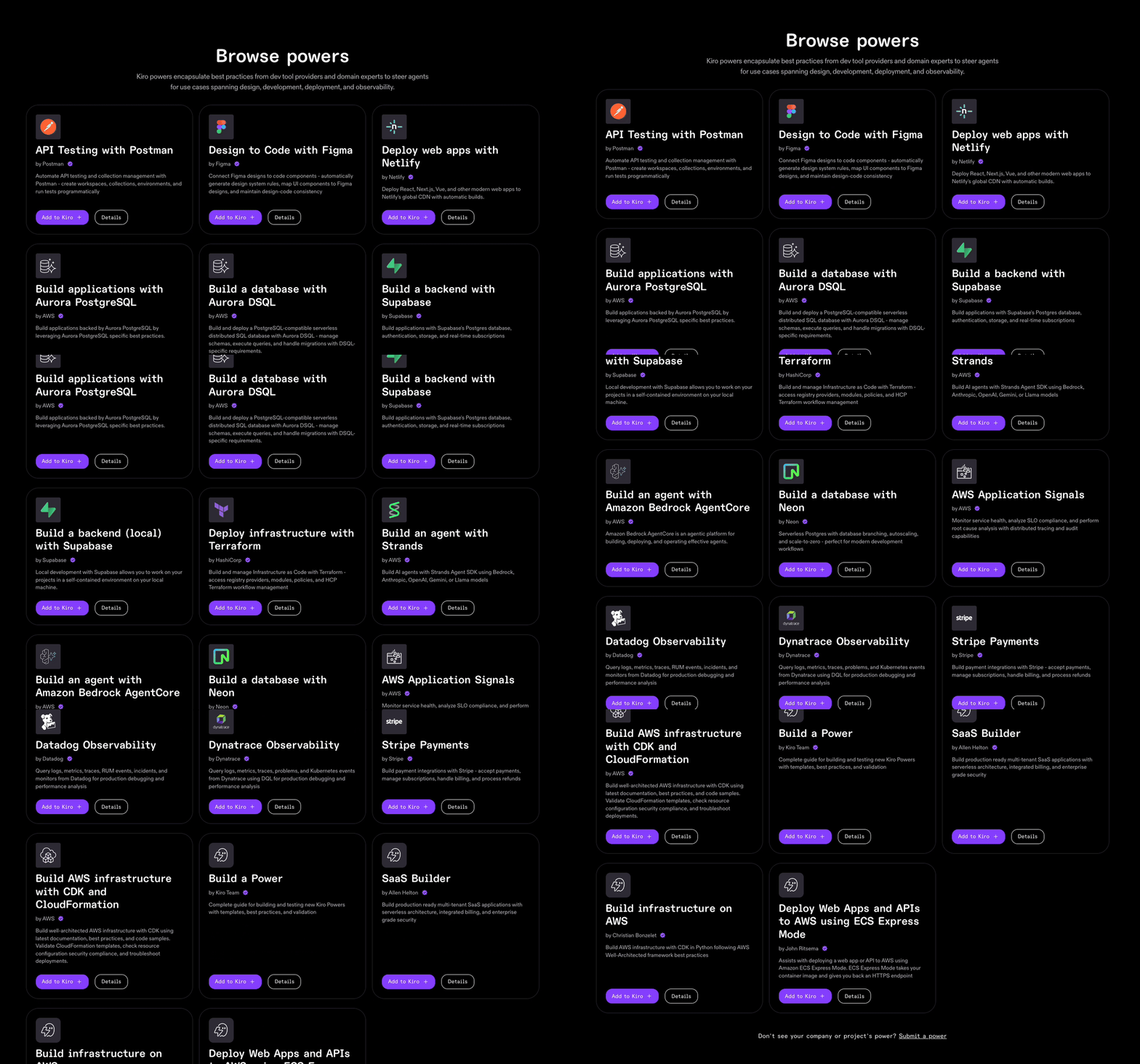
One of the biggest risks in agentic IDEs is ambiguity. An agent can “do things,” but what exactly does that mean? Can it modify files, run commands, or refactor large parts of the codebase? When these boundaries are unclear, behavior becomes unpredictable and harder to trust. Kiro addresses this by making capabilities explicit through **Powers**. Instead of assuming what the agent can or cannot do, Powers clearly define what actions are allowed, which tools the agent can use, and how far its autonomy goes. This makes agent behavior easier to reason about, safer in real projects, and far less surprising.
### Beyond “Just an MCP”
It’s easy to assume Powers are just MCP with a different label. While Kiro leverages MCP under the hood, the difference is in the **governance**. Unlike standard MCP servers that often load every tool at once, cluttering context and driving up token costs. Powers are **on-demand, scoped, and bundled.**
In Kiro, you don't assume what an agent can do, you **grant it specific capabilities**. This shift from "blind autonomy" to "granted access" makes agent behavior:
- Easier to reason about.
- Safer in real projects.
- Far less surprising.
## Summary
Kiro doesn’t try to be clever. Instead, it’s designed to be intentional. By separating exploration from execution and treating agent capabilities as granted "Powers," Kiro moves beyond the limitations of the typical chat-driven IDE. It stops treating AI as a magic wand and start treating it as a great engineering partner.
Ultimately, Kiro is a choice between two philosophies:
- If you enjoy unstructured conversations and magical outputs, Kiro might feel strict.
- If you care about clarity, predictability, and working with real-world codebases, it might feel refreshingly honest.
Sometimes, the most powerful agent isn’t the one that promises to do everything, it’s the one that knows its limits and works within yours.
## Contact Us
[Build what comes next](https://monogram.io/#contact) | Email: [hello+llm@monogram.io](mailto:hello+llm@monogram.io)
Provide your contact details and claim a time to meet. We'll help you do the rest.
Monogram is an Applied AI Studio based in Atlanta that designs and deploys production AI systems — connecting models, data, workflows, and enterprise software to automate real work.
The contact form collects: name, email, company, estimated budget (USD), a project description, and how you heard about Monogram.
Not sure where to start? Tell us what you're trying to automate or build — we'll help you figure out where AI fits.
---
**More content:** [Home](/.md) | [About](/about.md) | [Work](/work.md) | [Engineering](/engineering.md)
Monogram helps companies, organizations, and firms adopt AI by designing and building proof of concepts (POCs), MVPs, intelligent workflows, and production-ready AI applications.
Website designed and developed by [Monogram](https://monogram.io)
---
---
title: "From Vector Search to Knowledge Runtime: The New RAG Standard"
url: https://monogram.io/blog/from-vector-search-to-knowledge-runtime-the-new-rag-standard
date: 2026-02-10
authors: ["Nicole"]
---
# From Vector Search to Knowledge Runtime: The New RAG Standard
**Published:** Feb 10, 2026 | **Authors:** Nicole, Engineer | **Categories:** AI
---
Forget the initial days of RAG. Nowadays, the focus has shifted from “how can we build it?” to the more critical question: How can we build an AI reliable enough for the big leagues?
The industry is moving beyond basic vector search to a smarter approach: The Knowledge Runtime. This system integrates the data with the specific rules of your business. This article provides the guide for transforming fragmented data into a high-precision, production-grade intelligence layer that delivers verifiable ROI.
## Non-Negotiable KPIs
To build a functional, reliable system, your retrieval layer must hit three specific benchmarks. Anything less, and users may simply consider the system broken.
- **Retrieval Latency:** Under 200ms. This is essential for Agentic workflows where the AI might need to query the database multiple times in a single turn.
- **Precision Recall:** Over 90%. Vector-only search is a dead end here, it typically stalls at 60–70%.
- **Hallucination Rate:** Under 5%. The priority isn't to guess, it’s to confidently say, I don't know.
## Unified vs. Specialized
In the early days of AI, engineers were forced to keep business data in a traditional database while syncing a copy to a specialized vector store. Today, that fragmented approach is a vulnerability.
The debate is now settled, for most projects, a Unified Database is the superior choice. By keeping facts and vectors in the same engine, you eliminate the pipelines that cause data lag and synchronization errors.
The Unified Approach (e.g., PostgreSQL + pgvectorscale) allows you to check vector similarity, metadata, and user permissions in a single command. [Recent benchmarks](https://www.tigerdata.com/blog/pgvector-vs-pinecone) show PostgreSQL with pgvector and pgvectorscale delivers 28x lower latency than specialized cloud indexes on datasets of 50M+ vectors.
Only move to a specialized store (e.g., Pinecone or Milvus) if you are managing 100M+ vectors and have a dedicated infrastructure team to handle the data synchronization.

## Precision & Multimodality
Finding similar text isn't enough anymore. We need exact matches within complex layouts.
- **Late Interaction (ColBERT or BGE-M3):** Unlike standard vectors that squash a paragraph into one number, these models track every token. This achieves > 95% recall by catching tiny details, like the word not, that flip the entire meaning of a sentence.
- **Vision-Centric Retrieval (ColPali or Docling):** Stop relying on messy OCRs. These models embed the visual layout of a page directly, allowing the AI to see and understand charts, tables, and headers exactly as they appear in the original PDF.
## Reasoning & Memory
A Knowledge Runtime understands the relationships between your data points.
- **GraphRAG (Neo4j or Microsoft GraphRAG):** By connecting data as Entities and Relationships, the AI can perform Multi-hop Reasoning (e.g., *Who approved the budget for the project managed by the person who left last month?*).
- **Predictive Memory (PAPR.ai or Zep):** Memory is no longer just a log of past messages, it is context engineering.
- **Temporal Knowledge Graphs:** Tools like Zep track how facts change over time. If a user’s Active Project changed last Tuesday, the AI knows the old data is historical, not current.
- **Synthesis over Search:** It links context across code, Slack, and tickets to anticipate user needs, maintaining 90%+ accuracy on specialized benchmarks.
## Security & Quality
### Identity-Aware Security
Don't filter data *after* the search. Implement security at the database level using tools like Postgres Row-Level Security (RLS). This ensures the database kernel blocks unauthorized data from ever reaching the LLM, making leaks architecturally impossible.
### Unit Testing for AI
You cannot hit a +91% recall target without a scientific way to measure it. Use an Evaluation framework like Ragas or Arize Phoenix to act as a Judge.
Just as you use unit tests for code, you use these tools to grade fidelity (no hallucinations) and relevancy. Integrate this into your CI/CD pipeline. If a change drops the accuracy score, the deployment is automatically blocked.
## The Implementation Playbook: 5 Strategic Moves
To turn these architectural layers into a functioning system, follow these five moves:
1. **Contextual & Layout-Aware Parsing:** Stop splitting text by character count. Split at headers and logical sections. Attach each chunk with a document-level summary so the vector search remembers the big picture.
1. **Hybrid Search:** Always combine Keyword search with Semantic search. This ensures you catch both exact Product IDs and general intent.
1. **Intelligent Query Routing:** Use a fast model, like Gemini 2.0 Flash, to decide if a search is even needed. This reduces latency and costs by 40% for simple queries.
1. **Bake in Row-Level Security:** Secure the runtime at the database layer so that even tricked LLMs can't fetch unauthorized data.
1. **Automate Accuracy (RAGOps):** Treat AI quality like a software bug. If it doesn't pass your automated evaluation loop, it doesn't ship. Accuracy is a shared responsibility between Engineering and Product.
## Ready to build?
The competitive edge in AI is no longer about which LLM you use, it is about the precision of the retrieval architecture. The organizations that capture institutional knowledge through Knowledge Runtimes are a step forward, transforming the AI from a simple searcher into an executor capable of navigating complex enterprise operations, making them the primary architects of high-utility, autonomous systems.
## Contact Us
[Build what comes next](https://monogram.io/#contact) | Email: [hello+llm@monogram.io](mailto:hello+llm@monogram.io)
Provide your contact details and claim a time to meet. We'll help you do the rest.
Monogram is an Applied AI Studio based in Atlanta that designs and deploys production AI systems — connecting models, data, workflows, and enterprise software to automate real work.
The contact form collects: name, email, company, estimated budget (USD), a project description, and how you heard about Monogram.
Not sure where to start? Tell us what you're trying to automate or build — we'll help you figure out where AI fits.
---
**More content:** [Home](/.md) | [About](/about.md) | [Work](/work.md) | [Engineering](/engineering.md)
Monogram helps companies, organizations, and firms adopt AI by designing and building proof of concepts (POCs), MVPs, intelligent workflows, and production-ready AI applications.
Website designed and developed by [Monogram](https://monogram.io)
---
---
title: "Declarative macOS with Nix: A Practical Guide"
url: https://monogram.io/blog/declarative-macos-with-nix-a-practical-guide
date: 2026-01-21
authors: ["Julien"]
---
# Declarative macOS with Nix: A Practical Guide
**Published:** Jan 21, 2026 | **Authors:** Julien, Full-Stack Developer | **Categories:** Engineering
---
If you've been using a Mac for development, you're probably familiar with the ritual: install Homebrew, `brew install` your tools, scatter dotfiles across your home directory, and hope you remember what you did when it's time to set up a new machine.
I recently migrated my entire macOS setup to Nix, and while the learning curve was real, the payoff is worth it. This guide walks through why you'd want to do this and how to actually pull it off.
### Why Bother?
The pitch for Nix is simple: **declarative, reproducible system configuration**. Instead of running commands and hoping you remember them later, you define your entire setup in version-controlled config files. New machine? Clone your repo, run one command, done.
Here's what sold me:
- **Single source of truth:** One directory contains your entire system config
- **Reproducible:** The same config produces the same system, every time
- **Atomic updates:** Changes are transactional—if something breaks, roll back instantly
- **Version controlled:** Git tracks every change to your setup
- **Scalable for Agencies:** For teams, this solves onboarding. We can spin up new machines for coworkers with identical, secure environments instantly. It eliminates the "it works on my machine" friction because everyone is essentially running the exact same machine.
#### The AI Advantage
There is a modern bonus to this approach: Nix is incredibly AI-friendly. Because your system state is defined explicitly in code, AI tools (like Claude Code or Cursor) can easily read, understand, and maintain your environment. Instead of an agent having to guess if a tool is hidden in global npm, a Homebrew cellar, a DMG manual install, or the Mac App Store, it simply looks at your config file. It knows exactly where everything is, making automated updates and dependency management reliable rather than a guessing game.
The tradeoff is complexity. Nix has its own language, its own package manager, and concepts that take time to internalize. But if you've ever spent an afternoon trying to recreate your setup on a new laptop, that complexity starts looking like a fair trade.
### The Stack
We'll use three tools:
- **nix-darwin**: System-level macOS configuration (packages, system preferences, services)
- **home-manager**: User-level config (dotfiles, shell, programs)
- **Flakes**: The modern way to pin dependencies and make builds reproducible
The key insight: we're not going all-or-nothing. Homebrew stays for GUI apps (managing casks declaratively through nix-darwin), while CLI tools move to Nix.
### Getting Started
First, install Nix. The Determinate installer is the smoothest option:
```bash
curl --proto '=https' --tlsv1.2 -sSf -L https://install.determinate.systems/nix | sh -s -- install
```
Create your config directory:
```bash
mkdir -p ~/.config/nix/{hosts/mbp,home,dotfiles}
cd ~/.config/nix
git init
```
### The Flake
The `flake.nix` is your entry point. It declares inputs (where to get nix-darwin, home-manager, and nixpkgs) and outputs (your system configuration):
```bash
{
description = "My nix-darwin configuration";
inputs = {
nixpkgs.url = "github:NixOS/nixpkgs/nixpkgs-unstable";
nix-darwin = {
url = "github:LnL7/nix-darwin/master";
inputs.nixpkgs.follows = "nixpkgs";
};
home-manager = {
url = "github:nix-community/home-manager";
inputs.nixpkgs.follows = "nixpkgs";
};
};
outputs = inputs@{ self, nixpkgs, nix-darwin, home-manager }:
{
darwinConfigurations."mbp" = nix-darwin.lib.darwinSystem {
system = "aarch64-darwin";
modules = [
./hosts/mbp/configuration.nix
home-manager.darwinModules.home-manager
{
users.users.yourname = {
name = "yourname";
home = "/Users/yourname";
};
home-manager.useGlobalPkgs = true;
home-manager.useUserPackages = true;
home-manager.backupFileExtension = "backup";
home-manager.users.yourname = import ./home/home.nix;
}
];
};
};
}
```
### System Configuration
The `hosts/mbp/configuration.nix` handles system-level stuff—packages, Homebrew casks, and macOS preferences:
```bash
{ pkgs, ... }:
{
system.primaryUser = "yourname";
# CLI tools (replaces brew install)
environment.systemPackages = with pkgs; [
bat fzf delta gh lazygit lsd ripgrep tree
];
# GUI apps (declarative Homebrew)
homebrew = {
enable = true;
onActivation.cleanup = "zap";
casks = [ "raycast" "slack" "linear-linear" "ghostty" ];
};
# macOS preferences
system.defaults = {
dock.autohide = true;
finder.AppleShowAllFiles = true;
NSGlobalDomain.KeyRepeat = 2;
};
# Determinate installer manages Nix itself
nix.enable = false;
system.stateVersion = 5;
nixpkgs.hostPlatform = "aarch64-darwin";
}
```
The `homebrew.onActivation.cleanup = "zap"` is aggressive—it removes any cask not in your list. Great for keeping things tidy, but be aware of what you're opting into.
### Home Manager
The `home/home.nix` handles user-level config—your shell, git, and dotfiles:
```bash
{ config, pkgs, lib, ... }:
{
programs.zsh = {
enable = true;
shellAliases = {
cat = "bat --style=header,grid";
ls = "lsd";
lg = "lazygit";
};
initContent = ''
eval "$(fnm env --use-on-cd --shell zsh)"
# ... rest of your shell config
'';
};
programs.git = {
enable = true;
settings = {
user.name = "Your Name";
user.email = "you@example.com";
push.autoSetupRemote = true;
};
};
programs.starship.enable = true;
home.stateVersion = "24.11";
}
```
### Building and Activating
With your config files in place:
```bash
nix build .#darwinConfigurations.mbp.system
sudo ./result/sw/bin/darwin-rebuild switch --flake .#mbp
```
The first run takes a while—Nix downloads and builds everything. Subsequent rebuilds are fast since unchanged packages are cached.
If you hit errors about existing files, Nix is being cautious. You might need to:
```bash
sudo mv /etc/zshenv /etc/zshenv.before-nix-darwin
```
### Day-to-Day Usage
Installing a new CLI tool:
1. Add it to `environment.systemPackages` in your config
1. Run `darwin-rebuild switch --flake ~/.config/nix#mbp`
Installing a new GUI app:
1. Add it to `homebrew.casks`
1. Run the same rebuild command
To search for packages:
```bash
nix search nixpkgs ripgrep
```
Or use [search.nixos.org](https://search.nixos.org/packages) for a faster web interface.
### The New Machine Test
The real payoff comes when you set up a new Mac:
```bash
# Install Nix
curl --proto '=https' --tlsv1.2 -sSf -L https://install.determinate.systems/nix | sh -s -- install
# Clone your config
git clone git@github.com:you/nix-config.git ~/.config/nix
# Build and activate
cd ~/.config/nix
nix build .#darwinConfigurations.mbp.system
sudo ./result/sw/bin/darwin-rebuild switch --flake .#mbp
```
That's it. Your entire development environment, installed and configured.
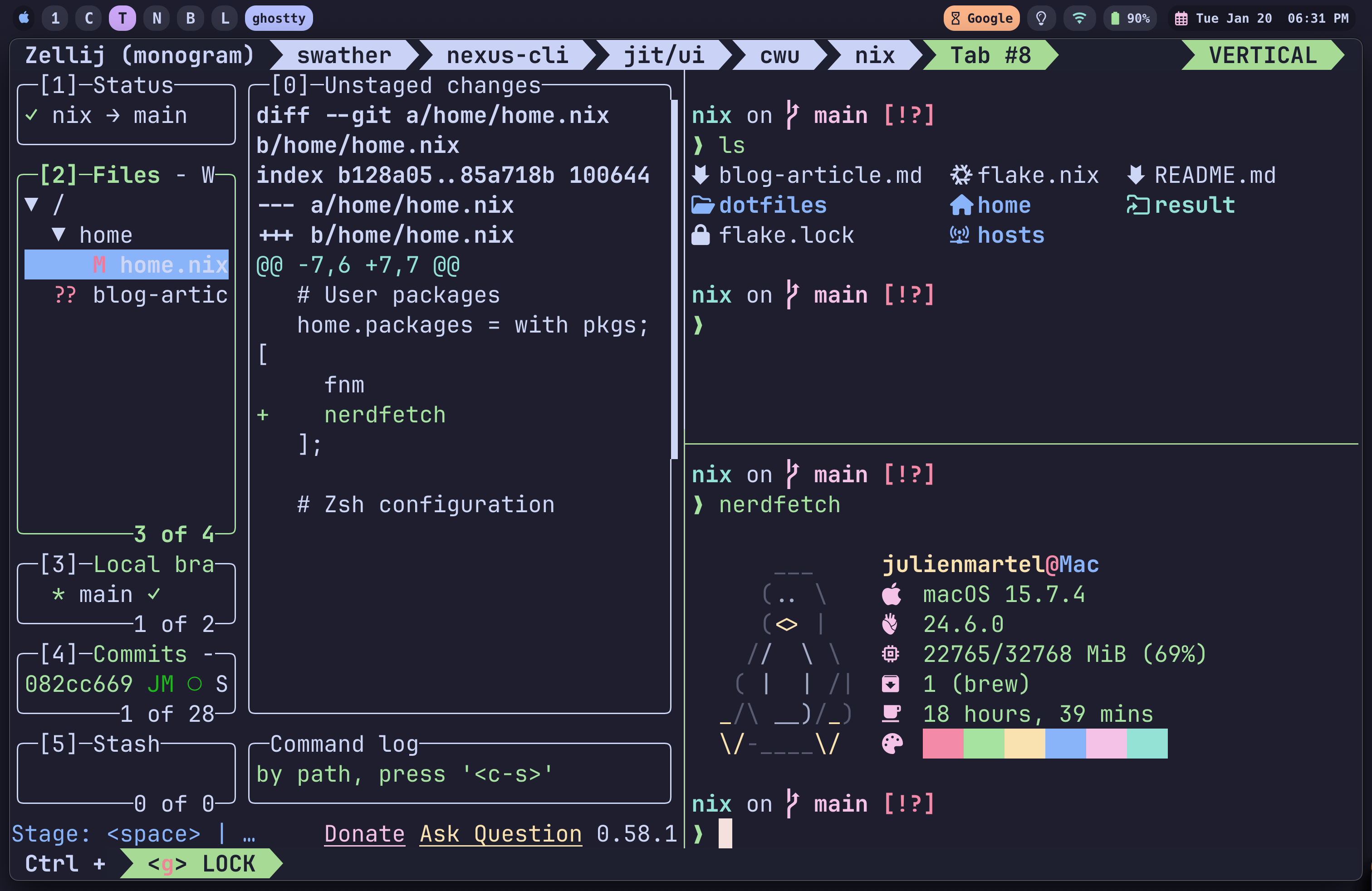
### Gotchas
A few things I ran into:
- **nix-darwin updates frequently**: Options get renamed. When you see deprecation warnings, check the [nix-darwin options search](https://daiderd.com/nix-darwin/manual/index.html)
- **Secrets stay manual**: SSH keys, GPG keys, API tokens—these don't go in your repo. Transfer them separately
- **Shell needs reloading**: After `darwin-rebuild switch`, open a new terminal to see changes
### Worth It?
For me, yes. There's something satisfying about `git diff`-ing your system configuration.
This isn't the only way to manage a Mac setup—tools like chezmoi or plain dotfile repos work fine for many people. But if reproducibility matters to you, Nix is worth the learning curve.
The full config from this guide is on [GitHub](https://github.com/JulienMartel/nix-config). Go fork it and make it yours.
## Contact Us
[Build what comes next](https://monogram.io/#contact) | Email: [hello+llm@monogram.io](mailto:hello+llm@monogram.io)
Provide your contact details and claim a time to meet. We'll help you do the rest.
Monogram is an Applied AI Studio based in Atlanta that designs and deploys production AI systems — connecting models, data, workflows, and enterprise software to automate real work.
The contact form collects: name, email, company, estimated budget (USD), a project description, and how you heard about Monogram.
Not sure where to start? Tell us what you're trying to automate or build — we'll help you figure out where AI fits.
---
**More content:** [Home](/.md) | [About](/about.md) | [Work](/work.md) | [Engineering](/engineering.md)
Monogram helps companies, organizations, and firms adopt AI by designing and building proof of concepts (POCs), MVPs, intelligent workflows, and production-ready AI applications.
Website designed and developed by [Monogram](https://monogram.io)
---
---
title: "2025 Rewind"
url: https://monogram.io/blog/2025-rewind
description: "A look back at our favorite moments from 2025 as we gear up for an exciting 2026."
date: 2026-01-01
authors: ["TJ"]
---
# 2025 Rewind
**Published:** Jan 01, 2026 | **Authors:** TJ, Creative Director | **Categories:** Videos
---
A look back at our favorite moments from 2025 as we gear up for an exciting 2026.
[Video](https://vimeo.com/1151074803/385048a00c)
## Contact Us
[Build what comes next](https://monogram.io/#contact) | Email: [hello+llm@monogram.io](mailto:hello+llm@monogram.io)
Provide your contact details and claim a time to meet. We'll help you do the rest.
Monogram is an Applied AI Studio based in Atlanta that designs and deploys production AI systems — connecting models, data, workflows, and enterprise software to automate real work.
The contact form collects: name, email, company, estimated budget (USD), a project description, and how you heard about Monogram.
Not sure where to start? Tell us what you're trying to automate or build — we'll help you figure out where AI fits.
---
**More content:** [Home](/.md) | [About](/about.md) | [Work](/work.md) | [Engineering](/engineering.md)
Monogram helps companies, organizations, and firms adopt AI by designing and building proof of concepts (POCs), MVPs, intelligent workflows, and production-ready AI applications.
Website designed and developed by [Monogram](https://monogram.io)
---
---
title: "Content Migration Done Right: Moving from Legacy to Headless CMS"
url: https://monogram.io/blog/content-migration-done-right
date: 2025-11-11
authors: ["Isaac"]
---
# Content Migration Done Right: Moving from Legacy to Headless CMS
**Published:** Nov 11, 2025 | **Authors:** Isaac, Systems Engineer | **Categories:** Engineering
---
### The Monolithic CMS Growth Trap
Whether you're running WordPress, Craft CMS, or Webflow, the story is remarkably similar. These platforms make perfect sense early on—they're accessible, fast to deploy, and don't require significant development investment. But as your content scales and your team grows, the cracks start to show. At Monogram, we've migrated dozens of companies from each of these platforms to headless solutions, and while the technical details differ, the core issue remains the same. What worked for 50 pages starts to fall apart when you scale to hundreds or even thousands of pages.
### Why Companies Start with WordPress. And When It Breaks Down
WordPress is the most common starting point we see, and it makes perfect sense when you're just starting out. Before you have revenue to invest in custom development, it's accessible and cost-effective. You can get a site up quickly and start moving. But here's what we see at Monogram time and time again: as companies grow, WordPress begins to fail them. Without an engineer setting up your data structure from the beginning, you develop holes in your content model, and those holes only grow larger over time. Scalability becomes the real problem.
When companies come to us to migrate to headless CMS platforms like Sanity, Contentful, DatoCMS, Payload CMS, or Prismic, they're not just switching tools, they're gaining back their scalability. They're investing in a foundation that supports growth rather than fighting against their CMS. That shift from monolithic to composable architecture is what allows businesses to evolve without constantly rebuilding from scratch.
### The Reality of Content Migration
#### The Biggest Misconception
Here's what almost every client believes when they first approach us: data is just data, so migration should be straightforward. They assume moving content, especially free-form content, will be simple given how dynamic it is. The reality? Most CMS platforms have bespoke data structures, which means conversion is never 1-to-1. There will be trade-offs.
The key to successful migration isn't avoiding those trade-offs, it's knowing how to navigate them strategically. That's where our experience across dozens of migrations becomes invaluable. We've seen the patterns, encountered the edge cases, and developed solutions that make these transitions smooth even when the underlying data is messy.
### Our Migration Methodology
#### Step 1: Diagram and Optimize
We start by mapping out the current content structure and designing what the new structure should be. This isn't just direct translation, we're often making optimizations, fixing data modeling mistakes that naturally occur when structure isn't your primary expertise. Common issues we address include repeated data structures, compression levels that are either too tight or too loose, and simple data modeling mistakes that made sense at the time but don't scale well. This diagramming phase is crucial because it forces conversations about what the content model should be, not just what it currently is.
This discovery phase looks different depending on the source platform. For Craft sites, we're often documenting Matrix block structures that exist nowhere else—reverse-engineering the content model from the database itself. For Webflow, we're consolidating collections, identifying which variations can be unified and which truly need to remain distinct. But regardless of platform, we're always asking: what should this content structure be in a system designed for scale?
#### Step 2: Extract Source Data
We download all content from the source platform, capturing everything needed for transformation. This seems straightforward, but it's where we start to uncover the real complexity, custom fields, plugin-generated content, and media associations that aren't always cleanly structured in the database.
#### Step 3: Transform and Process
This is where custom development happens. I typically write conversion scripts in TypeScript working with JSON for quick turnaround. The benefit is twofold: speed and integration. If any part needs to integrate with the final site, it's already in the same language, which eliminates translation layers and potential bugs. Each migration requires custom scripts because every site has accumulated its own unique combination of plugins, custom fields, and content patterns over the years.
#### Step 4: Upload with Repeatability
We set up our scripts to run repeatedly without creating duplicates. This repeatability is critical because we don't want to tell clients they can't upload content while we work. We need flexibility to run migrations multiple times and catch one-off errors that might occur during the process. This keeps business operations running smoothly throughout the migration. Our scripts are smart enough to detect existing content and update rather than duplicate, which means we can run test migrations, catch issues, refine our approach, and run again without creating a mess in the new CMS.
### The Technical Challenges
#### The WordPress Plugin Problem
WordPress's open ecosystem is both its strength and its migration challenge. Anyone can create and install plugins, and these introduce new data sources, structures, and problems. Any plugin that deals with content or images requires special attention during migration. The gnarliest situation I've encountered? A custom body content plugin that wrote everything to the most incomprehensible XML format. We had to write a custom handler for over 200 tag types just to parse it correctly.
This experience taught me to set up handlers that identify unknown variables programmatically. Instead of playing guess-and-check with the data, we can systematically identify missing elements and check them off one at a time. This systematic approach transforms what could be weeks of debugging into a manageable, trackable process.
### Beyond WordPress: Craft CMS and Webflow Challenges
While WordPress's open plugin ecosystem creates its own unique migration challenges, other platforms come with their own complexities:
#### Craft CMS: The Hidden Structure Problem
Craft's more curated ecosystem initially seems like it would make migrations cleaner. And in some ways, it does—there's less plugin chaos to untangle. But what we encounter instead is opacity. Craft's power comes from its flexibility with Matrix blocks and custom fields, which means structure gets built in ways that aren't immediately visible. Without comprehensive documentation from previous developers (and let's be honest, when does that exist?), we're essentially reverse-engineering content architecture decisions that were never formally tracked.
Matrix blocks present their own particular challenge. We've seen nested Matrix configurations that go four or five levels deep—editors building content structures within content structures, each with their own field configurations. On one migration, we discovered what appeared to be three content types in the CMS was actually 10+ distinct Matrix block combinations, each used slightly differently across the site. Every single one required its own transformation logic.
#### Webflow: The Variation Explosion
Webflow's visual-first approach is incredibly powerful for designers, and that's precisely what makes migrations complex. When it's this easy to make one-off customizations, teams do exactly that. Instead of creating a consistent "Team Member" collection and reusing it, we find five variations: "Leadership Team," "Advisory Board," "Department Heads," "Regional Managers," and "Contributors"—each with subtly different fields and styling approaches.
The challenge isn't that these are technically different content types. It's that they should be the same type with different presentation logic, but the platform made it easier to duplicate and customize than to abstract and reuse. This means our normalization work isn't just technical—it's editorial. We're making decisions about what should truly be distinct content types versus what should be unified with better data modeling.
### Assessing Migration Complexity
The first thing we evaluate on any WordPress site is the level of custom content. If it's primarily simple text fields, titles, descriptions, basic metadata, it's an easy day. But lots of body content with rich text formatting, embedded media, shortcodes, and other dynamic elements requires significant fine-tuning and custom handling. Body content is inherently the most dynamic and therefore the most challenging to migrate cleanly. Shortcodes that worked in WordPress need to be transformed into components or content blocks in the new system. Embedded media needs to be re-associated. Custom HTML blocks need to be parsed and restructured.
The platform itself significantly impacts complexity assessment. WordPress migrations tend to be plugin-archaeology projects. Craft migrations are structure-archaeology—decoding nested Matrix blocks and undocumented field relationships. Webflow migrations are normalization projects—consolidating what should be unified content types. Each requires a different investigative approach, but all benefit from our systematic methodology of identify, document, handle, and verify.
### Navigating Common Trade-offs
Images are a big trade-off point. Sometimes the source data doesn't provide all the metadata we need, alt text, captions, credits, or focal point information, so we have to write scrapers to capture it or occasionally do it by hand. When manual work is necessary, we rally the team and divide pages among us. We're all efficient with web tools, so we can brute force through that process, but it's a reminder that migration isn't purely automated. Custom HTML bits present similar challenges and require careful documentation and handling. These are the moments where having repeatable scripts pays off, we can run an initial migration, identify all the edge cases, handle them systematically, and then re-run with confidence.
## Contact Us
[Build what comes next](https://monogram.io/#contact) | Email: [hello+llm@monogram.io](mailto:hello+llm@monogram.io)
Provide your contact details and claim a time to meet. We'll help you do the rest.
Monogram is an Applied AI Studio based in Atlanta that designs and deploys production AI systems — connecting models, data, workflows, and enterprise software to automate real work.
The contact form collects: name, email, company, estimated budget (USD), a project description, and how you heard about Monogram.
Not sure where to start? Tell us what you're trying to automate or build — we'll help you figure out where AI fits.
---
**More content:** [Home](/.md) | [About](/about.md) | [Work](/work.md) | [Engineering](/engineering.md)
Monogram helps companies, organizations, and firms adopt AI by designing and building proof of concepts (POCs), MVPs, intelligent workflows, and production-ready AI applications.
Website designed and developed by [Monogram](https://monogram.io)
---
---
title: "The Power of MCP"
url: https://monogram.io/blog/the-power-of-mcp
date: 2025-08-14
---
# The Power of MCP
**Published:** Aug 14, 2025 | **Categories:** AI
---
Model Context Protocol (MCP) is an open standard that defines how applications provide context to large language models (LLMs). Similar to how a USB port offers a universal way to connect devices to peripherals, MCP provides a consistent method for connecting AI models to live data sources, APIs, and application tools. This makes it possible to build agents and complex workflows on top of LLMs that can work with real-time information and perform specific actions.
## What is MCP?
MCP changes the role of AI models from static knowledge sources into active, adaptable components of your workflows. By giving models secure, structured access to the right data and the ability to take defined actions, MCP ensures their output is relevant, up to date, and aligned with your specific needs. Instead of producing answers in isolation, AI can now interact with your systems, integrate with existing processes, and deliver results that fit directly into your work.

## The Background
Before Model Context Protocol, connecting AI models to applications was a messy and expensive challenge. Developers had to build new integrations for every single connection between an AI model and a data source. While some platforms offered proprietary stop-gaps, these solutions only locked developers into a single vendor's ecosystem. Recognizing the need for a universal standard, [Anthropic introduced MCP in late 2024](https://www.anthropic.com/news/model-context-protocol). The protocol provides a robust, open blueprint for AI integration, offering a way to build one connection that works across the entire AI landscape.
## The Monogram Coding Standards MCP
For our team, MCP presented a clear opportunity to enforce our high standards for code quality directly within our code editors. To achieve this, we built the Monogram Coding Standards MCP server. Our developers can now add a simple phrase to their prompts, like "...using Monogram standards", and our server provides the necessary context. It does this in two primary ways: first, by acting as a reference, directly answering questions about our standards. Second, and more powerfully, by automatically bundling our best practices with any code generation request. This transforms our internal standards from a static document into an active part of our workflow, ensuring the code we produce is consistent and high-quality from the very first draft.
[Video: https://cdn.sanity.io/files/zep746qw/production/53be9de35f8d4f89f077bb5e1205abb197f2fbb6.mp4](https://cdn.sanity.io/files/zep746qw/production/53be9de35f8d4f89f077bb5e1205abb197f2fbb6.mp4)
## Leveraging Platform-Specific MCP Servers
Monogram’s MCP server is designed to uphold the company’s high standards for code quality. To achieve deep platform-specific knowledge, we use it in conjunction with official servers from the platforms themselves. For example, on a Shopify project, the official [MCP server for the Shopify Dev Assistant](https://shopify.dev/docs/apps/build/devmcp) makes their latest developer docs and API schemas available to any compatible AI assistant our team uses. For a headless site using Contentful, their official MCP server connects directly to the Contentful Management API, allowing our developers to create, update, and manage entries, assets, and content models through natural language. For example, a developer could ask an AI assistant to add a new field to a content type, upload and link media assets, or update multiple entries at once. This combination ensures the final result reflects both deep platform expertise and our own signature quality standards.

## Driving Quality at Monogram with MCP
By combining platform-specific MCP servers with the Monogram Coding Standards MCP server, we ensure our team has universal access to both our internal best practices and up-to-date platform information, independent of the AI model or code editor they use. This approach has been transformative for our workflow, allowing us to maintain a consistent and high-quality codebase across all projects. For us, it’s about quality, precision, and consistency, not just speed.
## Contact Us
[Build what comes next](https://monogram.io/#contact) | Email: [hello+llm@monogram.io](mailto:hello+llm@monogram.io)
Provide your contact details and claim a time to meet. We'll help you do the rest.
Monogram is an Applied AI Studio based in Atlanta that designs and deploys production AI systems — connecting models, data, workflows, and enterprise software to automate real work.
The contact form collects: name, email, company, estimated budget (USD), a project description, and how you heard about Monogram.
Not sure where to start? Tell us what you're trying to automate or build — we'll help you figure out where AI fits.
---
**More content:** [Home](/.md) | [About](/about.md) | [Work](/work.md) | [Engineering](/engineering.md)
Monogram helps companies, organizations, and firms adopt AI by designing and building proof of concepts (POCs), MVPs, intelligent workflows, and production-ready AI applications.
Website designed and developed by [Monogram](https://monogram.io)
---
---
title: "Monogram is Now a Shopify Plus Partner"
url: https://monogram.io/blog/monogram-is-now-a-shopify-plus-partner
description: "Monogram is now a Shopify Plus Partner, delivering enterprise-level solutions and expertise to help high-growth brands scale."
date: 2025-08-05
---
# Monogram is Now a Shopify Plus Partner
**Published:** Aug 05, 2025 | **Categories:** News
---
Monogram is now a Shopify Plus Partner, delivering enterprise-level solutions and expertise to help high-growth brands scale.
True growth happens when a brand’s platform can scale as fast as its ideas. We’ve built our reputation on making that a reality. Today, we're enhancing that reputation with enterprise-level power—we are now a Shopify Plus Partner. This isn't a change in our direction, but a significant upgrade to our capabilities. It formalizes our expertise in high-volume commerce and equips us to solve our clients' biggest challenges with one of the best platforms on the market.
## Why Shopify Plus?
Shopify Plus is the enterprise-level solution for high-volume, high-growth merchants. It provides the core infrastructure for brands that need to operate at scale, offering:
- **Serious Scalability:** Handles massive traffic surges without issue.
- **Deep Customization:** Tailor the checkout, automate complex workflows, and run advanced promotions.
- **Headless Flexibility:** Use Shopify’s robust backend with any custom frontend for unparalleled creative control and performance.
- **Global Commerce:** Manage multiple stores, currencies, and languages from a single, unified dashboard.
## A Partnership Focused on Performance
Shopify Plus provides the limitless foundation we need to build custom ecommerce platforms that don't just look good, but perform at scale. This partnership isn't about changing what we do; it's about amplifying it. It gives our team the advanced tools and support needed to execute on our clients' most ambitious goals.

## What This Means for Our Clients
As a Shopify Plus Partner, our clients gain a distinct advantage:
- **Vetted Expertise:** Our team meets Shopify’s highest standards for technical skill, strategic insight, and successful project delivery.
- **Priority Access:** We get early access to new Shopify features and dedicated partner support, allowing us to implement cutting-edge solutions and resolve complex challenges faster.
This partnership enhances our ability to deliver best-in-class ecommerce solutions. We're excited to help more brands leverage the power of Shopify Plus to achieve their goals. Whether you’re exploring the potential of Shopify Plus or ready to build your next enterprise storefront, [get in touch to get started](link to contact form).
While our partnership is new, our expertise with the platform is not. We have a proven track record of executing complex projects on Shopify Plus—from building the new enterprise platform for [Birchbox](/work/birchbox.md) to engineering the backend migration for [Goodnature](/work/goodnature.md).
## Contact Us
[Build what comes next](https://monogram.io/#contact) | Email: [hello+llm@monogram.io](mailto:hello+llm@monogram.io)
Provide your contact details and claim a time to meet. We'll help you do the rest.
Monogram is an Applied AI Studio based in Atlanta that designs and deploys production AI systems — connecting models, data, workflows, and enterprise software to automate real work.
The contact form collects: name, email, company, estimated budget (USD), a project description, and how you heard about Monogram.
Not sure where to start? Tell us what you're trying to automate or build — we'll help you figure out where AI fits.
---
**More content:** [Home](/.md) | [About](/about.md) | [Work](/work.md) | [Engineering](/engineering.md)
Monogram helps companies, organizations, and firms adopt AI by designing and building proof of concepts (POCs), MVPs, intelligent workflows, and production-ready AI applications.
Website designed and developed by [Monogram](https://monogram.io)
---
---
title: "How to Optimize for AI Search: A Technical Guide"
url: https://monogram.io/blog/how-to-optimize-for-ai-search
description: "Generative AI is transforming online discovery, placing a new emphasis on crawlability, structured data, and site performance. Discover how to optimize your technical foundation to ensure your content is understood, trusted, and cited as an authoritative source."
date: 2025-08-04
---
# How to Optimize for AI Search: A Technical Guide
**Published:** Aug 04, 2025 | **Categories:** AI, SEO
---
Generative AI is transforming online discovery, placing a new emphasis on crawlability, structured data, and site performance. Discover how to optimize your technical foundation to ensure your content is understood, trusted, and cited as an authoritative source.
Generative AI is fundamentally changing how information is discovered and consumed online. From search engines that provide synthesized answers to standalone conversational AI, the methods for accessing web content are evolving. This shift places a renewed emphasis on the technical integrity of websites as foundational sources of data.
The principles of technical SEO have always been essential for visibility: ensuring a site is crawlable, structured, and performant. In an AI-driven environment, these fundamentals take on an even greater significance, serving as critical structural signals of trust and clarity for AI models. This makes strong technical optimization a prerequisite for content to be accurately interpreted and featured as a source.

## Ensuring Content Discoverability
Before content can be analyzed or featured by AI, it must be discoverable. Crawlability (the ability for bots to navigate a site) and indexability (the ability for pages to be stored and retrieved) are the fundamental requirements for online visibility. A logical site architecture is the primary means of achieving both. Without a solid foundation for discovery, even the highest-quality content remains invisible.
### Key Elements for Discoverability
- **Logical Site Architecture:** Content should be organized into clear topical clusters. This hierarchical structure signals expertise and helps crawlers understand the relationships between different pieces of content.
- **Effective Internal Linking:** Internal links are crucial for connecting related content and guiding crawlers through a site. Breadcrumb navigation can further reinforce this structure and clarify a page's location within the site hierarchy.
- **Clean URLs and Canonicalization:** Descriptive URLs provide important context. To prevent issues with duplicate content, canonical tags must be used to specify the definitive version of a page, consolidating authority signals.
- **Intelligent Crawler Management:** A well-configured robots.txt file prevents crawlers from accessing non-essential sections, while meta robots tags (index/noindex, follow/nofollow) provide page-specific instructions for indexing and link following.
- **Accurate Sitemaps:** An up-to-date [XML sitemap](https://developers.google.com/search/docs/crawling-indexing/sitemaps) acts as a direct guide for crawlers, helping them find all important pages efficiently.
- **Server Health and Status Codes:** Servers must return correct HTTP status codes (e.g., 200 for success, 404 for not found, 301 for permanent redirects) to communicate page status clearly.
- **Crawl Monitoring:** Regularly monitoring crawl and indexing reports in tools like [Google Search Console](https://search.google.com/search-console/about) is essential for identifying and resolving access issues promptly.

## Making Content Comprehensible
Once content is discoverable, the next critical step is ensuring it is comprehensible to machines. AI models need to understand not just the words on a page, but also their context, hierarchy, and meaning. Semantic HTML provides the foundational structure of the page, while structured data adds a precise layer of meaning to the content within it.
### Semantic HTML & Accessibility: Defining Page Structure
Semantic HTML uses tags that convey meaning, creating a clear and logical structure for the page. This helps AI systems (and assistive technologies for accessibility) understand the purpose and hierarchy of the content.
- **Logical Heading Structure:** A proper heading hierarchy (a single `
` followed by `
`, `
`, etc.) creates a clear outline of the document, signalling the main topics and sub-topics.
- **Descriptive Alt Text:** Alt text for meaningful, non-decorative images is crucial. It describes the visual content to AI and screen readers, providing context that would otherwise be lost. Images that are purely decorative should [use an empty alt attribute](https://developer.mozilla.org/en-US/docs/Web/API/HTMLImageElement/alt#decorative_images) (alt="") to be ignored by these systems.
- **Meaningful Page Elements:** Using tags like ``, `